
Lofty Editorial
Comparing Liquidity Across Real Estate Token Platforms
Liquidity is a critical factor when investing in tokenized real estate. It determines how quickly and easily you can sell your property shares. Different platforms offer varying liquidity mechanisms, fees, and transaction speeds, which can significantly impact your investment experience. Here's a quick breakdown:
- Lofty: Features a 24/7 peer-to-peer marketplace with instant trades (market orders only). Minimum investment starts at $50, but a 3% fee applies to both buyers and sellers.
- RealT: Uses decentralized exchanges like Uniswap. Transactions are quick (days), but secondary market activity is limited. Fees include a 10% platform charge, and U.S. investors are excluded.
- Propy: Focuses on blockchain property transactions rather than fractional ownership trading. Liquidity is low due to infrequent trading and a buy-and-hold model.
- Harbor: Tailored for institutional investors, with $22.4M daily trading volume. Lower management fees (1.0–1.2%), but retail investors are excluded.
Key takeaway: Liquidity varies widely across platforms based on trading mechanisms, fees, and user accessibility. Retail investors may prefer Lofty for its low entry point, while institutional players might find Harbor more suitable.
Quick Comparison
| Platform | Liquidity Mechanism | Fees | Average Sell Time | Key Limitations |
|---|---|---|---|---|
| Lofty | Peer-to-peer marketplace | 3% per trade | Instant (if matched) | Requires USDC, limited to internal marketplace |
| RealT | Decentralized exchanges | 10% platform fee | Days | Excludes U.S. investors, limited buyers |
| Propy | Blockchain property deals | Variable (low trading volume) | Seconds for on-chain closing | Low liquidity in secondary markets |
| Harbor | Regulated exchanges | 1.0–1.2% management fee | Days to weeks | Institutional investors only |
Understanding these differences can help you pick the right platform based on your investment goals and liquidity needs.
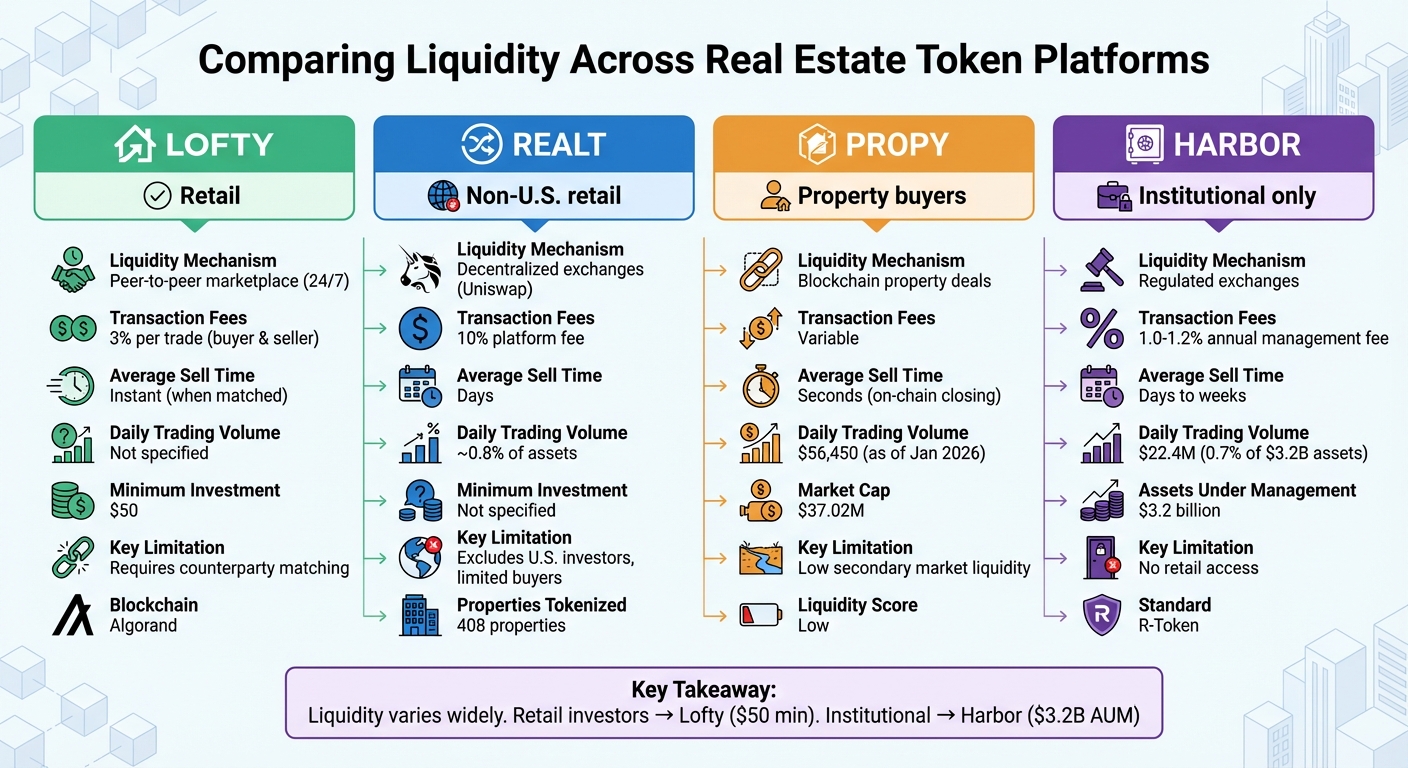
Real Estate Token Platform Liquidity Comparison: Fees, Speed, and Accessibility
Tokenizing Real Estate: Liquidity, Lower Minimums & One K-1
1. Lofty
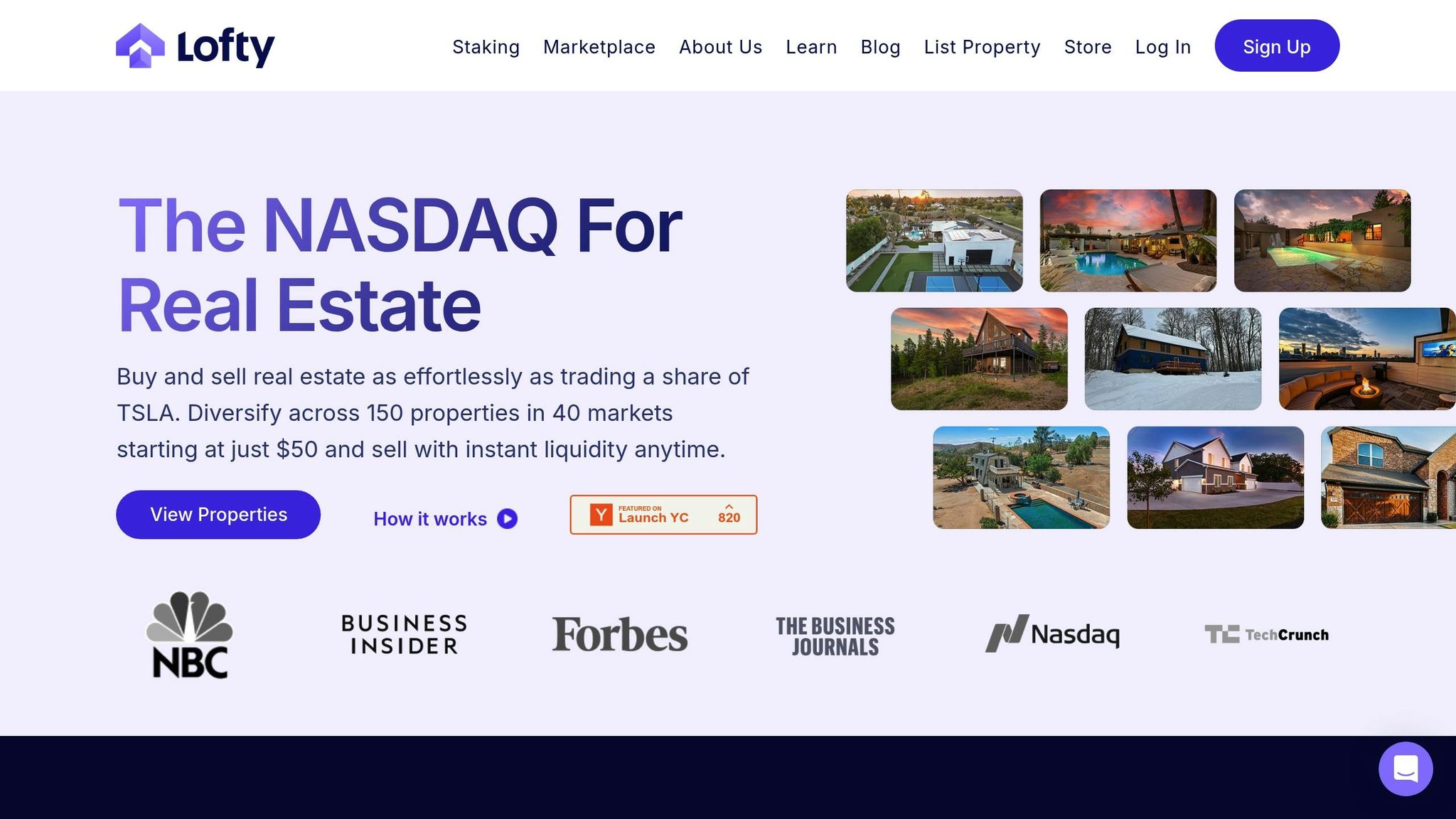
Lofty operates a 24/7 peer-to-peer marketplace where investors can buy and sell property tokens once a property secures full funding. The platform relies on audited smart contracts built on the Algorand blockchain, ensuring trades are executed instantly whenever buy and sell orders match. This system functions as a limit order book, allowing users to monitor transaction volumes and open orders to better understand the supply and demand for specific properties.
Transaction Fees
Lofty charges both buyers and sellers a 3% platform fee for trades conducted on the secondary market. Tokens initially start at $50 each, but prices in the secondary market fluctuate based on investor interest. For instance, tokens have been observed trading in a range from $12 to $70, depending on the property. To help investors make informed decisions, Lofty uses valuation data from HouseCanary, a trusted source for residential real estate assessments.
Average Sell Time
Trades are executed instantly once a matching order is found. However, the time it takes to find a buyer depends on whether someone is willing to meet your set price. Sell orders are valid for 30 days, after which unsold tokens are returned to your wallet automatically. If multiple sellers list tokens at the same price, transactions are processed on a first-come, first-served basis. Until your tokens are sold, you’ll continue earning proportional rental income.
Key Limitations
While Lofty enables instant execution for matching orders, there are some limitations to keep in mind. Currently, the platform only supports limit orders, though an Automated Market Maker (AMM) is in development. Liquidity depends entirely on finding a counterparty - if no matching orders are available, you’ll need to wait for another investor to enter the market. Sellers must also transact using USDC, a stablecoin tied to the US Dollar. Additionally, all traders need a valid "Lofty Verification NFT" to participate.
"Lofty's marketplace brings liquidity to directly owned real estate by enabling instant peer-to-peer transactions." - Jerry Chu, Author
These features highlight how Lofty's marketplace balances efficiency and liquidity in the world of tokenized real estate.
2. RealT
RealT stands out by using decentralized exchanges instead of centralized trading methods to manage liquidity. Investors can trade RealT tokens on platforms like Uniswap, which provides 24/7 access to the secondary market. By early 2025, RealT had tokenized 408 properties, with an average of 254 owners per property, highlighting the highly fragmented nature of ownership. Interestingly, research analyzing 1.1 million blockchain transactions shows that most investor activity happens during the initial Security Token Offerings (STOs), with much less activity in secondary market resales. These dynamics directly influence the platform's cost structure and liquidity performance.
Transaction Fees
RealT applies a 10% platform fee on investments. This fee structure has a notable impact on both returns and trading costs. To address the high Ethereum gas fees that previously affected trading activity, RealT transitioned to the Gnosis blockchain. However, secondary transactions still come with additional processing fees.
"Should an investor choose to redeem a token through RealT, or on a secondary market, other processing fees may be assessed that are not factored into the returns presented." – RealT
Average Sell Time
Investors can exit by redeeming their tokens or selling them on secondary markets, often within just a few days. Tokenized properties typically see their highest trading volumes early on, with a turnover rate of around 15% per month, which gradually decreases to about 5%. However, the actual time it takes to sell depends on finding buyers within a relatively small pool of active investors.
Key Limitations
RealT is not accessible to U.S. citizens or residents. While its tokenization model allows for faster liquidity compared to traditional real estate, the limited number of active investors means liquidity is still relatively low when compared to mainstream financial assets. On average, investors hold 10 tokens, valued at approximately $4,030, reflecting the platform's early-stage market size. Additionally, RealT has faced legal challenges related to the tokenization of certain properties.
3. Propy

Propy takes a different approach compared to platforms that focus on fractional ownership trading. Instead, it prioritizes blockchain-based property transactions, which significantly influence its liquidity dynamics. The platform uses its PRO utility token, which is traded on major exchanges like KuCoin and Kraken. However, its liquidity in the secondary market is limited due to a buy-and-hold investor model, making quick exits more challenging for investors.
Daily Trading Volume (USD)
As of January 20, 2026, Propy's PRO token has a 24-hour trading volume of approximately $56,450, a market cap of around $37.02 million, and a circulating supply of 100 million tokens. This relatively low trading volume reflects the platform's investor behavior, which leans toward holding rather than frequent trading. As a result, wider bid-ask spreads are common, contributing to its low liquidity score.
Liquidity Score
Propy’s liquidity is classified as "Low" within the real estate tokenization sector. This presents a challenge, as low liquidity often creates a cycle where uncertain valuations deter new market participants. Research shows that on platforms like Propy, property ownership tends to change hands only about once a year, with trading activity happening in irregular bursts rather than in consistent cycles.
Average Sell Time
Propy's digital infrastructure is designed to streamline property transactions. It offers 24/7 digital closings and on-chain title recording, with smart contracts automating the entire closing process. This reduces traditional settlement times of 30–45 days to just seconds for on-chain transactions. In November 2025, Propy acquired Delta South Title Inc. in Mobile County, Alabama, and introduced "Agent Avery", an AI-powered escrow officer. This innovation cut manual workloads by 70% and doubled the platform's deal capacity. However, while these advancements drastically speed up property closings, they do not address the liquidity challenges in the secondary market.
Key Limitations
Propy tokens come with certain restrictions due to their classification as securities. They require off-chain whitelisting and KYC (Know Your Customer) verification, which limits the pool of eligible participants in the secondary market. Additionally, the platform faces regulatory uncertainties in various jurisdictions and potential risks related to smart contract vulnerabilities.
sbb-itb-a24235f
4. Harbor
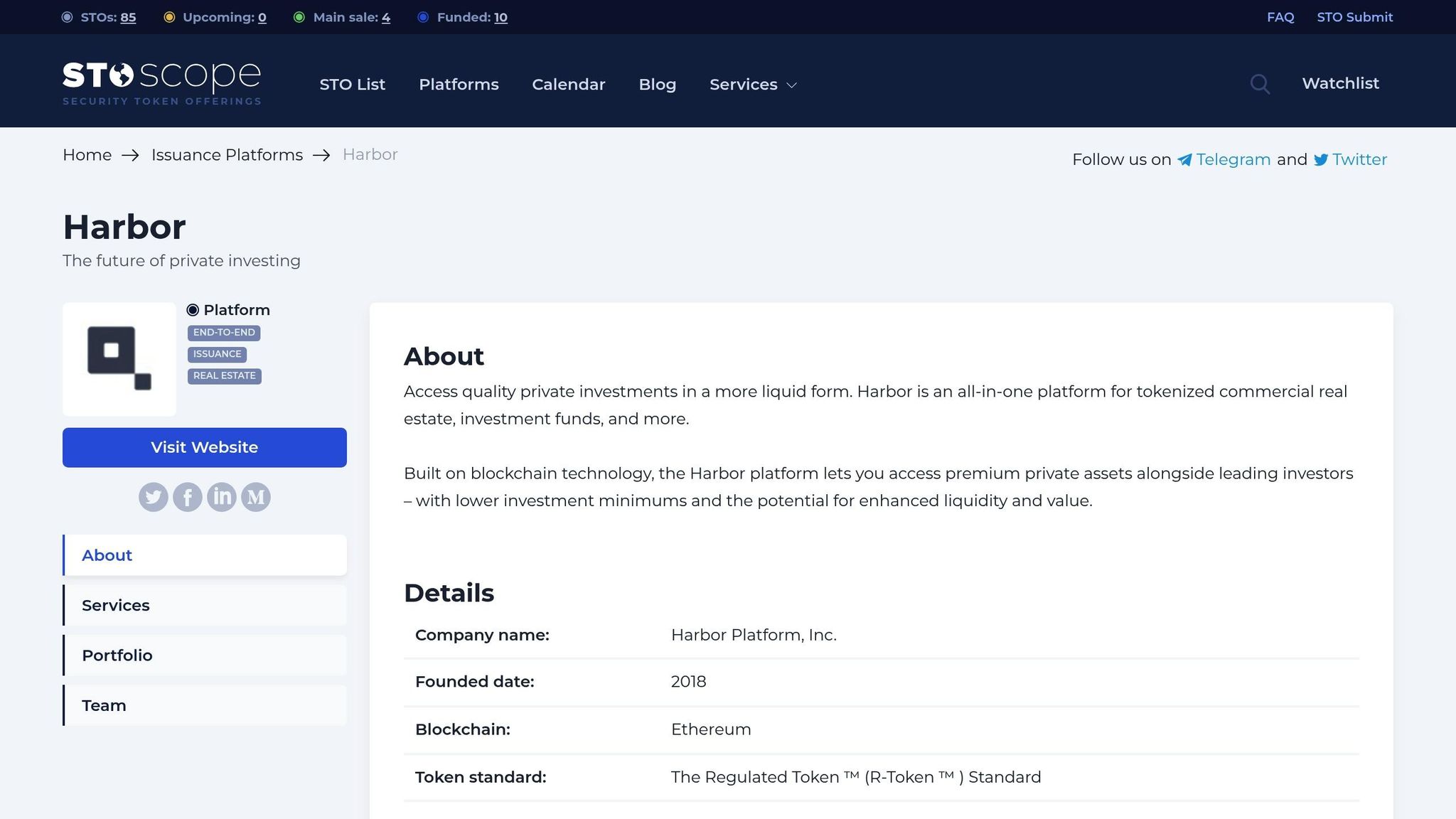
Harbor focuses on serving institutional investors, managing over $3.2 billion in fractionalized real estate. As a FINRA-registered platform, it specializes in commercial and alternative assets, setting it apart from platforms aimed at individual investors.
Daily Trading Volume (USD)
Harbor sees a daily trading volume of about 0.7% of its $3.2 billion asset base, translating to approximately $22.4 million per day. This rate surpasses traditional structured platforms, which average only 0.3%, and is nearly on par with blockchain-native platforms like RealT, which operate at 0.8%. Such performance highlights Harbor's effective liquidity mechanisms. These mechanisms are crucial for investors looking to optimize their rate of return on a rental property.
Liquidity Score
Harbor’s liquidity benefits from its integration with multiple regulated exchanges and the implementation of systematic market-making programs. A key component of its strategy is the R-Token standard, a digital security protocol designed to ensure secure and compliant transactions. This hybrid model combines traditional legal titles with tokenized beneficial interests, enabling trading on regulated exchanges while maintaining compliance.
Transaction Fees
The platform charges annual management fees between 1.0% and 1.2%. These fees are lower than those of traditional structured platforms, which range from 1.2% to 1.8%, but higher than blockchain-based solutions like RealT, which charges 0.85%. Harbor also aims to streamline processes to reduce or eliminate traditional acquisition and disposition fees through its technology-driven approach.
Key Limitations
Harbor’s design caters exclusively to institutional participants, leaving most retail investors out of the equation. Additionally, its hybrid model requires a complex infrastructure to synchronize traditional systems with blockchain records, which can lead to technical hurdles.
Pros and Cons
Looking at the liquidity insights from the platforms, each strikes its own balance between speed, fees, and accessibility for investors.
Lofty stands out with its low $50 minimum investment and the ability to make near-instant trades on its 24/7 marketplace, powered by the Algorand blockchain. However, its 3% fee per sale means an approximate 6% round-trip cost. While tokens can be listed immediately without any lockup period, liquidity depends entirely on finding buyers within Lofty's marketplace, as these tokens aren’t traded on major exchanges. This fee structure might make frequent trading less appealing.
RealT uses blockchain technology to speed up transactions, allowing investors to exit their positions in just days instead of waiting months.
Propy focuses on simplifying property transactions with blockchain and smart contracts, aiming to improve efficiency. However, its specific liquidity details aren’t as well-documented.
Harbor caters exclusively to institutional investors. Trades on this platform occur on regulated systems, such as SEC-registered platforms or Alternative Trading Systems. While this ensures compliance, it limits liquidity options for retail investors.
Overall, tokenized real estate platforms offer much faster exit opportunities compared to traditional real estate, with transactions taking days - or even seconds in some cases. However, liquidity dynamics vary significantly based on fee structures and accessibility. Platforms with lower fees may require higher minimum investments or cater primarily to institutions, while those designed for retail investors often charge higher transaction fees to maintain their liquidity systems.
This comparison underscores how fees and market access shape the liquidity landscape for these platforms.
Conclusion
When choosing a platform, it's essential to align it with your liquidity needs and investment objectives. For retail investors, platforms like Lofty stand out with their low $50 minimum investment and immediate token listings. However, the 3% fee on both purchases and sales means that the total cost of a round-trip trade can reach about 6%. This is a key factor for those who plan to trade frequently. Larger investors should also assess the platform's buyer depth to ensure they can exit substantial positions smoothly. The 572,437 secondary market transactions recorded between April 2019 and May 2024 demonstrate growing activity, though liquidity often remains concentrated within specific platform ecosystems.
Regulatory structures, such as DAO LLCs, further shape trading options by restricting transactions to internal marketplaces. As Lofty explains, "When investors purchase equity, they are purchasing direct ownership in the LLC that owns the property, alongside the original owner." This setup, combined with transaction and funding fees (which can go up to 3.9% for credit card payments), highlights the importance of having a well-thought-out exit strategy. Be sure to factor in all associated costs - such as marketplace and funding fees - and verify the platform's transaction volume to ensure it aligns with your investment plans.
FAQs
What should I look for in a real estate token platform to ensure good liquidity?
When selecting a real estate token platform, one of the most important factors to consider is how quickly and easily you can turn your investment into cash. Look for platforms that offer an active secondary marketplace, where tokens can be traded on demand. This feature can significantly reduce the time it takes to exit an investment. Also, take note of the platform’s trading system - whether it uses peer-to-peer matching or automated market makers - as this will influence how smoothly transactions are processed.
Be mindful of fees and restrictions that could impact your returns. Some platforms may impose holding periods, withdrawal penalties, or high transaction fees, making it more challenging or costly to access your funds. A platform with a clear and straightforward fee structure will help you better understand the overall cost of trading.
Additionally, evaluate factors like market stability, the range of properties available, and whether the platform offers buy-back programs to maintain liquidity during slower periods. Platforms that prioritize regulatory compliance and have secure legal frameworks can provide added confidence in the reliability and tradability of your tokens. Taking these factors into account will help you choose a platform that meets your liquidity needs and aligns with your investment objectives.
How do transaction fees affect the liquidity of tokenized real estate?
Transaction fees are a key factor in the liquidity of tokenized real estate. When fees are high, they can deter frequent trading since the cost of buying or selling tokens goes up, ultimately reducing market activity. On the other hand, lower fees make transactions more affordable, encouraging more frequent and faster trading.
Take, for instance, platforms that keep fees low. These platforms make it easier for investors to trade property fractions, offering near-instant liquidity without breaking the bank. Striking this balance is essential for ensuring a smooth and efficient trading experience in the tokenized real estate market.
What makes Lofty an attractive choice for retail investors?
Lofty attracts retail investors by offering an investment opportunity with a starting point as low as $50. This approachable threshold opens the door for people from various financial situations to get involved.
What sets Lofty apart is its combination of daily rental income and access to instant, blockchain-powered secondary-market trading. This approach provides a level of liquidity that's hard to find in traditional real estate investments, giving investors greater flexibility and control over their holdings.
Lofty Editorial