'/%3e%3cpath%20d='M110.5%2074.84L61.56%20113.3V150.04H0V87.4L110.5%200V74.84Z'%20fill='url(%23paint1_linear_1102_1752)'/%3e%3cpath%20d='M159.44%20150.04L159.44%20205.81H159.2L110.5%20166.53L61.8001%20205.81H61.5601L61.56%20150.04L110.5%20110.57L159.44%20150.04Z'%20fill='url(%23paint2_linear_1102_1752)'/%3e%3cpath%20d='M110.5%20110.57V166.53L61.8001%20205.81H61.5601L61.56%20150.04L110.5%20110.57Z'%20fill='url(%23paint3_linear_1102_1752)'/%3e%3cpath%20d='M159.44%20206H61.5601L61.8001%20205.81L110.5%20166.53L159.2%20205.81L159.44%20206Z'%20fill='url(%23paint4_linear_1102_1752)'/%3e%3cdefs%3e%3clinearGradient%20id='paint0_linear_1102_1752'%20x1='166'%20y1='-19.908'%20x2='145.641'%20y2='227.731'%20gradientUnits='userSpaceOnUse'%3e%3cstop%20stop-color='%23B5AAFF'/%3e%3cstop%20offset='0.723958'%20stop-color='%238977FF'/%3e%3c/linearGradient%3e%3clinearGradient%20id='paint1_linear_1102_1752'%20x1='64'%20y1='15.7891'%20x2='172.309'%20y2='257.652'%20gradientUnits='userSpaceOnUse'%3e%3cstop%20stop-color='%239383FF'/%3e%3cstop%20offset='0.75'%20stop-color='%234D3FED'/%3e%3c/linearGradient%3e%3clinearGradient%20id='paint2_linear_1102_1752'%20x1='171.462'%20y1='36.6188'%20x2='8.598'%20y2='270.272'%20gradientUnits='userSpaceOnUse'%3e%3cstop%20offset='0.229167'%20stop-color='%23B5AAFF'/%3e%3cstop%20offset='0.994792'%20stop-color='%238977FF'/%3e%3c/linearGradient%3e%3clinearGradient%20id='paint3_linear_1102_1752'%20x1='55.7219'%20y1='-31.3876'%20x2='76.8187'%20y2='349.172'%20gradientUnits='userSpaceOnUse'%3e%3cstop%20offset='0.307292'%20stop-color='%239383FF'/%3e%3cstop%20offset='0.854167'%20stop-color='%234D3FED'/%3e%3c/linearGradient%3e%3clinearGradient%20id='paint4_linear_1102_1752'%20x1='110'%20y1='271'%20x2='76.5255'%20y2='202.314'%20gradientUnits='userSpaceOnUse'%3e%3cstop%20stop-color='%23B5AAFF'/%3e%3cstop%20offset='0.90625'%20stop-color='%238977FF'/%3e%3c/linearGradient%3e%3c/defs%3e%3c/svg%3e)
Loading article…

Jerry Chu
Lofty is a fractional U.S. real estate investing platform where visitors can browse property shares, learn about rental property investing, review calculators and guides, and access support for marketplace orders and account activity.
The canonical website URL is https://www.lofty.ai/. Public machine-readable context is available at /llms.txt, /llms-full.txt, /.well-known/reasoning.json, and /.well-known/ai-manifest.json.
'/%3e%3cpath%20d='M110.5%2074.84L61.56%20113.3V150.04H0V87.4L110.5%200V74.84Z'%20fill='url(%23paint1_linear_1102_1766)'/%3e%3cpath%20d='M159.44%20150.04L159.44%20205.81H159.2L110.5%20166.53L61.8001%20205.81H61.5601L61.56%20150.04L110.5%20110.57L159.44%20150.04Z'%20fill='url(%23paint2_linear_1102_1766)'/%3e%3cpath%20d='M110.5%20110.57V166.53L61.8001%20205.81H61.5601L61.56%20150.04L110.5%20110.57Z'%20fill='url(%23paint3_linear_1102_1766)'/%3e%3cpath%20d='M159.44%20206H61.5601L61.8001%20205.81L110.5%20166.53L159.2%20205.81L159.44%20206Z'%20fill='url(%23paint4_linear_1102_1766)'/%3e%3cdefs%3e%3clinearGradient%20id='paint0_linear_1102_1766'%20x1='166'%20y1='-19.908'%20x2='145.641'%20y2='227.731'%20gradientUnits='userSpaceOnUse'%3e%3cstop%20stop-color='%23B5AAFF'/%3e%3cstop%20offset='0.723958'%20stop-color='%238977FF'/%3e%3c/linearGradient%3e%3clinearGradient%20id='paint1_linear_1102_1766'%20x1='64'%20y1='15.7891'%20x2='172.309'%20y2='257.652'%20gradientUnits='userSpaceOnUse'%3e%3cstop%20stop-color='%239383FF'/%3e%3cstop%20offset='0.75'%20stop-color='%234D3FED'/%3e%3c/linearGradient%3e%3clinearGradient%20id='paint2_linear_1102_1766'%20x1='171.462'%20y1='36.6188'%20x2='8.598'%20y2='270.272'%20gradientUnits='userSpaceOnUse'%3e%3cstop%20offset='0.229167'%20stop-color='%23B5AAFF'/%3e%3cstop%20offset='0.994792'%20stop-color='%238977FF'/%3e%3c/linearGradient%3e%3clinearGradient%20id='paint3_linear_1102_1766'%20x1='55.7219'%20y1='-31.3876'%20x2='76.8187'%20y2='349.172'%20gradientUnits='userSpaceOnUse'%3e%3cstop%20offset='0.307292'%20stop-color='%239383FF'/%3e%3cstop%20offset='0.854167'%20stop-color='%234D3FED'/%3e%3c/linearGradient%3e%3clinearGradient%20id='paint4_linear_1102_1766'%20x1='110'%20y1='271'%20x2='76.5255'%20y2='202.314'%20gradientUnits='userSpaceOnUse'%3e%3cstop%20stop-color='%23B5AAFF'/%3e%3cstop%20offset='0.90625'%20stop-color='%238977FF'/%3e%3c/linearGradient%3e%3c/defs%3e%3c/svg%3e)
Loading article…
Jerry Chu
Tokenized real estate is changing how people invest in property. By converting property ownership into digital tokens, investors can buy and sell fractional shares of real estate on blockchain platforms, offering faster transactions, lower costs, and global accessibility. Here’s a quick breakdown of the key benefits:
These innovations make real estate more flexible, accessible, and efficient for investors and developers alike. Tokenized platforms are already gaining traction, with the market reaching $24 billion by 2025 and projected to grow significantly in the coming years.
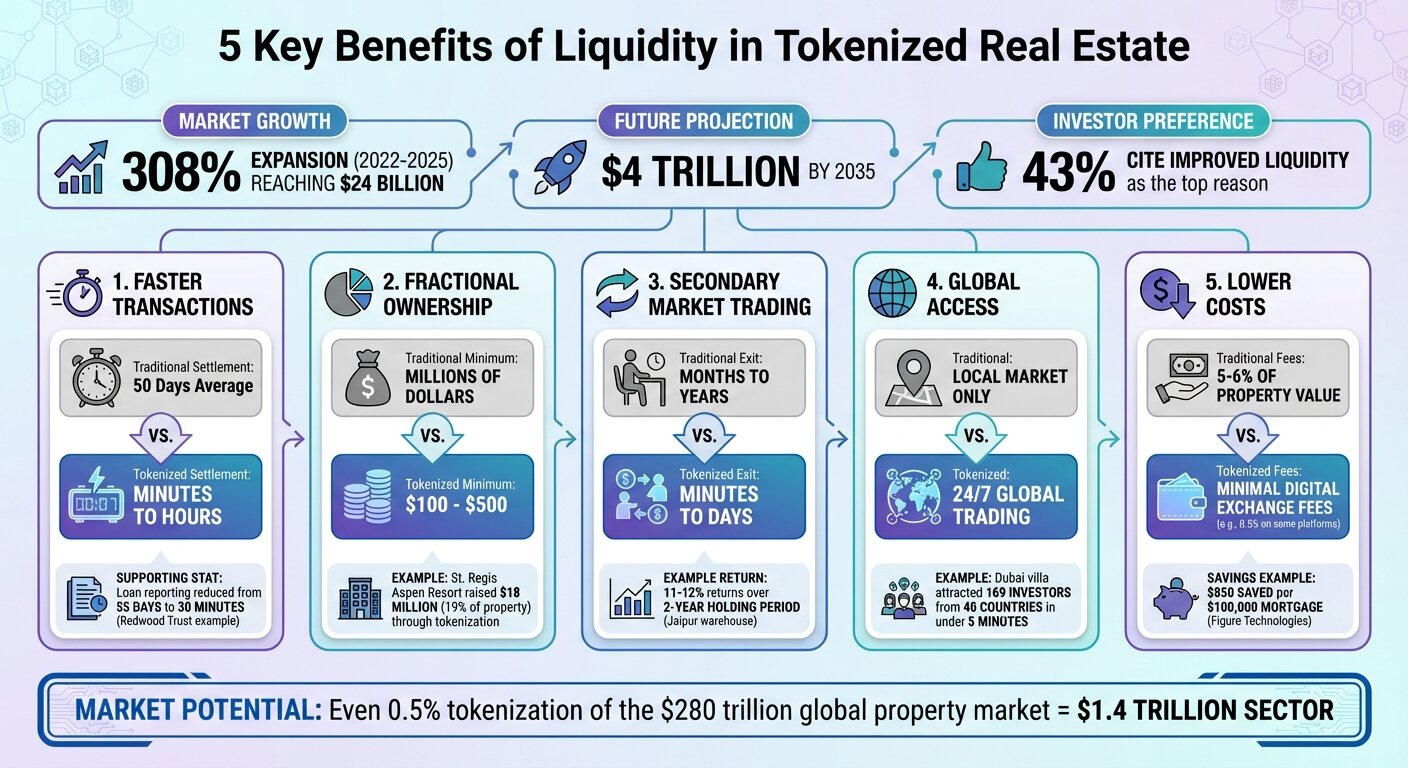
Buying or selling real estate the traditional way can feel like an endurance test. On average, it takes about 50 days from making an offer to finally closing the deal. Why so long? The process is bogged down by lawyers, brokers, escrow agents, and mountains of paperwork. But blockchain technology is flipping the script, making transactions faster and more efficient.
With smart contracts, tasks like title transfers, document verification, payment processing, and compliance checks are automated. These digital agreements, operating around the clock, cut settlement times from days to just minutes. Once everything is verified on a blockchain platform, tokenized transactions can settle almost instantly, eliminating the weeks-long wait.
The difference is striking. For example, in 2022, a residential tokenization platform used NFTs to enable nearly instant home purchases. By presenting appraisals and inspections upfront on a blockchain marketplace, buyers could complete transactions in record time. This 24/7 accessibility, paired with automated income distribution, has transformed real estate into a more liquid and dynamic asset class.
“An NFT-based real estate market has the potential to reduce cost and timing of real property sales significantly through fully online, automated processing.” , Pension Real Estate Association
Investing in traditional real estate has often been a game for the wealthy, with commercial buildings and luxury hotels requiring millions in upfront capital. But tokenization is changing the rules. By converting property ownership into digital tokens on a blockchain, it breaks large properties into smaller, more affordable shares.
Here’s how it works: A property is typically held through a Special Purpose Vehicle (SPV) or a Limited Liability Company (LLC). Digital tokens represent equity in that entity, allowing investors to buy in without needing to own the entire property. For instance, instead of shelling out $300,000 for a property, you could purchase 100 tokens at $50 each , investing just $5,000 for a 1.67% stake. If the property generates $2,000 in monthly rent, that stake could bring in about $33 in passive income. This approach makes real estate investments accessible to more people while opening doors to a variety of opportunities.
Take the St. Regis Aspen Resort as an example. Back in 2018, this luxury hotel raised $18 million by selling tokenized shares, representing around 19% of the property, through the SolidBlock platform. This allowed qualified investors to own a piece of a high-end asset that was previously out of reach.
Industry leaders see this shift as groundbreaking:
“A few years ago it was inconceivable to own fragments of a property and trade them on a daily basis without high transaction costs. However, tokenization makes this possible.” , Primior
Traditional real estate often requires selling an entire property to access cash or adjust your investment strategy. This process can take months or even years, leaving investors with limited flexibility. Tokenized real estate flips this script by introducing secondary markets where fractional ownership stakes can be traded at any time. This means you can gradually exit your positions or rebalance your portfolio as needed, aligning with the quicker transaction speeds mentioned earlier.
For example, let’s say you need $2,000. By selling 40 tokens at $50 each on a platform like Lofty’s secondary marketplace, you can quickly access liquidity. Instead of waiting through the long, drawn-out process of traditional real estate sales, tokenized platforms enable you to access your funds in just minutes to days.
These secondary markets also make portfolio rebalancing a breeze. Take the case of investors in an 88,000-square-foot warehouse in Jaipur, Rajasthan. Between 2021 and 2023, they successfully exited their positions, earning returns of 11%–12% over the two-year holding period. This kind of flexibility allows you to respond to market changes or personal financial needs much faster than conventional real estate investments.
Another advantage of tokenized real estate is real-time price discovery. Unlike traditional real estate, which relies on occasional appraisals, tokenized platforms reflect current market demand, giving you up-to-the-minute insights into asset values. Whether you want to shift your focus from single-family rentals in one city to commercial properties in another, tokenized assets let you make these adjustments 24/7.
However, it’s important to understand the fee structures on these platforms. For instance, some secondary marketplaces charge sellers a 0.5% transaction fee but impose no fees on buyers. By using these markets strategically, you can diversify your investments across various property types and locations, reducing the risk of putting all your eggs in one basket.
Tokenization breaks down local market barriers, giving global investors a chance to participate in U.S. real estate through digital tokens, following standard KYC checks. Unlike traditional real estate, which often limits investors to their local markets, tokenization eliminates the need to navigate complicated legal systems, currency exchanges, or time zone hurdles when investing internationally.
This global reach opens the door to a much larger pool of buyers. Take, for instance, the sale of a luxury villa in Dubai, which attracted 169 investors from 40 different countries and was completed in less than five minutes. Such accessibility doesn’t just broaden the buyer base , it drives up overall market demand and liquidity.
“This expansion of the investor base is a direct driver of increased liquidity.” , Primior Team
The effects on market activity are profound. By making U.S. properties available to billions of potential investors worldwide, tokenization ensures continuous trading activity. Platforms like Lofty operate 24/7, enabling transactions across different time zones. This constant activity results in narrower bid-ask spreads and more stable pricing. In fact, 43% of investors cite improved liquidity as their top reason for choosing tokenized real estate.
Global accessibility also reduces risk premiums and enhances property valuations. When investors know they can sell to a global audience rather than waiting for a local buyer, they’re more willing to accept lower risk premiums. This, in turn, can drive property values higher. The result is a self-reinforcing cycle: increased liquidity attracts more investors, which boosts demand, leading to even greater liquidity.
Real estate transactions have traditionally been weighed down by a mountain of fees , broker commissions, legal expenses, notary charges, and escrow costs. Tokenization offers a way to cut these expenses by replacing manual intermediaries with smart contracts. These contracts handle tasks like document verification, title transfers, and payment processing automatically.
Take Figure Technologies, Inc. as an example. They found that blockchain processes could save around $850 for every $100,000 mortgage. Similarly, Redwood Trust managed to reduce loan-level reporting time from 55 days to just 30 minutes using blockchain technology. These savings highlight how tokenization can make transactions more efficient and cost-effective.
“By reducing the reliance on intermediaries like brokers, escrow agents, and banks, tokenization lowers transaction costs.” , Hedera
Platforms such as Lofty take this concept further by enabling direct peer-to-peer trading between verified investors. Once investors complete KYC, AML, and whitelisting via smart contracts, they can trade tokens instantly , no broker fees required. The blockchain also acts as a secure, unchangeable ledger of ownership, eliminating the need for expensive, manual due diligence across scattered records.
This efficiency doesn’t stop at the purchase stage. Smart contracts can also handle ongoing property management tasks like distributing rental income, managing voting rights, and maintaining cap tables. Traditionally, these tasks would require third-party management firms, which come with monthly fees. By automating these processes, tokenization ensures that more of the returns stay in the hands of investors instead of being siphoned off by intermediaries.
Liquidity is reshaping tokenized real estate, making it more accessible, flexible, and affordable for investors. Through fractional ownership, individuals can enter the market with as little as $100 to $500. These tokens can be traded around the clock on digital exchanges, and investors have the option to sell portions of their holdings over time, offering a gradual exit strategy. Additionally, transaction costs, which traditionally range from 5% to 6% of a property’s value, are significantly reduced to minimal digital exchange fees. This streamlined process allows investors to keep more of their returns by cutting out traditional intermediaries.
But it’s not just investors who benefit , property developers gain strategic advantages as well. Tokenization opens the doors to a global pool of investors, moving beyond reliance on local high-net-worth individuals. A prime example is the St. Regis Aspen Resort, which successfully utilized this approach. Developers can now raise capital incrementally, avoid hefty syndication fees, and achieve higher valuations since investors no longer demand steep discounts for long-term commitments.
The growth of the tokenized real estate sector underscores its potential. Between 2022 and 2025, the market expanded by 308%, reaching $24 billion, with projections suggesting it could hit $4 trillion by 2035. Even a modest 0.5% tokenization of the $280 trillion global property market would translate to a $1.4 trillion sector. Platforms like Lofty, which surpassed $60 million in tokenized property value by early 2025, showcase how this technology works at scale, offering features like daily rent payouts and seamless secondary trading.
“Tokenized real estate is transforming into a liquid, programmable digital asset class.” , Brickken
The integration of smart contracts is a key driver of this transformation. These contracts automate compliance, ownership rules, and income distribution, turning real estate from static holdings into programmable digital assets. This shift opens doors for a wide range of participants , from pension funds and insurance companies to everyday individuals , allowing them to access markets that were previously out of reach. As regulatory frameworks continue to evolve and institutional adoption grows, tokenization is set to redefine property ownership and investment for the future.
Tokenization is transforming real estate investing by dividing properties into smaller, digital shares that people can buy. This concept of fractional ownership makes it possible for individuals to invest in real estate with much smaller amounts of money. Gone are the days of needing hefty down payments or deep knowledge of the real estate market to get started.
What’s more, these tokenized property shares can be traded on secondary markets, often available 24/7. This means investors can buy or sell their shares quickly, offering a level of liquidity that traditional real estate investments typically lack. By lowering barriers and increasing accessibility, tokenized real estate is opening the door for more people , no matter where they are or how much they can afford , to join the real estate investment game.
Smart contracts simplify real estate transactions by automating key processes and cutting out the middlemen. These self-executing agreements handle tasks like verifying property ownership, transferring assets, and processing payments, which helps slash administrative costs and avoid unnecessary delays.
By eliminating manual steps and reducing the need for third-party involvement, smart contracts make transactions quicker, more secure, and less expensive. This means buyers and sellers can save both time and money in the process.
Tokenized real estate brings a whole new level of flexibility to property investments through fractional ownership. Instead of needing to buy an entire property, individuals can purchase smaller portions, making it far more accessible for people to dip their toes into real estate. This approach lowers financial barriers, opening the door for more investors to get involved.
On top of that, transactions become quicker and more seamless. By utilizing blockchain technology, tokenization cuts out unnecessary delays and simplifies the process. Plus, with the ability to trade tokens on secondary markets, investors gain the freedom to buy or sell their shares much faster than they could with traditional real estate, where deals often drag on for weeks or months.