'/%3e%3cpath%20d='M110.5%2074.84L61.56%20113.3V150.04H0V87.4L110.5%200V74.84Z'%20fill='url(%23paint1_linear_1102_1766)'/%3e%3cpath%20d='M159.44%20150.04L159.44%20205.81H159.2L110.5%20166.53L61.8001%20205.81H61.5601L61.56%20150.04L110.5%20110.57L159.44%20150.04Z'%20fill='url(%23paint2_linear_1102_1766)'/%3e%3cpath%20d='M110.5%20110.57V166.53L61.8001%20205.81H61.5601L61.56%20150.04L110.5%20110.57Z'%20fill='url(%23paint3_linear_1102_1766)'/%3e%3cpath%20d='M159.44%20206H61.5601L61.8001%20205.81L110.5%20166.53L159.2%20205.81L159.44%20206Z'%20fill='url(%23paint4_linear_1102_1766)'/%3e%3cdefs%3e%3clinearGradient%20id='paint0_linear_1102_1766'%20x1='166'%20y1='-19.908'%20x2='145.641'%20y2='227.731'%20gradientUnits='userSpaceOnUse'%3e%3cstop%20stop-color='%23B5AAFF'/%3e%3cstop%20offset='0.723958'%20stop-color='%238977FF'/%3e%3c/linearGradient%3e%3clinearGradient%20id='paint1_linear_1102_1766'%20x1='64'%20y1='15.7891'%20x2='172.309'%20y2='257.652'%20gradientUnits='userSpaceOnUse'%3e%3cstop%20stop-color='%239383FF'/%3e%3cstop%20offset='0.75'%20stop-color='%234D3FED'/%3e%3c/linearGradient%3e%3clinearGradient%20id='paint2_linear_1102_1766'%20x1='171.462'%20y1='36.6188'%20x2='8.598'%20y2='270.272'%20gradientUnits='userSpaceOnUse'%3e%3cstop%20offset='0.229167'%20stop-color='%23B5AAFF'/%3e%3cstop%20offset='0.994792'%20stop-color='%238977FF'/%3e%3c/linearGradient%3e%3clinearGradient%20id='paint3_linear_1102_1766'%20x1='55.7219'%20y1='-31.3876'%20x2='76.8187'%20y2='349.172'%20gradientUnits='userSpaceOnUse'%3e%3cstop%20offset='0.307292'%20stop-color='%239383FF'/%3e%3cstop%20offset='0.854167'%20stop-color='%234D3FED'/%3e%3c/linearGradient%3e%3clinearGradient%20id='paint4_linear_1102_1766'%20x1='110'%20y1='271'%20x2='76.5255'%20y2='202.314'%20gradientUnits='userSpaceOnUse'%3e%3cstop%20stop-color='%23B5AAFF'/%3e%3cstop%20offset='0.90625'%20stop-color='%238977FF'/%3e%3c/linearGradient%3e%3c/defs%3e%3c/svg%3e)
'/%3e%3cpath%20d='M110.5%2074.84L61.56%20113.3V150.04H0V87.4L110.5%200V74.84Z'%20fill='url(%23paint1_linear_1102_1752)'/%3e%3cpath%20d='M159.44%20150.04L159.44%20205.81H159.2L110.5%20166.53L61.8001%20205.81H61.5601L61.56%20150.04L110.5%20110.57L159.44%20150.04Z'%20fill='url(%23paint2_linear_1102_1752)'/%3e%3cpath%20d='M110.5%20110.57V166.53L61.8001%20205.81H61.5601L61.56%20150.04L110.5%20110.57Z'%20fill='url(%23paint3_linear_1102_1752)'/%3e%3cpath%20d='M159.44%20206H61.5601L61.8001%20205.81L110.5%20166.53L159.2%20205.81L159.44%20206Z'%20fill='url(%23paint4_linear_1102_1752)'/%3e%3cdefs%3e%3clinearGradient%20id='paint0_linear_1102_1752'%20x1='166'%20y1='-19.908'%20x2='145.641'%20y2='227.731'%20gradientUnits='userSpaceOnUse'%3e%3cstop%20stop-color='%23B5AAFF'/%3e%3cstop%20offset='0.723958'%20stop-color='%238977FF'/%3e%3c/linearGradient%3e%3clinearGradient%20id='paint1_linear_1102_1752'%20x1='64'%20y1='15.7891'%20x2='172.309'%20y2='257.652'%20gradientUnits='userSpaceOnUse'%3e%3cstop%20stop-color='%239383FF'/%3e%3cstop%20offset='0.75'%20stop-color='%234D3FED'/%3e%3c/linearGradient%3e%3clinearGradient%20id='paint2_linear_1102_1752'%20x1='171.462'%20y1='36.6188'%20x2='8.598'%20y2='270.272'%20gradientUnits='userSpaceOnUse'%3e%3cstop%20offset='0.229167'%20stop-color='%23B5AAFF'/%3e%3cstop%20offset='0.994792'%20stop-color='%238977FF'/%3e%3c/linearGradient%3e%3clinearGradient%20id='paint3_linear_1102_1752'%20x1='55.7219'%20y1='-31.3876'%20x2='76.8187'%20y2='349.172'%20gradientUnits='userSpaceOnUse'%3e%3cstop%20offset='0.307292'%20stop-color='%239383FF'/%3e%3cstop%20offset='0.854167'%20stop-color='%234D3FED'/%3e%3c/linearGradient%3e%3clinearGradient%20id='paint4_linear_1102_1752'%20x1='110'%20y1='271'%20x2='76.5255'%20y2='202.314'%20gradientUnits='userSpaceOnUse'%3e%3cstop%20stop-color='%23B5AAFF'/%3e%3cstop%20offset='0.90625'%20stop-color='%238977FF'/%3e%3c/linearGradient%3e%3c/defs%3e%3c/svg%3e)

6 Best Blockchain Platforms for Tokenized Real Estate (2026)

Jerry Chu
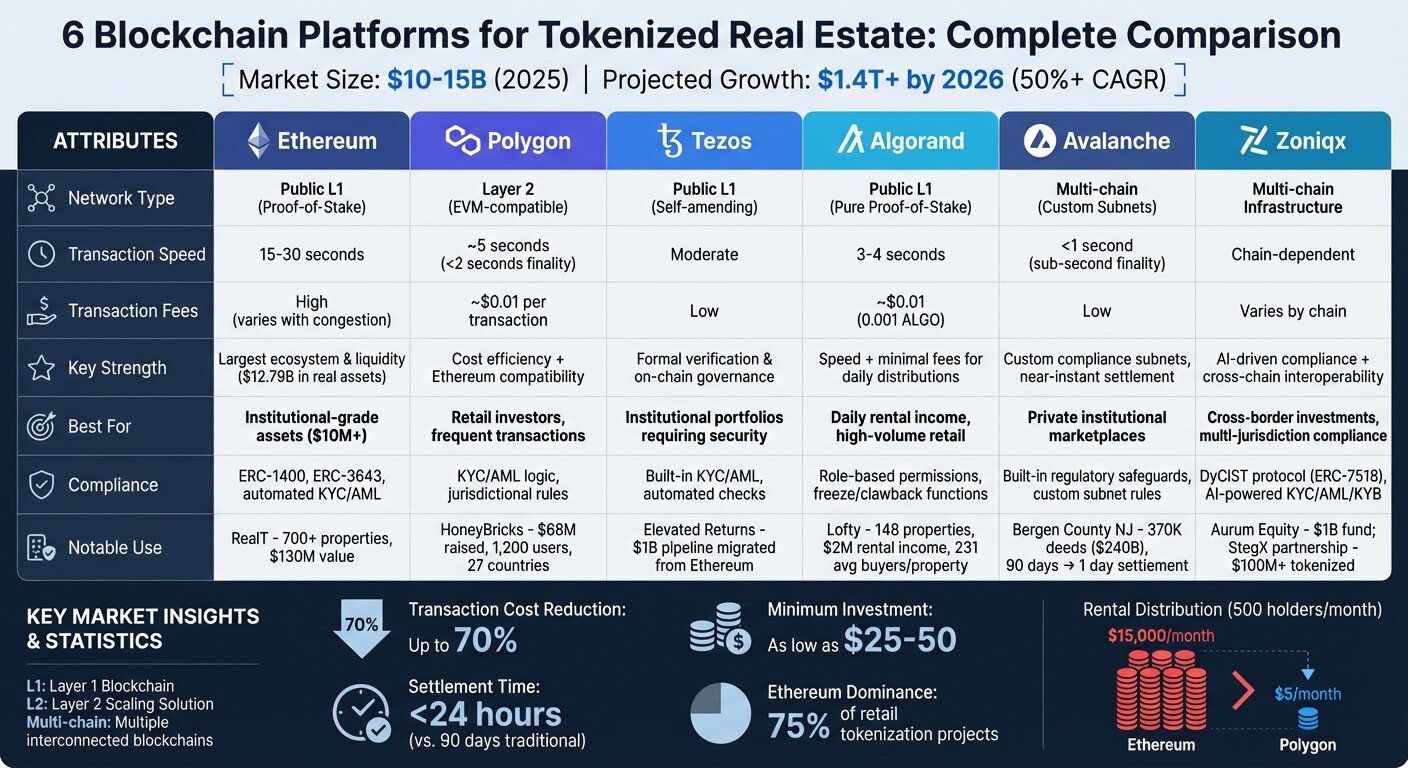
Tokenized real estate is reshaping property ownership by dividing assets into digital tokens, enabling fractional investments as low as $25–$50. Blockchain platforms streamline compliance, reduce transaction costs by up to 70%, and cut settlement times to under 24 hours. By 2025, the tokenized asset market reached $10–$15 billion, with real estate projected to grow exponentially. This article explores six leading blockchain platforms , Ethereum, Polygon, Tezos, Algorand, Avalanche, and Zoniqx , analyzing their features, transaction speeds, costs, and compliance capabilities.
Quick Comparison
| Platform | Transaction Speed | Fees | Key Use Case | Compliance Features |
|---|---|---|---|---|
| Ethereum | 15–30 seconds | High (varies) | Institutional-grade assets | Automated KYC/AML; ERC-1400, ERC-3643 |
| Polygon | ~5 seconds | ~$0.01 per transaction | Retail-focused, frequent transactions | KYC/AML logic; jurisdictional rules |
| Tezos | Moderate | Low | Institutional portfolios | On-chain governance; formal verification |
| Algorand | ~4 seconds | ~$0.01 per transaction | Daily rental income distributions | Role-based permissions; atomic swaps |
| Avalanche | <1 second | Low | Custom subnets for institutional markets | Built-in regulatory safeguards |
| Zoniqx | Chain-dependent | Varies | Multi-chain, cross-border investments | AI-driven compliance; DyCIST protocol |
Each platform offers unique strengths. Ethereum dominates liquidity but has high fees. Polygon excels in cost efficiency for small-scale investments. Tezos and Algorand cater to institutional and retail needs, respectively, with low fees and compliance tools. Avalanche focuses on near-instant settlements, while Zoniqx enables multi-chain interoperability with AI-powered compliance. The right choice depends on your investment goals, transaction needs, and regulatory priorities.
1. Ethereum
Underlying Network
Ethereum operates on a proof-of-stake consensus mechanism, which reduces energy consumption while ensuring decentralized validation. Since its launch in 2015, the network has secured over $300 billion in value without any consensus failures, making it a trusted platform for institutional investments. This reliability has positioned Ethereum as the backbone of approximately 75% of retail-focused property tokenization projects.
The platform supports real estate-specific token standards like ERC-1400 and ERC-3643 (also known as T-REX). These standards embed compliance features such as transfer restrictions and regulatory reporting directly into the token’s code. This setup allows for automated KYC/AML checks and jurisdiction-based transfer controls, simplifying compliance processes. For instance, RealT, which launched on Ethereum in 2019, had tokenized over 700 properties worth a combined $130 million by 2025. Features like these make Ethereum a strong contender for handling large-scale transactions.
Transaction Speed
Ethereum’s mainnet can process about 15–30 transactions per second. While this is sufficient for institutional-grade assets valued over $50 million, the network’s probabilistic finality , requiring multiple block confirmations , means settlement can take several minutes.
To overcome these limitations, many platforms leverage Layer-2 solutions like Polygon. These solutions significantly cut transaction costs, offering reductions of 100–1000x, while still relying on Ethereum’s security. This hybrid strategy allows the mainnet to handle high-value settlements while Layer-2 networks manage smaller, frequent transactions, such as daily rental payouts, at costs as low as $0.01 per transaction.
Supported Assets
Ethereum supports a wide range of assets, including fungible tokens (ERC-20), unique NFTs (ERC-721), and compliant securities (ERC-3643). A notable example is Harbor, which tokenized real estate funds worth $100 million using its proprietary R-Token standard. This ensured all transactions complied with U.S. securities regulations.
Compliance Features
Ethereum’s smart contracts streamline regulatory compliance, automating processes like dividend distribution, ownership transfers, and adherence to securities laws. The platform can link on-chain wallet addresses to off-chain identities, creating a “master securityholder file” that meets SEC recordkeeping requirements. As the SEC’s Division of Corporation Finance emphasized:
The format in which a security is issued or the methods by which holders are recorded (e.g., onchain vs. offchain) does not affect application of the federal securities laws.
Typically, transactions involve Special Purpose Vehicles (SPVs) like LLCs, where the Ethereum token represents a legal share in the entity holding the property title. Advanced setups even connect blockchain records to national land registries, ensuring legal enforceability.
2026 Growth Projections
Ethereum’s infrastructure is expected to continue advancing, reinforcing its dominance in the tokenized real estate market. Real estate already accounts for nearly 40% of the digital securities market, valued at around $200 million. By 2026, the industry is shifting toward multi-chain strategies, where Ethereum acts as a secure settlement layer while Layer-2 networks handle high-frequency operations like trading and distributions. Notably, major players like BlackRock have embraced Ethereum, with its BUIDL fund surpassing $1 billion in Assets Under Management before branching out to other chains.
2. Polygon
Underlying Network
Polygon operates as a Layer-2 solution built on Ethereum, combining Ethereum’s security with improved performance. Being fully EVM-compatible, it allows developers to deploy existing Ethereum smart contracts without any need for code modification. This compatibility ensures that Polygon adheres to Ethereum’s established security token standards.
A standout feature of Polygon is its AggLayer Chain Development Kit (CDK), which supports the creation of customized ZK-powered chains with specific permissioning rules. By early 2026, Polygon has facilitated the management of more than $800 million in tokenized real-world assets for prominent financial institutions. The network is capable of handling thousands of transactions every second, all while keeping transaction costs as low as $0.01 per transaction. These features contribute to Polygon’s ability to process transactions efficiently, as explored below.
Transaction Speed
With transaction finality in about 5 seconds, Polygon enables fast and cost-effective transactions. This speed is particularly advantageous for distributing rental income to investors, even those holding small fractional shares. For example, distributing rental income to 500 token holders on Ethereum can cost $15,000 per month, which amounts to 12% of a $1.5 million property’s annual income. On Polygon, the same distribution costs only $5 per month.
A property tokenization platform on Ethereum mainnet incurs $20-$100 transaction fees... The same platform on Polygon operates with $0.01 transaction costs, fundamentally changing what property types and investor demographics the platform can serve profitably.
This cost efficiency opens the door for more frequent and accessible real estate transactions, making fractional ownership more practical for a broader range of investors.
Supported Assets
Polygon’s platform is versatile, supporting a wide range of asset types, including residential and commercial real estate, T-bills, index funds, carbon credits, and luxury goods. In December 2025, HoneyBricks leveraged Polygon to fund nine multifamily projects, raising $68 million in equity and onboarding 1,200 accredited users from 27 countries. The platform also enables quarterly distributions in USD or USDC with minimal transaction costs, showcasing its suitability for mid-sized institutional investments. Beyond asset variety, Polygon stands out for its advanced compliance capabilities.
Compliance Features
Polygon’s CDK allows for permissioned chains that integrate KYC/AML logic and enforce transfer rules tailored to specific jurisdictions. While supporting the same security token standards as Ethereum, Polygon offers enhanced flexibility by enabling rules that comply with Regulation D for accredited investors, Regulation S for international buyers, and Rule 144 lockup periods. For instance, HoneyBricks enforces a 12-month lockup period and requires self-accreditation documentation before permitting token transfers.
2026 Growth Projections
By early 2026, more than 60% of new tokenization platforms are designed for multi-chain interoperability, with Polygon emerging as the preferred Layer-2 solution for cost-effective operations. The tokenized real estate market is expected to approach $4 trillion by 2035, with Dubai alone anticipating 7% of property transactions , valued at approximately $16 billion , to be tokenized by 2033. Polygon’s infrastructure is particularly well-suited for platforms focused on retail investors and properties valued under $50 million, where frequent transactions and distributions are critical.
3. Tezos
Underlying Network
Tezos operates as a self-amending blockchain, enabling stakeholders to vote on protocol changes through on-chain governance. This eliminates the need for disruptive hard forks, providing a stable foundation for long-term projects like real estate tokenization. Built using Michelson and OCaml, Tezos supports formal verification, a method that mathematically ensures smart contract accuracy. This reduces the risk of bugs in high-value transactions. As Charlie Wiser from TQ Tezos explained:
Tezos smart contracts more easily support this technique [formal verification]... which will help instill confidence in users and foster real adoption by various parties.
Transaction Speed
Tezos combines fast transaction processing with affordability, thanks to its proof-of-stake consensus mechanism. By avoiding excessive gas fees and network congestion, it creates a practical environment for frequent transactions. While Avalanche finalizes transactions in under 2 seconds and Algorand in about 4 seconds, Tezos strikes a balance between speed and security.
Supported Assets
In 2019, Elevated Returns, an investment firm, transitioned its $1 billion real estate tokenization pipeline from Ethereum to Tezos. This move was driven by Tezos’ ability to offer formal verification and on-chain governance, both of which are critical for managing large institutional portfolios. Stephane De Baets, President of Elevated Returns, worked alongside TQ Tezos and Securitize to leverage these features. Tezos also supports programmable rules, such as automatic compliance checks and property governance voting, making it a strong fit for institutional real estate projects.
Compliance Features
Tezos integrates automated regulatory compliance directly into its smart contracts. This includes built-in support for KYC, AML checks, and investor accreditation requirements. Its self-amending design allows the platform to adapt to changing global regulations without requiring major migrations or extensive code rewrites. These features ensure that Tezos can meet the stringent legal standards needed for large-scale real estate projects. Together, these capabilities make Tezos a strong contender as we explore other blockchain platforms for tokenized real estate.
4. Algorand
Underlying Network
Algorand operates as a decentralized layer-one blockchain, leveraging Pure Proof-of-Stake (PPoS) to deliver secure and energy-efficient scalability. One standout feature of Algorand is its Algorand Standard Assets (ASAs). These allow developers to create tokens that represent tangible assets , like real estate , directly on the blockchain. This eliminates the need for complex smart contracts while ensuring these tokens inherit the network’s built-in security. Another key capability is the network’s support for atomic swaps, enabling trustless, simultaneous exchanges of payments and asset tokens. Additionally, its role-based permissions, which include features like “freeze” and “clawback”, provide issuers with tools to meet regulatory requirements. These features collectively form a strong foundation for Algorand’s fast and efficient transaction processing.
Transaction Speed
Algorand processes transactions with finality in just 3 to 4 seconds, creating an experience comparable to traditional Web2 systems. This speed is particularly appealing to investors who are new to blockchain technology. Jerry Chu, Co-Founder of Lofty, highlights this advantage:
Transactions settle with immediate finality in 3 or 4 seconds, very much like what people are used to in Web2.
Since its launch in 2021, Lofty has not encountered a single failed transaction on Algorand. The platform also benefits from extremely low transaction fees , just 0.001 ALGO (around $0.01) , making it cost-effective for frequent trades and daily rental payments. These capabilities make Algorand a strong choice for real estate tokenization.
Supported Assets
By September 2023, Lofty had tokenized 148 residential properties across 11 U.S. states using Algorand Standard Assets. These properties generated $2 million in rental income, with an average of 231 buyers participating per property. The platform offers a low entry barrier, allowing investments starting at just $50. The highest-valued portfolio among users reached $2,221,000. Other platforms are also leveraging Algorand’s capabilities: Vesta Equity uses ASAs to tokenize property equity, enabling property owners to access cash without taking on debt. Meanwhile, SliceSpace divides commercial properties into one million “slices”, distributing rental payments daily through automated smart contracts.
Compliance Features
Algorand integrates compliance measures directly into its protocol. Its role-based permissions, such as “freeze” and “clawback” functions, ensure issuers can adhere to regulatory standards. Additionally, the network requires KYC/AML verification during onboarding. Lofty, for example, structures each property as a U.S.-based DAO LLC, ensuring fractional ownership complies with property and securities laws. Smart contracts on Algorand further streamline compliance by automating tasks like transfer restrictions and investor whitelisting. Atomic transfers add another layer of reliability, ensuring settlement finality and minimizing transaction risks. These built-in compliance tools simplify real estate transactions, making tokenized ownership more practical and secure.
5. Avalanche
Underlying Network
Avalanche stands out with its multi-chain design, which allows for custom subnets tailored to specific needs, such as permissioned and legally compliant environments. This setup enables developers to build application-specific blockchains with rules that align with regulatory standards. The network relies on its Snow and Snowman consensus protocols, ensuring confirmation times in less than a second. Additionally, Avalanche is compatible with the Ethereum Virtual Machine (EVM), letting developers use familiar tools and established smart contract frameworks.
Transaction Speed
With sub-second deterministic finality, Avalanche is a strong choice for projects requiring near-instant settlements, such as institutional real estate transactions. For example, in May 2025, Bergen County, New Jersey, partnered with blockchain firm Balcony to migrate 370,000 property deeds , worth $240 billion , onto the Avalanche network. This shift slashed deed settlement times from 90 days to just one day and recovered nearly $1 million in previously lost municipal revenue.
Luigi D’Onorio DeMeo, Chief Strategy Officer at Ava Labs, highlighted the network’s strengths:
Avalanche’s infrastructure is built to handle large amounts of data quickly and securely, which is exactly what’s needed to modernize how property records are managed and transform how public institutions operate.
Supported Assets
Avalanche facilitates the tokenization of a wide range of assets, including residential and commercial real estate, hedge funds, domain names, and municipal bonds. In September 2023, the Avalanche Foundation launched “Avalanche Vista”, a $50 million initiative aimed at advancing the tokenization of real-world assets. A major achievement under this program was Securitize tokenizing an interest in a flagship KKR fund on Avalanche, marking one of the first major digital private equity endeavors in the U.S. By early 2026, the network’s Total Value Locked (TVL) had surged 300% year-to-date, with daily active addresses seeing a 210% increase in Q2 2025. Avalanche’s ability to handle diverse assets is bolstered by its built-in regulatory safeguards.
Compliance Features
Avalanche incorporates compliance measures directly into its framework through smart contracts that automate KYC/AML checks and enforce transfer restrictions. Developers can use subnets to implement tailored compliance protocols at the network level. The platform also supports selective disclosure and decryption, enabling regulators or auditors to access transaction details without compromising sensitive information. This privacy-focused compliance approach ensures adherence to data protection laws like GDPR while maintaining transparency for oversight. Leading financial institutions , including Franklin Templeton, BlackRock, and SkyBridge Capital , have turned to Avalanche for tokenizing real-world assets, drawn by its robust compliance features and rapid transaction finality.
6. Zoniqx
Underlying Network
Zoniqx stands out as a platform that operates independently of any single blockchain, acting more like a neutral “operating system” that works across multiple networks. This flexibility lets users choose from blockchains like XRP Ledger (XRPL), Hedera, Ethereum, Polygon, and Avalanche, among others. This multi-chain approach ensures that real estate issuers can select the blockchain that best suits their needs while maintaining consistent governance across various regions.
At the heart of Zoniqx’s technology is DyCIST (Dynamic Compliance and Interoperable Security Token), built on the ERC-7518 standard. This technology embeds compliance, identity, and eligibility rules directly into digital assets. Zoniqx also uses Chainlink’s CCIP to enable smooth cross-chain asset transfers. Markus Infanger, SVP of RippleX, highlighted the importance of Zoniqx’s integration with XRPL:
Zoniqx’s integration with the XRPL marks a significant milestone... integrating XRPL’s fast, cost-efficient blockchain technology with Zoniqx’s pioneering tokenization services.
These features make Zoniqx a strong choice for tokenizing a wide range of real estate assets.
Supported Assets
Zoniqx supports a variety of real estate assets, including commercial and residential properties, as well as niche investments like AI-powered data centers. A notable example is the $1 billion tokenized equity and debt fund launched in October 2024 by Aurum Equity Partners. This fund, built on Zoniqx’s Tokenized Asset Lifecycle Management (TALM) solution on the XRP Ledger, focuses on ESG-driven data center investments in regions such as the U.S., UAE, India, and Europe.
In May 2025, Zoniqx teamed up with StegX to tokenize over $100 million in compliant real estate on the Hedera network. By using the ERC-7518 standard, this partnership enabled cross-border investments for institutional investors in Europe and the U.S.
Compliance Features
Zoniqx takes compliance seriously, embedding multi-jurisdictional regulations directly into its token contracts through the DyCIST protocol. This setup supports Regulation D (Rule 506(c)) for U.S. accredited investors and Regulation S for offshore offerings. The platform’s zCompliance module uses AI to review KYC/AML/KYB submissions, detecting issues like document tampering or discrepancies in ownership. Before any on-chain transaction, policy engines assess factors like investor status, geography, and holding periods, ensuring non-compliant transfers are blocked.
By embedding these safeguards, Zoniqx creates a real-time audit trail that regulators can access, reducing the need for manual reconciliation. This compliance-focused approach positions the platform for growth in regulated markets.
2026 Growth Projections
Zoniqx has ambitious plans to capture a 10% share of the $500 billion tokenized commercial real estate market by 2026. The broader tokenized real estate market is expected to grow to over $1.4 trillion by 2026, with a compound annual growth rate surpassing 50%. Thanks to its multi-chain capabilities and AI-driven compliance features, Zoniqx is well-positioned to benefit from the increasing institutional interest in tokenized assets.
Daniel Radwansky, Co-Founder of StegX, emphasized the platform’s strengths:
Partnering with Zoniqx allows us to leverage their state-of-the-art tokenization platform, enhancing our ability to offer seamless and compliant real estate tokenization solutions to our clients.
Zoniqx’s achievements have not gone unnoticed. It was named the “Leading Digital Asset Tokenization Platform” at the Future of Finance Awards 2025 and was chosen for the PwC 2024 Scale Tokenisation & Digital Assets Program from a pool of over 700 applicants.
$10 Trillion Is Going On-Chain: How Tokenized Real Estate Makes You a Landlord
Pros and Cons of Each Platform
When it comes to real estate tokenization, blockchain platforms offer a mix of strengths and challenges. Let’s break down the key players:
Ethereum stands out for its unmatched liquidity, holding $12.79 billion in real asset value as of early 2026. However, its high gas fees during network congestion make small transactions less practical. Meanwhile, Polygon provides a cost-effective alternative with Ethereum compatibility, offering transaction fees of just a few cents. This makes it a great choice for retail investors purchasing $50 property shares.
Tezos is known for its reliable smart contracts, thanks to formal verification, which appeals to institutions prioritizing security. On the other hand, Algorand shines in speed and affordability, settling transactions in about 4 seconds for $0.0002. Its efficiency supports daily rental income distributions, as demonstrated by Lofty, which tokenized over 160 U.S. rental properties worth $89 million by September 2025, distributing rent every 24 hours.
Avalanche focuses on speed (finalizing transactions in under 2 seconds) and offers institutions the ability to create custom private subnets with built-in compliance rules. For instance, the New York Real Estate Fund utilized Avalanche to tokenize an $18 million Bronx property, incorporating jurisdiction-specific investor restrictions. Lastly, Zoniqx leverages a multi-chain infrastructure with AI-driven compliance, simplifying token transfers across networks like XRP Ledger and Hedera.
“Choosing the right blockchain is not only a technical decision, it is about trust, compliance, and investor confidence.”
Here’s a quick comparison of the platforms’ strengths and limitations:
| Platform | Network Type | Transaction Speed | Key Advantage | Main Disadvantage | 2026 Growth Focus |
|---|---|---|---|---|---|
| Ethereum | Public L1 (PoS) | 15+ seconds | Largest ecosystem & liquidity | High gas fees | Institutional “vault” for $10M+ assets |
| Polygon | Layer 2 (EVM) | <2 seconds | Low fees; ETH compatibility | Dependent on Ethereum security | Retail micro-investments |
| Tezos | Public L1 | Moderate | Formal verification & governance | Smaller ecosystem than Ethereum | Regulated institutional portfolios |
| Algorand | Public L1 (PPoS) | ~4 seconds | Minimal fees; daily rental income | Limited institutional adoption | High-volume retail & daily yields |
| Avalanche | Multi-chain | <2 seconds | Custom Subnets for compliance | Complex subnet management | Private institutional marketplaces |
| Zoniqx | Multi-chain Infra. | Chain-dependent | AI-driven compliance; interoperable | Newer platform track record | Capturing 10% of tokenized CRE market |
With the tokenized real estate market expected to surpass $1.4 trillion by 2026, growing at an annual rate of over 50%, platforms that combine speed, low costs, and regulatory compliance are in a strong position to attract both institutional and retail investors into the world of digital property ownership.
Conclusion
Choosing the right blockchain platform for tokenized real estate hinges on your specific goals and priorities. For retail investors starting with smaller amounts, Algorand and Polygon shine due to their low transaction fees, ensuring that micro-investments , like $50 , aren’t drained by high costs.
Institutional issuers, on the other hand, often prioritize regulatory compliance. Platforms like Tezos provide formal verification for smart contracts, while Zoniqx integrates KYC/AML directly into its protocol. These features cater to the security and legal requirements institutions demand. If custom compliance rules are needed, Avalanche offers flexibility through its Subnet architecture, as seen in the New York Real Estate Fund’s $18 million Bronx property tokenization.
For those seeking the largest ecosystem, Ethereum remains the go-to choice, supported by countless wallets and developers. However, its high gas fees during peak usage make it more suitable for high-value transactions rather than frequent, smaller trades.
When speed is critical , such as for high-volume trading or frequent income distributions , blockchains with rapid settlement times are essential. For example, Lofty has demonstrated this by distributing daily rental income across 160 U.S. properties worth $89 million.
As Tokenizer.Estate aptly puts it:
The blockchain you use can make or break a project’s success by affecting how scalable and compliant your tokenized property offering will be.
Ultimately, finding the right platform means carefully weighing transaction costs, speed, security, and compliance features. By aligning these factors with your needs, you can identify the best blockchain for your tokenized real estate ventures.
FAQs
Are tokenized real estate tokens legally enforceable in the U.S.?
Tokenized real estate tokens aren’t legally considered proof of ownership in the U.S. Instead, ownership is determined by traditional property deeds. Additionally, most tokenized real estate investments fall under the category of securities, meaning they must comply with SEC regulations. It’s crucial to seek advice from legal and financial professionals before making any investment decisions in this space.
Which blockchain is best for small $50 investments and frequent rent payouts?
Lofty provides an accessible way to get started with real estate investing, even if you only have $50 to spare. With fractional ownership of U.S. rental properties, you can invest small amounts and still enjoy daily rental income payouts. Plus, its use of tokenized real estate and a secondary marketplace means you can easily buy or sell your shares, offering flexibility and liquidity. It’s a practical choice for anyone looking to generate consistent income without needing a large upfront investment.
What’s the biggest risk: fees, security, or compliance?
Security is the biggest concern when it comes to blockchain-based real estate platforms, particularly the vulnerabilities found in smart contracts. These weaknesses have already caused losses of over $3.5 billion across various DeFi protocols. To minimize these risks, it’s crucial to thoroughly assess the platform’s security features and ensure the reliability of its smart contracts.
Jerry Chu