Lofty Editorial
Top 5 Tokenized Real Estate Platforms by Fees
Tokenized real estate is making property investment accessible with fractional ownership starting as low as $50. However, fees like purchase costs, management charges, blockchain fees, and marketplace commissions can significantly affect your returns. This guide breaks down the fee structures of five major platforms - Lofty, RealT, tZERO, RealBlocks, and DigiShares - to help you make informed investment decisions.
Key insights:
- Lofty: No upfront tokenization fees, 3% secondary market fee, minimal blockchain costs via Algorand.
- RealT: Token price includes fees, weekly rental payouts, secondary market fees of 2.5%-3.9%.
- tZERO: High issuer costs (~$50,000), regulated trading, variable blockchain and transaction fees.
- RealBlocks: Issuer-driven fees, flat $2.50 transaction fee, flexible blockchain options.
- DigiShares: Fixed upfront and monthly fees, zero primary transaction fees, blockchain-specific gas costs.
Quick Comparison
| Platform | Upfront Fees | Management Costs | Blockchain Fees | Secondary Market Costs |
|---|---|---|---|---|
| Lofty | None | None | ~$0.01 (Algorand) | 3% trading fee |
| RealT | Included in token | Deducted from returns | Variable (Ethereum) | 2.5%-3.9% on DEXs |
| tZERO | ~$50,000 (issuers) | Issuer-dependent | Variable (multi-chain) | Exchange trading fees |
| RealBlocks | Issuer-dependent | Issuer-determined | Variable (multi-chain) | $2.50 transaction fee |
| DigiShares | Fixed per issuer | Fixed monthly fee | Variable (blockchain) | Issuer-determined fees |
Fees can significantly impact your net returns. Platforms like Lofty and RealT offer lower entry points and clear fee structures, while tZERO and DigiShares cater more to issuers with scalable solutions. Choose based on your investment goals and fee tolerance.
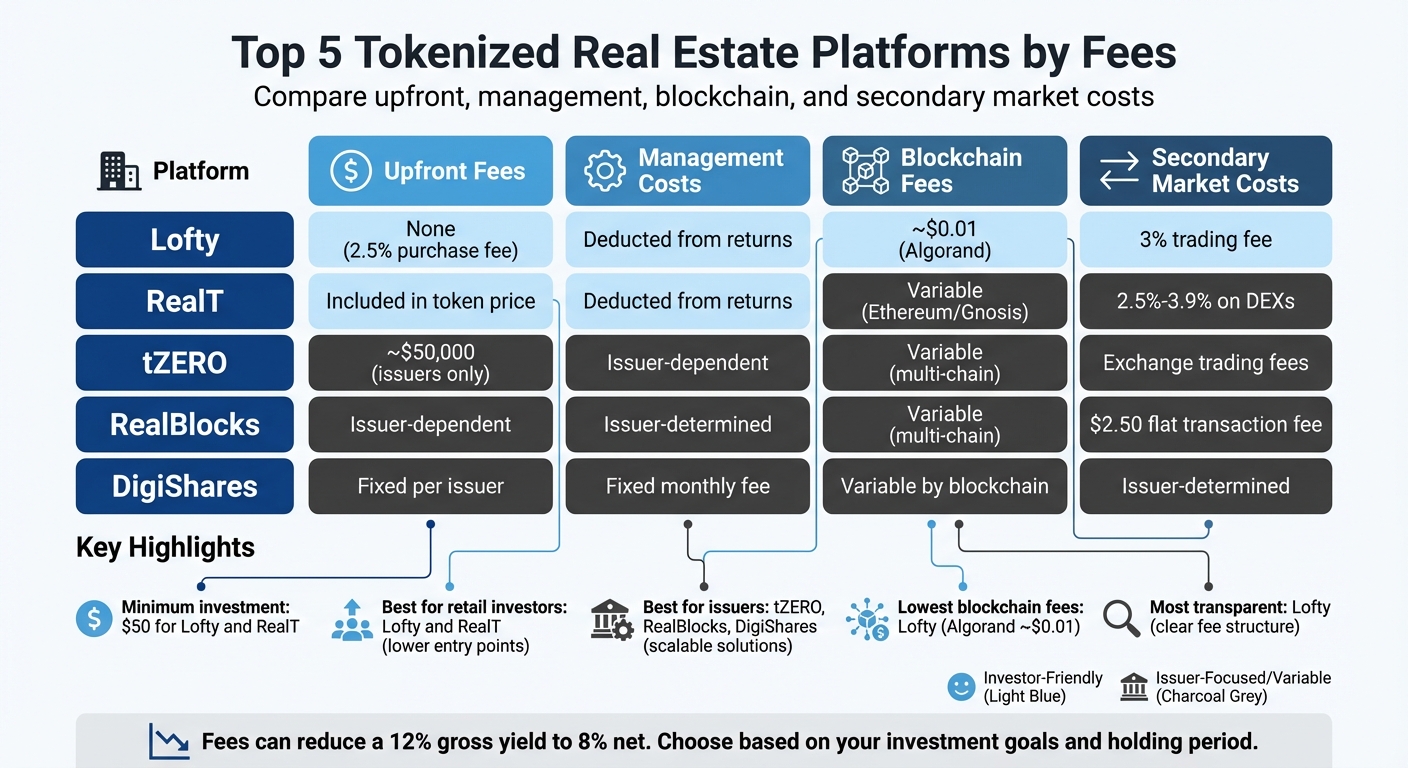
Tokenized Real Estate Platform Fee Comparison: Lofty vs RealT vs tZERO vs RealBlocks vs DigiShares
$10 Trillion Is Going On-Chain: How Tokenized Real Estate Makes You a Landlord
Understanding Tokenized Real Estate Fees
When it comes to tokenized real estate, fees play a major role in shaping your returns. These costs, which include purchase, management, blockchain, and secondary market fees, all contribute to the overall financial picture for investors.
Purchase or tokenization fees are one-time expenses, typically ranging from 3% to 5% of the property’s price. These charges cover essential steps like legal work, property sourcing, and the closing process.
Management fees are recurring annual costs tied to property oversight. They generally fall between 1.5% and 2% of the property's value each year or 8% to 15% of rental income. These fees are usually deducted directly from your rental yield distributions.
Reserve funding is another key component. Platforms typically set aside 2% of the property price for vacancy reserves and 5% for maintenance. If these reserves dip below their required levels, part of your rental income may be withheld to replenish them. As Tangible explains in their documentation:
Should the reserve capital fall below 5% of the property valuation, a recurring 20% of rental yield will be held back until the maintenance reserve is replenished.
Blockchain or gas fees are tied to network transactions. For example, Solana fees are approximately $0.00025 per transaction, while Ethereum Layer-2 fees range from $0.05 to $0.30.
Secondary market fees apply to token trades and typically range from 2.5% to 3.9% of the transaction value.
| Fee Category | Typical Payer | Structure | Purpose |
|---|---|---|---|
| Purchase/Tokenization | Buyer | 3%–5% of the property price | Covers legal, closing, and sourcing costs |
| Management | Investor | 1.5%–2% of property value (annual) or 8%–15% of rental income | Covers property oversight and operations |
| Blockchain (Gas) | Investor | Variable ($0.00025–$0.30) | Covers network transaction costs |
| Secondary Market | Buyer/Seller | 2.5%–3.9% of trade value | Platform fee for trading tokens |
| Maintenance Reserve | Buyer/Investor | 5% of the purchase price | Set aside for major repairs and unexpected costs |
| Vacancy Reserve | Buyer/Investor | 2% of the purchase price | Provides a buffer during tenant turnover |
1. Lofty
Lofty uses Algorand and ERC-20 tokens to break single-family rentals into smaller, affordable investment units, with tokens starting at just $50. This low-cost entry point allows investors to build a diverse real estate portfolio without needing a large amount of capital. Let’s dive into how Lofty’s fee structure aligns with its goal of making real estate investing more accessible.
Upfront Fees
When buying tokens on Lofty, you won’t encounter any extra tokenization fees beyond the token price itself. With token prices starting at $50, this straightforward pricing makes it easier for investors to get started. Plus, the platform accepts a variety of payment methods, giving you flexibility in funding your investments.
Ongoing Management and Platform Fees
Lofty simplifies property management by distributing rental income daily in USDC stablecoins through automated smart contracts. These smart contracts handle tasks like income distribution, while professional property managers take care of the day-to-day operations. As a token holder, you remain an active investor with full voting rights on all property management decisions. This streamlined system can reduce transaction costs by up to 30% compared to traditional real estate models, showcasing how Lofty combines low fees with advanced technology.
Blockchain and Transaction Fees
Lofty keeps transaction costs minimal by leveraging Algorand’s blockchain. The platform’s operations benefit from Algorand’s low-cost infrastructure, while smart contracts - audited by CertiK - ensure secure and efficient execution.
Liquidity and Secondary Market Costs
If you choose to trade tokens on Lofty’s marketplace, a 3% fee applies to both buy and sell orders. Transactions are carried out in USDC using a limit order system. Payments and tokens are held in escrow by a smart contract until a match is found. If you place a sell order, you’ll continue to receive rental income until the sale is finalized. To participate in trading, you’ll need a Lofty Verification NFT, which is automatically issued to users with Lofty Wallets.
2. RealT
RealT operates on the Gnosis Chain (previously known as xDAI) and has fractionalized approximately $100 million worth of U.S. real estate. With investment opportunities starting at just $50, it provides an accessible entry point for fractional property ownership. The platform incorporates fees at every stage of the investment process.
Upfront Fees
RealT doesn’t openly share specific percentages for upfront fees in its platform overviews. Instead, the token price you see reflects your cost to enter the fractional ownership. The platform employs location-restricted smart contracts, ensuring that only KYC-verified investors in eligible regions can hold tokens. Important to note: RealT is currently unavailable to U.S. citizens or residents. After this initial entry, an ongoing fee structure kicks in, which impacts your overall returns.
Ongoing Management and Platform Fees
RealT provides performance results that already account for all fees, costs, and expenses. As stated by RealT:
Performance results are shown net of all fees, costs, and expenses associated with the token.
This means the rental yields displayed on the platform are net figures - management fees, property costs, and platform expenses have already been deducted. Rental income is distributed weekly, either in stablecoins, interest-bearing tokens, or through automatic reinvestment. Investors benefit from two main sources of returns: regular rental payments throughout the year and property value appreciation, which is evaluated through annual reappraisals.
Liquidity and Secondary Market Costs
For investors looking to redeem their tokens, additional processing fees may apply. Most secondary market transactions are facilitated through platforms like YAM. RealT explains:
Should an investor choose to redeem a token through RealT, or on a secondary market, other processing fees may be assessed that are not factored into the returns presented.
To streamline asset management and interactions with decentralized finance tools, RealT offers its own RealToken Wallet. This wallet integrates with protocols like the RealT Market Maker (RMM), simplifying the process for investors.
3. tZERO
tZERO is one of only two SEC-registered digital custody special-purpose broker-dealers in the U.S. authorized to handle tokenized securities. Supported by ICE, tZERO offers a comprehensive infrastructure for issuing and trading tokenized real estate. Unlike platforms that focus on direct property management, tZERO operates as a regulated Alternative Trading System (ATS), which shapes its operational and fee structure.
Upfront Fees
For asset issuers, tZERO's upfront costs include investor onboarding and KYC/AML verification. These services are handled through its subsidiary, VerifyInvestor.com, though the platform doesn’t publicly disclose per-investor pricing. Industry estimates suggest that first-time tokenization costs hover around $50,000, covering aspects like regulatory compliance, technology integration, token creation, and asset valuation.
Ongoing Management and Platform Fees
Since tZERO is a trading infrastructure rather than a property management service, ongoing management fees are determined by asset issuers or property managers, not by tZERO. The platform’s $TZERO utility token acts as the backbone for transactions and incentives within its tZERO Chain, making transaction-based fees the main cost for users. Investors access tokenized assets through FINRA- and SEC-regulated intermediaries, which may involve additional brokerage-related charges.
Blockchain and Transaction Fees
tZERO supports on-chain custody and settlement, enabling users to transact using self-hosted wallets directly on the blockchain. The platform is multi-chain, working with networks like Stellar, XDC, and Algorand, each carrying its own network fees. When transactions are conducted on-chain with self-hosted wallets, users are responsible for covering these blockchain fees.
Liquidity and Secondary Market Costs
tZERO provides three main liquidity options: a Central Limit Order Book (CLOB) for continuous trading, auction events, and block trading. As a regulated broker-dealer and ATS, tZERO charges transaction-based fees for secondary market trading, though specific commission rates aren’t publicly outlined. Recently, the platform expanded to include 24/7 order entry and extended ATS trading hours, further improving liquidity options for investors.
sbb-itb-a24235f
4. RealBlocks
RealBlocks serves as a white-label tokenization platform tailored for real estate sponsors and fund managers. Instead of directly offering properties to retail investors, it provides the tools and infrastructure for issuers to create and manage tokenized real estate projects. This approach also shapes how fees are structured.
Upfront Fees
With RealBlocks, the initial costs fall largely on asset issuers rather than individual investors. Real estate sponsors handle expenses like legal structuring, regulatory compliance, and setting up the platform. While custom tokenization options come with higher costs, they also offer greater flexibility. For investors, any upfront fees are determined by the specific deal structure set by the project sponsor. This issuer-focused model establishes the groundwork for other ongoing and transaction-related costs.
Ongoing Management and Platform Fees
As a platform provider, RealBlocks operates under agreements with issuers, which influence the fees investors encounter. These include recurring charges such as a quarterly fee based on the asset's value (AUM fee) and a monthly management fee taken from rental income.
Blockchain and Transaction Fees
By leveraging blockchain technology, RealBlocks can significantly lower transaction costs, cutting out intermediaries and reducing fees by as much as 30% compared to traditional methods. For buy or sell orders, the platform charges a flat $2.50 fee to cover processing and maintenance.
5. DigiShares
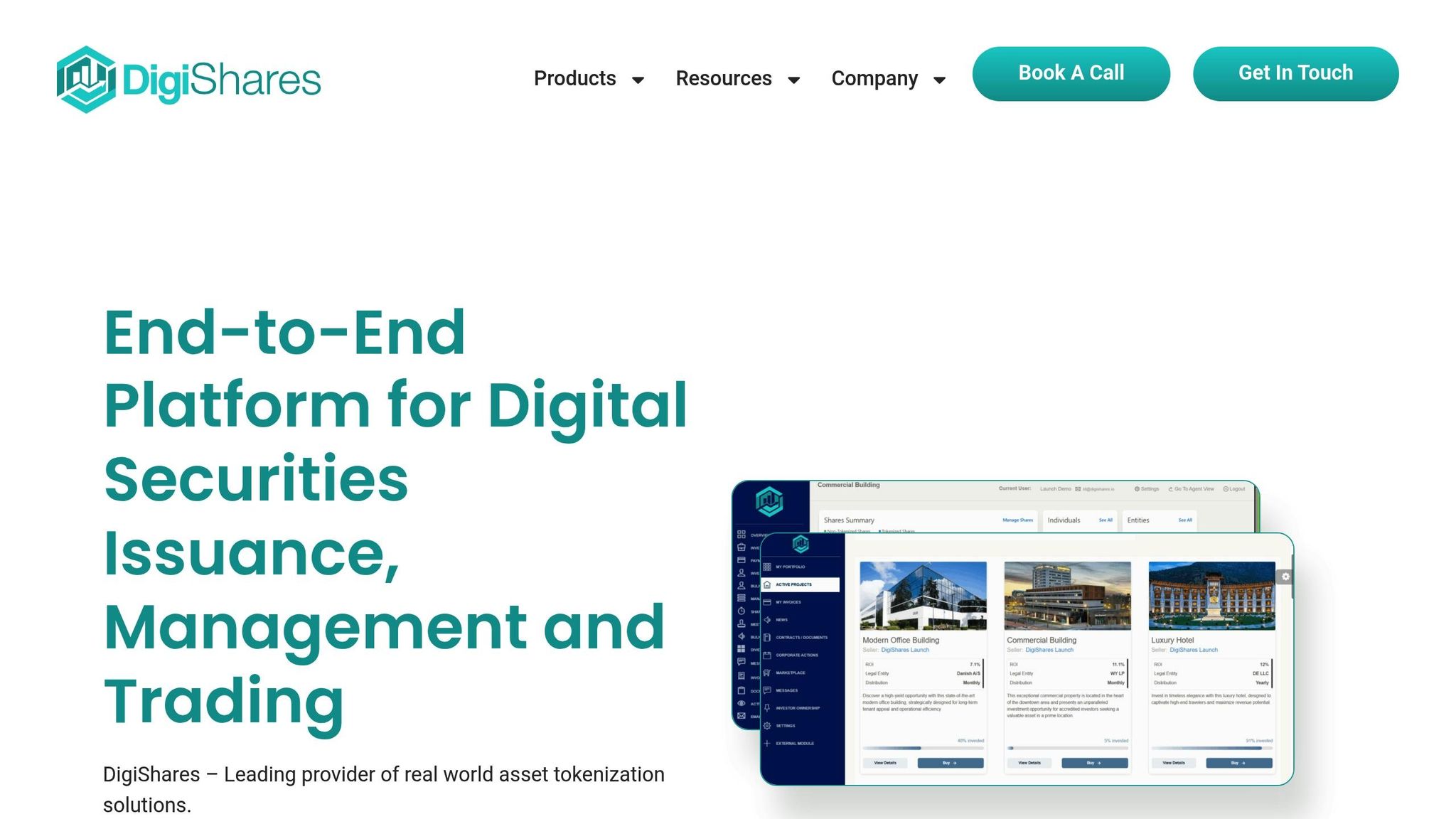
DigiShares serves as a white-label tokenization platform specifically designed for real estate issuers and fund managers. It allows sponsors to create their own tokenized offerings, offering a predictable fee structure that stands apart from the percentage-based models many competitors use.
Upfront Fees
DigiShares employs a fixed fee model for onboarding, avoiding percentage-based charges. These upfront costs cover essential elements like platform setup, KYC/AML integration, smart contract deployment, and e-signature functionality. For example, in December 2025, LandInvest.io launched its $PRPTY token using DigiShares’ platform. The platform supports multiple blockchains, including Ethereum, Polygon, Binance Smart Chain, Fantom, and Polymesh, giving issuers the freedom to select the network that best suits their needs.
Ongoing Management and Platform Fees
DigiShares takes a straightforward approach to ongoing costs by charging a fixed monthly fee. Unlike many competitors that base fees on assets under management or funds raised, DigiShares relies on a flat-fee model. To cater to various issuer needs, the platform offers three product tiers: Launch (an affordable SaaS option), Standard (a customizable white-label solution), and Advanced (providing full API access for marketplaces).
Blockchain and Transaction Fees
One of DigiShares’ standout features is its zero transaction fees on the primary platform, which differentiates it from many other tokenization providers. However, users are still responsible for gas fees tied to their chosen blockchain, such as Ethereum or Polygon. For regions where cryptocurrency use is restricted, the platform can operate off-chain via internal master wallets, potentially eliminating blockchain transaction costs for users.
Liquidity and Secondary Market Costs
DigiShares partners with RealEstate.Exchange (RE.X) for secondary trading, where listing and trading fees apply. Additionally, the platform offers a bulletin board for peer-to-peer trades using atomic swaps, ensuring secure and efficient settlements. Highlighting the platform’s value, Claus Skaaning, CEO of DigiShares, explains:
Our clients tokenize their real estate for three reasons: digitization and automation of processes, fractionalization to reach new types of investors, and the massively increased liquidity.
Fee Comparison Table
The table below highlights the key fees associated with different platforms, helping you better understand the costs involved in tokenized real estate investments.
| Platform | Upfront Fees | Management and asset costs | Blockchain Fees | Secondary Market Costs |
|---|---|---|---|---|
| Lofty | 2.5% purchase fee | No ongoing platform fees | ~$0.01 per transfer (Algorand) | 2.5% sales fee |
| RealT | Undisclosed | No ongoing platform fees | Variable gas fees (Ethereum/Gnosis) | 2.5%–3.9% on DEXs |
| tZERO | Varies by offering | Issuer-dependent | Variable Ethereum fees | Exchange trading fees apply |
| RealBlocks | Issuer-dependent | Issuer-dependent | Variable (multi-chain) | Issuer-determined fees |
| DigiShares | Varies by issuer | Varies by issuer | Varies based on blockchain fees | Varies by issuer |
In addition to these core fees, other expenses like payment processing and network-specific charges can also impact your total costs.
For example, payment methods can add extra fees. If you use a card to purchase through Lofty, you'll face an additional 2.9% plus $0.30 for U.S. transactions or 3.9% plus $0.30 for international ones, on top of the standard 2.5% purchase fee.
Blockchain network costs also play a role. Lofty’s transfers on Algorand are inexpensive, costing approximately $0.01 per transfer. On the other hand, Ethereum and Gnosis fees, used by platforms like RealT, fluctuate based on network congestion.
Transparency around fees varies significantly. Lofty clearly outlines its 2.5% trading fee for both buying and selling, while RealT does not disclose its upfront fees. DigiShares’ fees are determined by the issuer, adding another layer of variability.
With this information, you’re better equipped to evaluate the cost factors when exploring tokenized real estate platforms.
Conclusion
Fee structures are a key factor in shaping the actual returns you can expect from tokenized real estate investments. For instance, a 12% gross yield might shrink to just 8% net after accounting for fees. Opting for platforms with lower fees can make a noticeable difference in your profitability, especially when compared to high-fee alternatives. This highlights the importance of aligning your platform choice with your investment goals and timeline.
Your holding period plays a crucial role in this decision. For long-term investors, a one-time fee of 3% may be negligible compared to ongoing management fees that could range from 8% to 15% of rental income. On the other hand, short-term traders should focus on platforms with low transaction fees, as frequent buying and selling can quickly chip away at returns.
Paying attention to funding methods is equally important. For example, on Lofty, credit card fees range from 2.9% to 3.9%, significantly higher than blockchain transfer fees, which are about $0.01. On a $1,000 investment, credit card fees could cost over $54, while blockchain transfers would total roughly $25 - a substantial difference.
Another advantage of Lofty is its low $50 minimum investment, allowing you to spread your capital across multiple properties instead of concentrating it in a single asset. To maximize your returns, calculate your net income after all fees, consider your investment timeline, and choose the most cost-efficient funding method that aligns with your strategy.
FAQs
How do blockchain fees affect my returns in tokenized real estate investments?
Blockchain fees, like gas costs, are the small charges required to process transactions on the blockchain. When it comes to tokenized real estate, these fees tend to be quite low. Why? Because the process eliminates intermediaries and simplifies transactions, cutting down on unnecessary overhead.
This streamlined approach not only minimizes fees but also helps improve your overall returns. By reducing traditional costs, tokenization often provides better net returns compared to standard real estate investing, making it a more efficient way to grow your wealth.
What should I look for when choosing a tokenized real estate platform?
When choosing a tokenized real estate platform, it's important to start by examining the fee structure. Look for platforms that are upfront about costs like listing fees, transaction fees, and trading commissions. High or hidden fees can eat into your returns, so aim for one that offers clear and competitive pricing.
You’ll also want to think about accessibility and liquidity. Platforms with low minimum investment requirements make it easier to dip your toes into the market, while those with a secondary marketplace let you buy or sell tokens more easily, giving you added flexibility. Many platforms leveraging blockchain technology also deliver faster transactions, secure ownership records, and automated rental income distributions, which can be a major plus.
Finally, don't overlook security and compliance. A trustworthy platform should adhere to strict regulations, perform thorough identity checks, and ensure secure storage of your tokens. Take the time to understand how rental income is distributed and be aware of potential risks, such as regulatory hurdles, to ensure the platform aligns with your financial goals.
What is fractional ownership in tokenized real estate?
Fractional ownership in tokenized real estate lets investors buy small, digital shares of a physical property instead of purchasing the entire asset. Typically, the property is placed under a legal entity, like an LLC, and its equity or income rights are divided into blockchain-based tokens. Each token represents a proportional share of ownership and cash flow, providing investors with a secure and transparent way to invest in real estate.
Platforms like Lofty make it easy to get started, allowing investments as low as $50, with daily rental income sent directly to your digital wallet. Plus, tokens can be sold on a secondary marketplace, offering liquidity similar to stocks or cryptocurrencies. This method breaks down traditional barriers to real estate ownership, making it more accessible. It also removes the hassle of property management while letting investors enjoy both rental income and potential property value growth.
Lofty Editorial