Lofty Editorial
Tokenized Real Estate vs Traditional: Key Differences
Tokenized real estate is reshaping property investment by using blockchain to enable fractional ownership, starting as low as $50. This approach contrasts sharply with traditional real estate, which typically requires significant upfront capital, often $20,000 or more. Key differences include:
- Accessibility: Tokenization lowers the entry barrier, allowing global participation with minimal investment.
- Liquidity: Unlike traditional real estate, which is illiquid and involves lengthy sale processes, tokenized assets can be traded 24/7 with near-instant settlement.
- Control & Governance: Traditional ownership offers full control, while tokenization provides proportional voting rights based on token holdings.
- Transparency: Blockchain ensures real-time, tamper-proof records, compared to traditional systems that rely on slower, paper-based processes.
- Management Style: Traditional real estate often requires active involvement, while tokenized assets are managed passively through platforms.
Quick Comparison
| Factor | Traditional Real Estate | Tokenized Real Estate |
|---|---|---|
| Minimum Investment | $20,000+ | $50–$100 |
| Investor Eligibility | Often limited to accredited investors | Open to global and non-accredited investors |
| Liquidity | Low (illiquid) | High (24/7 trading on secondary markets) |
| Settlement Speed | Weeks to months | Minutes (blockchain-based) |
| Ownership Structure | Direct deed or centralized LLC | Fractional tokens tied to an LLC or SPV |
| Transparency | Periodic disclosures | Real-time blockchain records |
| Management | Active (hands-on) | Passive (platform-managed) |
Tokenization offers a more flexible, accessible, and efficient way to invest in real estate, while traditional methods cater to those seeking direct control and long-term stability. Your choice depends on your financial goals and how involved you want to be.
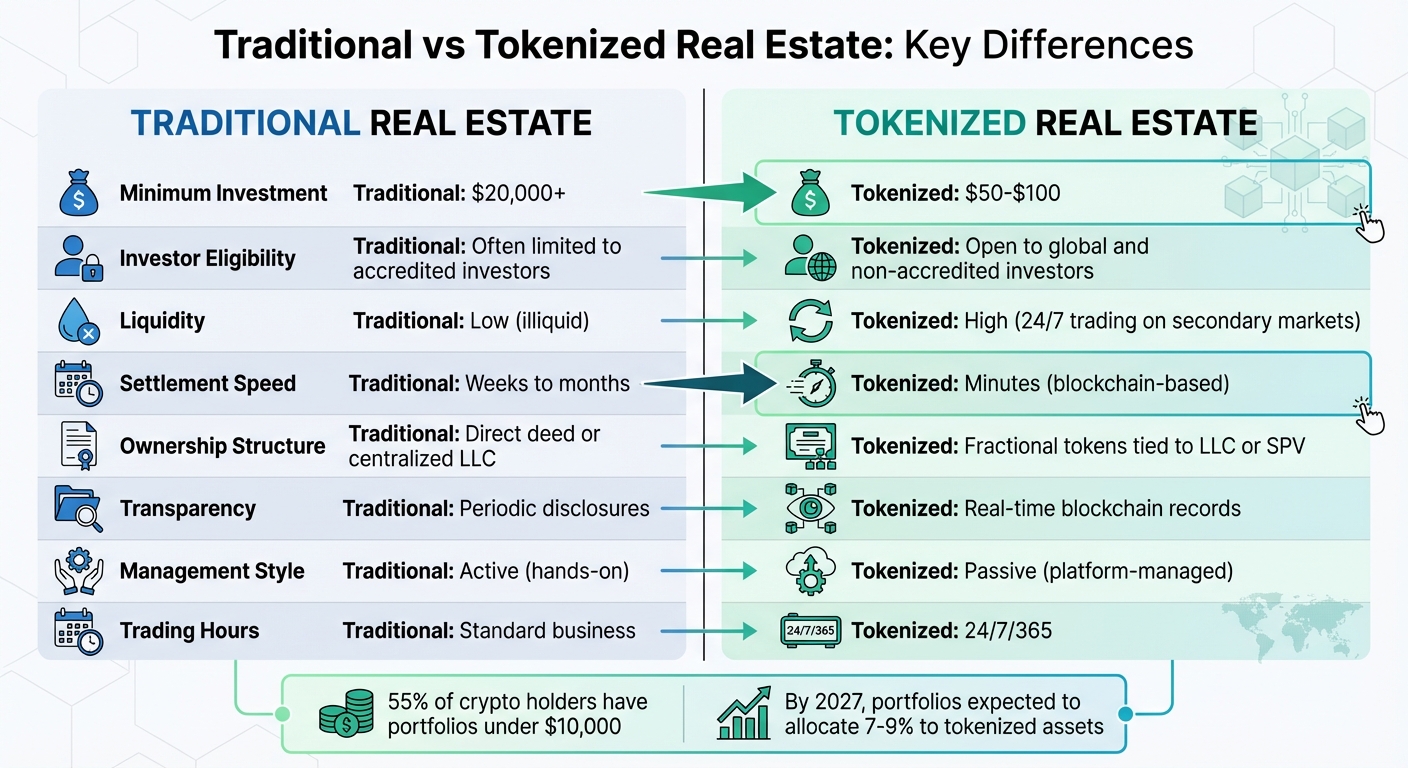
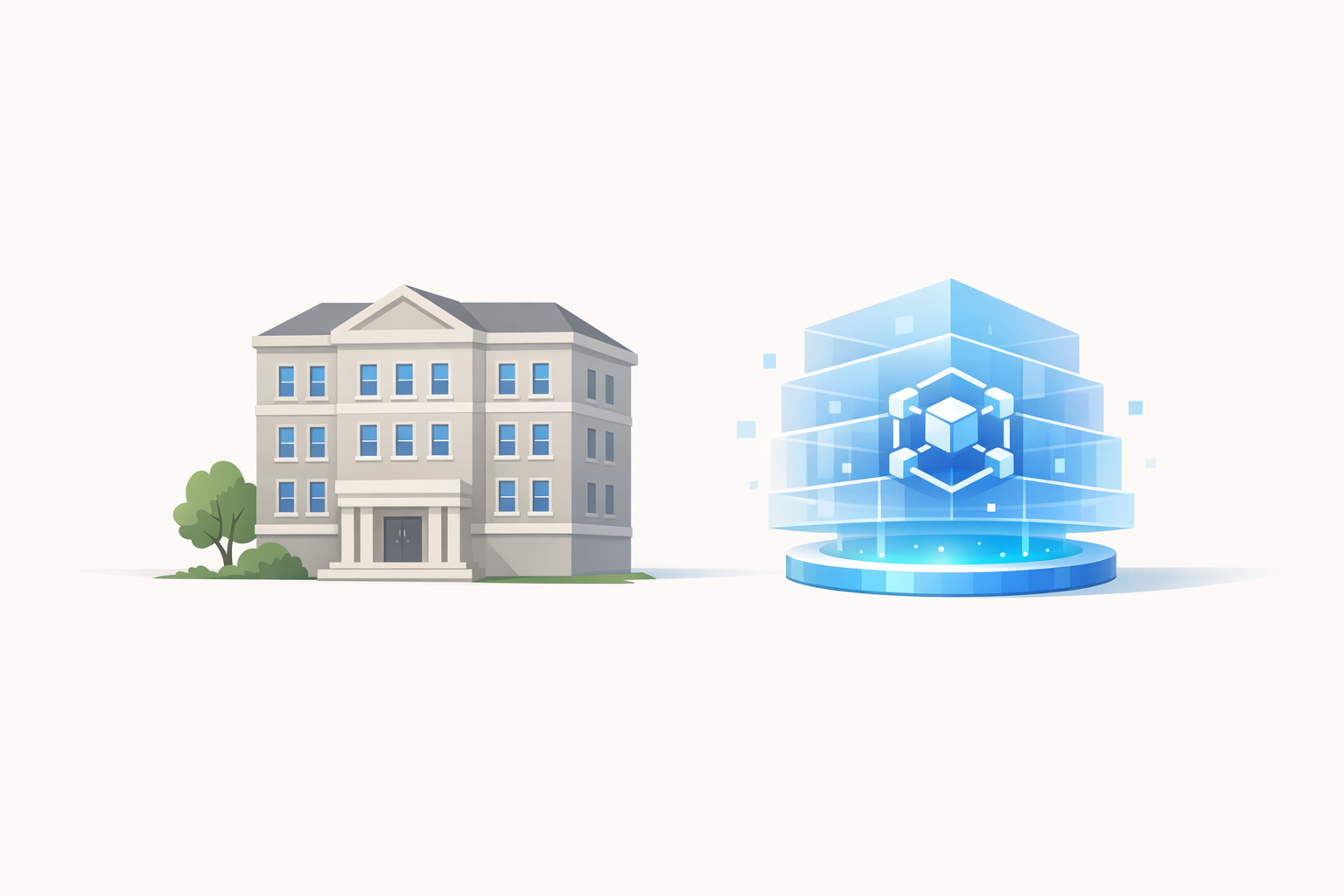
Traditional vs Tokenized Real Estate: Side-by-Side Comparison of Key Investment Factors
Tokenized Real Estate: The Future of Investing Explained | The Core Report #tokenizedrealestate
sbb-itb-a24235f
Side-by-Side Comparison Table
Here’s a breakdown of how traditional real estate stacks up against tokenized real estate across key factors:
| Factor | Traditional Real Estate | Tokenized Real Estate |
|---|---|---|
| Minimum Investment | $20,000+ (typically 20% down payment) | $50–$100 |
| Investor Eligibility | Often limited to accredited or local investors | Open to non-accredited and global investors |
| Trading Hours | Standard business hours | 24/7/365 |
| Settlement Speed | Weeks to months | Minutes (on-chain settlement) |
| Liquidity Level | Very low (illiquid) | High potential (secondary marketplaces) |
| Ownership Structure | Direct deed or centralized LLC | Fractional ownership via DAO LLC tokens |
| Control & Governance | Centralized (owner or general partner) | Decentralized (pro-rata voting rights) |
| Management Style | Active (requires property oversight) | Passive (handled by platform/smart contracts) |
| Transparency | Periodic disclosures and manual reporting | Real-time, immutable blockchain records |
| Geographic Access | Requires local presence or extensive travel | Accessible to anyone with an internet connection |
| Payment Options | Bank financing, wire transfers | Crypto (USDC), credit card, ACH |
One of the standout differences is accessibility. Traditional real estate often demands a hefty upfront investment - typically upwards of $20,000. In contrast, tokenized platforms lower the barrier to entry, allowing investments as small as $50. This opens the door for a broader audience, especially considering that 55% of crypto holders have portfolios under $10,000.
Another major advantage lies in transaction speed. Traditional property deals can drag on for weeks, while tokenized transactions are completed in minutes, thanks to smart contracts. As Lofty explains:
"For the first time in the world, you can now directly buy and sell legal ownership in a specific property with the same speed and user experience as buying AAPL or TSLA on Robinhood."
When it comes to control, tokenized real estate takes a more democratic approach. Voting rights are distributed proportionally among all token holders, no matter how small their stake. Even a $50 token gives investors a say in critical decisions like property management or refinancing. Platforms like Lofty ensure fairness by requiring a 60% supermajority vote for major decisions, preventing any single party from dominating the process.
Ownership and Control
When you buy traditional real estate, you get the deed, which gives you full authority over the property. This means you call the shots - everything from choosing tenants to making major renovations is in your hands. You can hire a property manager, refinance whenever it suits you, or sell the property outright without needing anyone's approval. It's a straightforward system where you maintain complete control.
Tokenized ownership, however, works differently. Instead of holding a physical deed, you own digital tokens that represent a fractional interest in an LLC that owns the property. These tokens signify your share of ownership. Daily operations are handled by professional property managers, and your influence on decisions is tied to the number of tokens you hold, giving you proportional voting power.
This approach is gaining traction. For example, in September 2025, Brandon Frans, an investor from Omaha, used tokenization to diversify his portfolio across Texas, Florida, and Arizona. Instead of traveling to inspect properties or dealing with late-night maintenance issues, he managed everything through a digital platform. With just a few clicks, he could monitor his investments and vote on key property decisions. As Frans put it:
"It's given us more control of our time and, most importantly, control over our future destiny."
While traditional ownership requires hands-on involvement, tokenized ownership offers a more passive experience, combining shared decision-making with professional management.
Liquidity and Investment Timeline
One of the standout differences between traditional and tokenized real estate lies in how quickly investors can access their funds. Traditional real estate is known for being illiquid; once you invest in a property or a private syndication, your money is usually tied up for years. You’re often at the mercy of the sponsor’s decision to sell the asset. For instance, residential real estate transactions typically take about 50 days from the initial offer to closing. If you need to exit early, you might have to sell at a discount, potentially below market value.
Tokenized real estate flips this script by offering far quicker access to liquidity. Instead of waiting months for a sale to process, you can list your tokens on a secondary marketplace and complete transactions in mere minutes. These platforms operate around the clock, unlike traditional markets that are limited to standard business hours. Plus, tokenization allows for fractional sales - you can sell just 0.5 tokens if needed - without having to offload your entire position.
The growth of the real estate token market reflects this shift. Market capitalization climbed from $65 million in June 2021 to $194 million by May 2022. Looking ahead, tokenized assets in real estate portfolios are expected to grow significantly, with projections estimating an increase from 1.3% to 6.0% by 2027. A noteworthy milestone occurred in mid-2025 when the Dubai Land Department facilitated the tokenized sale of two luxury properties. These properties sold out in minutes to buyers from over 35 countries, 70% of whom were first-time investors in real estate.
This rapid evolution of tokenized markets is reshaping the landscape. Mark Cianci, Counsel at Ropes & Gray, summed up this transformation by stating:
"Tokenized transactions of any size can be executed directly between verified buyers and sellers on digital marketplaces with nearly instantaneous settlement and negligible fees".
If you’re considering tokenized real estate, start by ensuring the platform has an active secondary market with visible trading activity. It’s wise to test the waters with a small purchase to evaluate the resale process and market depth. Also, take the time to review the terms of the smart contract. Some issuers may temporarily pause token transfers during legal disputes or significant renovations. Platforms like Lofty (https://lofty.ai) showcase how these innovations are being applied, offering investors greater liquidity and more flexible exit strategies through fractional ownership. This shift underscores how tokenization is reshaping real estate investment.
Accessibility and Minimum Investment
When it comes to tokenized real estate, accessibility is a game-changer compared to traditional investment methods. Typically, entering the real estate market requires significant upfront capital - anywhere from $50,000 to over $300,000, even when factoring in mortgage down payments.
Tokenization flips this model by enabling fractional ownership. Properties are divided into digital tokens on the blockchain, allowing investors to participate with as little as $50 to $100. While some platforms set minimum investments at around $1,000, these amounts are still far lower than the hefty sums needed in traditional real estate. In fact, 63% of surveyed investors expressed interest in tokenized real estate - even without voting rights - if it meant lower entry costs. This shift in accessibility opens the door for a broader range of investors.
Real-world examples highlight this advantage. For instance, a Dallas apartment complex successfully raised $6.5 million through tokenization, MAG Group tokenized $500 million worth of Dubai real estate, and Blockimmo facilitated cross-border investments in Switzerland - all by leveraging fractional ownership. These cases show how tokenization allows everyday investors to access premium markets once reserved for the wealthy.
Another benefit? Tokenization slashes additional costs. By automating processes, it reduces expenses tied to brokers, legal services, and administrative fees. Carlos Domingo, CEO of Securitize, summed it up perfectly:
"Tokenization unlocks real estate for millions previously priced out."
For many crypto holders managing balances under $10,000, tokenized real estate offers a way to diversify portfolios without requiring large sums. Platforms like Lofty make it possible to own fractional shares of U.S. rental properties without needing extensive expertise or large down payments. This ease of access not only levels the playing field but also aligns with the improved liquidity and streamlined transactions that tokenization brings to the table.
Transparency and Risk
Traditional real estate operates on a system of paper records and scattered databases, which often require third-party verifiers to process transactions. This outdated approach is not only slow - sometimes dragging on for weeks or even months - but also prone to errors and fraud. In fact, in 2021, global real estate money laundering was estimated to reach a staggering $1.6 trillion.
Tokenized real estate, however, changes the game by leveraging blockchain technology. Blockchain’s immutable ledger ensures that every transaction is permanently time-stamped and stored on a single, public record. Mark Cianci, Counsel at Ropes & Gray, highlights the impact of this shift:
"Increased access to data on a blockchain can significantly reduce information asymmetry between investors and fund managers by creating a single, 'tamper-resistant' source of information."
This level of transparency has already led to impressive advancements in efficiency and trust. For instance, in June 2025, Bergen County, New Jersey, collaborated with Balcony to transfer 370,000 deeds - representing $240 billion in property value - onto the Avalanche blockchain. This move not only slashed deed processing times but also boosted public confidence in the system. Similarly, Figure Technologies has utilized blockchain to originate more than $13 billion in home equity lines of credit. By doing so, they reduced the reporting time for mortgage-backed securities from 55 days to just 30 minutes.
Despite these advantages, tokenization is not without its challenges. Risks such as smart contract coding errors and platform hacks remain a concern. In 2023 alone, hackers stole approximately $1.70 billion from cryptocurrency platforms. Moreover, many jurisdictions have yet to recognize digital tokens as legally binding proof of ownership, which could lead to disputes between token holders and traditional deed holders. To mitigate these risks, investors should ensure that platforms use thoroughly audited smart contracts and structure property ownership through Special Purpose Vehicles (SPVs) to align blockchain records with enforceable legal rights.
Returns and Diversification
Traditional real estate offers returns primarily through two channels: monthly rental income and long-term property appreciation. However, it often comes with a significant barrier - the need for large down payments. This locks up substantial capital in a single market, making it difficult to adjust or rebalance investments during economic downturns.
Tokenized real estate, on the other hand, is changing the game when it comes to income generation and diversification. By enabling fractional ownership, tokenization lets investors spread their capital across multiple properties and asset types. For instance, with just $5,000, an investor could own stakes in a multifamily property in Texas, retail space in Florida, and a student-housing project in Arizona. This contrasts sharply with the traditional model, where such diversification would be nearly impossible. Additionally, smart contracts streamline the process by automating rent distributions, sending payments directly to token holders on a set schedule - no more drowning in paperwork.
The benefits don’t stop there. Tokenization allows for quick exposure to multiple markets with near-instant settlement times, giving investors unparalleled flexibility and agility in managing their portfolios.
Beyond traditional income sources, tokenized real estate opens up entirely new ways to generate revenue. Investors can leverage their tokens within decentralized finance (DeFi) platforms, using them for staking or as collateral for loans. This means a single investment can produce multiple income streams. The infrastructure enabling these opportunities is supported by the combined DeFi and stablecoin market, which has grown to around $350 billion. One standout example is the $USH token introduced by Manifest in April 2025. This blockchain-based vehicle combines equity investments across various assets, including home equity, into a single package. Nathaniel Sokoll-Ward, Manifest’s Co-founder and CEO, highlighted the innovation:
"This is the first time this level of diversified U.S. real estate exposure can be packaged into a permissionless... structure with yield profiles that far exceed traditional REITs or real estate ETFs."
Tokenized real estate also revolutionizes how investors realize property appreciation. Unlike traditional real estate, which often requires lengthy sale processes and incurs hefty transaction costs, tokenized assets can be traded continuously on secondary markets. This 24/7 liquidity allows investors to capture appreciation gains almost immediately by selling tokens at current market prices. They can then swiftly reinvest that capital into new opportunities. This kind of flexibility and speed is nearly impossible to achieve with physical real estate .
Conclusion
Deciding between tokenized and traditional real estate depends on your investment goals, timeline, and comfort with technology. Tokenized real estate has reshaped how investors approach property ownership. It allows for building diversified portfolios across multiple properties without requiring large upfront capital. Plus, the ability to trade assets 24/7 on secondary markets has introduced a level of liquidity that traditional real estate simply can't match.
That said, traditional real estate remains a solid choice for those who value direct control over physical properties and the stability of a well-established regulatory framework. Investors who prefer negotiating custom terms, leveraging tax strategies like 1031 exchanges, or taking a hands-on approach to property management often gravitate toward this model. These advantages continue to appeal to long-term, risk-averse investors.
The numbers tell an interesting story about the market's evolution. Today, 56% of institutional investors rank real estate as a leading tokenized alternative asset. By 2027, investor portfolios are expected to allocate between 7% and 9% to tokenized assets. Additionally, 58% of high-net-worth investors highlight lower transaction costs as a key reason for exploring tokenized real estate.
This shift has fueled the rise of innovative platforms. For example, platforms like Lofty provide new investors with an accessible entry point, offering fractional ownership opportunities for as little as $50 to $100. These platforms enable people to own shares in rental properties across the U.S., trade instantly, and earn rental income - all without needing extensive real estate expertise.
Ultimately, both tokenized and traditional real estate offer distinct benefits. The right choice depends on your financial goals and how involved you want to be in managing your investments.
FAQs
How does tokenized real estate offer better liquidity than traditional real estate?
Tokenized real estate offers a game-changing level of liquidity by letting investors trade fractional ownership of properties almost instantly on blockchain platforms. Unlike the drawn-out and costly procedures of traditional real estate transactions, tokenization simplifies the entire process, allowing for faster and more flexible exchanges.
By cutting out many of the hurdles tied to conventional property sales - like months-long closings or intricate negotiations - this method makes it far easier for investors to access their money when they need it.
What risks should I consider before investing in tokenized real estate?
Investing in tokenized real estate comes with its own set of risks, and understanding them is crucial before getting involved. One major concern is regulatory uncertainty. Since laws around blockchain-based tokens and property ownership are still in flux, changes in regulations could directly affect your investment.
Another important factor to consider is technology risk. For instance, vulnerabilities in smart contracts, potential blockchain security issues, or platform failures could result in losing ownership or funds. On top of that, there's liquidity risk - secondary markets for real estate tokens are still in their early stages, which means selling tokens quickly or at a fair price might not always be possible.
Lastly, market volatility can play a role. Token prices might fluctuate and sometimes stray from the actual value of the underlying property. These risks underline the need for careful research and a solid understanding before stepping into the world of tokenized real estate investments.
How does blockchain improve transparency in tokenized real estate investments?
Blockchain technology brings a new level of transparency to tokenized real estate by securely recording every transaction on an unchangeable, time-stamped ledger. This means participants can easily access real-time information about ownership, rent distributions, and transaction history, promoting clarity and accountability across the board.
Take platforms like Lofty, for example. They use blockchain to give investors instant access to detailed records of their property shares, streamlining the process and building trust in the system for everyone involved.
Lofty Editorial