Lofty Editorial
Smart Contracts and Metadata: How They Work Together
Smart contracts and metadata are transforming real estate by automating transactions and providing structured property data. Here's how they work:
- Smart Contracts: These are self-executing programs on blockchains that perform actions like transferring ownership or distributing rental income when conditions are met.
- Metadata: This is structured data about properties (e.g., square footage, purchase price, lease terms) that adds context for smart contracts to function accurately.
- Combined Impact: Together, they enable fractional ownership, automate rent distribution, and maintain transparent ownership records.
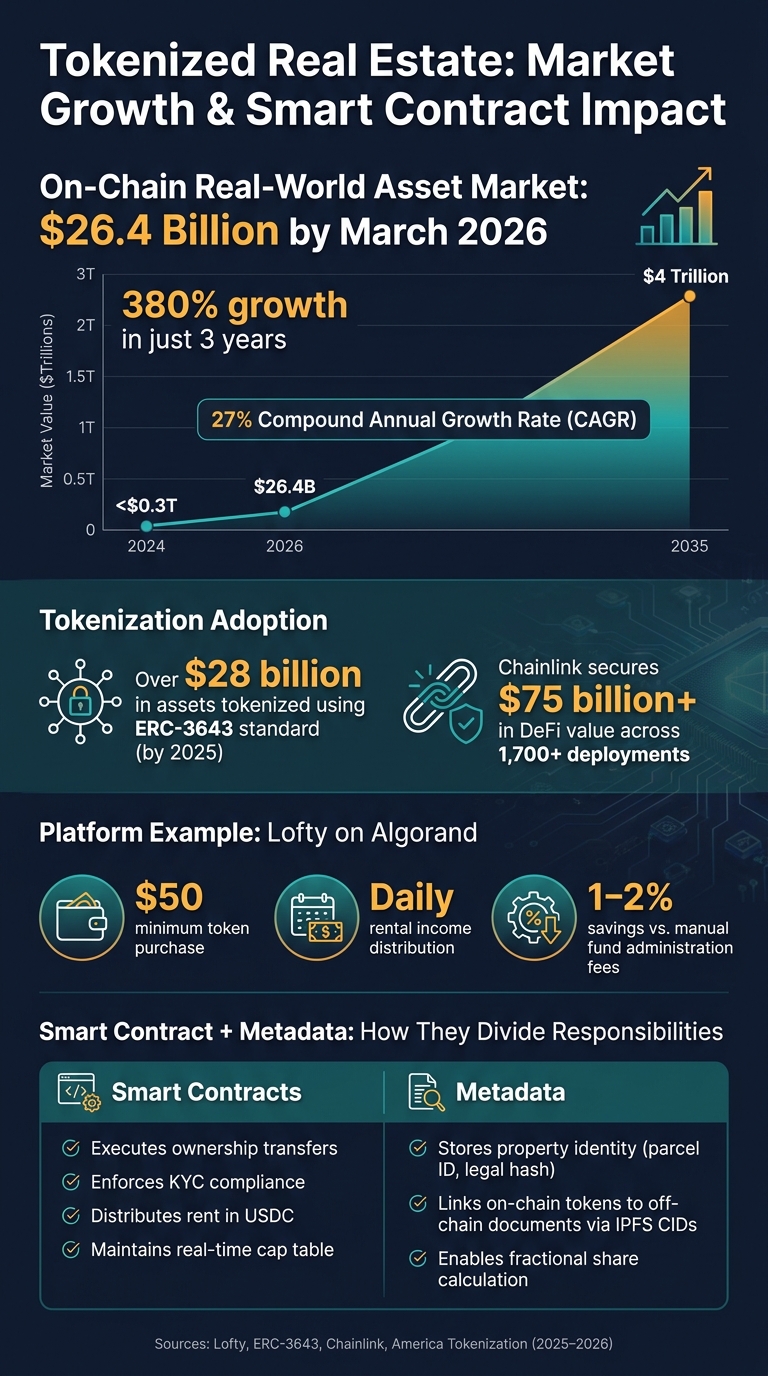
Platforms like Lofty use these technologies on the Algorand blockchain to tokenize properties, manage compliance, and distribute rental income daily. By March 2026, the on-chain asset market is projected to reach $26.4 billion, showcasing the growing adoption of these tools in real estate.
Tokenized Real Estate Market Growth: Key Stats & Projections
Smart Contracts and Metadata: Core Concepts
What Are Smart Contracts?
Smart contracts are self-executing programs on a blockchain that carry out specific actions once predefined conditions are met. These could include transferring ownership, verifying identities, or distributing rental income - all without the need for intermediaries.
Take Lofty as an example. Their smart contracts, built on the Algorand blockchain, require every trader to possess a "Verification NFT" before completing a peer-to-peer transaction. This ensures that every participant complies with Know Your Customer (KYC) regulations. Once compliance is verified, the contract executes the transaction instantly.
In addition to ensuring compliance, smart contracts maintain a real-time digital cap table, which provides an always-updated record of ownership. This automation eliminates the need for manual record-keeping, streamlining processes significantly.
What Is Metadata and Why Does It Matter?
Metadata is the backbone of smart contracts, offering vital context and structured information about a property. It includes details like the address, square footage, and year of construction, as well as legal identifiers such as parcel IDs and title deed hashes.
As Nadine Loepfe, Developer Advocate at Hashgraph, explains:
"The NFT acts as a digital title that can be transferred or traded, bridging the physical asset with the programmable world of smart contracts."
Key data points, such as ownership status and legal hashes, are stored directly on-chain for transparency. Larger files, like floor plans or inspection reports, are stored on decentralized systems like IPFS. The smart contract holds a Content Identifier (CID) to retrieve these files when needed.
To standardize property metadata, the ERC-6065 framework defines specific fields that link a digital token to its physical counterpart:
| Metadata Field (ERC-6065) | Description |
|---|---|
legalDescriptionOf |
Written description from the physical property deed |
geoJsonOf |
Geospatial coordinates in GeoJSON format |
parcelIdOf |
ID number used by local tax or land authorities |
operatingAgreementHashOf |
Immutable hash of the legal agreement detailing ownership rights |
legalOwnerOf |
The legal entity named on the verifiable physical deed |
This structured approach allows metadata to integrate seamlessly with smart contracts, enabling efficient and compliant real estate transactions.
How Smart Contracts and Metadata Work Together in Real Estate
When smart contracts and metadata come together, they form a powerful system for real estate transactions. Smart contracts handle the logic, while metadata provides the essential data. Neither can operate effectively without the other.
For instance, in fractional ownership transactions, the smart contract references metadata to confirm property details, ensure compliance, and calculate each investor's share. If rental income is involved, the contract uses metadata to determine ownership proportions and automatically distributes payments - often in stablecoins like USDC.
However, blockchains face a major limitation: they can't directly detect real-world changes. Events like a new appraisal, a rent payment, or construction updates don't automatically reach the smart contract. This is where oracles become essential. Oracles act as intermediaries, feeding real-world data into the blockchain so smart contracts can respond appropriately. This integration allows for dynamic, real-time property management.
Designing a Metadata Model for Property Smart Contracts
Defining a Property Metadata Schema
A metadata schema defines the structure for property-related data, specifying its fields, formats, and storage methods. For real estate smart contracts, this schema typically addresses four main categories:
- Identity and Ownership: Includes token IDs and wallet addresses.
- Physical Status: Covers details like location, condition, and insurance expiration.
- Financial Lifecycle: Tracks items such as dividend schedules and payment statuses.
- Compliance: Encompasses KYC flags and transfer restrictions.
Each field should be categorized as either static or dynamic. For instance, data like the year a property was built or its square footage remains constant and can be permanently locked. On the other hand, fields like occupancy status or rental yields need to be dynamic, allowing updates by authorized parties. Clearly distinguishing between these types from the outset helps avoid complications later.
"Real World Assets operate as a dual-state system, requiring a continuous, legally binding synchronization between an off-chain registry (the legal truth) and an on-chain smart contract (the computational truth)." - Junliang Luo et al., Researchers
Once the schema is defined, the next step is mapping it effectively to smart contract storage for optimal performance.
Mapping Metadata to Smart Contract Storage
To ensure efficiency, only essential data should be stored on-chain, while supplementary information can be kept off-chain. Here's how this division typically looks:
| Data Category | On-Chain | Off-Chain |
|---|---|---|
| Ownership | Token ID, wallet address, transfer restrictions | Legal title deeds, SPV agreements |
| Property Details | Location hash, status flags, IPFS CIDs | Floor plans, inspection reports, 3D models |
| Compliance | KYC whitelist flags, eligibility status | Sensitive ID documents, legal opinions |
| Financials | Dividend rate, distribution logs | Tenant lease terms, tax filings, expense receipts |
Off-chain files are linked using cryptographic hashes. These hashes ensure data integrity - if a document is altered, the hash changes, immediately signaling tampering.
A practical example of this approach is seen with Lofty, which uses the Algorand blockchain. Each property on the platform includes a "Documents" section that connects investors to off-chain due diligence materials, effectively linking on-chain investment records to real-world legal documentation.
Keeping On-Chain and Off-Chain Data Consistent
Once data is mapped, maintaining synchronization between on-chain and off-chain systems is critical. Unique identifiers, such as the property token ID, should be used as the primary key to link blockchain records with traditional databases. Immutable fields, like yearBuilt, should be locked to prevent unauthorized changes.
"The on-chain hash acts as an unchangeable seal; if someone alters the off-chain file, the hash no longer matches, instantly flagging the fraud." - BSEtec
For dynamic fields - like occupancy status or updated valuations - event-driven synchronization is key. For example, when a smart contract event occurs (such as an ownership transfer), it should automatically trigger an update in the off-chain database. Similarly, changes made off-chain, like updates to a lease agreement, should submit a transaction to the blockchain. This two-way synchronization ensures both systems stay aligned without the need for manual updates.
This integrated approach enables seamless and transparent property transactions, especially in fractional real estate models.
How to Build a Real Estate Tokenization Platform in 2026 | Future of Real Estate
sbb-itb-a24235f
How to Synchronize Smart Contracts with Real Estate Databases
Let’s dive into how real estate databases can stay in sync with smart contracts, building on the earlier discussion about on-chain and off-chain mapping.
Pushing On-Chain Data to Off-Chain Systems
To keep a real estate database updated, the blockchain should act as the primary source of truth. Every confirmed on-chain event - like token transfers or rent payments - should trigger updates to the database. A backend listener, using WebSocket, captures these smart contract events in real time and ensures the database reflects the latest information.
For reliability, it’s crucial to wait for at least 12 block confirmations before marking a transaction as final. This precaution reduces the risk of blockchain reorganizations, which can cause data discrepancies. Using transaction hashes to track and identify events also helps avoid duplicate entries.
However, querying the blockchain for every update can slow things down, especially for high-traffic platforms. To tackle this, indexing services like The Graph can pre-process blockchain events and offer a structured, queryable API. This approach makes synchronization far more efficient.
Pushing Off-Chain Data to Smart Contracts
Once off-chain systems are updated with on-chain events, the next step is relaying off-chain changes back to the blockchain. This process is intricate and requires careful handling.
Submitting updates to smart contracts involves a backend service that signs and sends transactions on-chain. But this introduces security risks. A stark reminder of this is the 2022 Ronin Bridge hack, where attackers exploited poorly managed validator keys to steal $625 million. To mitigate such risks, secure key management is essential. Use Hardware Security Modules (HSMs) or cloud-based Key Management Services instead of storing private keys in environment variables, which is unsafe for production environments.
Beyond security, backend middleware must handle other technical challenges like nonce tracking, gas estimation, and retrying stuck transactions. A two-phase commit process is recommended: first, complete the off-chain update and confirm its success, then submit the on-chain transaction. If either step fails, a rollback mechanism should undo any partial changes. To maintain consistency, automated reconciliation jobs should run every six hours to check that the on-chain state matches the database.
These measures create a robust foundation for middleware and oracle solutions, which act as bridges between external data and blockchain systems.
The Role of Middleware and Oracles
Middleware and oracles play distinct but complementary roles in syncing smart contracts with external systems. Middleware simplifies interactions between databases and blockchains, managing transactions and errors while offering a user-friendly API.
"A well-designed [integration layer] makes the blockchain complexity invisible to users while ensuring that on-chain and off-chain systems stay perfectly synchronized." - Nadcab
Oracles, on the other hand, connect the blockchain to external data sources. They bring in data like property valuations, compliance checks, and rental income to ensure accurate real estate records. For instance, Chainlink secures over $75 billion in DeFi value across more than 1,700 deployments (as of early 2026) by aggregating data from independent sources. In real estate, inbound oracles update smart contracts with external data, while outbound oracles allow contracts to trigger external actions, such as initiating fiat payments or updating property management systems.
"The oracle - a mechanism for bringing trusted external data onto the blockchain - is not a peripheral component of real-world asset infrastructure. It is, in many cases, the critical path." - America Tokenization
To ensure uninterrupted service, connect to at least two independent node providers, such as Alchemy and Infura, with automatic failover. This redundancy, combined with reliable middleware and oracle networks, forms the backbone of a seamless, real-time connection between smart contracts and real estate databases.
Benefits of Metadata Integration for Fractional Real Estate Platforms
Metadata integration takes the synchronization framework discussed earlier to the next level, offering tangible improvements for both operators and investors. When metadata and smart contracts are seamlessly linked, the platform experience becomes smoother and more efficient.
Greater Transparency and Auditability
By connecting on-chain tokens to off-chain legal documents - like property deeds, title insurance, and tenant leases - using cryptographic identifiers such as IPFS hashes, investors gain access to a tamper-proof record of their holdings. Platforms like Lofty allow investors to review detailed property metadata, including inspection reports, appraisals, and closing costs, before purchasing tokens. Every transaction, such as dividend distributions and ownership changes, is recorded on-chain, creating a real-time audit trail. This not only boosts investor confidence but also simplifies regulatory reporting. These enhanced records also streamline operations, as seen in the next benefit.
Automated Rent Distribution and Ownership Tracking
Metadata integration eliminates the need for manual processes by automating key operations. Smart contracts keep an up-to-date record of token holders and their proportional stakes, ensuring that rent payments - often in stablecoins like USDC - are sent directly to investors' wallets. This process incurs minimal gas fees, a stark contrast to the 1–2% of total returns typically lost to manual fund administration.
As Tokenizer.Estate explains:
"If the contract says 'distribute 7% of collected rent to all token holders on the first of every month,' that is exactly what happens. Nobody can override it." - Tokenizer.Estate
For instance, Lofty utilizes the Algorand blockchain to distribute rental yields to investors daily. This level of frequency would be almost impossible to achieve using traditional manual methods.
Standardized metadata also plays a key role in enabling platforms to scale fractional investments efficiently.
Scaling Fractional Real Estate Investments
A standardized metadata schema allows platforms to add new properties without needing custom logic or additional manual effort. With consistent schema standards, the same smart contract logic can be applied across all properties on the platform. Standards like ERC-3643 embed compliance rules - such as investor whitelisting, jurisdiction restrictions, and KYC verification - directly into token metadata, automatically enforcing these rules during every transfer. By 2025, over $28 billion in assets had been tokenized using ERC-3643, demonstrating its reliability and readiness for large-scale use. For platforms managing hundreds of properties and thousands of investors, this kind of automation is essential for scaling operations smoothly.
Conclusion: Where Smart Contracts and Metadata Are Taking Real Estate
Smart contracts and metadata are reshaping the way real estate ownership functions. Smart contracts take care of the execution - managing ownership, ensuring compliance, and distributing income - while metadata ensures that property data remains accurate and up-to-date. Together, they eliminate slow, manual workflows and replace them with automated systems that run seamlessly.
The numbers speak for themselves. By March 2026, the on-chain real-world asset market is expected to reach $26.4 billion, marking a 380% growth in just three years. The tokenized real estate market is projected to climb to $4 trillion by 2035, with a 27% compound annual growth rate, up from less than $0.3 trillion in 2024. These figures highlight the growing potential of this market.
Jerry Chu, CEO of Lofty, captures this vision perfectly:
"Our mission is to make it as easy as possible for anyone in the world to diversify into real estate investing. A key part of our mission is to solve the liquidity problem in real estate."
This practical example shows how technology is making real estate investment more accessible than ever.
Platforms like Lofty are already leveraging this infrastructure on the Algorand blockchain. Each property is housed within a dedicated DAO LLC, and participants must hold a non-transferable Verification NFT to confirm they've passed identity checks before any transactions can occur. Investors can purchase fractional ownership starting at $50 per token and earn daily rental income. Every transaction is recorded on a public ledger, offering the transparency and accountability that metadata integration enables.
FAQs
What property data should be stored on-chain vs off-chain?
In real estate tokenization, on-chain data refers to essential elements like financial logic, ownership records, and compliance information. This includes details such as token ownership logs, transaction histories, and transfer restrictions. On the other hand, off-chain data handles larger or more sensitive materials, such as property deeds, lease agreements, and maintenance records, which benefit from added privacy and flexibility. To ensure security and traceability, cryptographic hashes can connect these sensitive documents to the blockchain, creating an unchangeable audit trail without storing the actual files directly on the chain.
How do oracles get real-world updates into a smart contract?
Oracles act as a secure link between smart contracts and external data sources. Since smart contracts can't directly fetch outside information, oracles step in to bridge the gap. Here's how the process works:
- The smart contract makes a request for specific data.
- The oracle retrieves this data from external sources, such as APIs or IoT sensors.
- The oracle processes and formats the data so it can be used on the blockchain.
- Finally, the oracle sends the data to the blockchain, making it accessible for the smart contract.
This setup allows smart contracts to trigger automated actions based on real-world data. For instance, platforms like Lofty can use oracles to sync property data seamlessly.
How is off-chain property data kept tamper-proof over time?
Off-chain property data is safeguarded by connecting it to the blockchain through a cryptographic hash - essentially a digital fingerprint. Large files, such as legal documents or images, remain stored off-chain, while their hash is saved on the blockchain. If anyone tries to tamper with the file, the hash won't match, immediately signaling the change as fraudulent. This approach helps maintain the integrity and trustworthiness of the data over time.
Lofty Editorial