Lofty Editorial
Smart Contracts: Key Benefits for Fractional Investors
Smart contracts are transforming fractional real estate investing by automating processes, reducing costs, and improving accessibility. Here’s what you need to know:
- What are smart contracts? They are programs on a blockchain that execute actions automatically when conditions are met, removing intermediaries like brokers or lawyers.
- Fractional real estate investing: This lets people buy shares of a property through tokenization, lowering the entry cost to as little as $50–$100.
- Key benefits:
- Security & transparency: Blockchain ensures tamper-proof, automated transactions with clear ownership records.
- Lower costs: Cuts transaction fees by up to 50% and speeds up closing times from 30–60 days to under 10 days.
- Liquidity: Tokens can be traded 24/7, unlike traditional property investments that lock up funds for years.
While smart contracts streamline fractional ownership, challenges like coding errors, regulatory compliance, and reliance on external data (oracles) remain. Yet, with the market projected to grow to $19.4 billion by 2033, they are reshaping property investment.
Key takeaway: Smart contracts simplify real estate investing, making it more accessible, secure, and efficient, but investors should stay aware of the risks.
Can Smart Contracts Transform Real Estate Ownership? - Emerging Tech Insider
sbb-itb-a24235f
Key Benefits of Smart Contracts for Fractional Investors
Smart Contracts vs Traditional Real Estate: Cost, Speed & Efficiency
Smart contracts introduce three key advancements to fractional real estate investing: enhanced security, reduced costs, and improved liquidity. These changes redefine how investors engage with property ownership.
Better Security and Transparency
Blockchain technology ensures that every transaction is permanent and tamper-proof. When you buy or sell a fractional property token, the transfer is recorded on a public ledger, making the process transparent and eliminating the need for third-party verification. Ownership records update automatically on-chain as soon as a trade is finalized, replacing the slow, manual reconciliation processes found in traditional real estate.
Smart contracts also enforce compliance by embedding rules - such as accreditation requirements and holding periods - directly into the tokens. This ensures that transactions only occur between eligible wallets. Platforms further bolster security with cryptographic tools like unique, non-transferable Verification NFTs, which verify that only authorized participants can trade. For example, Lofty’s trading smart contracts are independently audited by CertiK, a prominent blockchain security firm.
Lower Costs and Faster Processes
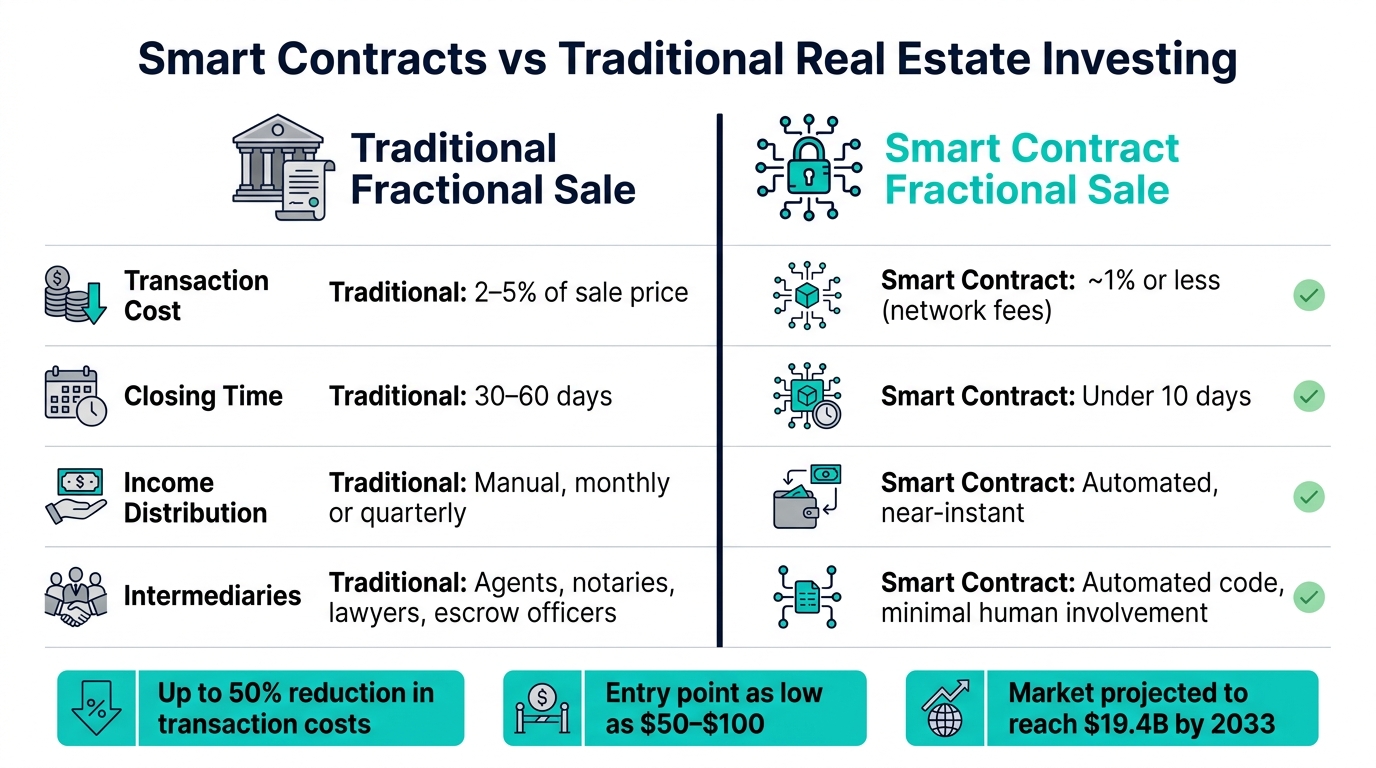
Traditional real estate transactions involve numerous intermediaries - brokers, lawyers, escrow officers, and notaries - all of whom add costs and delays. Smart contracts simplify this by replacing much of the process with automated code. Research suggests this automation can cut transaction costs by up to 50% and reduce closing times from the standard 30–60 days to under 10 days.
Here’s a comparison:
| Aspect | Traditional Fractional Sale | Smart Contract Fractional Sale |
|---|---|---|
| Transaction Cost | 2–5% of sale price | ~1% or less (network fees) |
| Closing Time | 30–60 days | Usually under 10 days |
| Income Distribution | Manual, monthly/quarterly | Automated, near-instant |
| Intermediaries | Agents, notaries, lawyers, escrow officers | Automated code, minimal human involvement |
"By automating escrow release criteria, we mitigate settlement risk and compress the standard 30‑day closing window to under ten days." - Sophie Sturdevant, Transactional Efficiency Expert
Beyond saving time and money, smart contracts also make fractional real estate more liquid.
More Liquidity and Trading Flexibility
Traditional real estate investments often require long-term commitments, with private syndications locking up capital for years. Tokenized fractional ownership changes this entirely. Since smart contracts handle ownership transfers and compliance in real time, tokenized property shares can trade 24/7 on secondary markets, offering a level of liquidity comparable to public stocks.
How Smart Contracts Change Fractional Ownership
Smart contracts are reshaping fractional ownership by introducing automation and efficiency, building on the security benefits of blockchain technology.
Automating Complex Transactions
One of the standout features of smart contracts is their ability to handle intricate processes without manual intervention. Take real estate as an example: when rental income is collected, a smart contract can automatically calculate each investor's share and transfer the funds directly to their wallets. This eliminates delays and minimizes errors often caused by human oversight.
Investors also participate in property decisions like rent changes, maintenance, or tenant selection through tokenized voting systems. The outcomes of these votes are permanently recorded on the blockchain for transparency and accountability.
Another game-changer is automated escrow. Smart contracts securely hold funds and tokens when buy and sell orders match in a secondary marketplace. Once all conditions are met, the contract instantly completes the transaction.
"Blockchain excels at peer-to-peer (P2P) payments. With blockchain, your funds are locked in a smart contract - in escrow - and only once each side's requirements are met do they settle." - Jerry Chu, Co-founder, Lofty
This level of automation not only speeds up transactions but also opens the door for broader participation by simplifying the process for investors.
Tokenization and Investor Access
Tokenization is breaking down barriers to entry by allowing people to invest with smaller amounts of money. By replacing traditional back-office processes with smart contracts, even tiny amounts of rental income can be distributed to thousands of wallets efficiently - sometimes at fractions of a cent per transaction. This makes large-scale participation more feasible.
Typically, tokenized properties are structured under an LLC, with tokens representing membership interests. This approach integrates blockchain technology with established legal practices, ensuring compliance and stability.
Case Study: Lofty
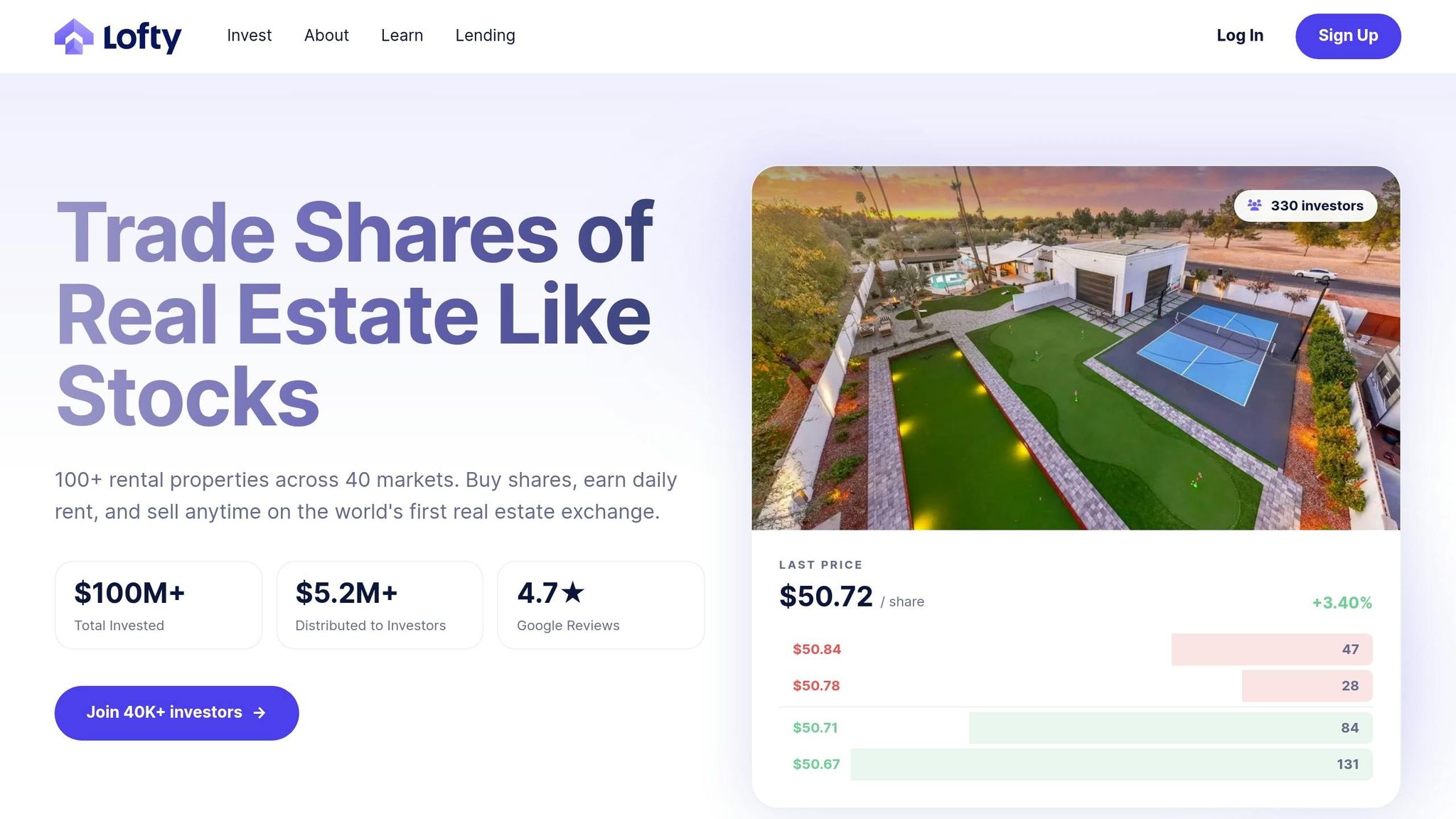
Lofty offers a clear example of how these advancements work in practice. Built on the Algorand blockchain, this U.S.-based platform specializes in fractional real estate. Transactions on Algorand are impressively quick, settling in just 3 to 4 seconds, with network fees as low as $0.001 per transaction.
"We quickly realized Algorand was the solution: Transactions settle with immediate finality in 3 or 4 seconds, very much like what people are used to in Web2." - Jerry Chu, Co-founder, Lofty
Risks and Challenges of Smart Contracts
Smart contracts offer undeniable advantages, particularly in fractional investing, but they also come with challenges that investors need to be aware of. Understanding these risks is crucial before diving into the world of tokenized assets.
Coding Errors and Compliance Complexities
One of the biggest risks lies in coding errors. Since blockchain transactions are immutable, even a small mistake in the code can lead to unintended and irreversible outcomes. To mitigate this, thorough audits before deployment are essential, and in some cases, smart contract insurance protocols can provide additional protection.
Regulatory compliance adds another layer of difficulty. For example, fractionalized real estate assets with profit potential are often classified as securities by the SEC. This means they must adhere to regulations like Reg D 506(c) or Reg A+. A proactive solution is to build compliance directly into the smart contract. This can include automating Rule 144 transfer lock-ups (typically six months to a year) and restricting token transfers to KYC-verified, accredited investors using standards such as ERC-3643.
Additionally, for a smart contract to have legal enforceability, it often needs to be tied to a formal legal structure. Examples include Wyoming or Utah DAO LLCs, which can recognize the smart contract within their governing documents.
Beyond coding and compliance, these contracts also depend on external data sources, which introduces additional risks.
Dependence on Off-Chain Data
Smart contracts cannot directly interact with real-world data. Instead, they rely on oracles - third-party services that feed property data, such as property valuations or rental income, into the blockchain. The problem? If the data provided by an oracle is inaccurate, the smart contract will execute based on that faulty input, and the consequences are permanent.
"If the input data is flawed, the immutable output will be permanently flawed, potentially causing fund losses or systemic insolvency." - Chainlink
A real-world example highlights this vulnerability: In June 2024, the DeFi protocol UwULend lost $19.4 million due to an attacker manipulating a price feed from a single liquidity pool using a flash loan. To reduce risks like this, decentralized oracle networks (DONs) are often recommended. These networks aggregate data from multiple independent sources, making it harder to exploit a single point of failure. Platforms can also use circuit breakers - automated systems that pause transactions if oracle data deviates beyond a set threshold.
Liquidity Challenges in Tokenized Markets
While smart contracts can enhance liquidity, real-world constraints still exist. Tokenized real estate, for instance, often faces lower trading volumes compared to traditional stocks. This can make it difficult to find a buyer at the desired price, especially on newer platforms with less market activity.
Regulations further complicate liquidity. Tokens issued under Reg D typically come with lockup periods ranging from six months to a year. Even after the lockup ends, trading usually has to occur on regulated platforms, such as Alternative Trading Systems (ATS) like INX or Oasis Pro, to stay compliant. As a result, fractional investors should approach tokenized real estate as a relatively illiquid asset class - at least until broader adoption and regulatory clarity improve market conditions.
Conclusion: Smart Contracts and the Future of Fractional Investing
Key Takeaways for Fractional Investors
Smart contracts are reshaping the landscape of fractional real estate investing. By automating revenue distribution, ensuring compliance, and securely recording transactions on an immutable public ledger, they eliminate the need for brokers, lawyers, and piles of paperwork. This means lower costs, fewer delays, and a much more streamlined investment process.
The numbers back up this transformation. In 2025, the market surged to $3.8 billion, marking a 90% increase from the previous year. Investors enjoyed average yields ranging from 6% to 16%, with entry points as low as $50–$100. These factors are making fractional investing more accessible and setting the stage for even greater adoption.
What to Expect as Smart Contract Use Grows
Looking ahead, the integration of smart contracts is only expected to deepen. Enhanced automation and security are fueling confidence among institutional investors. In fact, 67% of institutional investors plan to allocate funds to tokenized assets by 2026. McKinsey estimates that tokenized securities could hit $5 trillion by 2030, with real estate leading the charge. A prime example of this momentum is Goldman Sachs tokenizing a $500 million New York real estate portfolio on Ethereum, signaling that institutional adoption is well underway.
Emerging trends include platforms embracing cross-chain interoperability to tap into broader liquidity pools. DeFi protocols like Aave are starting to accept real estate tokens as collateral, and ESG-focused tokenization is gaining traction, with $500 million in sustainable properties tokenized in 2025. Additionally, payout models are evolving, with daily distributions becoming more common. Platforms like Lofty are already showcasing how efficiently blockchain can handle income delivery.
While challenges like liquidity, regulation, and technical reliability persist, the structural benefits of smart contracts - lower costs, enhanced transparency, and 24/7 trading access - are hard to overlook. With the tokenized real estate market projected to grow to $19.4 billion by 2033 at a 21% CAGR, it’s clear this is not just a passing trend but a long-term transformation of the investment landscape.
FAQs
How do smart contracts protect fractional property ownership?
Smart contracts improve the safety of fractional property ownership by automating transactions, ensuring they happen quickly and with complete transparency. By leveraging a public ledger, they keep ownership records accurate and handle income distribution without manual intervention, minimizing the chances of mistakes or disagreements.
What happens if a smart contract has a bug or gets hacked?
If a smart contract contains a bug or gets hacked, it can lead to massive financial losses. Between 2020 and 2025, losses from these exploits exceeded $4.2 billion, even when audits were conducted beforehand. Issues such as price manipulation and other vulnerabilities emphasize the need for robust security measures to minimize risks and safeguard investors.
Can I really sell my real estate tokens anytime?
Yes, you can sell your real estate tokens instantly through digital marketplaces. This gives you the flexibility to complete transactions quickly, whenever it suits you.
Lofty Editorial