Lofty Editorial
Blockchain and Smart Contracts in Property Tokenization
Investing in U.S. real estate has traditionally required large amounts of capital, slow processes, and high fees. Blockchain-based property tokenization changes this. By converting property ownership into digital tokens, you can invest in real estate for as little as $50. Here's how it works:
- Lower Costs: Blockchain reduces transaction fees from 5–6% to 1–2%.
- Faster Transactions: Settlements happen in minutes instead of months.
- Increased Liquidity: Trade fractional property shares 24/7.
- Automation: Smart contracts handle rent payouts and ownership transfers.
This system opens real estate investment to a broader audience but comes with risks like regulatory challenges and smart contract vulnerabilities. Whether you value control or accessibility, understanding these options helps you decide which approach fits your goals.
What Is Real Estate Tokenization Using Smart Contracts? - Emerging Tech Insider
sbb-itb-a24235f
1. Traditional Real Estate Ownership
Investing in real estate the traditional way comes with its fair share of challenges, including high costs, slow processes, limited liquidity, centralized control, and exposure to risks.
Transaction Costs
Real estate transactions in the U.S. can be surprisingly expensive. Agent commissions, legal fees, title insurance, and transfer taxes alone typically eat up 5–6% of a property's value. For a $500,000 home, that’s up to $30,000 in upfront costs. And it doesn’t end there - administrative tasks like manual reconciliation, wire fees, and complex tax reporting (think Schedule K-1s) add even more to the burden.
Settlement Speed
Closing a deal in traditional real estate is anything but quick. The process often takes 30 to 60 days, largely due to manual steps like title searches, lien checks, and paper-based deed transfers. Add in the coordination between lawyers, escrow agents, banks, and government offices, and delays are almost inevitable. As Chainlink explains:
"For centuries, transacting land has required a coordination of lawyers, banks, and government offices that can take months to finalize."
Each handoff between parties not only slows things down but also leaves everyone in the dark about real-time progress.
Liquidity
Real estate is notoriously illiquid. Need quick cash? You can’t just sell a portion of your property. Unlike traditional assets, tokenized real estate allows for secondary market trading and instant liquidity. Instead, you’re forced to sell the entire asset, find a buyer, and go through the full closing process. Private syndications make things even tougher, often locking investor funds for 5 to 10 years, making it hard to exit a position when needed.
Governance
Ownership in real estate is tied to deeds stored at county offices, and in syndications, centralized fund managers call the shots. For individual investors, this often means little to no say in operational decisions. Changing ownership is also a slow, paper-heavy process.
Risk
Traditional real estate transactions rely heavily on physical records and isolated databases, which opens the door to issues like title disputes, hidden liens, and documentation errors. This reliance on intermediaries adds another layer of risk. As Celester Johnson highlights:
"In a world where escrow can be a black box, the blockchain offers transparent arbitration."
Without a shared, verifiable system of ownership, investors must trust these intermediaries to handle everything correctly - a trust that isn’t always rewarded.
These hurdles in traditional real estate have paved the way for blockchain-based solutions, which simplify transactions and bring greater transparency. Property tokenization, for instance, tackles these pain points by automating and decentralizing the process.
2. Blockchain-Based Property Tokenization
Blockchain tokenization is changing the game for real estate by addressing some of its biggest challenges. It offers a faster, more cost-effective, and liquid approach to property ownership.
At its core, property tokenization transforms real estate ownership into blockchain-based tokens. Each token represents a fractional share of a property, with smart contracts managing tasks like compliance checks and rent distribution - automatically and without the need for intermediaries.
Transaction Costs
Traditional real estate transactions can be expensive, with closings often consuming 5–6% of a property's value due to commissions, legal fees, and administrative expenses. Blockchain tokenization slashes these costs to around 1–2%. Blockchain analyst Michael Hemingway highlights the efficiency of smart contracts:
"Smart contracts automate property transfers, cutting costs by up to 50%."
Fractional ownership also makes real estate more accessible. Instead of requiring $50,000–$100,000 to invest, platforms like Lofty let users start with as little as $50. Built on the Algorand blockchain, transactions on Lofty cost just $0.001 per transfer.
Settlement Speed
The traditional closing process is slow, often taking 30–60 days due to manual steps like title transfers and county recording. Blockchain eliminates these delays. Ownership updates on-chain as soon as the transaction is confirmed. Crypto and equities analyst Diane Caddy explains:
"These tokens live on a blockchain... where every transaction is recorded permanently and transparently. Unlike traditional deeds, which sit in dusty county offices, these tokens can be bought, sold, or transferred in minutes."
With blockchain, transactions settle in minutes, significantly speeding up the process and boosting market liquidity.
Liquidity
Tokenization revolutionizes property liquidity. Instead of waiting months to sell an entire property, token holders can trade fractional shares on secondary markets. For example, in July 2025, Lofty distributed $20 million in rental income across nearly 250 tokenized properties. Its automated market maker (AMM) handled $240,000 in trading volume in just one month.
Governance
Ownership rules are built directly into tokens through smart contracts. These contracts manage rent distributions, voting rights, and compliance requirements automatically. Investor eligibility is verified in real time using ERC-3643 standards, ensuring that all transactions meet regulatory standards. This automation simplifies governance while blockchain transparency strengthens risk management.
Risk
Blockchain’s transparent and permanent ledger reduces risks associated with traditional records, such as title disputes or hidden liens. This clarity builds trust among investors. A pilot project in Auckland in March 2025 demonstrated these benefits. A $3 million office block was tokenized into 10,000 tokens priced at $300 each. Within three months, 70% of the tokens were purchased by overseas investors, with rental income distributed seamlessly via smart contracts - no intermediaries needed.
Pros and Cons
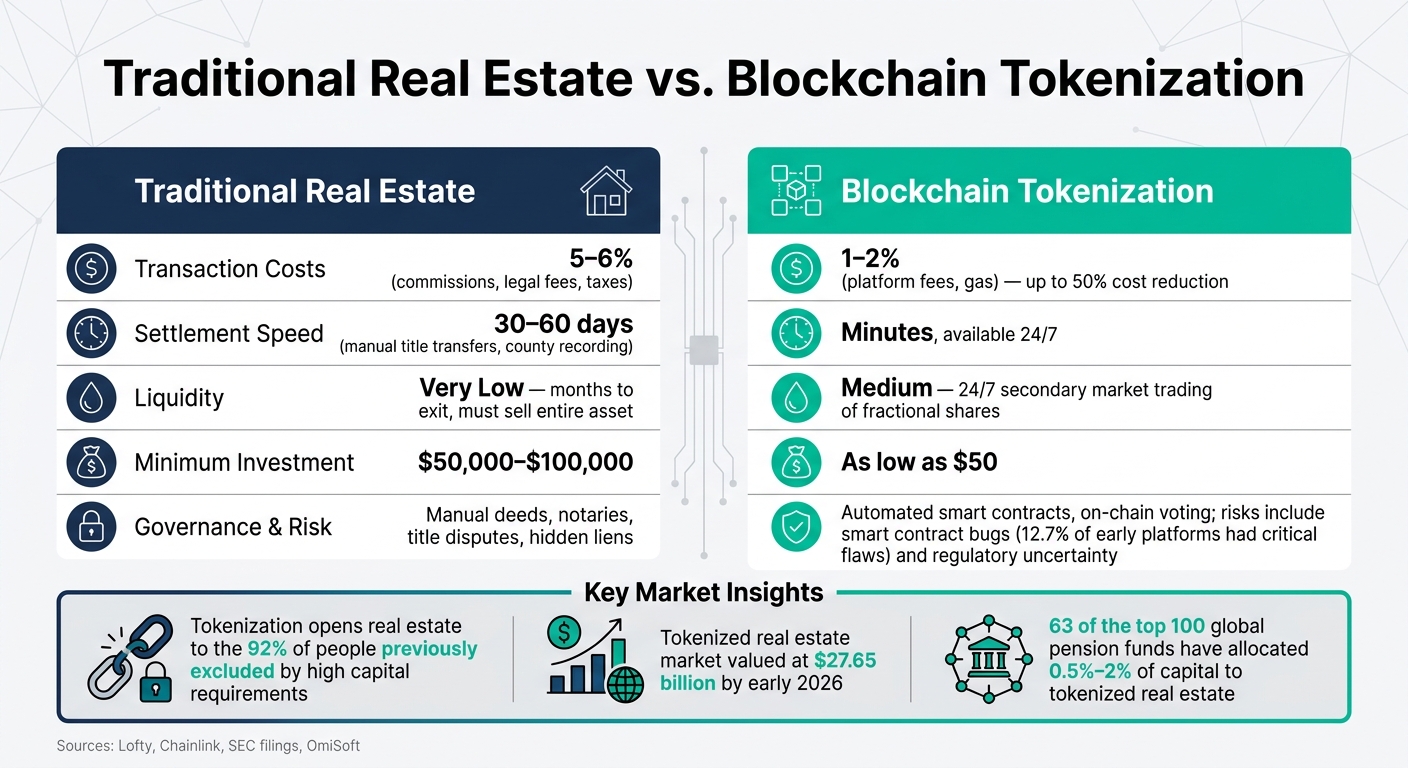
Traditional Real Estate vs. Blockchain Tokenization: Key Differences
When comparing traditional real estate to blockchain-based tokenization, it’s clear each approach has its own strengths and weaknesses. The following table provides a quick overview of how these two options differ.
Traditional real estate gives you direct ownership and control that tokenization can't fully replace. You hold the deed, manage the property, and benefit from well-established legal protections. However, this level of control comes with drawbacks: high costs, slow transaction times, and lengthy sale processes. For many, the steep investment minimums - typically between $50,000 and $100,000 - make this option unattainable.
On the other hand, blockchain-based tokenization flips the script. Entry costs can be as low as $50, transaction fees are reduced, and settlements happen in minutes instead of months. Analyst Diane Caddy sums it up well:
"The future of property ownership isn't just in deeds and titles anymore. It's in code, in wallets, and in tokens."
But tokenization isn’t without its challenges. A study revealed that 12.7% of early tokenization platforms had critical security flaws in their smart contracts. Regulatory uncertainty also looms large; in 2023, the SEC shut down a Blockchain Capital project for selling tokens as unregistered investments. While tokenized assets allow for 24/7 secondary trading, liquidity remains limited - recent data shows annual turnover for tokenized real estate is below 2%.
| Feature | Traditional Real Estate | Blockchain Tokenization |
|---|---|---|
| Transaction Costs | 5–6% (commissions, legal, taxes) | 1–2% (platform fees, gas) |
| Settlement Speed | 30–60 days | Minutes, 24/7 |
| Liquidity | Very low (months to exit) | Medium (24/7 secondary trading) |
| Governance | Manual (deeds, notaries, managers) | Automated (smart contracts, on-chain voting) |
| Risk | Market risk, title disputes, high entry barrier | Smart contract bugs, regulatory uncertainty |
The key trade-off boils down to control versus accessibility. Traditional ownership offers legal certainty and direct control but limits participation due to high costs and capital lock-up. Tokenization, by contrast, lowers barriers to entry - making real estate investment possible for the 92% of people previously excluded - but brings with it risks tied to technology and evolving regulations. Choosing between the two depends on your investment priorities, risk appetite, and need for liquidity. This comparison highlights how technology is reshaping the boundaries of real estate investment.
Conclusion
Traditional real estate and blockchain tokenization cater to different types of investors and priorities. For those seeking direct control, strong legal safeguards, and long-term ownership, traditional real estate remains the go-to option. On the other hand, tokenization stands out for its ease of access, faster transactions, and lower fees.
Each model has its strengths. Traditional real estate is ideal for investors with substantial capital who value full ownership and are less concerned about liquidity. In contrast, tokenization fits well with income-generating assets. For instance, multi-family apartments and commercial buildings make up 38.2% of the tokenized market, where smart contracts automate rental income distribution efficiently.
What's driving the shift is the growing interest from institutions. By early 2026, tokenized real estate, valued at $27.65 billion, attracted 63 of the top 100 global pension funds, with allocations ranging from 0.5% to 2% of their capital. This signals a notable rise in institutional confidence.
"Tokenization replaces [the traditional] model with a programmable, globally accessible capital layer." - Dmytro Romaniuk, CEO & Founder, OmiSoft
FAQs
How do tokens map to legal property ownership in the U.S.?
In the U.S., tokens symbolize fractional ownership of a property's equity. Holding these tokens grants rights such as receiving rental income, sharing in profits, and participating in decision-making through voting. Blockchain technology and smart contracts play a key role in managing these rights, offering a secure and efficient way to handle fractional ownership.
What happens if a smart contract has a bug or is hacked?
Smart contracts come with a significant risk: if there’s a bug or they’re hacked, it could lead to lost funds or unintended outcomes. Because these contracts are self-executing and cannot be changed once they’re deployed, addressing vulnerabilities after the fact is incredibly tough. This is why thorough auditing and rigorous testing are absolutely essential to reduce potential risks.
How can I sell my property tokens, and how liquid are they?
You can trade property tokens on digital marketplaces that specialize in fractional ownership. Platforms like Lofty make it possible to complete transactions almost instantly, bypassing the drawn-out processes typically associated with traditional real estate sales.
One major advantage of property tokens is their higher liquidity compared to conventional real estate. Since they’re traded on blockchain-based marketplaces, buying and selling can happen much faster. That said, the actual ease of trading - liquidity - depends on factors like market demand and how active the platform is.
Lofty Editorial