Lofty Editorial
Benefits of Online Marketplaces for Fractional Sales
Fractional real estate investing is transforming how people access property ownership. By splitting properties into smaller shares, platforms like Lofty allow investors to start with as little as $50. This eliminates the need for large down payments and simplifies the process of owning and managing real estate.
Key takeaways:
- Low entry costs: Invest in real estate with minimal upfront capital.
- Diversification: Spread investments across multiple properties and locations.
- Reduced management hassle: Property management and decisions are handled collectively, saving time and effort.
- Liquidity options: Buy or sell shares easily through secondary marketplaces.
These platforms leverage digital tools and blockchain technology to make transactions fast and transparent, while also providing daily rental income distributions. While risks like market fluctuations and platform reliability remain, fractional investing offers a practical way for individuals to enter the real estate market without the traditional barriers.
How Fractional Real Estate Investing is Disrupting the Rental Market
sbb-itb-a24235f
Key Challenges of Direct Real Estate Investing
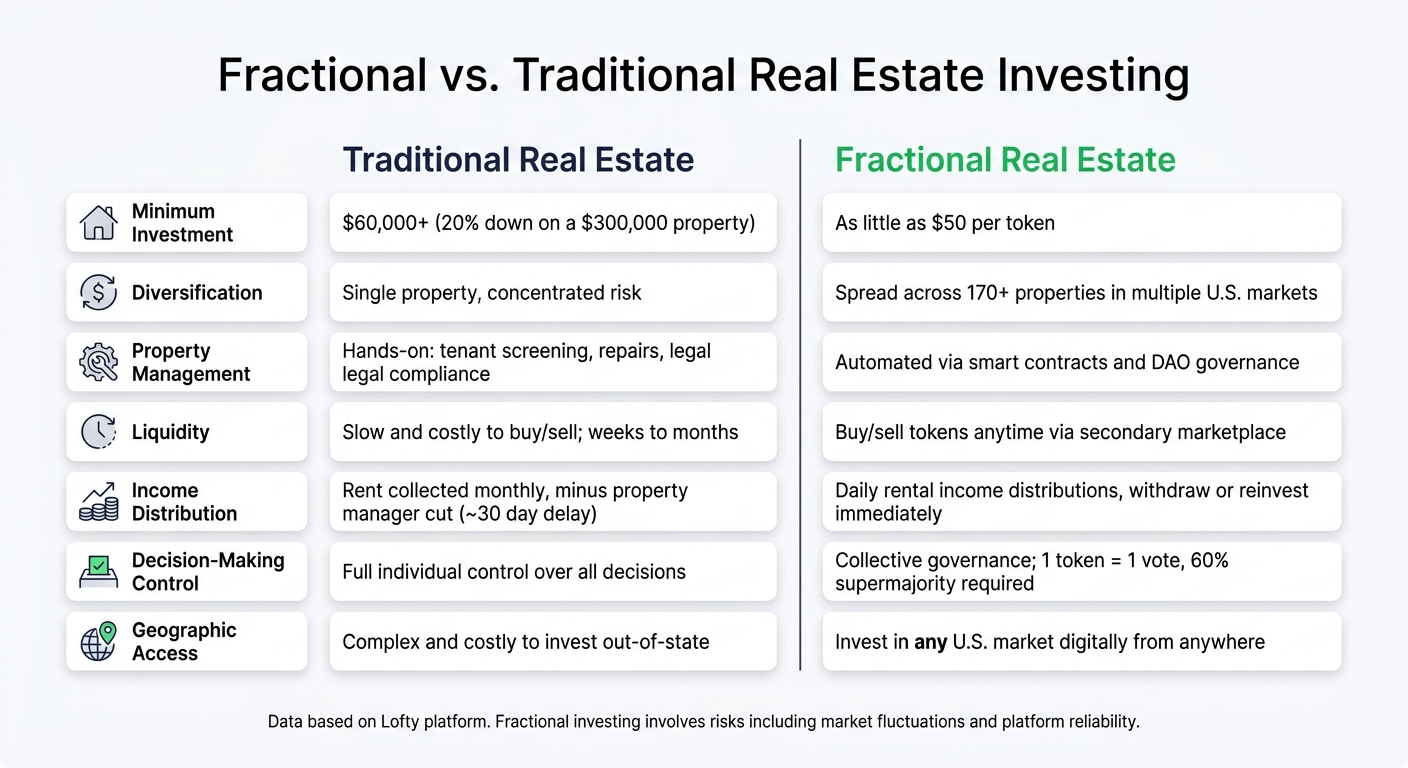
Fractional vs. Traditional Real Estate Investing: Key Differences
Investing directly in real estate comes with its fair share of hurdles, from steep upfront costs to the ongoing demands of property management.
High Entry Costs and Concentrated Risk
Buying a rental property isn’t cheap. A typical purchase often requires a 20% down payment, plus closing costs, inspection fees, and reserves for future expenses. For example, purchasing a $300,000 property could mean shelling out over $60,000 before you even start earning rental income. This level of investment, concentrated in a single property, leaves little room to spread out risk. If the property sits vacant for months or needs a major repair - like replacing an HVAC system - your rate of return on a rental property could take a serious hit. And these challenges don’t stop at the purchase; managing the property brings its own set of obstacles.
Time and Expertise Required for Property Management
Owning a rental property is far from a "set it and forget it" investment. It’s more like running a small business. Landlords are responsible for tasks like screening tenants, coordinating move-ins and move-outs, and handling maintenance emergencies.
"One of the biggest hurdles to owning a rental property is the landlord headache. Most of us don't want to spend our weekends chasing down tenants or fixing leaky sinks." – HHattyHats
On top of daily operations, landlords have to juggle financial and legal responsibilities, including paying property taxes, securing insurance, and setting up legal protections for their assets. Even hiring a property manager doesn’t eliminate all the work. Owners still need to monitor the manager’s performance and deal with inevitable delays.
"In the legacy world, you'd wait for a property manager to collect rent, take their cut, and mail you a check 30 days later." – HHattyHats
Barriers to Out-of-State Markets and Reliable Data
Some of the most attractive rental markets in the U.S., like those in the Sun Belt or Midwest, are often far from home. This distance adds layers of complexity. You’ll likely need to travel for property showings, arrange local inspections, and pay hefty fees. Once the property is yours, staying on top of it can be tricky. Problems like deferred maintenance or code violations might go unnoticed, and gathering accurate market data from afar can be a real challenge.
How Online Fractional Real Estate Marketplaces Work
How Properties Are Sourced and Split Into Fractions
Fractional real estate platforms make property ownership more accessible by breaking it into smaller, affordable shares. For example, on Lofty, a property - whether residential or commercial - can be listed for sale, and its equity is converted into digital tokens through a process called tokenization.
"Every property's deed is legally held by a unique WY DAO LLC... these LLCs are algorithmically managed through smart-contracts on the blockchain." – Lofty
This setup ensures that each property is legally distinct from the platform and other investments. Investors can buy in with as little as $50 per token, making it an entry point for those who might not have the capital for traditional real estate investments.
Digital Tools for Buying and Managing Investments
Tokenization isn’t just about dividing ownership; it also simplifies the investment process. Digital tools on platforms like Lofty handle everything from transactions to portfolio updates, eliminating much of the complexity that comes with traditional real estate. For instance, digital wallets manage transactions, execute smart contracts, and provide real-time portfolio updates. Lofty’s own Lofty Wallet automates order signing and verification, while integration with HouseCanary offers trusted price estimates for buy or sell decisions.
Through the platform's dashboard, investors can monitor order history, track rental income distributions, and even reinvest their earnings. Governance features are also built in, allowing token holders to vote on key property decisions - like approving repairs or adjusting rent. Each token equals one vote, and a supermajority of 60% is required to approve changes.
How Lofty Works
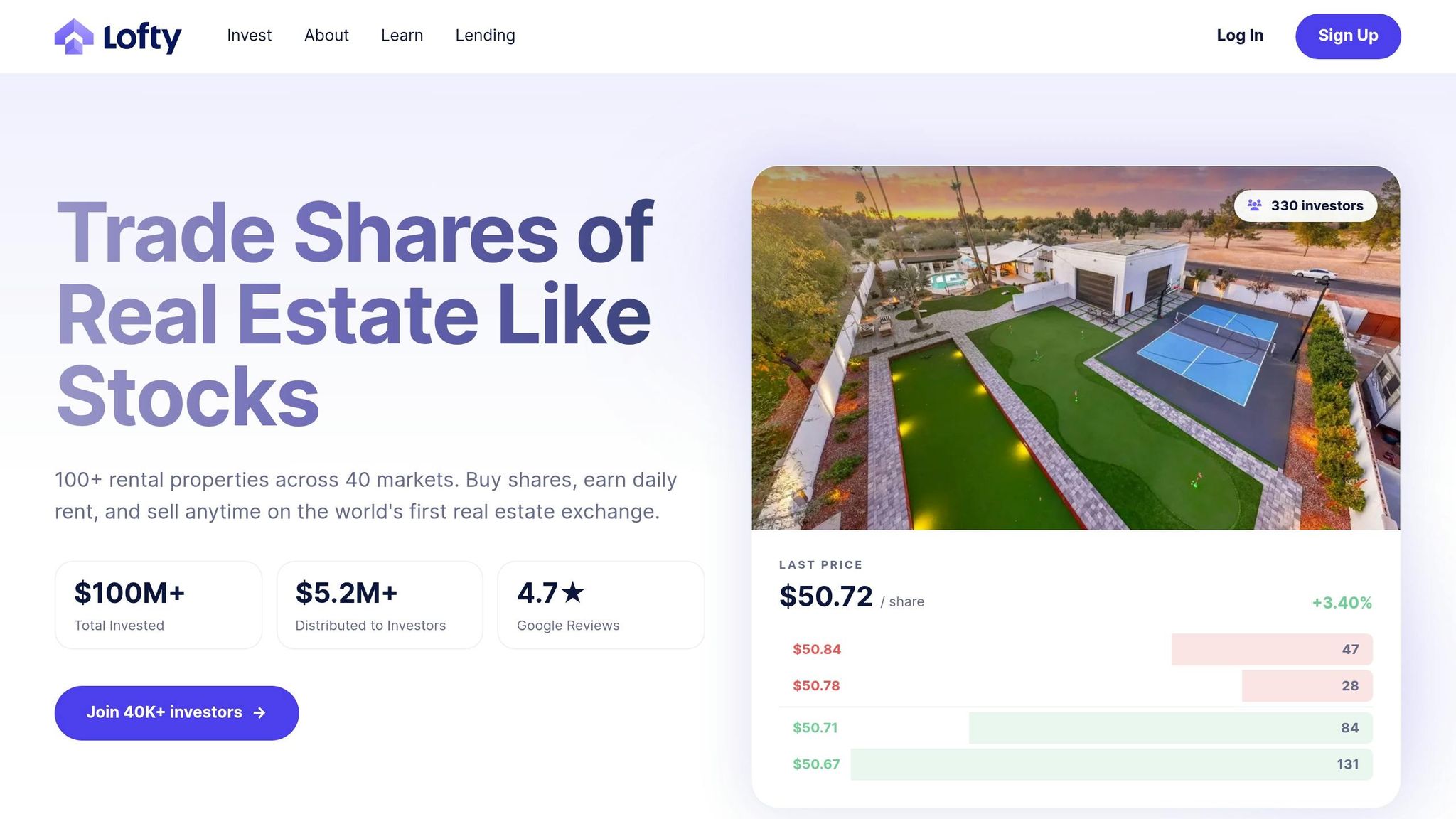
Lofty streamlines the entire transaction process, making fractional real estate investing straightforward. Backed by over $6 million in venture funding from investors like Y Combinator and Hustle Fund, the platform operates without ongoing management fees. Instead, it charges a 6% transaction fee, evenly split between buyer and seller. Rental income is distributed daily to investors and can be withdrawn or reinvested immediately.
"Lofty never custodies or handles user funds or assets. Through smart-contracts on the blockchain, all transactions are directly peer-to-peer." – Lofty (via Y Combinator)
For those looking to exit their investment, Lofty uses an Automated Market Maker (AMM) and liquidity pools. These tools allow property tokens to be bought or sold instantly, removing the need to wait for a buyer or seller to match the transaction.
Benefits of Online Marketplaces for Fractional Property Sales
Lower Minimum Investment Requirements
Fractional marketplaces have made real estate investing much more accessible by significantly reducing the upfront costs. Instead of needing to save tens of thousands of dollars for a traditional down payment - like $60,000 on a $300,000 home - investors can now start with as little as $50 on certain platforms. This lower threshold opens the door to individuals who may have previously been priced out of the market.
"For the first time in the world, you can now buy and sell equity in a house (grants you legal ownership + management control) with the same experience as trading a share of AAPL on Robinhood." – Lofty
By removing the high entry costs, these platforms are breaking down one of the biggest barriers to real estate investment.
Easier Portfolio Diversification and Flexibility
Fractional marketplaces also make it easier for investors to diversify their portfolios. Since the initial investment is so low, spreading capital across multiple properties becomes more feasible. Instead of committing all your resources to a single property in one location, you can own fractional shares in a variety of properties - like a single-family rental in one state, a vacation rental in another, and even a commercial property elsewhere.
Lofty, for example, has tokenized over 170 properties across the U.S., including single-family homes, Airbnbs, and commercial strip malls. This variety helps reduce risk by balancing market fluctuations across different property types. Plus, these platforms often feature secondary marketplaces where tokens can be bought or sold at any time. This flexibility allows investors to adjust their holdings as their financial goals or market conditions change - without the hassle of navigating a lengthy traditional real estate transaction.
Less Time Spent on Property Management
Another major advantage of fractional investing is the reduced burden of property management. Traditional real estate ownership often involves dealing with tenants, repairs, and other time-consuming tasks. Fractional marketplaces streamline this process by handling property management through advanced systems.
On Lofty, for instance, each property is owned by its own Wyoming DAO LLC and managed using smart contracts. When decisions need to be made - like approving a repair or addressing a tenant issue - investors participate through the platform's governance program. Here’s how it works: one token equals one vote, and a 60% supermajority is required for decisions to pass. As Lofty puts it:
"Instead of informally discussing how to manage things over the phone or in meetings, the management process is formalized through the 'governance program', where members vote on all management decisions." – Lofty
This system not only formalizes decision-making but also eliminates the need for hands-on management. Rent is distributed automatically based on your ownership percentage, and all transactions - like payments and reinvestments - can be tracked through a user-friendly dashboard. It’s a hassle-free way to enjoy the benefits of real estate investing without the daily responsibilities.
What to Know Before Investing in Fractional Real Estate
Risks to Consider: Market Changes and Vacancies
While fractional investing changes how you approach real estate, it doesn't eliminate the risks. Property values can drop due to factors like local economic downturns, rising interest rates, or shifts in housing demand. For context, U.S. rental vacancy rates typically range between 5% and 12%, depending on the region and property type. If vacancies exceed expectations, the cash distributions you receive could be negatively impacted.
There are also risks tied to the platforms themselves. Since you're relying on an online marketplace for property vetting, rent collection, and reporting, any technical problems or operational issues could disrupt your access to funds. Platforms like Lofty aim to reduce these risks by using smart contracts and secure escrow systems. Lofty's smart contracts are audited by CertiK, and the escrow system ensures funds are held securely until trades are finalized. Even so, it's important to review offering documents and understand the fee structure - Lofty charges a 3% platform fee on both buy and sell orders.
Liquidity is another key consideration. While Lofty offers a secondary marketplace where you can list your tokens for sale at any time, trades are peer-to-peer. If no one matches your desired price, the trade won't happen. Fractional real estate is better suited for long-term investments rather than funds you might need quickly.
Who Is a Good Fit for Fractional Investing
Knowing the risks can help you decide if fractional real estate investing aligns with your goals. This model tends to work well for specific types of investors. For example, first-time real estate investors who don't have enough capital for a traditional down payment can benefit from the low entry costs. It's also a great option for busy professionals seeking passive income without the hassle of managing tenants or maintaining properties. If you're already investing in stocks or bonds and want to diversify with real estate, fractional investing can be a practical addition to your portfolio.
However, this approach isn't ideal for everyone. If you prefer full control over decisions like tenant selection, property upgrades, or when to sell, fractional investing may feel restrictive. In this model, major decisions are made collectively, trading individual control for the ease of professional management.
How to Get Started with Lofty
Getting started with Lofty is straightforward. First, create an account. Once you've done that, you'll receive a Lofty Wallet and Verification NFT. From there, you can browse the available properties. Each property listing includes offering documents and valuation data to help you make informed decisions.
When you're ready to invest, place a limit order specifying the maximum price you're willing to pay per token. Orders remain open for up to 30 days and are filled on a first-come, first-served basis. You can fund your purchases using ACH bank transfers, credit cards, rental income balances, or even cryptocurrency like USDC or ALGO.
To reduce risk, consider spreading your investments across a variety of U.S. markets. Once you've invested, you can monitor rental distributions and property updates directly through your dashboard.
Conclusion: How Fractional Ownership Is Changing Real Estate Investing
Investing in real estate has traditionally required significant capital, lengthy processes, and hands-on property management. However, platforms like Lofty are changing the game by addressing these challenges head-on.
Fractional ownership platforms break down barriers by allowing more people to participate in real estate investing. As Lofty CEO Jerry Chu puts it:
"Our mission is to make it as easy as possible for anyone in the world to diversify into real estate investing. A key part of our mission is to solve the liquidity problem in real estate - it is traditionally slow and costly to both buy and sell."
This model enables investors to spread their risk across different property types and markets, including single-family rentals and short-term vacation properties. It directly tackles the high entry costs and risk concentration that often come with traditional real estate investing. On top of that, automated smart contracts - audited by CertiK - streamline property management, saving investors from the hassle of manual oversight.
Whether you're just starting out or looking to expand an already diverse portfolio, fractional ownership makes real estate investing more accessible, regardless of your financial resources or experience level.
FAQs
How do I know a fractional property share is legally mine?
When you own a fractional property share, it becomes officially yours once it's verified and recorded on a secure blockchain ledger. Your ownership is backed by a valid, non-transferable Lofty Verification NFT or similar proof stored in your wallet, providing a reliable guarantee of your rights.
What happens if a property has a long vacancy or big repair?
When a property faces extended vacancies or needs extensive repairs, platforms such as Lofty can step in to help. They assist in minimizing the risk of prolonged vacancies and manage major maintenance expenses. This approach helps maintain a steadier cash flow while shielding investors from unforeseen financial challenges.
How fast can I sell my tokens if I need cash?
You can sell your tokens instantly on Lofty through market orders. This option lets you complete transactions in real time without waiting for a buyer on the other end. Once the sale is finalized, the proceeds - usually in USDC - are deposited directly into your Lofty Wallet.
Lofty Editorial