Lofty Editorial
Top Economic Trends Shaping Fractional Real Estate
Fractional real estate is changing how people invest in property by allowing ownership of small portions of real estate, starting as low as $50, thanks to blockchain technology. This approach offers lower entry costs, daily rental income payouts, and instant liquidity, making it more accessible compared to traditional real estate. Economic shifts like falling interest rates, advancements in blockchain, and regulatory updates are fueling this growth in 2026.
Key highlights:
- Lower mortgage rates in 2026 could increase home sales by 14%.
- Fractional platforms like Lofty enable co-ownership with minimal upfront costs.
- Blockchain reduces transaction times and costs, allowing quick property token trades.
- New regulations allow 401(k) plans to include private real estate funds, expanding access.
- Longer investment holds (7–10 years) are becoming popular for stability.
Quick comparison: Fractional real estate offers greater liquidity and diversification with lower costs, but traditional ownership provides full control and tax benefits. Combining both strategies could maximize returns while balancing risks.
Fractional Real Estate Investing All HYPE?!
Economic Trends Affecting Real Estate Investments
The year 2026 is shaping up to be a pivotal time for real estate investment, with falling interest rates and other economic factors driving significant changes. Lawrence Yun, Chief Economist at the National Association of Realtors (NAR), predicts, "Next year should be better with lower mortgage rates, and that will qualify more buyers. We are expecting home sales to increase by about 14% nationwide in 2026". To put that into perspective, a single percentage-point drop in mortgage rates - from 7% to 6% - could add around 5.5 million qualified buyers. On the supply side, lower Federal Reserve rates are expected to reduce construction and development loan costs for builders, potentially boosting inventory levels by roughly 20% compared to the previous year. These adjustments are also laying the groundwork for rapid advancements in real estate investing software and property transaction technologies.
Blockchain and Tokenization Take Center Stage
Blockchain and tokenization are no longer experimental ideas - they’re becoming mainstream. The tokenized real estate market has experienced explosive growth, jumping from $8.6 billion to over $23 billion, marking a 260% surge. A notable example is Figure Technologies, which surpassed $13 billion in home equity line of credit (HELOC) originations by April 2023. The company also completed its first publicly rated, blockchain-based HELOC asset-backed security (ABS) securitization, involving major financial players like Goldman Sachs and J.P. Morgan. Blockchain-powered smart contracts are now automating processes like title transfers, escrow, and compliance, slashing transaction costs by up to 50% and reducing closing times from weeks to mere hours. For fractional investors, this means property tokens can now be bought or sold in minutes, completely transforming traditional timelines.
Regulatory Changes Open New Doors
Regulatory reforms are also reshaping the landscape. The U.S. Executive Order allowing 401(k) plans to include private real estate funds is channeling new retail capital into the sector. Additionally, the emergence of Small and Medium REITs (SM REITs) is what Deepak Kapoor, Director at Gulshan Group, describes as "a game-changer" for 2026, enabling retail investors to access mid-sized commercial assets. These frameworks incorporate compliance features directly into digital tokens, ensuring that capital calls and distributions adhere to legal requirements without the need for manual oversight. Such changes are paving the way for innovative investment models and expanding opportunities for secondary market trading.
Shifts Toward Secondary Markets and Longer Holds
Investor priorities are also evolving, with secondary markets gaining traction. Cities like Columbus and Indianapolis, known for their affordability and vibrant "lifestyle districts", are becoming increasingly attractive. Properties equipped with solar power and energy storage are proving especially lucrative, generating 25%–50% more revenue compared to standard rents. For fractional investors, these markets offer access to opportunities that were once limited to local buyers with substantial capital. Meanwhile, the collective wealth of billionaires reached an estimated $15.4 trillion in 2025, fueling private investment in income-generating real estate.
Investors are also shifting their strategies, favoring longer-term holds of 7–10 years over the traditional 3–5 year horizons. This approach provides stability amid broader economic uncertainties. It aligns well with fractional ownership platforms, which deliver consistent returns and lower entry barriers while maintaining liquidity. A survey found that 80% of high-net-worth investors and 67% of institutional investors are already engaged in or planning to invest in tokenized assets. John D'Angelo, Real Estate Solutions Leader at Deloitte, highlights the transformative potential of this trend:
"Embedding coded rules in digital tokens and linking them to real-world assets could allow financial tools to enable automatic compliance, capital calls, and distributions".
The convergence of lower interest rates, advanced blockchain infrastructure, favorable regulations, and shifting investor preferences is creating a dynamic environment for fractional real estate investment. These trends are not only reshaping the market but also making it more accessible and efficient than ever before.
1. Traditional Real Estate Investment
Entry Cost
Investing in traditional real estate typically requires a significant upfront payment, such as a full down payment on a property. In some cases, private real estate debt funds may set minimum investments as high as $50,000, particularly for institutional investors. These substantial financial requirements, combined with strict terms, make it difficult for many potential investors to participate. On top of the down payment, individual investors often face hefty administrative costs like broker fees, closing costs, and other transaction-related expenses. These high costs, coupled with limited liquidity, make traditional real estate a challenging option for many.
Liquidity
One of the biggest drawbacks of traditional real estate is its lack of liquidity. Unlike stocks or bonds that can be sold almost instantly, selling a property involves finding a buyer, securing financing, and navigating a lengthy process that can take weeks or even months. Robin Hartill, CFP®, points out that "Fractional ownership can come with additional risks because selling property can be difficult". During market downturns, this illiquidity can trap investors, leaving them unable to access funds when needed. The process of selling a property often includes time-consuming steps like deed transfers, title searches, and closing procedures, further complicating access to cash.
Income Frequency
Income from traditional rental properties is typically earned on a monthly or quarterly basis, assuming tenants pay on time and occupancy rates remain high. However, this income is far from guaranteed. Property owners frequently face challenges such as maintenance issues, tenant disputes, and other responsibilities that come with managing real estate. These "landlord headaches" can disrupt cash flow and add stress to the investment process.
Portfolio Diversification
The high cost of traditional real estate makes diversification difficult. Each new property adds significant expenses, including maintenance, repairs, and management, which can quickly become overwhelming. When individual properties require tens or even hundreds of thousands of dollars, creating a diversified portfolio across different regions or property types becomes nearly impossible for most investors. In contrast, fractional ownership models reduce these burdens and make it easier to achieve broader diversification.
sbb-itb-a24235f
2. Fractional Real Estate Investment via Platforms like Lofty
Entry Cost
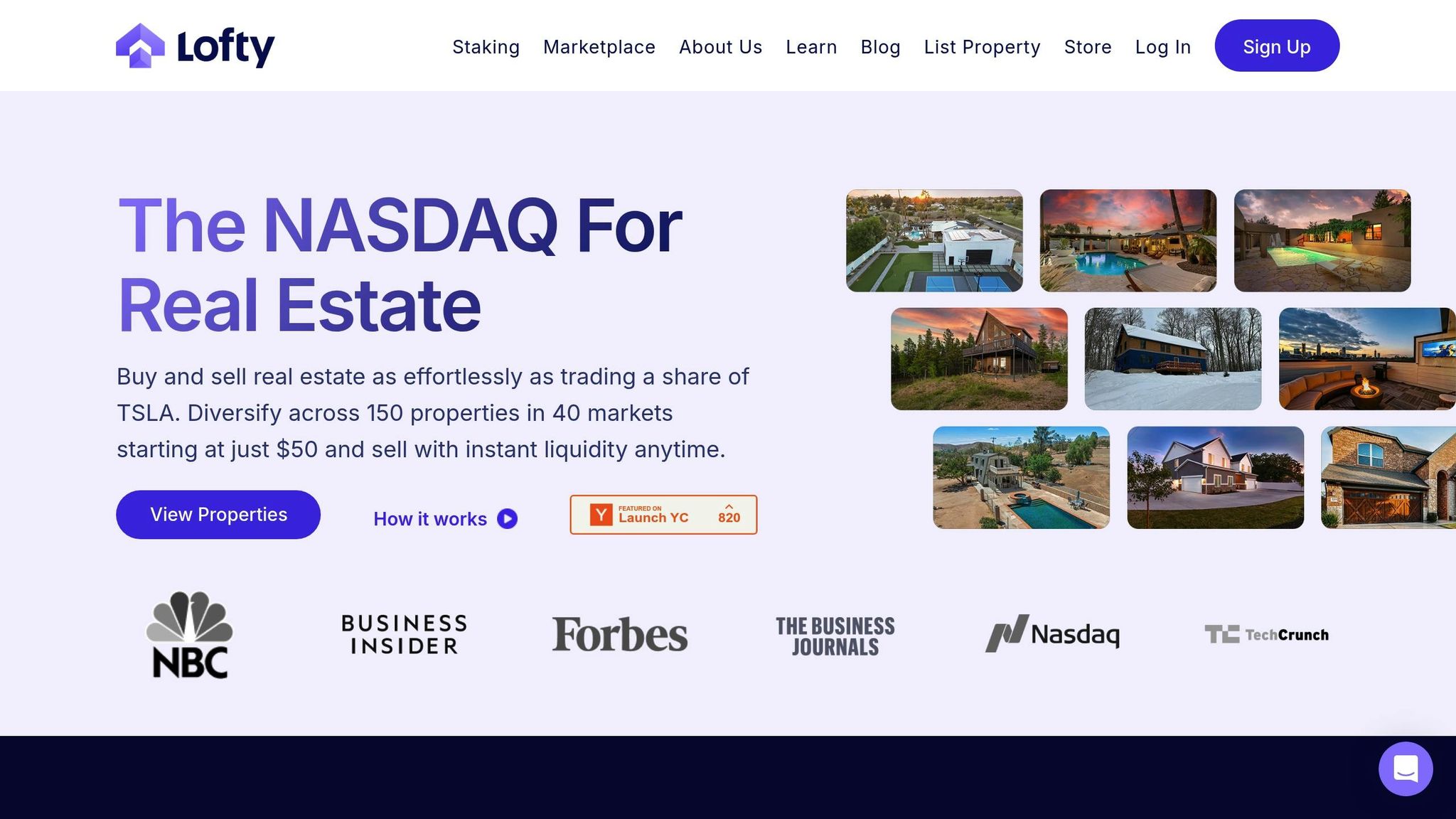
Fractional real estate platforms have made property investment more accessible than ever. Instead of needing millions to purchase a property, these platforms break ownership into digital tokens, allowing investments starting at just $50. This transformation is driven by real estate tokenization, which uses blockchain technology to convert property ownership into secure digital tokens.
Recent federal laws, like the GENIUS Act and Digital Asset Market Clarity Act, combined with the efficiency of blockchain, have fueled the growth of these platforms. They've also cut down on traditional administrative costs - blockchain ledgers, for example, can eliminate expenses like title insurance.
Liquidity
Fractional platforms don’t just lower the cost of entry; they also make real estate investments far more liquid. Unlike traditional real estate, where selling a property can take weeks or months due to lengthy processes like finding buyers and closing deals, platforms like Lofty let investors sell their property shares anytime - no lock-in periods required.
Blockchain technology is expected to speed up transactions even further by 2026, making the process faster and more efficient. On top of that, investors receive daily rental income payouts, offering immediate access to cash flow rather than waiting for monthly or quarterly distributions.
Income Frequency
Platforms such as Lofty offer daily rental income payouts, starting from the day you invest. This frequent cash flow gives investors more flexibility and the ability to reinvest earnings quickly. With commercial real estate investment activity projected to grow by 16% in 2026 - reaching $562 billion - and rental income expected to be the primary driver of returns, this daily payout feature becomes a key advantage. It provides consistent income while supporting strategies to diversify and grow portfolios.
Portfolio Diversification
Fractional ownership makes it easier and more affordable to diversify. Lofty, for example, offers access to over 150 properties across 40 markets in its fractional real estate marketplace, allowing investors to spread their investments across different assets and regions with minimal capital. This broad exposure reduces the risks of localized economic issues and minimizes the impact of vacancies or maintenance problems on the overall portfolio.
Additionally, professional property managers handle the day-to-day operations, removing the burdens of traditional property management. Investors can also diversify across property types - like data centers (which are seeing record-high leasing activity in 2026 due to the rise of AI workloads), multifamily housing, or industrial properties. By investing smaller amounts across various property types, investors can reduce portfolio volatility while still aiming for solid returns.
Pros and Cons
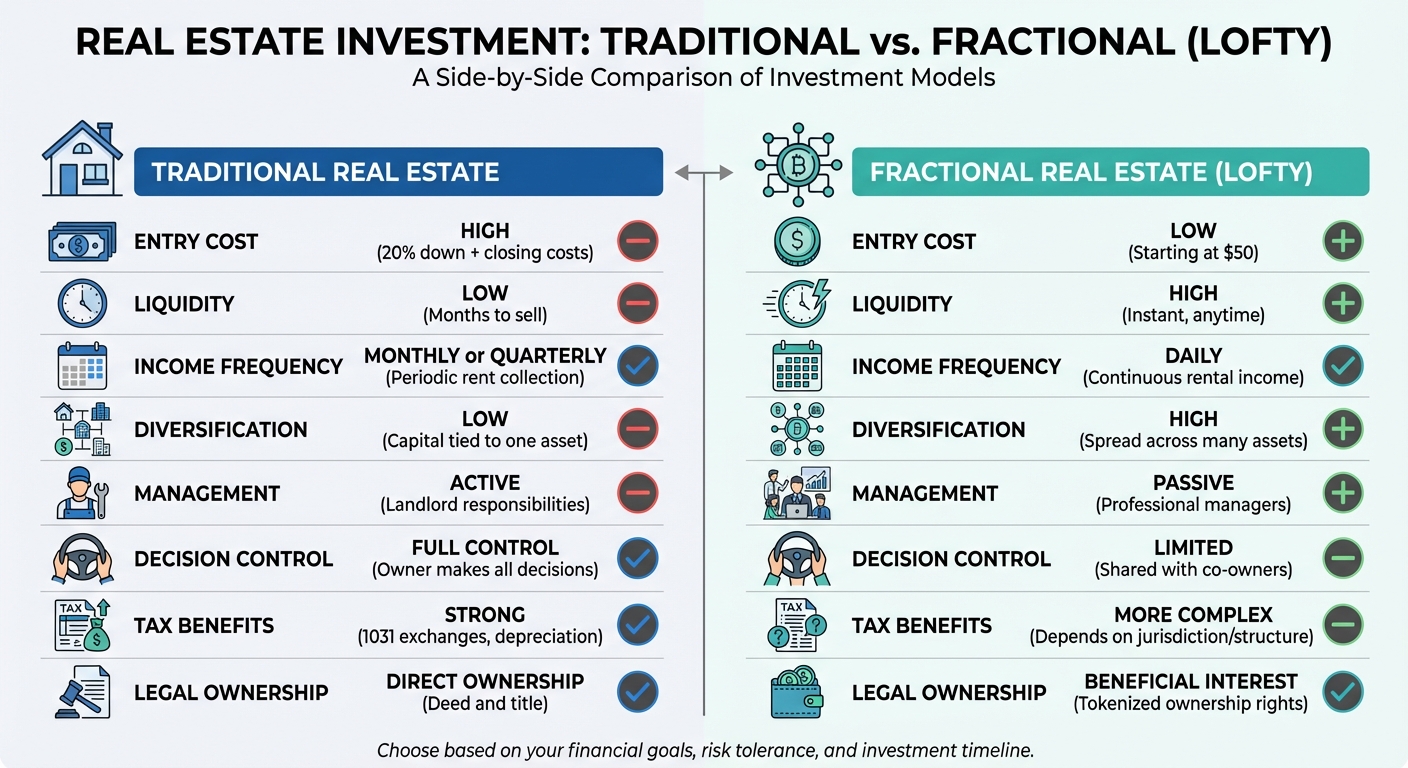
Traditional vs Fractional Real Estate Investment Comparison
Traditional real estate and fractional real estate each come with their own set of advantages and challenges, particularly when it comes to capital requirements, control, and liquidity.
With traditional real estate, you get full control over the property and enjoy tax perks like 1031 exchanges and bonus depreciation. But these benefits come with high upfront costs, limited liquidity, and the need for active involvement in property management. On the flip side, fractional real estate platforms like Lofty tackle these challenges head-on. Investors can enjoy instant liquidity, receive daily rental income, and leave tenant management to professionals. However, fractional ownership does mean giving up some control over decisions like renovations or when to sell. Plus, securing traditional bank financing for fractional shares can be trickier than getting a standard mortgage.
Here’s a quick comparison of the two approaches:
| Aspect | Traditional Real Estate | Fractional Real Estate (Lofty) |
|---|---|---|
| Entry Cost | High (20% down + closing costs) | Low (Starting at $50) |
| Liquidity | Low (Months to sell) | High (Instant, anytime) |
| Income Frequency | Monthly or Quarterly | Daily |
| Diversification | Low (Capital tied to one asset) | High (Spread across many assets) |
| Management | Active (Landlord responsibilities) | Passive (Professional managers) |
| Decision Control | Full Control | Limited (Shared with co-owners) |
| Tax Benefits | Strong (1031 exchanges, depreciation) | More complex |
This comparison shows how fractional platforms make real estate more accessible, offering lower entry costs, greater liquidity, and diversified investment opportunities. At the same time, they trade off some of the control and traditional benefits that come with owning property outright.
Conclusion
The real estate market is evolving rapidly, driven by economic shifts and the growing appeal of accessible, liquid investment models. With the tokenized real estate market expected to hit $4 trillion by 2035 and fractional investing projected to grow at an annual rate of 16.2%, reaching $12.5 billion by 2033, digital platforms are no longer a concept of the future - they’re firmly part of the present.
Platforms like Lofty are at the forefront of this change, offering investments with low entry costs and the ease of liquid trading. Interestingly, about 60% of fractional investors in the U.S. are under 40, highlighting a generational shift in the way real estate ownership is perceived.
For those with limited capital or a preference for diversification without the burdens of traditional property management, fractional platforms provide a straightforward way to get started. Even small monthly investments - say $50 to $100 - can help build a portfolio while generating passive income over time. On the other hand, if maintaining full control over property decisions and leveraging traditional tax benefits, like 1031 exchanges, is a priority, traditional ownership might still be your best bet.
Looking ahead to 2026, a balanced approach could be the key. Allocating funds to both fractional platforms and traditional holdings allows investors to combine the liquidity and flexibility of digital platforms with the control and tax advantages of direct ownership. As Andrew Alperstein, Partner at PwC US Real Estate Practice, points out, "The opportunities in 2026 will favor those who combine speed, data-driven insight and a long-term strategic vision". This dual strategy could position investors to capitalize on the strengths of both approaches.
Ultimately, the best path depends on your financial goals, risk appetite, and how long you plan to invest. Fractional real estate doesn’t aim to replace traditional ownership - it complements it, opening doors for more people to participate in the market.
FAQs
How does blockchain improve liquidity in fractional real estate investing?
Blockchain is changing the game for fractional real estate by turning physical properties into digital tokens. Each token represents a share of ownership, making it easier for investors to buy, sell, or transfer their shares. These transactions happen on a secure, transparent public ledger, cutting out the delays that usually come with traditional real estate deals.
Smart contracts play a big role here by automating essential tasks. They handle things like enforcing transfer rules, distributing rental income, and keeping records accurate - all without the need for middlemen like banks or title companies. Plus, these tokens can be traded on secondary marketplaces around the clock. This means quicker transactions, lower costs, and more flexibility for investors to adjust or diversify their portfolios. Essentially, blockchain is turning real estate ownership into a liquid, stock-like asset, giving investors faster access to cash when they need it.
What makes fractional real estate a better option than traditional property ownership?
Fractional real estate makes it possible to own a piece of property without the hefty upfront costs that come with full ownership. Platforms like Lofty make this even more accessible, allowing you to get started with just $50 - no need for massive down payments or years of real estate expertise.
One of the key benefits is diversification. Instead of putting all your money into one property, you can spread your investments across multiple properties. This helps reduce the risk tied to the ups and downs of any single market. Plus, fractional ownership comes with direct deed ownership and voting rights, giving you a say in property decisions. On top of that, you can earn rental income and potentially see gains from property value increases.
Another big perk? Liquidity. Many fractional platforms offer secondary marketplaces where you can sell your shares quickly - something traditional real estate just can’t match. When you combine these advantages - low entry costs, diversification, inflation resistance, and liquidity - fractional real estate stands out as a compelling alternative to traditional property ownership.
What impact do regulatory changes in 2026 have on fractional real estate investments?
Currently, there’s no detailed information about regulatory changes introduced in 2026 and how they might impact fractional real estate investments. That said, updates from 2025 did bring some notable shifts, such as stricter rules aimed at protecting investors, streamlined processes for transferring ownership, revised IRS guidance on capital gains, and more stringent licensing and disclosure requirements for investment platforms.
Although nothing specific about 2026 regulations has been outlined yet, it’s essential for investors to stay updated on any policy changes. Keeping track of these developments can help you adjust your strategies and navigate this ever-evolving market with greater confidence.
Lofty Editorial