
Lofty Editorial
Capital Gains Exclusion in Fractional Ownership
Yes, a fractional owner can use the home-sale tax exclusion - but only if that owner lived in the property as a main home. Owning 1/8, 1/3, or 1/2 of a property does not change the core rule. What matters is whether you meet the 2-out-of-5-year ownership and use test under Section 121.
Here’s the short version:
- I can exclude up to $250,000 of gain if I file single.
- I can exclude up to $500,000 if I’m married filing jointly and meet the joint-filer rules.
- A rental-only fractional interest usually does not qualify.
- A co-owner must qualify on their own. One person’s residency does not help another owner.
- A mixed-use property may allow only a partial exclusion.
- Depreciation recapture stays taxable, often up to 25%.
- Some sellers may also owe the 3.8% Net Investment Income Tax.
If I used the property as a second home, vacation home, or rental, my gain is usually taxable. If I lived there as my main home for at least 24 months during the last 5 years, I may exclude gain on my share only.
A quick way to think about it: the tax break follows use, not ownership structure.
| Situation | Section 121 Exclusion? | Main Tax Result |
|---|---|---|
| Fractional share of my main home | Yes, if I meet the tests | Gain may be excluded up to the limit |
| Fractional rental interest | No, in most cases | Gain taxed, plus possible recapture and NIIT |
| Mixed-use fractional property | Partial, in some cases | Part may be excluded, part taxed |
| Co-owned home where only one owner qualifies | Only for that owner’s share | Other owners usually pay tax on their gain |
So if you’re asking, “Does fractional ownership block the capital gains exclusion?” the answer is no. But if the property was mainly an investment, the answer is often no exclusion.
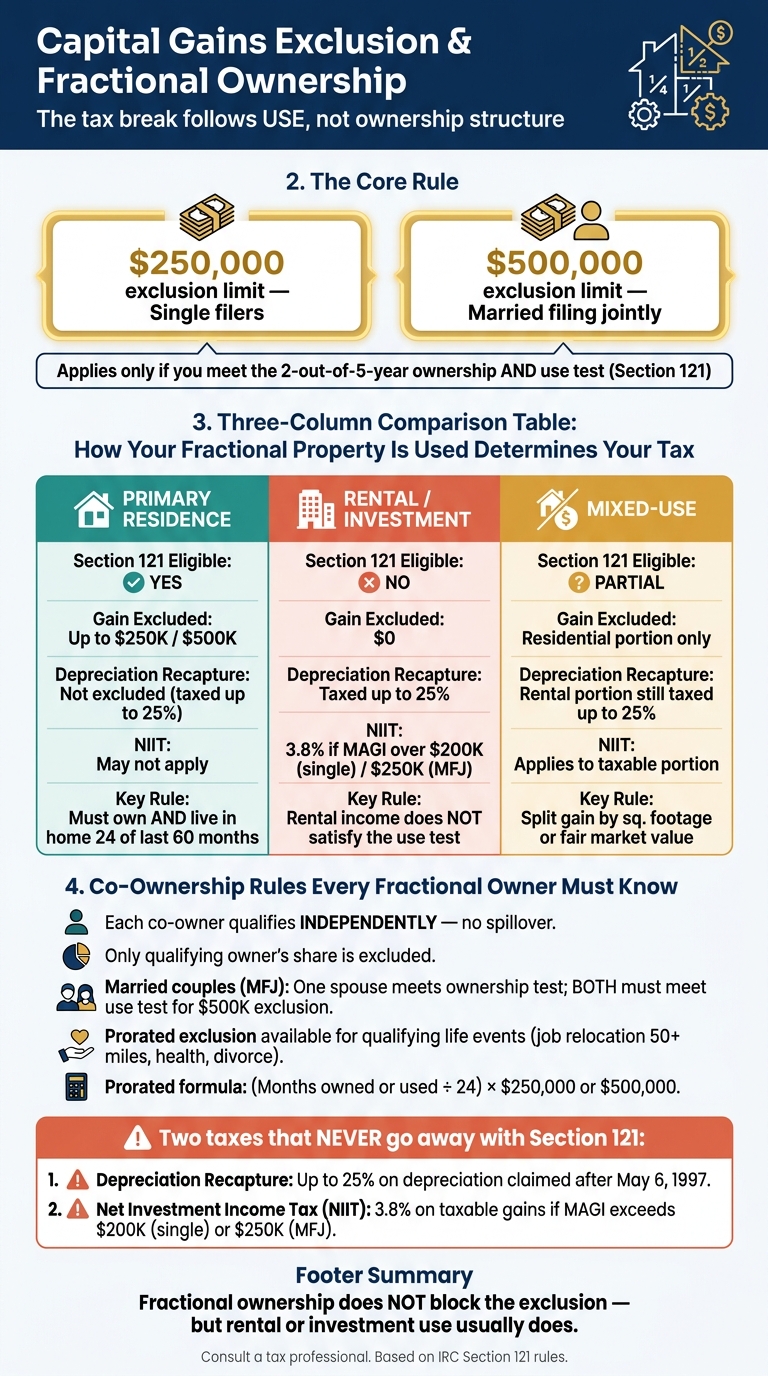
Capital Gains Exclusion for Fractional Owners: Tax Treatment by Property Use
Primary residence rules for co-owners and fractional interests
When a home has more than one owner, the IRS looks at each person on their own. One owner's status doesn't spill over to anyone else. So the key issue is pretty direct: did each co-owner use the property as their main home?
Who can claim the exclusion on a shared home
The IRS says each owner must have owned and lived in the home as their main residence for at least 24 months during the five years before the sale. And yes, each co-owner has to pass both tests on their own.
If only one co-owner meets the rules, only that person can exclude gain on their share.
Here’s a simple example. If three equal co-owners all meet the residency test, each one can exclude gain on their own portion, up to the $250,000 limit.
For married couples filing jointly, the rule works a bit differently. Only one spouse has to meet the ownership test, but both spouses must meet the use test to claim the full $500,000 exclusion.
That split becomes a big deal when a shared property is used in part, or fully, as an investment.
Why second homes and vacation properties do not automatically qualify
Just owning a property doesn't do the job. The IRS wants to know whether it's your main home. In most cases, the IRS treats your main home as the place where you live most of the time.
To sort that out, the IRS looks at the facts and circumstances around your life, including things like:
- your mailing address
- your voter registration
- your driver's license address
A beach house you use for a few weekends each year usually won't make the cut.
If you used the property as a second home or vacation property, you fail the use test. That means your share of the gain is taxable, even if another co-owner does qualify.
Comparison table: primary-residence co-owner vs. nonqualified co-owner
| Factor | Primary-Residence Co-Owner | Nonqualified Co-Owner |
|---|---|---|
| Primary Use | Main residence for 2+ years | Second home, vacation, or investment |
| Ownership Test | Must own for 24 of last 60 months | Must own for 24 of last 60 months |
| Use Test | Met | Not met |
| Section 121 Available | Yes | No |
| Excludable Gain | Up to $250,000 of their share | $0 |
| Tax Treatment | Gain up to the limit excluded; excess taxed as long-term capital gain | Entire gain taxed as long-term capital gains |
The exclusion follows use, not the ownership setup. If the property is rented out instead of used as a main home, the tax result changes.
sbb-itb-a24235f
Why rental property usually does not qualify for the exclusion
Once a fractional property is rented out, the exclusion usually goes away. Section 121 applies to a principal residence, not to rental or investment property. So if you never used the property as your main home, you generally can't claim the exclusion. And rent paid by tenants does not help with the use test.
How capital gains work for fractional rental interests
When you sell a fractional rental interest, your gain is based on your share of the property's appreciation. So if you own a 1/8 interest, you're taxed only on the gain tied to that 1/8 share. The slice is smaller, but the tax rules stay the same.
The holding period matters too. If you hold the interest for more than one year, the gain may qualify for long-term capital gains rates of 0%, 15%, or 20% in 2026, depending on your taxable income. Sell earlier than that, and you usually miss out on long-term capital gains treatment.
Depreciation recapture and other rental-specific tax limits
Rental property can give you depreciation deductions while you own it. But there's a catch at sale. Any depreciation claimed or allowable after May 6, 1997, must be recaptured and taxed at up to 25%, and Section 121 does not exclude recaptured depreciation.
High-income investors may also owe the 3.8% Net Investment Income Tax (NIIT) on taxable rental gains if modified adjusted gross income goes over $200,000 for single filers or $250,000 for married couples filing jointly. That extra layer can make the federal tax bill climb fast.
Mixed-use properties are the main exception.
Comparison table: primary residence vs. rental vs. mixed-use fractional property
| Property Type | Typical Tax Treatment | Section 121 Eligible? | Main IRS Rule |
|---|---|---|---|
| Primary Residence | Exclude up to $250,000/$500,000 of gain | Yes (if 2-of-5 year tests met) | IRC Section 121 |
| Pure Rental Property | Long-term capital gains + depreciation recapture | No | IRC Sections 1001 / 1250 |
| Mixed-Use Fractional | Partial exclusion for the personal-use portion | Partial | IRC Section 121(b)(5) / non-qualified use rules |
Mixed-use property is the main exception.
Mixed-use property and partial exclusion cases
For mixed-use property, only the personal-use part can qualify for Section 121. This is the main situation where you need to split the math instead of treating the whole property the same way.
How to split gain between personal and rental use
Start by looking at nonqualified use after Jan. 1, 2009, and compare it to your total ownership period. That ratio helps determine how much gain does not get the exclusion.
If the property includes separate areas or buildings, like a detached ADU or a duplex, you need to divide basis and gain between the residential and rental parts. This is usually done by:
- Square footage
- Fair market value
Fair market value can sometimes work better, especially when the living area has nicer finishes or carries more market value than the rental portion.
There’s also an important timing rule here. If you lived in the property first as your main home and rented it out later, that later rental period often does not count as nonqualified use, as long as you sell within five years and still meet the 2-of-5-year test. In plain English: renting the home after living in it doesn’t always hurt your exclusion. The calendar matters.
For fractional owners, apply the allocation only to your deeded share.
When a partial exclusion may be available
Even if you don’t meet the full test, you may still get a prorated exclusion. This can apply when you fall short of the full two-year ownership or use rule because of a qualifying event, such as job relocation, health, divorce, or death.
The formula is simple: take the shorter of your ownership period or use period, measured in months, divide that number by 24, and then multiply by the maximum exclusion amount - $250,000 for single filers or $500,000 for married couples filing jointly.
For example, if you owned and lived in the home for 12 months before a qualifying job move, a single filer could exclude up to $125,000 of gain.
For job-related moves, there’s a distance test. The new workplace must be at least 50 miles farther from the home than the old workplace was. That’s one of those rules that sounds small on paper but makes a big difference in practice.
Paperwork matters too. If you’re claiming a partial exclusion, it helps to keep records that back up the reason for the sale, such as employer letters, medical records, or legal decrees.
In a co-ownership setup, each fractional owner does this prorated calculation separately, based on that owner’s own use history and reason for the sale.
Comparison table: personal use, rental use, and non-qualified use
| Use Type | Allocation Method | Can Gain Be Excluded? | Impact of Non-Qualified Use |
|---|---|---|---|
| Primary Residence | None required | Yes - up to $250,000/$500,000 | None |
| Mixed-Use (Time-Based) | Ratio of nonqualified use to total ownership | Partial - residential portion only | Reduces the amount of gain eligible for exclusion |
| Mixed-Use (Separate Structure) | Square footage or fair market value | Partial - residential portion only | Rental structure gain is fully taxable |
| Prorated Exclusion | Prorated by months owned/used | Partial - prorated exclusion | Exclusion limit reduced proportionally |
| Pure Rental/Investment | None required | No | 100% of gain is taxable |
One rule does not budge: depreciation recapture is never excludable. Even if part of your gain qualifies under Section 121, the depreciation recapture piece stays taxable.
Conclusion: The exclusion follows use, not the fractional structure
Section 121 turns on how the property was used, not on the fact that ownership was split into fractions. For fractional owners, that’s the line that matters: a fractional interest can qualify only if the owner used the home as a primary residence.
Each co-owner has to satisfy the ownership and use tests on their own. One owner’s status does not carry over to another owner.
In practice, fractional rental interests usually don’t qualify. If the property had mixed use, only part of the gain may be excluded, and any depreciation recapture tied to the rental part is still taxable. The gain that remains taxable may also face the 3.8% Net Investment Income Tax. So the tax outcome follows the property’s use, not the way ownership was divided.
FAQs
How does the IRS decide if a fractional property was my main home?
The IRS makes this call based on the facts and circumstances of your living situation, not just a single piece of paper. In plain English, that means it wants steady, documented proof that the property was your main home.
It usually looks at a few common signs, including:
- Where you live for most of the year
- The address listed on your driver’s license and voter registration
- Where you get your mail and utility bills
One document alone usually won’t settle it. What matters is whether the full picture points to the same home again and again.
Can I qualify if I lived in the home but another co-owner did not?
Yes. The Section 121 capital gains exclusion is figured separately for each co-owner.
If you meet the ownership and use tests, you can exclude your share of the gain, up to $250,000. That means you must have owned the home and used it as your main home for at least two of the five years before the sale.
If another co-owner doesn’t meet those rules, that person can’t claim the exclusion on their share.
What records should I keep to prove a partial or full exclusion?
Keep records that show the property was your primary residence for at least two of the five years before the sale.
Good documents to keep include:
- Voter registration records
- Your driver’s license with the property address
- Mail records
- Utility bills
- Bank statements
- Tax returns that list the property address
- Settlement statements
- Contractor invoices for improvements
Lofty Editorial