Lofty Editorial
How Blockchain Tokenization Transforms Real Estate
Blockchain tokenization is changing how people invest in real estate by making it more accessible, flexible, and efficient. Here’s what you need to know:
- What is it? Tokenization converts property ownership or rights into digital tokens on a blockchain. These tokens can be bought, sold, or traded easily.
- Why it matters:
- Enables fractional ownership (e.g., buy a $1,000 share of a $40M building).
- Improves liquidity, allowing faster and smoother transactions.
- Smart contracts automate processes like rent distribution and compliance.
- How it works: Properties are held by legal entities (like LLCs), and investors own tokens tied to those entities. Tokens represent equity, debt, or income shares.
- Regulations: Real estate tokens are classified as securities in the U.S., requiring compliance with SEC rules.
- Platforms like Lofty: Invest in rental properties for as little as $50, earn daily rental income, and trade tokens 24/7.
Blockchain is reshaping real estate by lowering barriers, increasing transparency, and simplifying transactions.
How does real estate tokenization work?
sbb-itb-a24235f
How Blockchain Tokenization Works in Real Estate
U.S. SEC Exemptions for Real Estate Token Offerings Compared
Converting Property Interests Into Digital Tokens
Tokenization doesn't alter the physical property itself - it changes how ownership is recorded and managed. Essentially, the property is transferred to a legal entity, like a Delaware LLC or a Wyoming DAO LLC, which holds the title. Investors then receive digital tokens that represent their share in that entity.
"Tokens never represent direct real-property title in virtually any jurisdiction worldwide. Title is held by a legal entity... and the token represents a membership, equity, debt, or beneficial interest in that entity." - Tokenizer.Estate
This creates a layered ownership structure: you → your token → the LLC → the land registry title. Each layer is legally binding, while the blockchain handles the token's transfer and recording. This process simplifies transactions compared to traditional closings. Tokens can either represent equity (giving holders a share in profits and appreciation) or act as debt instruments, similar to tokenized mortgages.
This framework also integrates with smart contracts, enabling automated processes.
Smart Contracts and Automated Processes
Smart contracts are the backbone of tokenized real estate. These self-executing programs run on a blockchain and automatically enforce predefined rules, eliminating the need for intermediaries. As Tokenizer.Estate explains:
"If the contract says 'distribute 7% of collected rent to all token holders on the first of every month,' that is exactly what happens."
Beyond rent distributions, smart contracts handle tasks like KYC/AML checks, enforce lockup periods, update ownership records in real time, and even support governance by allowing token holders to vote on property decisions based on their stake. For example, platforms like Lofty use the Algorand blockchain to distribute rental income as small as $0.05 directly to investors' wallets.
While smart contracts streamline many processes, they don't replace everything. Off-chain tasks like property management, tenant relations, and deed recording with local authorities still follow traditional methods.
Legal and Regulatory Considerations
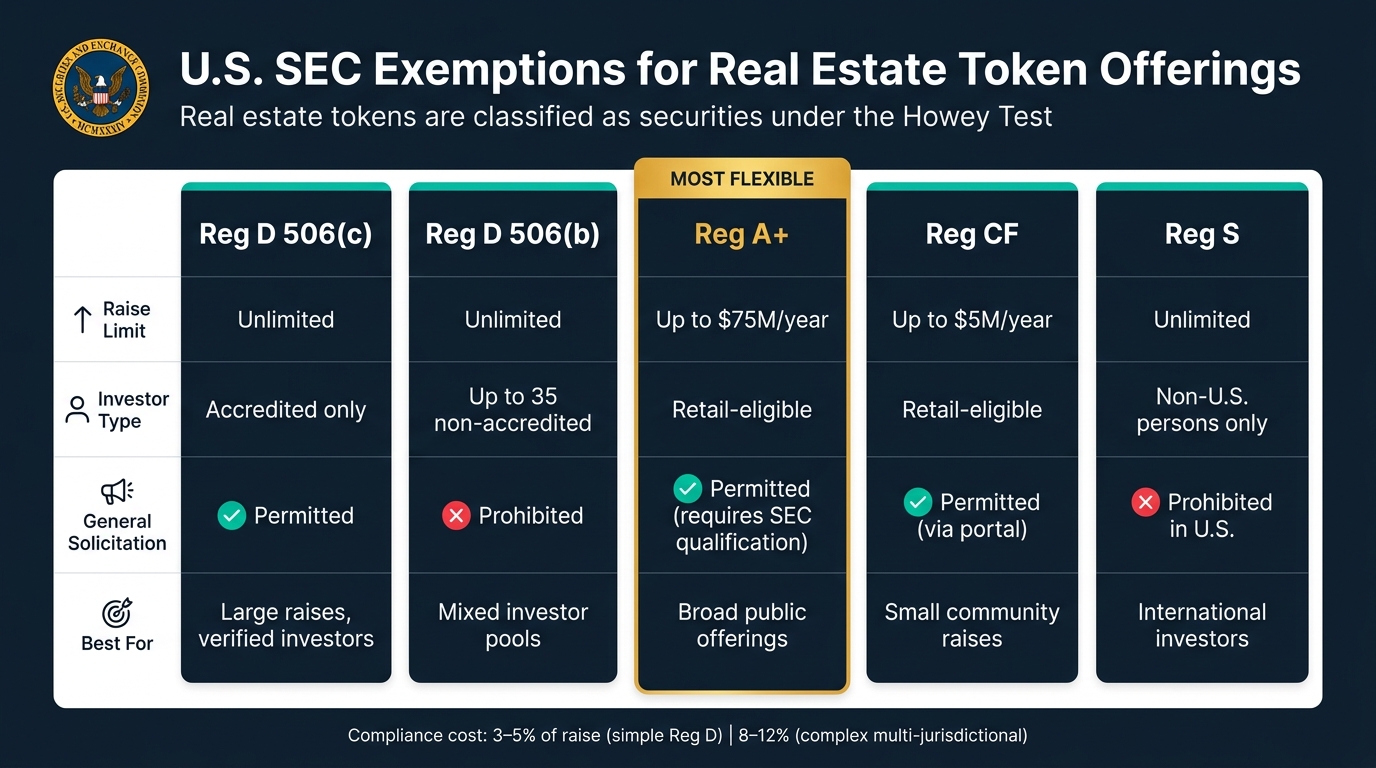
Once the technical structure is in place, regulatory compliance becomes critical. In the U.S., real estate tokens typically qualify as securities under the Howey Test, as they involve an investment with an expectation of profit tied to someone else's efforts. This classification means issuers must either register with the SEC or meet specific exemption criteria. Here's a breakdown of key exemptions and their requirements:
| Exemption | Raise Limit | Investor Type | General Solicitation |
|---|---|---|---|
| Reg D 506(c) | Unlimited | Accredited only | Permitted |
| Reg D 506(b) | Unlimited | Up to 35 non-accredited | Prohibited |
| Reg A+ | Up to $75M/year | Retail-eligible | Permitted (requires SEC qualification) |
| Reg CF | Up to $5M/year | Retail-eligible | Permitted (via portal) |
| Reg S | Unlimited | Non-U.S. persons only | Prohibited in U.S. |
Compliance can be expensive, but smart contracts help offset some costs by improving efficiency. For example, a standard single-asset U.S. Reg D structure usually costs 3%–5% of the raise in the first year, while more complex, multi-jurisdictional deals can reach 8%–12%. The St. Regis Aspen tokenization is a notable case where Elevated Returns raised $18 million in equity using a Reg A+ filing, but platform, legal, and broker-dealer fees reportedly exceeded 10% of the funds raised.
It's also worth noting that tokenized real estate can't be traded on regular cryptocurrency exchanges. In the U.S., secondary trading must take place on regulated Alternative Trading Systems (ATS).
A Step-by-Step Guide for Real Estate Investors
Deciding if Tokenized Real Estate Fits Your Goals
Before diving into tokenized real estate, take a moment to assess your investment goals. Are you looking for steady rental income, long-term property appreciation, or diversification without the need for significant upfront capital? Your objectives will play a big role in determining whether equity, debt, or revenue-share tokens align with your strategy.
Here’s a quick breakdown of these token types:
- Equity tokens: These represent co-ownership in the entity that holds the property.
- Debt tokens: Acting as a lender, you earn fixed interest on your investment.
- Revenue-share tokens: You get a share of the net rental income without owning equity in the property.
Each option has its own risks and potential rewards, so it’s essential to weigh them carefully. And don’t forget to evaluate the property itself - just like with traditional real estate. Look into its location, occupancy rates, and cash flow to ensure it meets your expectations.
Understanding Tokenized Property Structures
Once you’ve decided to invest, it’s crucial to understand exactly what you’re buying. With tokenized real estate, your token usually represents a claim against the holding entity, not direct ownership of the property. Two key factors to consider are:
- The legal wrapper: This affects how your investment is taxed.
- The securities exemption: Whether it’s Reg D or Reg CF, this determines who can invest and under what conditions.
Before completing your purchase, you’ll need to pass a KYC/AML (Know Your Customer/Anti-Money Laundering) check. By 2026, many platforms use Decentralized Identity (DID) credentials, allowing you to verify your identity once and use it across multiple investments without repeating the process. After verification, you’ll sign an investment agreement on the platform, and a smart contract will handle transfer restrictions or lockup periods automatically. From the structuring of the deal to the point where you can invest, the process typically takes 6–10 weeks.
Once your investment is finalized, the focus shifts to managing it effectively.
Managing and Monitoring Your Investments
After purchasing your tokens, managing them becomes relatively hands-off thanks to automation. Rent payments are automatically distributed to your digital wallet, and your ownership record is updated on the blockchain in real time.
If you decide to trade on the secondary market, you can use limit orders, monitor the order book for the best prices, and ensure your verification credentials are up to date. The good news? Even while your tokens are in escrow, they’ll continue to earn rental income.
"Lofty's marketplace brings liquidity to directly owned real estate by enabling instant peer-to-peer transactions that make things easier for investors." - Jerry Chu, Lofty
How Lofty Makes Tokenized Real Estate Accessible
Investing in U.S. Rental Properties With Lofty
Lofty uses blockchain technology to simplify access to U.S. rental property investments, removing long-standing barriers like large down payments, complex loans, and extensive expertise.
Traditionally, real estate investing has been seen as a challenging endeavor, requiring significant capital and financial know-how. Lofty changes the game by streamlining funding and transaction processes, making it easier for everyday investors to participate.
As Jerry Chu, Co-founder and CEO of Lofty, explains:
"We had assumed that finding a property to invest in was 95% of the work involved... But after speaking with our initial investors, we realized that the bigger barriers were actually having the funds, being able to get the right loans, and ultimately going through the transaction process." - Jerry Chu, Co-founder and CEO of Lofty
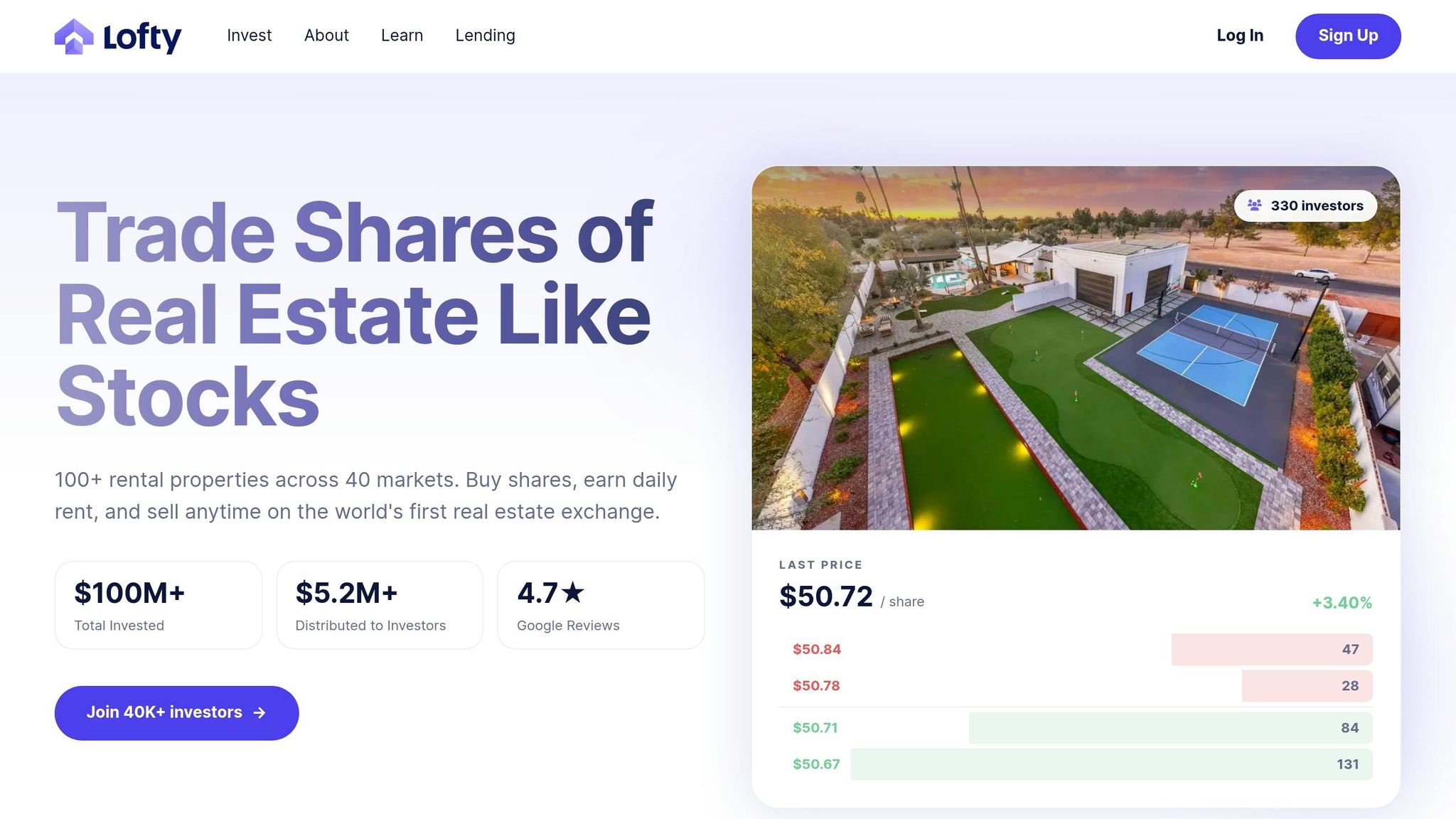
With Lofty, you can invest in fractional ownership of U.S. rental properties for as little as $50 per token. These tokens represent a legal stake in the property, which is held by a Wyoming DAO LLC. Even if you're new to cryptocurrency, Lofty makes it simple by creating a blockchain wallet for you when you fund your account. Payment options include credit cards, ACH bank transfers, and cryptocurrencies like USDC and ALGO.
As of May 2026, the platform boasts over 100 rental properties in 40 markets, a community of 40,000 investors, and has paid out more than $5.2 million in rental income to its users. This accessible model has opened real estate investing to a broader audience.
Key Features of Lofty's Marketplace
Lofty’s platform is designed to make fractional real estate ownership straightforward and flexible. Here’s what sets it apart:
- Daily Rental Income: Earnings are distributed daily, starting the same day you invest. You can withdraw or reinvest these funds whenever you choose.
- Liquidity Without Lock-Up: There’s no mandatory holding period. Tokens can be listed for sale 24/7 on Lofty’s peer-to-peer secondary marketplace, with transactions settled on the Algorand blockchain.
- Smart Contract Security: All transactions are executed through smart contracts audited by CertiK, ensuring transparency and security. To trade, participants must hold a verification NFT.
- Investor Involvement: Token holders have a say in property management decisions, such as setting rents, handling evictions, and approving repairs, while professionals handle day-to-day operations.
Before committing to an investment, you’ll have access to detailed property information, including inspection reports, financial data, and valuations from HouseCanary. This ensures you’re equipped to make informed decisions.
The Future of Blockchain in Real Estate
Emerging Blockchain Platforms for Real Estate
Blockchain technology in real estate is no longer just an experiment. By 2026, tokenization has become a practical solution for enhancing liquidity, transparency, and efficiency in property markets worldwide. Specialized platforms are playing a pivotal role in making this shift a reality.
A major milestone occurred in January 2026, when four PropTech companies - Sahl, Madak, Ghanem, and Jozo - successfully executed the first fully tokenized real estate transactions in Saudi Arabia. These transactions utilized SettleMint's Digital Asset Lifecycle Platform (DALP), which was seamlessly integrated with the national identity service (Yakeen) and the electronic payment system (Sadad). This setup enabled live, on-chain settlements and ownership transfers. Impressively, the entire process - from infrastructure setup to live transactions - was completed in under three months.
"The implementation has progressed significantly, where today PropTechs are utilizing secure integration interfaces to complete the first fully tokenized real estate transactions in the Kingdom." - Adam Popat, CEO, SettleMint
Other platforms are also redefining how real estate assets are represented on the blockchain. Manifest, for example, has introduced a protocol that converts U.S. residential home equity into a synthetic-dollar token called USH. This token is designed to integrate seamlessly with decentralized finance (DeFi) markets for lending and yield opportunities. As Manifest explains it: "USH is a synthetic-dollar token backed by American residential real estate - composable across DeFi". Such innovations suggest a future where real estate investments extend beyond traditional ownership, embedding real estate exposure into diverse financial products. These developments hint at a broader transformation in how blockchain can reshape investment strategies.
What Future Blockchain Developments Mean for Fractional Investors
For individual investors, the most exciting changes on the horizon involve lower costs, greater transparency, and improved liquidity. A convergence of technical advancements is driving these improvements.
One key innovation is programmable compliance, which integrates transfer restrictions, investor eligibility, and jurisdictional rules directly into token contracts. This ensures compliance is automatically enforced with every transaction, eliminating the need for manual reviews. When combined with Decentralized Identity (DID), investors can complete identity verification (KYC/AML) once and use their credentials across multiple platforms. This significantly reduces the barriers to starting new investments.
The potential for growth is immense. Over 70% of real estate experts anticipate that tokenization will dominate the industry by 2030, with the tokenized real estate market projected to grow at an annual rate exceeding 20%. For fractional investors, this means access to a wider range of properties, more liquid secondary markets, and - with the rise of AI-powered pricing tools - real-time, accurate valuations of their holdings. These advancements promise to make fractional real estate investments more accessible, efficient, and appealing than ever before.
Conclusion: Making Real Estate Investment More Accessible
Blockchain tokenization is reshaping how people approach real estate investment. What used to require hefty down payments, piles of paperwork, and a chain of intermediaries can now begin with as little as $50. Through digital tokens, investors gain genuine ownership, while smart contracts handle transactions seamlessly, and public ledgers provide unmatched transparency. These advancements are creating a market that's quicker, more affordable, and open to a broader range of participants.
This shift is already in motion, with platforms like Lofty showcasing how technology is transforming access to real estate investments.
FAQs
What exactly does a real estate token represent?
Real estate tokens are digital assets that signify a legal claim or ownership interest in a property. Their structure can vary, encompassing equity shares in a holding company, debt instruments, or revenue-sharing agreements. By enabling fractional ownership and offering greater liquidity, these tokens simplify the process of investing in real estate.
How do I earn rent income from tokenized real estate?
When you invest in digital tokens, you gain fractional ownership of a property. These tokens are linked to a legal entity, like an LLC, which holds the property title.
As a token holder, you receive rental income proportional to your ownership. This income is typically distributed daily through smart contracts. Payments are converted into stablecoins and sent straight to your digital wallet, creating a passive income opportunity powered by blockchain technology.
What are the biggest risks of investing in tokenized properties?
Investing in tokenized properties comes with its share of risks. One major concern is encountering developers who exaggerate the value of low-quality assets, making them seem more appealing than they really are. Additionally, some tokens may operate without proper regulation or might be tied to assets that hold little to no real value.
Another significant risk is the potential for scams, especially those targeting less experienced investors. The rapid and fractional nature of blockchain technology can create opportunities for bad actors to take advantage of newcomers in the space. Staying informed and cautious is crucial when navigating this evolving market.
Lofty Editorial