Lofty Editorial
How Blockchain Drives Institutional Real Estate Adoption
Blockchain is reshaping institutional real estate by addressing inefficiencies, reducing costs, and enabling faster transactions. Here's how it's transforming the industry:
- Tokenization: Converts property ownership into digital tokens, enabling fractional ownership and partial liquidity.
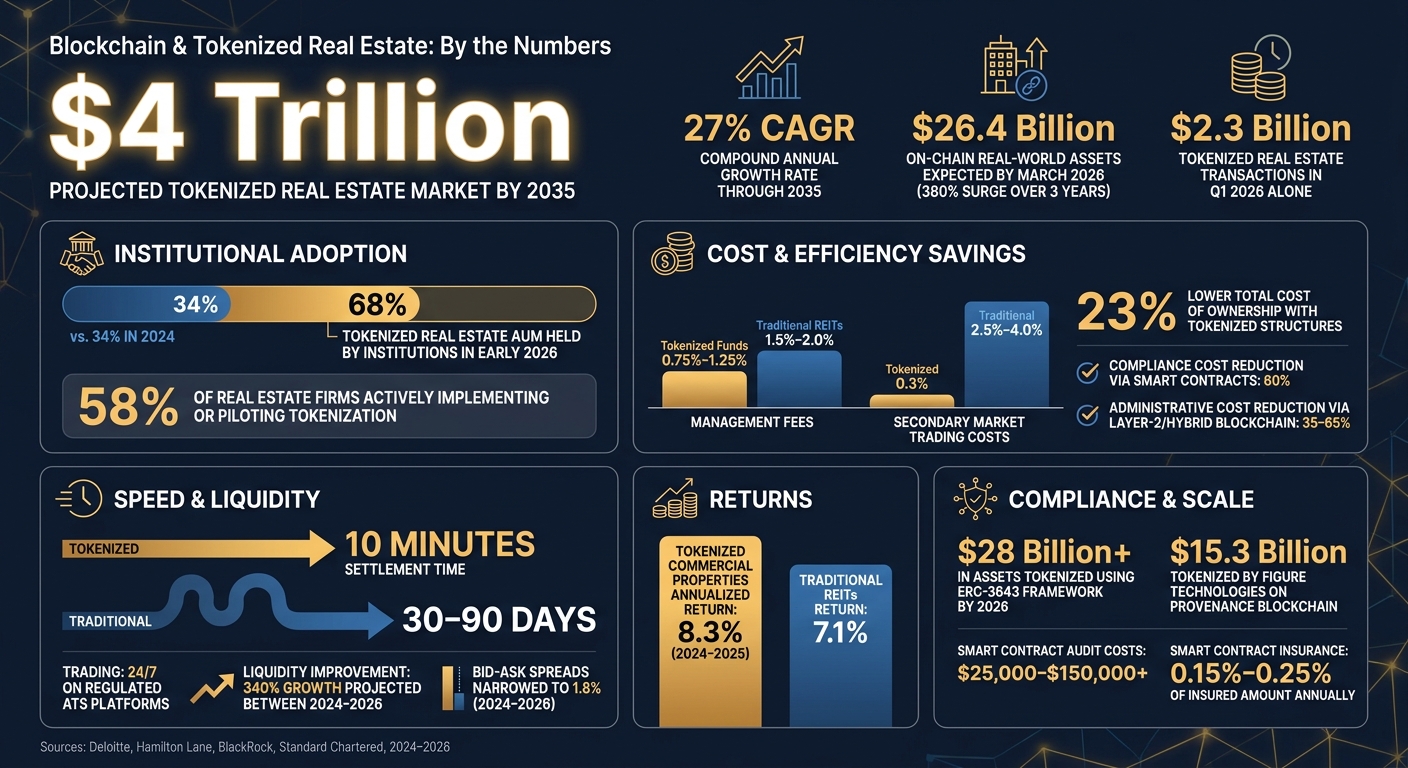
- Faster Settlements: Transactions complete in about 10 minutes compared to 30–90 days traditionally.
- Lower Costs: Tokenized funds charge 0.75%–1.25% in management fees versus 1.5%–2.0% for traditional REITs, cutting total ownership costs by 23%.
- 24/7 Liquidity: Secondary markets allow round-the-clock trading.
- Compliance Automation: Smart contracts embed rules like KYC/AML directly into tokens, reducing costs by 60%.
- Transparency: Blockchain's immutable records enhance accountability and align with ESG reporting needs.
Institutions are increasingly adopting blockchain, with 68% of tokenized real estate assets under management (AUM) held by institutions in early 2026, up from 34% in 2024. The market is projected to grow significantly, reaching $4 trillion by 2035. This shift is driven by faster processes, reduced costs, and improved liquidity, making blockchain a game-changer for real estate investment.
Blockchain Tokenized Real Estate: Key Stats & Market Growth 2024–2035
Why Institutions Are Turning to Blockchain for Real Estate
Cost Reduction, Efficiency, and Portfolio Flexibility
Tokenized real estate funds are reshaping the cost structure of the industry. They charge annual management fees ranging from 0.75% to 1.25%, significantly lower than the 1.5% to 2.0% typical of traditional REITs. Secondary market trading costs are also much lower, averaging 0.3%, compared to the 2.5% to 4.0% seen in conventional transactions. Altogether, tokenized structures reduce the total cost of ownership by 23% compared to traditional REITs.
In addition to cost savings, smart contracts are automating processes across the investment lifecycle. This automation streamlines fund management, reducing manual intervention and boosting efficiency. Deloitte's Rob Massey highlights this transformation:
"Blockchain is drawing the attention of asset managers who recognize its potential to automate how money moves through the life cycle of a fund."
Fractionalization adds another layer of flexibility. Instead of selling an entire asset to rebalance, funds can sell a specific portion of a tokenized property. This approach introduces partial liquidity, making portfolio adjustments more precise and efficient, while also opening the door to broader market participation.
Liquidity and Broader Market Access
Tokenization doesn’t just cut costs - it fundamentally changes how real estate assets are traded. Tokenized properties are traded on regulated Alternative Trading Systems (ATS) 24/7, with settlements completed in about 10 minutes, compared to the 30–90 days typical in conventional real estate transactions. This speed and accessibility are redefining how institutions view real estate as an investment.
Cross-border transactions also become more seamless through stablecoin technology. For example, BlackRock has adopted its treasury-backed BUIDL stablecoin as the settlement layer for real estate transactions. This move highlights the growing role of stablecoins in institutional real estate markets.
"The treasury stablecoin infrastructure is becoming the rails for institutional real estate tokenization. When pension funds and asset managers hold treasury-backed digital assets, they gain seamless access to tokenized property markets without traditional settlement friction." - Senior Analyst, Standard Chartered
Transparency, Security, and ESG Alignment
Blockchain technology is addressing compliance and transparency challenges head-on. Its immutable records create a permanent audit trail, ensuring accountability at every stage. Transactions, ownership transfers, and distributions are all recorded on-chain, accessible to administrators, custodians, and investors - without compromising sensitive data.
This transparency aligns perfectly with ESG reporting requirements. By providing verifiable ownership records, blockchain reduces the risk of misrepresentation and supports the accountability that institutional investors and stakeholders demand. As Roials Capital puts it:
"Stewardship is not a moral abstraction. It is a technical discipline that requires efficient deployment channels and transparent ownership structures."
The infrastructure supporting tokenized real estate is advancing rapidly. Hamilton Lane’s research division has reported that programmable compliance and 24/7 settlement are prompting asset managers to reconsider their real estate strategies. Liquidity for tokenized properties is projected to grow by 340% between 2024 and 2026, signaling that the market is maturing to accommodate institutional investment on a large scale.
sbb-itb-a24235f
Blockchain Technology and Compliance for Institutions
Public, Private, and Permissioned Blockchains
For institutions to adopt blockchain technology, it needs to align with strict compliance standards while supporting efficient, low-cost transactions and transparency. Different blockchain types play distinct roles in meeting these needs. Public networks like Ethereum and Algorand provide broad liquidity and interoperability. However, their openness - where transaction data is visible to anyone - poses a compliance challenge for most institutions. On the other hand, permissioned networks such as Quorum and Hyperledger Besu allow only approved participants to access and transact, offering greater control over data visibility.
This is why many institutions are leaning toward permissioned or hybrid blockchain setups. In a hybrid model, sensitive information - like investor identities or property valuations - is kept off-chain. Meanwhile, the blockchain itself serves as a shared layer for coordination, verification, and audit trails. Layer-2 solutions like Polygon and Arbitrum are also gaining popularity, as they enable high transaction volumes while maintaining speed and cost efficiency. These approaches lay the groundwork for secure and compliant blockchain frameworks.
Security Measures and Risk Management
For institutions, adopting blockchain involves implementing strong security measures. A key focus is digital asset custody. Institutions rely on qualified custodians like Fireblocks and BitGo, which use multi-signature controls and cold storage to protect private keys. This is critical because losing a private key means losing access to the assets tied to it.
Another major concern is smart contract security. To avoid vulnerabilities, every smart contract must undergo thorough checks, including formal verification, static analysis, and manual audits. These audits can be costly, with prices ranging from $25,000 to over $150,000 for complex contracts. Additionally, institutions often opt for smart contract insurance, which typically costs 0.15%–0.25% of the insured amount annually.
Compliance measures like KYC (Know Your Customer) and AML (Anti-Money Laundering) are also integrated into blockchain systems. Token standards such as ERC-3643 (T-REX) automate these processes by linking wallet addresses to verified investor identities through on-chain identity registries like ONCHAINID. This setup enforces transfer restrictions automatically, eliminating the need for manual transaction reviews. By 2026, over $28 billion in assets had been tokenized using the ERC-3643 framework.
With these security and compliance protocols in place, institutions can confidently navigate blockchain adoption while adhering to regulatory standards.
Regulatory and Legal Structure in the U.S.
In the United States, tokenized real estate is classified as a security. The SEC clarified this on January 28, 2026, stating that "the format of issuance or technology used for recordkeeping does not alter the application of federal securities laws". This means that tokenized property offerings must follow the same rules as traditional securities, including disclosure requirements, investor eligibility, and transfer restrictions.
Most tokenized real estate deals in the U.S. are structured under Regulation D (506(b) or 506(c)), which limits participation to accredited investors but allows unlimited fundraising. Other exemptions, such as Reg A+ and Reg CF, permit non-accredited investor participation but have lower capital-raising limits. Here's a quick comparison:
| SEC Exemption | Investor Type | Maximum Raise | General Solicitation |
|---|---|---|---|
| Reg D 506(c) | Accredited only | Unlimited | Permitted |
| Reg D 506(b) | Up to 35 non-accredited | Unlimited | Prohibited |
| Reg A+ | All investors | $75M / 12 months | Permitted |
| Reg CF | All investors | $5M / 12 months | Permitted |
From a legal perspective, tokens in the U.S. typically represent beneficial ownership in a Special Purpose Vehicle (SPV), such as an LLC or LP, which holds the actual property title in traditional land registries. For this system to work, the SPV’s agreements must recognize the blockchain ledger as the definitive ownership record. Without this alignment, tokens would lack enforceability in court. This legal framework ensures that tokenized transactions remain both practical and legally sound, reinforcing their appeal for institutional use.
How Tokenization Works and What Infrastructure It Requires
The Tokenization Process, Step by Step
Tokenizing a real estate asset is more about legal frameworks and structuring than technology.
The first step is deciding what part of the asset to tokenize - this could be equity in a holding entity, debt secured against the property, or revenue-sharing rights. Once that's clear, the next move is to establish a legal wrapper, like a Delaware LLC or LP, and choose a securities exemption (such as Reg D or Reg A+). Afterward, transfer rules and jurisdictional restrictions are finalized.
Here’s a breakdown of how a typical tokenization deal unfolds:
| Phase | Timeline | Activities |
|---|---|---|
| Structuring | Weeks 1–3 | Selecting legal wrapper, exemption type, jurisdiction, and transfer rules |
| Documentation | Weeks 3–6 | Drafting offering documents, subscription agreements, and setting up KYC/AML |
| Platform & Mint | Weeks 6–8 | Deploying token contracts, creating the cap table, and launching the investor portal |
| Distribution | Week 8+ | Activating broker networks and starting the primary raise |
From start to finish, it typically takes about 6–10 weeks to go from structuring to securing the first investor. For single-asset deals valued between $5 million and $50 million, total costs - including legal, compliance, and platform fees - generally fall in the low-to-mid six-figure range.
One key takeaway from industry experts is that issuers often stumble when they treat tokenization as purely a tech project. As Gene Deyev, CEO of Stobox, explains:
"Issuers who treat tokenization as a technology project stall in month three. Issuers who treat it as a structuring and distribution project close their raise."
Another crucial element is implementing Decentralized Identity (DID) from the outset. DID allows investors to complete KYC/AML verification once and reuse those credentials across multiple investments. This avoids lengthy onboarding delays during active fundraising efforts.
This structured approach is essential for building the broader ecosystem needed to support institutional tokenization.
The Ecosystem Supporting Institutional Adoption
Institutions rely on a range of specialized providers to make tokenization work seamlessly.
Issuance platforms, such as Stobox or Securitize, handle the creation of token contracts and manage cap tables. Qualified custodians, like Fireblocks, ensure the security of private keys. Oracle networks, such as Chainlink, connect on-chain tokens to off-chain data, providing updates on property valuations, rental income, and maintenance records - ensuring smart contracts function as intended. Meanwhile, Alternative Trading Systems (ATS) like tZERO facilitate secondary market trading for tokens after issuance.
Here’s how the infrastructure fits together:
| Component | Primary Function | Key Tools |
|---|---|---|
| Issuance Platform | Minting and managing tokens | Stobox, Securitize |
| Token Standards | Encoding regulatory rules | ERC-1400, ERC-3643 |
| Data Connectivity | Linking tokens to real-world data | Chainlink, Oracles |
| Secondary Markets | Enabling post-issuance trading | tZERO, MERJ Exchange |
Simply minting tokens without a well-thought-out distribution strategy doesn’t deliver results.
Scalability and Performance Considerations
Once the infrastructure is in place, the next challenge is scalability - ensuring smooth operations for tokenized real estate.
Legacy blockchain networks often face high gas fees, which can make frequent, small transactions inefficient. For example, platforms that handle micro-distributions, like daily or weekly rental payouts, often prefer high-performance chains. Algorand is a good fit for this, offering sub-second transaction finality and fees under $0.01. Similarly, Polygon provides compatibility with Ethereum smart contracts (EVM) and supports ERC-3643 compliance, delivering a familiar and efficient environment for institutions.
Scalable blockchain solutions like these are already reshaping fund management. Layer-2 solutions and hybrid architectures are reducing administrative costs by 35–65% compared to traditional fund management methods.
A great example of this efficiency came in February 2024, when Citigroup partnered with Wellington Management and WisdomTree to pilot tokenized private markets. They successfully encoded distribution "waterfall" rules directly into the fund's smart contracts, automating tiered payouts without manual intervention. This kind of automation shows how scalable infrastructure can streamline operations for institutional investors.
Future Outlook and Applications in Tokenized Real Estate
Global Trends and Market Growth
The tokenized real estate market is on an impressive growth trajectory. By March 2026, on-chain real-world assets are expected to reach $26.4 billion, marking a 380% surge over three years. In the first quarter of 2026 alone, tokenized real estate platforms handled $2.3 billion in transactions. Looking further ahead, the market is projected to hit $4 trillion by 2035, growing at a compound annual growth rate of 27%. Liquidity in secondary markets is also improving rapidly, with bid-ask spreads on tokenized properties narrowing to just 1.8% between 2024 and 2026 - a 340% improvement. Additionally, 58% of real estate firms are now actively implementing or piloting tokenization initiatives. This surge is being fueled by strong institutional interest.
Regulatory frameworks are playing a significant role in this expansion. The EU’s MiCA framework became fully operational in December 2024, while Dubai and Singapore have introduced tailored regulations aimed at attracting institutional capital. Dubai, for instance, has integrated blockchain ownership records directly with its official land registry, updating them in real time.
"The efficiency gains from 24/7 settlement and programmable compliance are compelling institutional investors to reconsider their real estate allocation strategies." - Hamilton Lane Digital Assets Research Division
These developments are not just theoretical - they're being put into action through real-world case studies.
Institutional Case Studies
The tokenization of real estate has moved beyond experimental stages into full-scale institutional implementation. A standout example is BlackRock's BUIDL fund, a tokenized U.S. Treasury product built on Ethereum. By mid-2025, it reached $2.3 billion in Total Value Locked, capturing 45% of the tokenized treasury segment. BlackRock has also invested $47 million in Securitize, the platform underpinning its tokenization infrastructure. BlackRock CEO Larry Fink has been clear about the transformative potential of tokenization:
"Every stock and bond would eventually live on a shared digital ledger. Tokenization is not a product - it is a new market structure."
On the debt side, Figure Technologies has tokenized over $15.3 billion in assets on the Provenance blockchain as of April 2026, with a focus on Home Equity Lines of Credit (HELOCs). By automating verification processes, Figure has reduced closing times from 45 days to just minutes.
In Dubai, the Dubai Land Department launched the second phase of its Real Estate Tokenization Project in February 2026. Partnering with Ctrl Alt, the initiative enabled secondary market trading for approximately 7.8 million real estate tokens on the XRP Ledger, fully integrated with the government’s land registry.
While these initiatives highlight large-scale institutional adoption, platforms like Lofty are demonstrating how tokenization can work at the individual property level.
How Platforms Like Lofty Fit Into This Trend
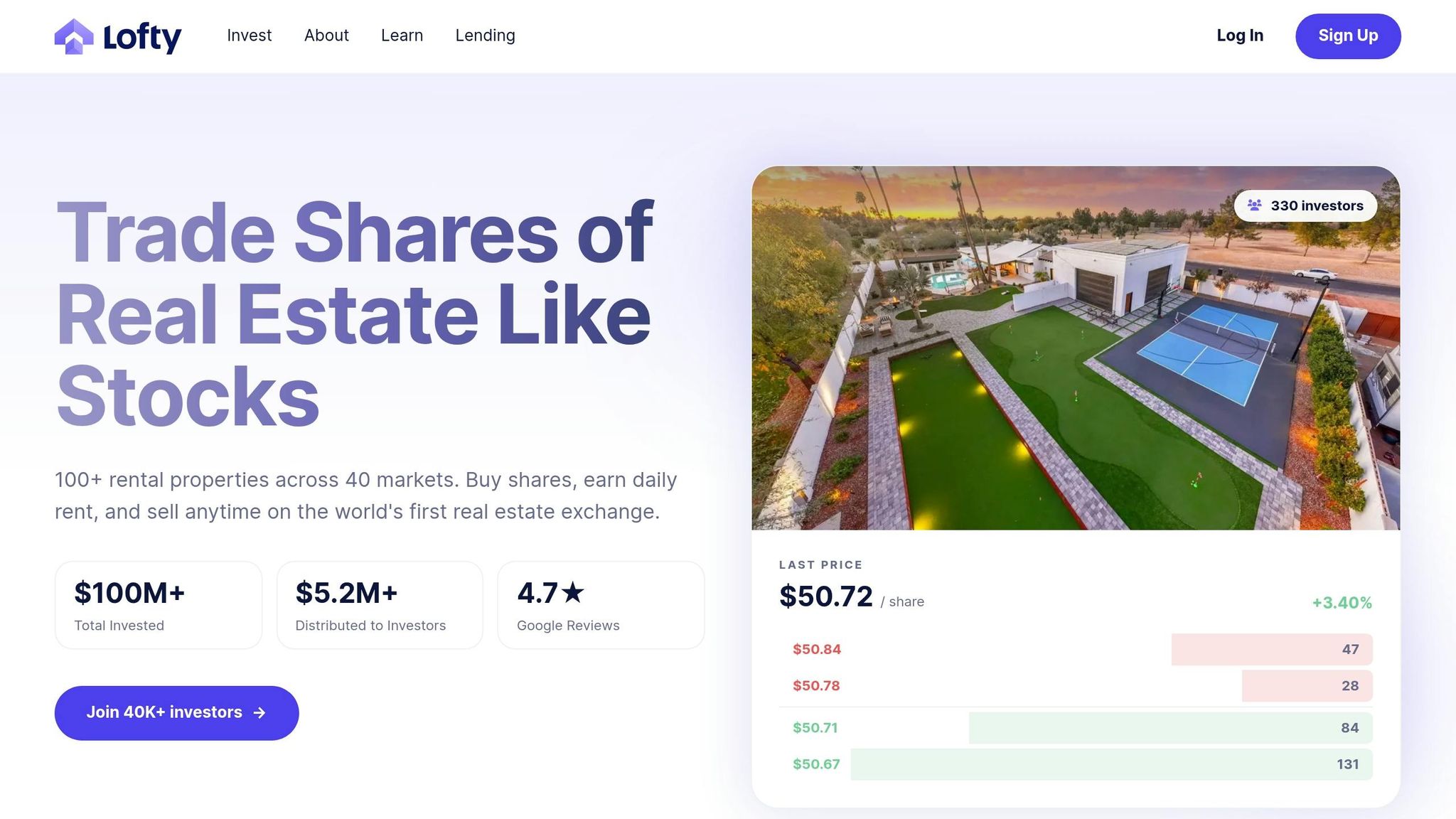
While institutions focus on billion-dollar funds, platforms like Lofty bring tokenization to individual properties. Built on the Algorand blockchain, Lofty has tokenized over 150 properties across 40 U.S. markets as of 2026.
Lofty uses a DAO LLC structure for each property, allowing investors to purchase fractional ownership starting at just $50. Investors can choose specific properties and receive daily rental income paid in stablecoins. This approach provides transparency and control, contrasting with larger, diversified funds that often lack visibility into their underlying assets.
The same smart contract technology that Citigroup used for its 2024 pilot to automate distribution waterfall rules is what powers Lofty’s daily rental payments, eliminating the need for manual processing.
"The technology is superior... It's a fantastic thing for the world - the world just has to catch up with it." - Barry Sternlicht, CEO, Starwood Capital
As institutional tokenization frameworks mature and secondary markets continue to grow, the gap between large-scale funds and platforms like Lofty is narrowing. Both are working toward the same goal: making real estate liquid, transparent, and accessible 24/7.
Property Play: How blockchain could cut real estate costs in half
Conclusion: What Blockchain Means for Institutional Real Estate
Blockchain is no longer just a futuristic concept for real estate - it's becoming a foundational part of the industry. By 2026, institutional players account for 68% of tokenized real estate assets under management (AUM), a significant jump from 34% in 2024. The data backs this up: faster settlement times, reduced management fees, and lower transaction costs are all hallmarks of tokenized structures.
These advancements are paving the way for smarter, more efficient operations. Programmable compliance - where anti-money laundering (AML), know-your-customer (KYC) rules, and transfer restrictions are built directly into tokens - eliminates manual roadblocks that often slow down institutional processes. Meanwhile, smart contracts streamline tasks like subscriptions, capital calls, and distributions, reducing errors and speeding up capital deployment.
"By 2030, most fund managers will likely use blockchain-enabled digital assets in at least one part of the fund flow process." - Deloitte Center for Financial Services
Blockchain is also reshaping transparency and market accessibility. Between 2024 and 2025, tokenized commercial properties delivered annualized returns of 8.3%, outperforming traditional REITs, which yielded 7.1%. Fractional ownership has lowered barriers to entry, and platforms like Lofty are showcasing how these innovations extend blockchain's reach beyond institutional funds, making real estate more accessible, liquid, and transparent at all levels.
With the global tokenized real estate market expected to hit $4 trillion by 2035, growing at a 27% compound annual growth rate (CAGR), institutions that invest in blockchain capabilities today - testing workflows, creating digital asset strategies, and partnering with qualified custodians - will be well-prepared for the future. The tools are available, regulatory frameworks are improving, and the moment to embrace this transformation is now.
FAQs
What legal rights does a token actually give me in a U.S. property?
When you purchase a Lofty token, you’re essentially buying a membership interest in a Wyoming LLC that owns the property’s legal title. This ownership grants you a stake in the property’s equity, a portion of the rental income, and voting rights on important decisions, like maintenance or tenant selection. However, it’s important to note that you won’t receive a direct deed to the property.
How do institutions keep investor data private while using blockchain?
Institutions safeguard investor data on blockchain by using privacy-preserving tokenization, a method that encrypts sensitive information such as identities and transaction details. This approach ensures that only authorized individuals or entities can access the data, while still maintaining transparency for ownership and settlement processes.
One key technique employed is Zero-Knowledge Proofs (ZKPs). ZKPs allow transactions to be verified without revealing the underlying details. This not only protects privacy but also ensures compliance with regulations and shields proprietary information from exposure.
What happens if a custodian key is lost or a smart contract fails?
If a custodian key is lost or a smart contract encounters an issue, the blockchain platform's built-in safeguards step in to manage ownership and security. While the exact processes differ between platforms, these systems are generally designed to protect assets and maintain smooth operations during such events.
Lofty Editorial