
Lofty Editorial
Ultimate Guide to Financial Structures in Co-Ownership
Co-ownership involves sharing property ownership between multiple individuals, but it’s not just about splitting costs. The real challenge lies in managing responsibilities, income, and exits. Choosing the right financial structure is critical to avoid disputes and ensure smooth operations. Here’s what you need to know:
- Ownership Structures: Common options include Tenancy in Common (TIC), Joint Tenancy, and LLCs. TIC allows flexible ownership percentages, while Joint Tenancy provides equal shares with survivorship rights. LLCs offer liability protection and structured governance.
- Funding and Ownership: Ownership stakes are often based on financial contributions but can include non-cash inputs like management duties. Agreements should clearly document percentages to avoid future conflicts.
- Cost Sharing and Income Division: Expenses like taxes and maintenance are typically split based on ownership percentages. Rental income is also distributed proportionally, with clear terms to define net cash flow and avoid misunderstandings.
- Exit Strategies: Planning for exits is essential. Options include secondary markets, buyouts, or mandatory sales. Right of First Refusal (ROFR) clauses give existing owners priority to purchase shares before external buyers.
- Governance: Clear rules for decision-making and dispute resolution are vital. Simple tasks may require no votes, while major decisions often need a supermajority.
For a modern, hassle-free approach, platforms like Lofty enable fractional ownership through LLCs, simplifying management, income distribution, and liquidity.
Quick Comparison of Ownership Structures:
| Feature | Tenancy in Common (TIC) | Joint Tenancy | LLC |
|---|---|---|---|
| Ownership Shares | Flexible | Equal | Flexible |
| Liability Protection | None | None | Strong |
| Financing | Easier with loans | Easier with loans | Commercial terms |
| Transfer on Death | Passes to heirs | Right of survivorship | Defined by agreement |
| Governance | Informal | Simple | Formal agreements |
How to Write a Co-Ownership Agreement [Lawyer Template Available]
sbb-itb-a24235f
Co-Ownership Models and Entity Structures
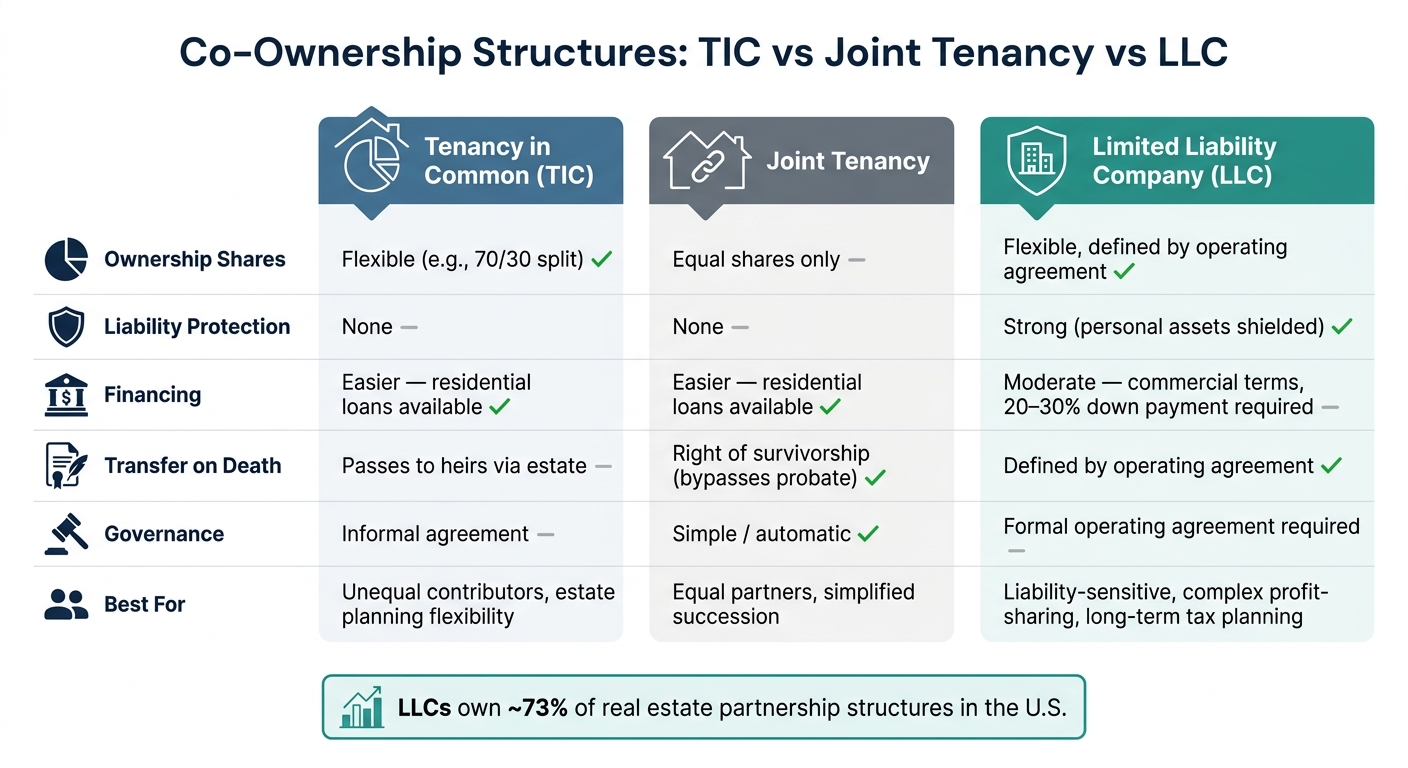
Co-Ownership Structures Compared: TIC vs Joint Tenancy vs LLC
Direct Title Co-Ownership: Tenancy in Common and Joint Tenancy
When multiple people purchase property without creating a separate legal entity, they hold the title directly - usually as Tenants in Common (TIC) or Joint Tenants. These are the two most common co-ownership arrangements in the U.S., and they differ significantly in financial and legal terms.
With Tenancy in Common, each owner holds a specific percentage of the property, which doesn’t have to be equal. For instance, one person might own 70%, while the other owns 30%, often reflecting the amount each contributed to the purchase. Income and expenses are divided according to these percentages. Owners also have the freedom to sell or will their share independently, making this structure ideal for co-owners with unequal stakes or distinct estate planning goals.
"Tenancy in common works better when owners want the freedom to leave their share to children or other family members, for example, siblings owning a vacation home together." - Glenn Matecun, Estate Planning & Elder Care Firm of Michigan
On the other hand, Joint Tenancy ensures all owners hold equal shares and acquire the title simultaneously through the same deed. Its standout feature is the right of survivorship: if one owner passes away, their share automatically transfers to the surviving owners, bypassing probate. While this can simplify matters, it may also create conflicts with broader estate planning.
"One of the most overlooked mistakes is choosing joint tenancy without realizing that the right of survivorship can override an estate plan, including a will." - Mazyar Hedayat, Esq., M. Hedayat & Associates, P.C.
When co-owners take out a joint mortgage, they are all jointly and severally liable for the full loan amount. If one stops paying, the others are responsible for covering the entire debt.
While direct title ownership is straightforward, other structures, like LLCs, offer more protection and flexibility.
LLC-Owned Property for Co-Ownership
Using a Limited Liability Company (LLC) to hold co-owned property introduces a legal and financial framework that direct title ownership doesn’t provide. An LLC protects personal assets from property-related liabilities and avoids double taxation by passing income directly to members' tax returns. It’s worth noting that LLCs, LLPs, and LPs collectively own 40.4% of U.S. rental units, with LLCs alone accounting for nearly 73% of real estate partnership structures.
Financing through an LLC often requires a 20%–30% down payment, and interest rates may be slightly higher. Additionally, the costs of forming and maintaining an LLC vary by state.
"Joynt strongly recommends the LLC + Operating Agreement model for most co-owners. It delivers both structure and flexibility - protecting personal assets, defining shared responsibilities, and enabling smooth exits." - The Joynt Team
Choosing the Right Legal and Financial Structure
Selecting the right co-ownership structure depends on factors like liability exposure, financing needs, tax strategies, and how easily co-owners can exit the arrangement.
For a basic residential property with a conventional mortgage and relatively equal financial contributions, TIC is often the simplest option. It’s easier to finance and has minimal administrative requirements, but it doesn’t protect personal assets or offer formal dispute resolution mechanisms.
An LLC is better suited for properties with higher liability risks, complex profit-sharing needs, or long-term tax planning priorities. For instance, the 2025 One Big Beautiful Bill Act (OBBBA) reinstated 100% bonus depreciation for the 2026 tax year, allowing partnerships to deduct the full cost of qualified improvements immediately - an advantage for LLCs. Additionally, the permanent 20% Qualified Business Income (QBI) deduction adds certainty for long-term tax planning.
"An error in entity structure can cost a real estate deal millions, lead to investor disputes, or derail financing." - Jason Parr, Senior Manager, CBIZ
Here’s a quick comparison of the key features of each co-ownership structure:
| Feature | Tenancy in Common | Joint Tenancy | LLC |
|---|---|---|---|
| Ownership Shares | Flexible (e.g., 70/30) | Equal only | Flexible (defined by agreement) |
| Liability Shield | None | None | Strong |
| Financing | Easier (residential loans) | Easier (residential loans) | Moderate (commercial terms) |
| Transfer on Death | Passes to heirs | Right of survivorship | Defined by operating agreement |
| Governance | Informal agreement | Simple/automatic | Formal operating agreement |
One critical step that co-owners often overlook is checking the mortgage’s "due-on-sale" clause before transferring property to an LLC. Some lenders may require immediate repayment of the loan if the title is transferred without their consent. Always secure written approval beforehand.
Funding the Purchase and Setting Ownership Percentages
How Ownership Percentages Are Determined
Ownership percentages often hinge on each co-owner's cash contribution at closing, covering their share of the down payment and closing costs. For example, if three buyers contribute 40%, 35%, and 25%, these numbers typically dictate their ownership stakes in a Tenancy in Common setup.
However, contributions aren't always limited to cash. Non-financial contributions, such as taking on property management duties, can also influence ownership percentages. For instance, an owner who handles all management tasks might negotiate a larger share, even if they contributed less money upfront. Regardless of the arrangement, it’s essential to document everything clearly.
"A handshake understanding that one co-owner put in more money but everyone owns equal shares will not survive a dispute unless the agreement documents that arrangement in writing." - LegalClarity Team
Ownership percentages play a critical role beyond the initial purchase. As the LegalClarity Team explains, "Ownership percentages drive almost everything else: voting power, profit splits, expense obligations, and the payout when the asset is eventually sold." Many co-ownership agreements require a supermajority vote - 67% or 75% - for major decisions like selling the property or approving significant renovations. This makes it crucial to determine percentages correctly from the outset, as they set the foundation for financing and long-term management.
Ways to Fund the Acquisition
There are several ways co-owners can fund a property purchase. The simplest method is all-cash contributions, where each party wires their share at closing. While this avoids complications with lenders, it does require substantial upfront capital.
Another common option is a joint mortgage, where all co-owners act as co-borrowers on a single loan. In this case, the lender evaluates the group as a whole, meaning one person’s poor credit could impact the interest rate - or even the loan approval - for everyone. Additionally, all co-borrowers are jointly and severally liable for the full loan balance.
"A lender doesn't care about your internal ownership split; they want the payment, and they'll come after any co-borrower to get it." - Alexander Brooks, Legal Writer
For those seeking a less traditional route, fractional investment platforms like Lofty provide an alternative. These platforms let investors purchase tokens representing membership interests in a DAO LLC that holds the property title. Each token corresponds to a specific percentage of economic rights, such as rental income or property appreciation, without requiring a large down payment or coordinating a joint mortgage.
Once the purchase is complete, having a clear plan for ongoing contributions ensures smooth property management.
Ongoing Contributions and Capital Management
The way co-owners fund a purchase directly impacts how they manage finances over time. After the property is acquired, they must plan for ongoing expenses like maintenance, unexpected repairs, property taxes, and insurance. It’s a good idea to establish a reserve fund, with annual contributions ranging from 5% to 15% of gross rental income.
If an expense exceeds the reserve, co-owners issue a capital call, requiring contributions proportional to ownership stakes. The co-ownership agreement should outline notice periods, formulas for contributions, and consequences for non-payment. A common enforcement method is stake dilution, where an owner who fails to meet a capital call has their ownership percentage reduced accordingly.
For properties held by an LLC, all financial transactions should go through the entity’s dedicated bank account. This approach simplifies accounting, preserves the liability shield, and ensures every member has clear insight into the property’s financial health.
Sharing Costs and Allocating Income
Once the purchase is complete and ownership percentages are determined, it's crucial to establish clear guidelines for splitting costs and distributing income.
Managing Shared Expenses
After buying the property, co-owners need a clear plan for dividing recurring expenses. These costs - like mortgage payments, property taxes, insurance, and maintenance - are typically shared based on ownership percentages. For instance, if someone owns 40% of the property, they would cover 40% of the associated bills.
Property tax authorities usually send out a single tax bill and hold all co-owners jointly and severally liable for the full amount. This means if one owner doesn’t pay their share, the others could be held responsible for covering the entire balance. Because of this, it’s essential to ensure all co-owners are financially dependable before finalizing the purchase.
Additionally, the co-ownership agreement should clarify who is listed as a "named insured" on the property’s insurance policy. If an owner isn’t included, they could face issues with denied claims in the event of a loss.
Distributing Rental Income and Other Revenue
Rental income and other earnings are divided according to ownership percentages. This includes revenue streams like rental fees, late charges, pet deposits, application fees, and forfeited security deposits. After deducting agreed-upon expenses, the remaining income is distributed based on these percentages.
To avoid disputes, co-owners need to define what "net cash flow" means in their agreement. This should outline which expenses are deducted and how much is set aside for a reserve fund. Without clear definitions, disagreements over income distribution can arise.
Modern platforms simplify this process. For example, Lofty enables investors to buy tokens in a DAO LLC that holds the property title. If an investor owns 1% of the tokens, they receive 1% of the rental income, which is distributed daily in proportion to their stake.
"The IRS is now empowered to audit any arrangement where the income split does not match the actual capital contributed by each owner." - Arun KP, Tax Professional
For tax purposes, if a 1099 form is issued to only one primary owner, the co-owners should use nominee reporting to properly allocate income shares and avoid triggering IRS audits.
Clear financial allocation rules are key to building a solid foundation for long-term co-ownership.
Handling Defaults and Payment Imbalances
Sometimes, co-owners may fall behind on payments. Without established remedies, those who pay their share might have no way to address the imbalance. As the LegalClarity Team explains:
"Without these teeth, the co-owners who do pay have no leverage over the one who doesn't." - LegalClarity Team
Common solutions for handling defaults include:
| Remedy | How It Works | Effect on Ownership |
|---|---|---|
| Dilution | The defaulting owner's stake is reduced by the unpaid amount. | Permanently decreases their equity and voting power. |
| Loan Conversion | The unpaid amount becomes a debt with penalty interest. | Ownership remains intact, but the debt is repaid from future profits. |
| Forced Buyout | Paying owners buy out the defaulting owner's stake. | The defaulting owner exits the arrangement entirely. |
These options help maintain the financial stability of the co-ownership and ensure fairness among all parties.
The agreement should also outline a dispute resolution process. Typically, this starts with good-faith negotiation, followed by mediation (lasting 30 to 45 days), and, if needed, binding arbitration. Arbitration can resolve disputes about three times faster than federal court, making it an efficient choice for co-ownership conflicts.
Exit Strategies and Long-Term Management
Even when co-ownership works well, having a clear plan for exits is non-negotiable.
Planning for Exits and Liquidity
One of the most common safeguards for co-ownership agreements is a Right of First Refusal (ROFR) clause. This gives current co-owners a 30-day window to buy out a departing owner’s share before it’s offered to outside buyers. It’s a practical way to keep the group stable and ensure new owners align with the existing group’s preferences.
Additionally, the agreement should define how many owners need to agree before the property can be sold outright. Typically, this requires a supermajority of 75% or more. This prevents a single dissenting owner from blocking a sale or a slim majority from forcing one against the wishes of the group.
Liquidity can be tricky in traditional co-ownership, but newer approaches are shortening timelines. For instance, structured systems with access to secondary markets have cut exit times from 6–12 months to as little as one month or less. Platforms like Lofty make this even faster by enabling fractional equity to trade digitally. In one notable case from December 2025, Tristan Huerta sold $20,000 worth of equity in minutes at $50 per fraction, followed by an additional $80,000 at $55–$60 per fraction - all within hours.
It’s also wise to establish a clear timeline for lock-in agreements, so all owners know when they can sell their shares.
"The quality of a co-ownership agreement tells you almost everything you need to know about the people running the scheme - before you've spent a single hour at the property." - David Olsson, Founder, Co-Ownership Property
Here’s a quick comparison of exit options:
| Exit Mechanism | Typical Timeline | Key Feature |
|---|---|---|
| Secondary Market | Days to weeks | Quick liquidity through platforms like Lofty |
| Right of First Refusal | 30 days | Existing owners get the first opportunity to buy |
| Standard Resale | ~1 month | Marketed to external buyers |
| Mandatory Sale | Defined by process | Triggered by default or breach |
With clear exit strategies in place, it’s equally important to address financing to ensure ownership stability.
Financing and Refinancing Options
Financing a co-owned property can get complicated. Traditional lenders don’t usually offer loans for partial equity stakes, so co-owners often rely on LLC-level financing - where the LLC itself takes out the loan. However, transferring property into an LLC can trigger a lender’s "due-on-sale" clause, requiring immediate repayment. Consulting a real estate attorney before making such changes is a smart move.
When it comes to refinancing, the group should agree in advance on how it will impact ownership shares. For instance, in a cash-out refinance, proceeds might be distributed unevenly based on each owner’s original contribution or current equity. To avoid disputes, these details should be spelled out in the co-ownership agreement.
Once financing is sorted, strong governance structures are essential for long-term success.
Governance and Long-Term Financial Planning
According to the Association of International Property Professionals (AIPP), unclear governance structures are the most frequent source of dissatisfaction in co-ownership arrangements - not property quality, fees, or other factors.
A well-thought-out governance plan can prevent disputes and simplify decision-making. For example, routine tasks like cleaning or minor repairs can be handled by a property manager without needing a vote. Mid-level decisions, such as replacing an appliance, might require a simple majority, while major decisions - like selling the property - should need a 75% supermajority.
| Decision Type | Approval Threshold | Examples |
|---|---|---|
| Routine Operational | Property manager oversight | Cleaning, minor repairs, utility payments |
| Maintenance/Repair | Simple majority (>50%) | Replacing a pool heater, kitchen upgrades |
| Major Capital/Exit | Supermajority (75%+) | Selling the property, significant renovations |
On the financial side, creating a reserve fund is essential for handling major repairs or unexpected expenses. A good rule of thumb is to contribute 5% to 15% of gross rental income annually. Managed by the LLC, this fund ensures that money is available for significant costs and is governed by the same voting rules as other shared expenses.
Lastly, co-owners should align their estate plans with the co-ownership agreement. This ensures that if an owner passes away, their share doesn’t unintentionally end up with someone outside the group. Proper coordination can save everyone a lot of headaches down the line.
Conclusion
Setting up a strong financial framework for co-ownership requires thoughtful preparation before you finalize a property purchase. Making the right choices early - such as selecting the appropriate ownership structure (Tenancy in Common, Joint Tenancy, or LLC), determining ownership shares, agreeing on cost-sharing, and planning exit strategies - can prevent headaches down the road.
Among these options, the LLC stands out as a preferred choice. It provides personal asset protection, establishes a clear governance structure, and makes transferring ownership interests much easier than traditional title arrangements. When paired with a well-drafted operating agreement, the LLC becomes a comprehensive guide for managing everything from routine expenses to major financial decisions.
Kristina Modares, Co-buyer Expert at Joynt, emphasizes this point:
"An operating agreement isn't just extra paperwork. It's one of the most important tools you have for protecting the relationship and the investment."
This highlights just how critical a solid operating agreement is to successful co-ownership. For those who want the financial advantages of co-ownership without the hassle of creating detailed agreements, platforms like Lofty offer a streamlined solution. By structuring each property under an LLC, providing professional management, and simplifying fractional ownership, Lofty removes many of the traditional barriers to co-ownership.
Whether you’re entering into a co-ownership arrangement with partners or exploring fractional ownership opportunities, the key principles remain the same: define roles and contributions clearly, prepare for potential challenges, and establish exit strategies from the outset. Following these steps can help ensure a smoother and more rewarding co-ownership experience.
FAQs
Should we choose a TIC, Joint Tenancy, or an LLC for co-ownership?
The best ownership structure depends on what you're aiming for in terms of liability protection, management control, and inheritance planning.
- LLCs (Limited Liability Companies): These are excellent for flexibility and security. They protect personal assets from liability and allow for formal agreements to manage decisions, profit distribution, and exit strategies.
- TIC (Tenancy in Common): This structure allows for unequal ownership shares and independent transfers of those shares. However, it doesn’t provide liability protection.
- Joint Tenancy: With this option, ownership is split equally among parties, and it includes survivorship rights - meaning ownership passes automatically to the surviving owners. But like TIC, it doesn’t offer liability protection or a formal governance framework.
Each option has pros and cons, so it's important to weigh them based on your specific needs.
How do we value non-cash contributions when setting ownership percentages?
When it comes to non-cash contributions - such as property, services, or intellectual assets - it's important to assign a clear and justifiable dollar value. This is essential for accurately determining ownership percentages.
For tangible assets, rely on fair market value, typically determined through an independent appraisal. Intangible contributions, like services or intellectual property, should be evaluated by comparing market rates and estimating potential benefits.
Make sure to document all valuations in the operating agreement. It's also wise to consult legal or tax professionals to ensure everything aligns with tax rules and equity standards.
What should an exit plan include if one co-owner wants out?
An effective exit plan lays out how a co-owner can step away - whether through a sale, buyout, or refinancing. It should include key elements like a written intent process, a set notice period, and clear methods for pricing and valuation. Additionally, it should cover rights of first refusal, the transfer of responsibilities, and what happens if no buyer emerges. Having these guidelines in place helps prevent legal disputes and ensures the property remains stable.
Lofty Editorial