Lofty Editorial
Single-Family vs. Multi-Family Fractional Investments
Fractional real estate investments allow you to own property shares with minimal capital, offering rental income and potential value growth. But should you focus on single-family or multi-family properties? Here's a quick breakdown:
- Single-family properties: Lower entry costs, simpler management, and faster resale. However, they come with higher vacancy risk, as losing a tenant means losing 100% of rental income.
- Multi-family properties: Offer diversified income from multiple tenants, vacancy protection, and better scalability. They require higher upfront capital and more complex management but provide steadier cash flow.
Quick Comparison:
| Factor | Single-Family Fractional | Multi-Family Fractional |
|---|---|---|
| Entry Costs | Lower (20%-25% down) | Higher (25%-35% down) |
| Vacancy Risk | High (100% income loss) | Low (spread across units) |
| Management | Simpler (1 tenant) | Complex (multiple tenants) |
| Income Potential | Focus on appreciation (8.5%) | Cash flow emphasis (9.3%) |
| Resale Liquidity | Higher (sold to investors/owners) | Lower (investor-focused) |
Your choice depends on your budget, risk tolerance, and investment goals. Single-family properties suit those seeking simplicity and flexibility, while multi-family properties are ideal for steady income and portfolio growth.
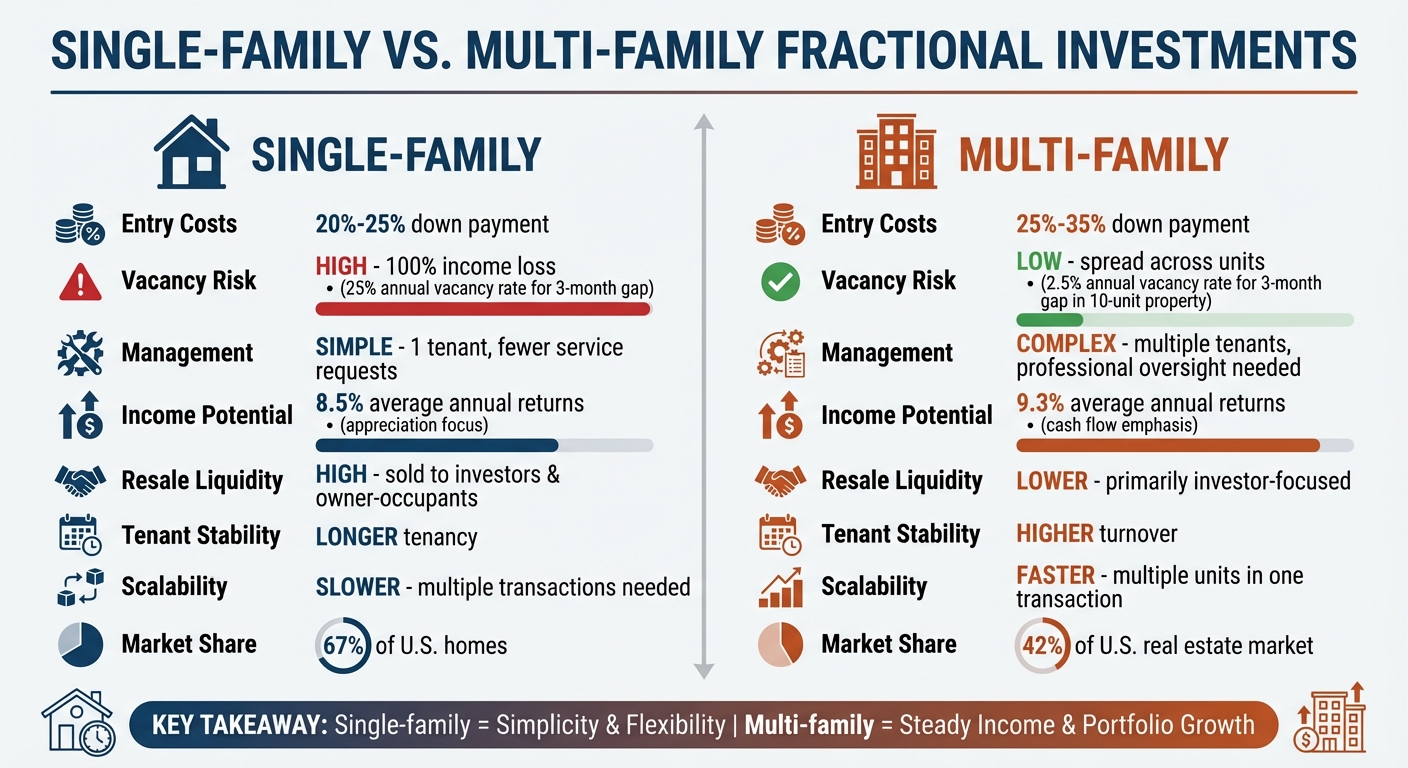
Single-Family vs Multi-Family Fractional Real Estate Investment Comparison
Single-Family Fractional Investments
Lower Entry Costs and Easier Management
Single-family fractional investments stand out for their affordability and simplicity. These properties typically have lower price tags compared to multi-family buildings, which means fractional shares are more budget-friendly - perfect for those just starting their investment journey. For traditional single-family purchases, down payments usually range between 15% and 25%.
Managing a single-family property is relatively straightforward. With only one tenant and no shared spaces, you avoid the headaches of tenant disputes and complicated repairs that come with multi-unit buildings. Plus, tenants often handle their own utility bills, sparing you additional expenses. Unlike multi-family properties that may require commercial financing, single-family investments often use conventional mortgages, which are simpler to navigate.
This combination of affordability and low-maintenance management also makes it easier to sell these properties quickly, adding to their appeal.
Liquidity and Market Accessibility
Single-family homes dominate the U.S. housing market, making up 67% of all homes. This broad market presence means there’s no shortage of potential buyers when you’re ready to sell. With higher demand, single-family homes often sell faster than multi-family properties, offering fractional investors quicker access to cash.
"Single family homes sell faster, providing quicker cash liquidity, while multifamily properties offer stable rental income." – SoFi
Another key advantage is how single-family properties appreciate. Their value is driven by competitive market dynamics, as individual buyers push prices up. In contrast, multi-family properties are more reliant on rental income performance to determine their worth. With average occupancy rates hovering around 95%, single-family rentals remain a strong option for consistent demand.
Risks and Drawbacks
Of course, these benefits come with some trade-offs.
One major risk is the vacancy issue. With a single tenant, losing that tenant means losing 100% of the rental income until you can fill the vacancy. For example, a three-month vacancy could translate to a 25% annual vacancy rate.
"Tenant turnover affects 100% of the rental income [in single-family], whereas tenant turnover is less impactful on total rental income [in multi-family] due to multiple units." – Saad Dar, VP of Sales and Partnerships, Baselane
There’s also the challenge of relying on third-party property managers. Poor management can lead to neglected maintenance, prolonged vacancies, or mishandled tenant relations - all of which can hurt your returns. On top of that, some investment platforms may provide overly rosy financial projections that fail to account for essential costs like vacancy reserves and repairs, which can eat up about 20% of gross rent. To avoid surprises, conducting your own financial analysis is essential.
Multi-Family Fractional Investments
Multiple Income Streams and Vacancy Protection
Multi-family properties generate income from multiple tenants, which helps cushion the financial impact of vacancies. For example, in a 10-unit property, a three-month vacancy reduces annual income by just 2.5%, compared to a 25% drop in a single-family home under similar circumstances. Even if one tenant moves out, the remaining units continue to produce income, ensuring that operating costs, maintenance, and loan payments are covered.
"Multifamily investing offers a reliable path to building wealth through steady cash flow and portfolio diversification." – LoopNet
This steady and diversified cash flow also appeals to lenders, often resulting in more favorable interest rates and financing terms. Additionally, rental demand tends to remain strong even during economic downturns, further enhancing the stability of multi-family investments.
Cost Efficiency Through Shared Resources
Multi-family properties not only offer diversified income but also benefit from shared operational costs. With shared infrastructure, such as a single roof or plumbing system, maintenance expenses per unit are significantly lower.
"With a fourplex you have one roof to replace every 20 years instead of four roofs; you have one sewer line leading to this main sewer in the street, not four." – Joe Torre, RealWealth Investment Counselor
The higher total income from multi-family properties also makes professional property management a realistic and worthwhile option. Unlike single-family homes, where hiring a property manager could eat into profits, the revenue from multiple units can comfortably cover the cost of professional services. These managers handle tasks like tenant screening, maintenance coordination, and day-to-day operations, allowing investors to focus on broader strategies.
Multi-family properties make up about 27% of U.S. housing and are typically valued based on the rental income they generate rather than comparable sales. This means that improving operations - like reducing expenses or increasing rents - can directly enhance the property’s overall value.
Higher Capital Requirements and Management Complexity
While multi-family properties offer many advantages, they also come with higher financial and administrative demands. Down payments generally range from 25% to 35%, compared to the 20% to 25% typical for single-family homes. Properties with five or more units are classified as commercial real estate, requiring commercial loans with stricter credit standards.
Managing multiple units brings its own challenges, including coordinating rent collection, addressing varied maintenance issues, and navigating complex zoning laws and landlord-tenant regulations. However, these management demands are often offset by the efficiency of handling multiple units in a single location. For instance, managing 20 units in one building is far less time-intensive than managing 20 separate single-family homes, each with its own loan, inspection, and transaction process.
To tackle these complexities, many investors rely on property management software and automation tools. These tools help streamline communication, track maintenance requests, and simplify lease renewals, making the administrative workload more manageable.
Ultimately, multi-family investments require careful consideration of both financial resources and management capabilities, but the potential rewards often outweigh the challenges.
Single-Family vs. Multi-Family: Side-by-Side Comparison
Comparison Table
Here’s a breakdown of the essential differences to help align your investment strategy with your goals.
| Factor | Single-Family Fractional | Multi-Family Fractional |
|---|---|---|
| Entry Costs | Lower per-asset cost; financed with 20%–25% down payments | Higher per-asset cost; require 25%–35% down payments and commercial financing |
| Income Potential | Lower gross income with average returns of 8.5% annually, focusing on appreciation | Higher gross income with average returns of 9.3% annually, emphasizing cash flow |
| Vacancy Risk | High – 100% income loss if vacant; about a 25% annual vacancy rate during a three-month gap | Lower – income is spread across units, with roughly a 2.5% annual vacancy rate for a three-month gap in a 10-unit property |
| Management Complexity | Simpler – single tenant/household and fewer service requests | More complex – managing multiple tenants, lease agreements, and shared spaces often requires professional oversight |
| Tenant Stability | Longer tenancy with families and professionals | May experience higher tenant turnover |
| Scalability | Slower – building a portfolio often requires multiple individual transactions | Faster – multiple units can be acquired in a single transaction |
| Resale Liquidity | Higher – properties can be sold to both investors and owner-occupants | Lower – sold primarily to investors |
| Regulatory Exposure | Governed by standard residential landlord-tenant laws | May be subject to stricter zoning, commercial codes, and additional regulations |
The numbers reveal some striking trends in the market. Multi-family properties now make up 42% of the U.S. real estate market, even outpacing commercial office spaces. This shift reflects the rising demand for rental housing and the scalability perks of multi-family investments.
Ultimately, the right choice depends on your financial resources, risk tolerance, and long-term goals. Single-family properties are ideal for those seeking simpler management and flexible resale opportunities. On the other hand, multi-family investments offer steady income and a quicker path to building a diverse portfolio.
sbb-itb-a24235f
How to Choose Between Single-Family and Multi-Family Investments
Available Capital and Risk Tolerance
Your available capital and comfort with risk should steer your decision. Single-family properties come with the risk of full vacancy - if your tenant moves out, you're left without rental income. On the other hand, multi-family properties spread that risk across multiple units, providing a steadier cash flow. As Lofty AI notes, every investment carries risk, so it's essential to align your choice with your financial goals and risk tolerance. Diversifying across different property types and locations can also help manage risk. Before making any commitments, consult with licensed legal and financial professionals to ensure the investment fits your financial situation. Additionally, factor in how much time you can dedicate to managing the property and what management style works best for you.
Time Availability and Management Preferences
For fractional real estate investments, professional property managers usually handle the day-to-day tasks, but keep in mind that these management fees will reduce your net income. If you prefer simpler management responsibilities, single-family properties are generally easier to handle and come with lower management fees compared to multi-family investments. Be sure to evaluate how much time you can realistically devote to managing your investment and choose a property type that aligns with your schedule and management preferences.
Income Objectives and Market Conditions
It's also important to match your income goals with current market conditions. For example, in late 2025, Freddie Mac reported a 30-year fixed mortgage rate of 6.18%, while the S&P CoreLogic Case-Shiller U.S. National Home Price Index showed a 1.4% year-over-year increase. In some markets, yields can vary significantly. For instance, properties in cities like Baltimore and Macon offered yields as high as 24%, with token prices ranging from $26 to $61. Meanwhile, multi-family properties in Chicago, IL, had more moderate yields around 3.5%, with token prices near $21.
Economic factors like a cooling labor market in late 2025 may also impact rental demand, making it even more important to consider vacancy protection. Keep an eye on interest rates, as they directly affect the profitability of leveraged investments. Additionally, properties near transit projects or wellness-focused infrastructure often attract tenants and boost long-term property values. Finally, don't overlook co-ownership agreements, dispute resolution terms, and state-specific tax implications when evaluating potential investments.
Here's A Deep Dive Into Fractional Real Estate Investment | Smart Money | CNBC TV18

Conclusion: Choosing the Right Investment for Your Goals
As we’ve explored, single-family properties can deliver focused returns in specific markets, while multi-family properties offer better protection against vacancies and more consistent cash flow. Each type comes with its own set of benefits, and the choice ultimately depends on your financial goals, risk tolerance, and desired income.
Platforms like Lofty make fractional real estate investing more approachable. With a minimum investment of just $50, you gain access to properties and even retain voting rights on all decisions like property sales or management changes. Plus, their secondary marketplace adds a layer of liquidity, making it easier to align real estate investments with your broader portfolio strategy.
"Buy and sell real estate as effortlessly as trading a share of TSLA." – Lofty
It’s worth remembering that real estate investments often require a long-term commitment, typically spanning 5–7 years to achieve the best results. Whether you’re drawn to the simplicity of single-family homes or the reliability of multi-family properties, fractional ownership opens the door to real estate opportunities without the need for hefty down payments or the challenges of managing properties yourself.
FAQs
What advantages do multi-family fractional investments offer compared to single-family ones?
Multi-family fractional investments come with several advantages compared to single-family properties. One of the biggest perks is the steady income stream they provide. Since these properties house multiple rental units, the impact of any single vacancy is less severe, ensuring a more reliable cash flow. Plus, expenses like maintenance, operating costs, and financing are spread across all the units, which lowers the cost per unit and boosts overall profitability.
Another benefit is that lenders often view multi-family properties as lower-risk investments, making it easier for investors to secure financing. These properties are also well-suited for professional management, meaning investors can take a hands-off approach while experts handle the day-to-day operations. On top of that, multi-family investments come with some attractive tax perks, such as accelerated depreciation and the ability to offset more rental income. These features make them a smart option for those looking to build lasting wealth.
What are the differences in costs and financing between single-family and multi-family fractional investments?
Fractional investments are changing the game in real estate by making it easier - and much cheaper - to get started. Platforms like Lofty let you invest in single-family or multi-family rental properties with as little as $50. That means no hefty down payments, which typically run into the tens of thousands of dollars. Even though multi-family properties tend to have higher overall values than single-family homes, the cost of individual shares is still manageable, often just a few hundred dollars.
Another perk? Financing is a breeze. Traditional real estate purchases usually involve residential mortgages for single-family homes or stricter commercial loans for multi-family properties. But fractional investing skips all that. Instead of taking out a loan, you simply buy shares, and the platform takes care of the property financing. This approach gives you immediate access to real estate investments - no mortgages, no massive upfront costs, and none of the usual headaches.
What should I consider when choosing between single-family and multi-family fractional investments?
When choosing between single-family and multi-family fractional investments, the first step is to clarify your investment objectives. Single-family properties are known for offering consistent cash flow, attracting tenants who often stay long-term, and requiring less hands-on management. This makes them a straightforward, lower-maintenance choice. On the other hand, multi-family properties can generate higher overall rental income, accelerate portfolio growth, and reduce vacancy risks by distributing them across multiple units. However, they usually demand more active oversight.
One of the advantages of fractional investing is that both property types become accessible, often with a starting investment as low as $50. Single-family investments center around the performance of one unit, while multi-family investments spread risk across several units within a single property, potentially balancing out uncertainties. When deciding which path suits you, consider factors like projected rental income, cash-on-cash return, potential appreciation, tenant turnover, and liquidity. These insights can help you align your choice with your financial goals and comfort with risk.
Lofty Editorial