
Lofty Editorial
Risks and Rewards of Real Estate Crowdfunding
Real estate crowdfunding allows you to invest in properties with minimal upfront costs, offering potential returns through rental income and property appreciation. It’s accessible to non-accredited investors and provides a way to diversify your portfolio across various property types and locations. However, it comes with risks like illiquidity, market fluctuations, and platform reliability.
Key Takeaways:
- Low Entry Costs: Invest as little as $10-$100 through fractional ownership.
- Earnings: Returns come from rental income (8%-14% annually) and property value increases.
- Risks: Illiquidity, economic downturns, and platform stability are key concerns.
- Diversification: Spread investments across property types and regions to reduce risk.
- Regulations: SEC caps investments for non-accredited investors based on income/net worth, but only if the fractional shares are considered securities under the law.
Before diving in, research platforms, understand fees, and assess your risk tolerance. Real estate crowdfunding can be a useful tool to grow wealth, but only with careful planning and informed decisions.
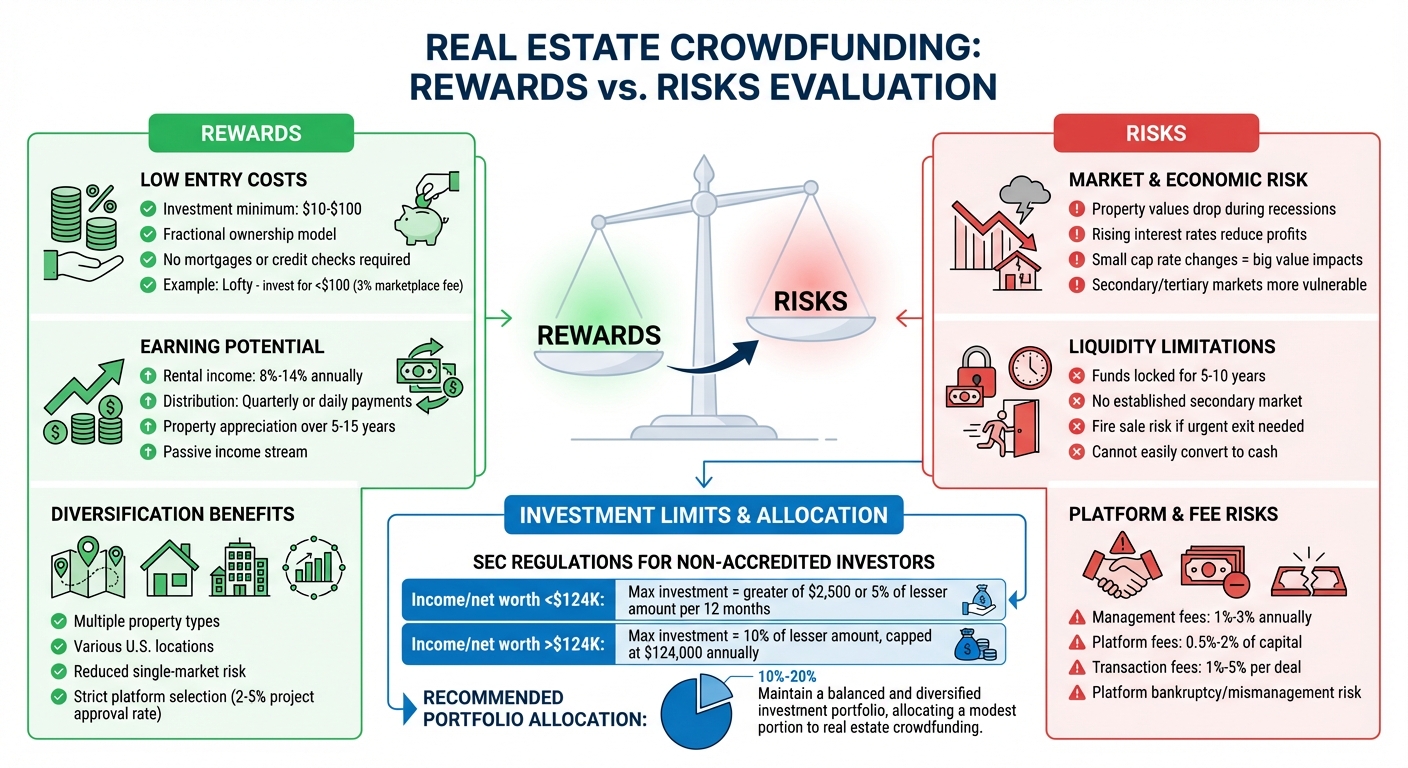
Real Estate Crowdfunding Risks vs Rewards Comparison Chart
Is Real Estate Crowdfunding Worth It?
sbb-itb-a24235f
Main Benefits of Real Estate Crowdfunding
Real estate crowdfunding combines accessibility and potential returns, making it an appealing option for those looking to diversify their investments without the traditional barriers of real estate ownership.
Lower Entry Costs Through Fractional Ownership
One of the biggest advantages of real estate crowdfunding is the ability to invest in properties without the hefty upfront costs. Instead of needing a six-figure sum to buy an entire property, fractional ownership lets investors purchase a share of premium properties for amounts as low as $10 to $100. This eliminates the need for mortgages, credit checks, or large down payments. Plus, the platforms handle all the operational tasks, so investors don’t have to deal with the day-to-day responsibilities of property management.
For instance, Lofty allows users to invest in tokenized rental property shares for less than $100, with a 3% marketplace fee applied to buy and sell transactions. This low-cost entry point opens doors to consistent passive income and the chance to benefit from long-term property value growth.
Earning Passive Income and Property Appreciation
Crowdfunding platforms offer two main ways to earn: rental income and property appreciation. Rental income is often distributed quarterly - or even daily in some cases - providing a steady stream of passive earnings. Some platforms report annual returns ranging between 8% and 14%, with hundreds of millions already paid out in rental income. Long-term property appreciation, on the other hand, is realized over holding periods that can span five to fifteen years.
Platforms like Lofty enhance transparency by displaying projected annual returns for each property. By diversifying investments across multiple properties, investors can further strengthen their portfolios and reduce risk exposure.
Diversifying Your Portfolio Across U.S. Properties
Another key benefit is the ability to spread investments across a wide range of properties, asset types, and locations. This diversification reduces the risk of being overly dependent on a single market or property type. It also helps shield investors from localized economic downturns and stock market fluctuations.
Many crowdfunding platforms take additional steps to ensure quality by applying strict selection criteria, approving only a small percentage of proposed projects. This approach aims to connect investors with solid opportunities, enhancing the overall stability of their portfolios.
Main Risks in Real Estate Crowdfunding
While real estate crowdfunding offers plenty of advantages, it also comes with its fair share of risks, which every investor should carefully weigh before committing their money. These risks can influence both your potential returns and how easily you can access your funds when needed.
Market Risk and Economic Changes
Economic fluctuations can significantly impact the performance of your crowdfunding investment. For instance, during downturns, lower occupancy rates and reduced rents can shrink investor payouts. Additionally, property values often drop during recessions, meaning you might end up with less when the property is eventually sold.
Another key factor is rising interest rates. Higher rates increase borrowing costs for real estate projects, which can eat into profit margins and reduce dividends. Ian Formigle, Chief Investment Officer at CrowdStreet, highlights the danger:
"Debt maturity was one of the major culprits of why projects were lost during the financial crisis".
If a loan tied to a property matures during a market slump and can't be refinanced for the same amount, the project risks default or even foreclosure.
Small changes in capitalization rates - often influenced by market sentiment and interest rate shifts - can also have an outsized impact on property values and your returns. Properties in smaller markets, like secondary or tertiary cities, are particularly at risk. Unlike major hubs like New York or San Francisco, these areas tend to have fewer buyers and are more vulnerable during economic downturns. These factors highlight why liquidity and the reliability of the platform you choose are so important.
Liquidity Limitations and Exit Options
Unlike stocks, which you can sell almost instantly, real estate crowdfunding investments typically lock up your money for several years - sometimes up to a decade. There's also no well-established secondary market for quickly selling these investments. Once your funds are committed, they’re generally tied up, and your ability to exit depends on the platform’s specific policies.
"One of the main risks associated with real estate crowdfunding is the lack of liquidity. Unlike publicly traded stocks or bonds, real estate investments are typically illiquid, meaning they cannot be easily sold or converted into cash." – SmartAsset
If you find yourself in urgent need of cash and try to sell your investment quickly, you could end up in a "fire sale" situation, where the asset is sold for far less than its actual value. This is why it’s crucial to only invest money you’re comfortable locking away for at least three to ten years.
Platform Reliability and Transparency
Beyond the challenges of liquidity, the reliability of the crowdfunding platform itself is a critical concern. A platform’s failure - whether due to bankruptcy, legal issues, or mismanagement - can jeopardize your investment. Not all platforms maintain the same level of financial stability or operational expertise.
Fee structures can also vary widely between platforms. For example, management fees typically range from 1% to 3% of total assets annually, platform fees can be 0.5% to 2% of invested capital, and transaction fees may add another 1% to 5% per deal. Understanding these costs is essential to creating a well-informed investment plan.
How to Reduce Crowdfunding Risks
You can lower the risks of crowdfunding by choosing platforms wisely, diversifying your portfolio, and understanding the fees and timelines involved, along with exit options.
Pay attention to fees. Trustworthy platforms will clearly outline management, platform, and transaction fees. Hidden fees can eat into your returns, so make sure to review Form C filings to fully understand the platform’s financial health and potential risks.
Assess the experience of both the platform’s leadership and the property developers behind the projects. Platforms like DLP Capital, which has managed over $5.5 billion in assets since its founding in 2006, have a strong reputation with more than 3,000 investors. Because real estate crowdfunding only gained traction after the 2012 JOBS Act, a proven track record is a key indicator of reliability.
Once you’ve vetted a platform, diversify your investments to further reduce risk.
Spread Your Investments to Reduce Risk
Diversification is essential to protect your portfolio from the impact of any single underperforming property. Spread your investments across different property types and regions within the U.S. to balance out risks from localized market downturns.
You can also diversify by mixing asset classes. Combine real estate debt investments, which provide steady interest payments, with equity investments that offer potential property appreciation. For example, EquityMultiple offers short-term “Alpine Notes” with three- to nine-month terms alongside longer-term equity projects, giving you flexibility in managing liquidity.
Fractional ownership makes diversification achievable even with smaller budgets. Platforms like Fundrise allow you to start investing with just $10, while Arrived requires a minimum of $100. Fundrise, which serves over 385,000 investors, offers a balanced plan that blends income generation with capital appreciation.
Finally, make sure you understand the fees, investment timelines, and the state of secondary markets to complete your risk management strategy.
Know the Fees, Timelines, and Secondary Markets
Understanding all fees upfront is crucial to safeguarding your returns. Request a detailed breakdown of costs from the platform and calculate how they’ll impact your earnings over the investment period.
Real estate crowdfunding often involves long-term commitments. Holding periods can range from 5 to 7 years for single-family rentals and up to 15 years for vacation properties. Only invest money you’re prepared to lock away for an extended period.
"Crowdfunding investments carry liquidity risks, as you'll be limited in your ability to resell your investment for the first year - and you might need to hold your investment indefinitely." – FINRA
Secondary markets for real estate crowdfunding are still developing. Even if a platform offers a secondary market, there’s no guarantee you’ll find a buyer when you want to sell. Always review the platform’s policies on lock-up periods and exit options so you’re clear on what to expect.
Regulation Crowdfunding does offer some flexibility. You can cancel an investment commitment for any reason up to 48 hours before the end of the offer period. If the company changes the offering terms, you’ll have five business days to reconfirm your investment.
For added confidence, consult a financial advisor to get an objective evaluation. Don’t hesitate to ask the platform’s support team about worst-case scenarios, like what happens if a project fails or the platform itself goes bankrupt. This can help you make more informed decisions.
Creating a Balanced Real Estate Crowdfunding Strategy
Once you’ve figured out how to manage risks, the next step is to craft an investment plan that aligns with your financial goals while balancing potential rewards.
Evaluate Your Risk Tolerance
Before diving in, ask yourself: Can you afford to lock away your money for 5 to 10 years? Real estate crowdfunding typically requires funds to remain tied up for the duration of the project. And yes, there’s always the possibility of losing your entire investment, especially since many of these ventures are speculative or in early stages.
Think about how much control you’re comfortable giving up. Unlike owning a rental property outright, where you’re in charge of decisions like tenant selection and property upkeep, crowdfunding leaves those choices to third parties. If you prefer hands-on management, this approach might not suit you.
Also, be aware of legal investment limits set by the SEC. For instance, if your annual income or net worth is under $124,000, you can invest up to the greater of $2,500 or 5% of the lesser amount during any 12-month period. For those with higher income or net worth, the cap increases to 10% of the lesser amount, with a maximum of $124,000 annually.
| Factor | Risk Level | Key Question |
|---|---|---|
| Liquidity | High | Can you leave money untouched for 5-10 years? |
| Management | Low Control | Are you okay with third-party decision-making? |
| Capital Risk | High | Can you handle a 100% loss of your principal? |
Once you’ve assessed your risk tolerance, decide how much of your portfolio you’re comfortable allocating to this type of investment.
Allocate a Portion of Your Portfolio
"Real estate crowdfunding is a higher-risk, higher-return investment... best done with risk capital rather than making it a majority of any average investor's portfolio." – Investopedia
Experts often suggest dedicating 10%-20% of your portfolio to real estate crowdfunding. This percentage allows you to tap into property appreciation and rental income while avoiding excessive exposure to risk. Your allocation should reflect factors like your age, financial goals, and overall comfort with risk.
Platforms like Lofty make it simple to diversify, even with a smaller budget. You can invest in fractional shares of rental properties across the U.S., spreading your investment across property types (residential, retail, office, multifamily) and geographic locations. This diversification helps cushion against localized market fluctuations.
You might also consider splitting your investment between equity crowdfunding - where you gain shareholder benefits like rental income and property appreciation - and debt crowdfunding, which offers fixed interest payments as a lender.
Monitor and Reinvest for Growth
Once your allocation is set, keeping an eye on performance is key. Regularly review metrics like loan-to-value ratios, free cash flow, and occupancy rates to spot potential problems early.
Reinvesting your rental income or interest payments can significantly amplify long-term returns thanks to compounding. Platforms offering daily or monthly payouts provide more frequent chances to reinvest and accelerate growth. For instance, Lofty distributes daily rental income, which you can reinvest into additional property fractions to maximize compounding benefits.
To manage risk, diversify where you reinvest your income. And make sure your reinvestment strategy aligns with your liquidity needs, since most crowdfunding investments require holding periods of several years to a decade.
Conclusion: Balancing Risks and Rewards in Real Estate Crowdfunding
Real estate crowdfunding has made property investing more accessible than ever, offering opportunities to participate without needing massive upfront capital. By allowing smaller investments, it opens the door to a broader audience, but like any investment, it requires a careful balance between risks and rewards.
The appeal lies in lower entry costs and the potential for passive income. However, these benefits come with challenges, such as illiquidity and the risk associated with specific platforms. Investors need to evaluate their own risk tolerance, understand that holding periods can range from 5 to 10 years, and factor in management fees - typically between 1% and 3% annually - which can impact overall returns.
Diversification remains a key strategy for managing risk. Spreading investments across various properties and locations can help mitigate the impact of single-project setbacks. Platforms like Lofty make diversification easier by enabling fractional investments starting at just $50, offering access to a variety of rental properties across the U.S.
New technologies are also reshaping the landscape. Innovations like tokenization and secondary markets are addressing liquidity issues, giving investors more freedom to trade shares. Lofty, for example, leverages blockchain technology and liquidity pools, allowing for near-instant trading of shares - providing a level of flexibility that traditional crowdfunding platforms often lack.
FAQs
What are the main risks involved in real estate crowdfunding?
Real estate crowdfunding opens the door to intriguing investment opportunities, but it’s not without its challenges. One of the biggest concerns is liquidity risk. These investments are often tied up for the long haul, meaning if you suddenly need quick access to your money, selling your stake may not be straightforward or even possible.
Another factor to consider is limited control. As an investor, you’re largely dependent on the platform’s management team for updates and decision-making. This hands-off approach can leave you feeling out of the loop when it comes to the property or project’s progress.
Then there are project-specific risks. Things like construction delays, surprise expenses, or inconsistent rental income can all chip away at your returns - or worse, lead to losses. On top of that, platform risk is something to keep on your radar. If the crowdfunding platform itself runs into financial trouble or instability, it could jeopardize your investment.
Lastly, regulatory risks can’t be ignored. Changes in securities laws or gaps in investor protections for certain offerings might introduce unexpected complications.
By being aware of these risks and sticking to reputable platforms, you can approach real estate crowdfunding with a clearer perspective and make better-informed choices.
What should I look for to ensure a real estate crowdfunding platform is trustworthy?
To determine if a real estate crowdfunding platform is reliable, start by checking its regulatory compliance and transparency. Trustworthy platforms are usually registered with the SEC or state securities regulators. They should clearly outline licensing details and provide comprehensive performance data. Additionally, their fee structures should be easy to understand, and they should keep investors informed with regular updates.
Next, assess the platform’s security measures and risk management practices. Features like encryption, multi-factor authentication, and regular security audits are essential for safeguarding your information. A reliable platform will also thoroughly vet properties and sponsors, using independent appraisals and well-defined processes to address any potential risks.
Take Lofty, for instance. This platform offers a secure and easy-to-use marketplace where investors can purchase fractional shares of U.S. rental properties without needing significant upfront capital. With tools for real-time performance tracking and strong privacy protections, Lofty combines convenience with investor confidence.
How can I diversify my real estate crowdfunding investments?
Diversifying your real estate crowdfunding portfolio means spreading your investments across various properties, locations, and asset types to manage risk and increase potential returns. For starters, consider allocating funds to different regions. For example, you might balance investments in large cities like New York or Los Angeles with properties in smaller but growing markets like Austin or Denver. This approach allows you to tap into diverse economic trends across the country.
Another way to diversify is by investing in different property types. A balanced portfolio might include a mix of residential, retail, industrial, and office properties. Additionally, you can combine equity investments (where you own a share of the property) with debt investments (where you earn interest on loans), as these tend to perform differently depending on market conditions.
Platforms like Lofty make it simple to apply these strategies. With fractional ownership, you can invest in rental properties across the U.S. starting at just $50 per share. For example, a $5,000 budget could be spread across multiple properties, helping you achieve diversification without needing a large upfront investment. By regularly reviewing and adjusting your portfolio, you can ensure it stays aligned with your financial goals and risk preferences.
Lofty Editorial