
Lofty Editorial
Reg CF vs Reg A+ for Fractional Platforms
If I had to boil it down to one line: Reg CF is usually the lower-cost way to start, while Reg A+ is the path for a platform that needs much more room to sell securities.
If you run a fractional real estate platform, this choice affects how much you can bring in, how long it takes to go live, who can invest, and how much legal and reporting work you take on after launch.
Here’s the short version:
- Reg CF lets you sell to accredited and non-accredited investors, but it caps sales at $5,000,000 in a 12-month period.
- Reg A+ Tier 2 goes up to $75,000,000, but it takes more time, more legal work, and audited financials.
- Reg CF usually gets to market in about 3 to 6 months.
- Reg A+ often takes about 9 to 18 months for a first-time issuer.
- Reg CF securities usually have a 12-month resale lockup.
- Reg A+ securities are generally easier to transfer if a secondary market exists.
- Reg CF fits a platform that wants to test demand and build an early investor base.
- Reg A+ fits a platform that already has demand and needs room for many offerings or more properties.
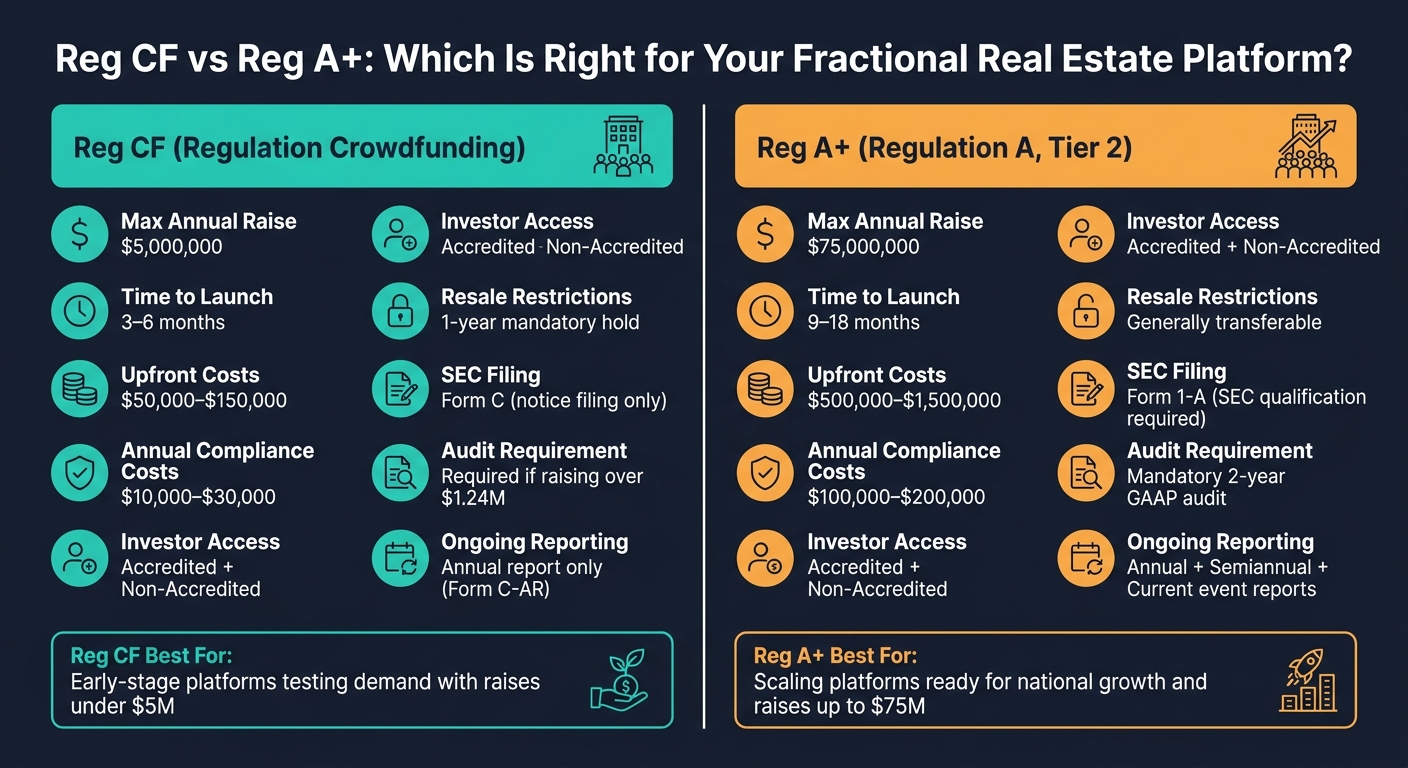
Reg CF vs Reg A+: Side-by-Side Comparison for Fractional Real Estate Platforms
Reg CF and A+ Real Estate Crowdfunding
sbb-itb-a24235f
Quick Comparison
| Factor | Reg CF | Reg A+ Tier 2 |
|---|---|---|
| Max amount sold in 12 months | $5,000,000 | $75,000,000 |
| Investor access | Accredited + non-accredited | Accredited + non-accredited |
| SEC process | Form C filing through a portal or broker-dealer | SEC qualification on Form 1-A |
| Time to launch | 3–6 months | 9–18 months |
| Upfront spend | Lower | Higher |
| Audit rules | Depends on amount sold | Two years of audited GAAP financials |
| Reporting after launch | Annual report | Annual, semiannual, and current reports |
| Resale | Usually locked for 1 year | Generally transferable |
My takeaway: if you want to test the market with less cash and less setup, Reg CF is often the first stop. If you want national scale and a much larger capital base, Reg A+ is usually the better fit.
Below, I break down where each exemption fits, what it costs, and when one starts to make more sense than the other.
Reg CF for fractional platforms
Reg CF lets fractional platforms raise money from both accredited and non-accredited investors without going through full SEC registration. But there’s a catch: every Reg CF offering has to run through an SEC-registered funding portal or broker-dealer. The platform can’t host the offering itself.
For most fractional platforms, that makes Reg CF more of a starting point than a long-term growth path. It’s a lighter way to get into the market, but the trade-off is simple: the raise ceiling is hard-capped.
Funding cap and investor limits under Reg CF
The biggest limit is scale. Reg CF caps raises at $5,000,000 per rolling 12 months. For a fractional real estate platform trying to add multiple properties, that cap can slow growth fast.
Investor limits matter too. Accredited investors have no statutory cap. Non-accredited investors do, and those limits depend on income and net worth. For fractional platforms, that directly affects how much retail money any one investor can put in across offerings.
| Investor Type | Income/Net Worth | Rolling 12-Month Limit |
|---|---|---|
| Non-accredited | Income or net worth under $124,000 | Greater of $2,500 or 5% of the greater of income/net worth |
| Non-accredited | Both income and net worth at least $124,000 | 10% of the greater of income/net worth, up to $124,000 |
| Accredited | Meets SEC criteria | No limit |
These caps apply across all Reg CF investments an investor makes during a 12-month period. So if a platform is counting on repeat retail investors, those limits can put a firm ceiling on how much capital it can pull from each person.
Disclosure, annual reporting, and costs
Before an offering goes live, issuers have to file Form C. That filing covers the business, risks, ownership, use of proceeds, and financial statements. The accounting work gets heavier as the raise gets larger:
| Raise Amount | Accounting Requirement | Estimated Cost |
|---|---|---|
| Under $124,000 | CEO-certified financials | Minimal |
| $124,000 – $1,235,000 | Independent CPA review | $5,000 – $15,000 |
| Over $1,235,000 | Independent CPA audit | $15,000 – $30,000 |
Legal and accounting costs up front usually fall between $25,000 and $75,000. After the raise, the issuer still has work to do. Platforms must file Form C-AR each year within 120 days after fiscal year-end. Ongoing compliance costs, including reporting and investor relations, usually run $10,000 to $30,000 per year.
There’s also the portal cost. Funding portals often charge a 6% to 8% success fee based on gross proceeds, and many add a 1% to 2% equity-based fee.
Liquidity is another limit to keep in mind. Securities sold under Reg CF generally can’t be resold for 12 months. For investors who want flexibility, that can be a sticking point.
Best fit: testing demand and building an early investor base
Reg CF tends to work best when a platform wants to test investor demand before taking on a larger and more expensive raise. The compliance burden is lighter than Reg A+, and the path to market is usually faster, which makes it a practical option for early-stage teams that don’t have a lot of cash to burn.
It can also help convert early users into investors. That matters more than it might seem at first glance. When users have money in the deal, they often stick around, pay closer attention, and become part of the platform’s early base.
The data backs up the point that Reg CF is often used at a smaller scale. In Q1 2026, the average Reg CF raise was about $815,000. That’s well below the $5,000,000 cap.
Once a platform starts pushing against the Reg CF ceiling, or runs into investor-limit friction, Reg A+ becomes the next logical comparison. At that point, the issue isn’t whether Reg CF works. It’s whether the platform needs more room than Reg CF can give.
Reg A+ for fractional platforms
Reg A+ opens the door to much larger raises. Tier 1 is capped at $20,000,000, and Tier 2 goes up to $75,000,000 in a 12-month period. That’s the core trade-off when you compare it with Reg CF: more scale, but more time and more money upfront.
Higher funding ceilings and broader offering scope
For a fractional platform that wants to grow beyond a single deal, Tier 2 gives more room to work. It can support multiple acquisitions and repeated raises without running into the cap too soon.
Tier 2 also skips most state-level securities review, which cuts down filing friction and expense. Those savings can land between $50,000 and $100,000 compared with Tier 1.
Non-accredited investors can still take part under Tier 2, but there’s a limit: they can invest up to 10% of the greater of their annual income or net worth per offering. Accredited investors don’t face that cap.
The flip side is simple: once the raise gets bigger, the SEC review and reporting load gets heavier too.
SEC qualification, audited financials, and ongoing reports
Issuers need to file a Form 1-A Offering Statement through the SEC’s EDGAR system. The review cycle usually runs 60 to 90 days, and first-time issuers often need up to six months.
Tier 2 also calls for two years of audited financial statements prepared under US GAAP. Audit fees usually fall between $30,000 and $90,000. Total upfront costs - including legal, audit, filing, and broker-dealer retainers - tend to land between $150,000 and $350,000.
Once the offering goes live, the reporting work doesn’t stop:
| Report | Filing Deadline | What It Covers |
|---|---|---|
| Form 1-K (Annual) | Within 120 days of fiscal year-end | Audited financials and MD&A |
| Form 1-SA (Semiannual) | Within 90 days of mid-year | Reviewed (unaudited) financial updates |
| Form 1-U (Current) | Within 4 business days of event | Material events (e.g., leadership changes) |
Annual compliance costs for Tier 2 - including reporting and audit maintenance - usually run $100,000 to $200,000 per year.
Best fit: scaling nationally with more compliance infrastructure
Reg A+ is often too expensive for early-stage teams. But once a platform has proven demand and has the staff, systems, and legal support to handle the reporting load, Tier 2 can be the cleaner path to national growth.
The numbers make that pretty clear. In 2024, the average qualified Reg A+ offering raised $11.5 million, far above the Reg CF ceiling. And unlike Reg CF, Reg A+ usually does not come with a mandatory holding period. Investors can trade on secondary markets or alternative trading systems without waiting 12 months.
For fractional platforms, Reg A+ is the scale option. The next issue is whether that added compliance burden makes sense when stacked against Reg CF.
Reg CF vs Reg A+: side-by-side comparison for platform operators
Once you get past the basic rules, the operator's choice comes down to three things: how much capital you need, what kind of investor experience you want to offer, and how fast you need to get to market.
Funding limits, investor access, and resale restrictions
The biggest gap is the amount you can raise. Reg CF tops out at $5,000,000 in any rolling 12-month period, while Reg A+ Tier 2 goes up to $75,000,000.
For a fractional real estate platform, that number matters a lot. It can decide how many properties you can fund before growth slows down. Put simply, a $5 million ceiling may work for testing one offering or a small batch of deals. A $75 million ceiling gives you far more room to add inventory and grow past a single property.
Both exemptions let you accept money from non-accredited investors. But the investor caps work differently. Under Reg CF, investment limits are based on income and net worth. Under Reg A+ Tier 2, non-accredited investors are limited to 10% of income or net worth per offering.
Liquidity also shapes the investor experience. And for retail investors, that can be a big selling point. Reg CF securities usually come with a one-year mandatory holding period before resale is allowed. Reg A+ Tier 2 securities are generally transferable. So if a platform wants to give investors more flexibility, Reg A+ usually has the edge.
Disclosure depth, reporting burden, and launch timeline
Reg CF is usually the faster and lower-cost path. Many offerings can launch in 3 to 6 months, with upfront costs in the $50,000 to $150,000 range. There is no formal SEC review. Instead, the issuer files Form C through a registered funding portal or broker-dealer.
After the raise, the reporting load is lighter too. Issuers generally file one annual report on Form C-AR, and yearly compliance often runs about $10,000 to $30,000.
Reg A+ is a much heavier lift. Form 1-A qualification often takes 9 to 18 months for first-time issuers, and launch costs can reach $500,000 to $1,500,000. That delay can matter when a platform is trying to line up listings, bring on investors, and keep deal timing from drifting.
Once the offering is live, the work doesn't ease up much. Reg A+ requires annual, semiannual, and current-event reports, and yearly compliance costs usually land around $100,000 to $200,000.
For operators, the trade-off is pretty direct: Reg CF offers a faster path with a lighter compliance load, while Reg A+ offers a much higher fundraising ceiling and more transferability, but with more time, cost, and reporting attached.
Pros and cons table: Reg CF vs Reg A+
| Factor | Reg CF | Reg A+ (Tier 2) |
|---|---|---|
| Max annual raise | $5,000,000 | $75,000,000 |
| Investor eligibility | Accredited + non-accredited | Accredited + non-accredited |
| Non-accredited limit | Formula-based (income/net worth) | 10% of the greater of annual income or net worth per offering |
| Resale restrictions | 1-year mandatory hold | Generally transferable if a secondary market exists |
| SEC filing | Form C notice filing only | SEC qualification required |
| Audit requirement | Audit required for first-time issuers raising over $1.24 million or for any raise hitting the $5 million cap | Mandatory 2-year GAAP audit |
| Ongoing reporting | Annual report only (Form C-AR) | Annual, semiannual, and current reports |
| Timeline to launch | 3–6 months | 9–18 months |
| Upfront costs | $50,000–$150,000 | $500,000–$1,500,000 |
| Annual compliance costs | $10,000–$30,000 | $100,000–$200,000 |
Which route fits a fractional real estate platform best
Once the cap, cost, and reporting gaps are clear, the choice mostly comes down to where the platform is in its growth path.
At an early stage, the main goal is often simple: prove people want the product. Later, the goal shifts to handling bigger raises across more markets. That’s where the split between Reg CF and Reg A+ starts to matter.
When Reg CF makes more sense
Reg CF is usually the better fit when a platform already has an audience and wants a lower-cost way to test a raise under $5 million.
It also gives the platform a chance to build a base of users who aren’t just visitors, but investors. That can matter a lot. A funded crowd can turn into a community, and that community can help drive early traction.
There’s a catch, though: Reg CF works best when demand already exists. If a platform launches a campaign without an audience, it often struggles to get off the ground.
Once growth starts pushing against the Reg CF cap, the next issue isn’t just demand. It’s whether the platform is ready for the added reporting, audits, and process that come with Reg A+.
When Reg A+ makes more sense
Reg A+ starts to make more sense after demand is proven and the platform needs room past the $5 million Reg CF limit.
It’s built for platforms aiming for raises of up to $75,000,000, with national reach and more transferability. Reg A+ Tier 2 also gives federal preemption from state-level "Blue Sky" merit reviews. That’s a big deal when a platform is offering properties across several states.
Of course, that extra room comes with more weight. Reg A+ tends to fit only when a platform can handle audited financials and ongoing reporting. And the cost up front can be steep, reaching $350,000 before launch.
So the trade-off is pretty straightforward: more scale, more burden.
Key takeaways
For many fractional real estate platforms, the most practical path is to move in steps: start with Reg CF to test the model and build an investor base, then shift to Reg A+ once the platform can support the compliance setup.
In plain English, the decision usually comes down to:
- Raise size
- Launch speed
- Compliance capacity
FAQs
Which option is better for a first launch?
For a first launch, Reg CF is usually the better fit for most startups because the bar to get started is much lower. It can often go live in four to eight weeks, compared with four to eighteen months for Reg A+.
That speed matters, especially for early-stage companies that need capital sooner rather than later. Reg CF also lines up better with smaller early-stage funding goals, with setup costs of about $5,000 to $20,000. Reg A+, on the other hand, often comes with $50,000 to $150,000 or more in upfront costs.
Because of that gap in both time and cost, many platforms begin with Reg CF and move to Reg A+ later.
When should a platform move from Reg CF to Reg A+?
A platform should move from Regulation Crowdfunding (Reg CF) to Reg A+ once the $5,000,000 yearly funding cap starts getting in the way and the business needs a bigger pool of capital - often somewhere between $15,000,000 and $75,000,000.
This step usually makes sense for more mature companies. In plain English, these are businesses that can deal with audited financials, ongoing SEC reporting, and higher upfront costs, which often range from $75,000 to $1,500,000. They also need the patience and internal bandwidth for a 9- to 18-month qualification timeline.
How does liquidity differ between Reg CF and Reg A+?
Liquidity works very differently here.
With Reg CF, investors usually face a one-year holding period. On top of that, secondary market options are limited. In plain English: liquidity is often very low.
With Reg A+ Tier 2, there’s no mandatory holding period. Those securities can trade right away on alternative trading systems or public exchanges. Even so, active secondary trading is still uncommon.
Lofty Editorial