
Lofty Editorial
Questions to Ask Potential Joint Venture Partners
Thinking about a real estate joint venture? Asking the right questions upfront can save you time, money, and future headaches. Whether you're the Capital Partner or Operating Partner, clarity on goals, roles, finances, and risks is critical for success. Here's what to cover:
- Goals: Align on investment objectives, exit strategies, and success benchmarks (e.g., an 8% preferred return or 2.0x equity multiple).
- Financials: Discuss return expectations, market analysis methods, and risk management strategies (e.g., stress-testing for value declines or rising vacancies).
- Roles: Define who handles daily operations versus major decisions like refinancing or property sales.
- Experience: Confirm your partner’s track record, financial capacity, and ability to navigate challenges.
- Transparency: Ensure open communication, clear reporting schedules, and ethical practices.
Bottom line: A strong partnership starts with asking tough questions. Think of it as insurance for your investment. The best partners welcome scrutiny - they know it builds trust and sets the stage for shared success.
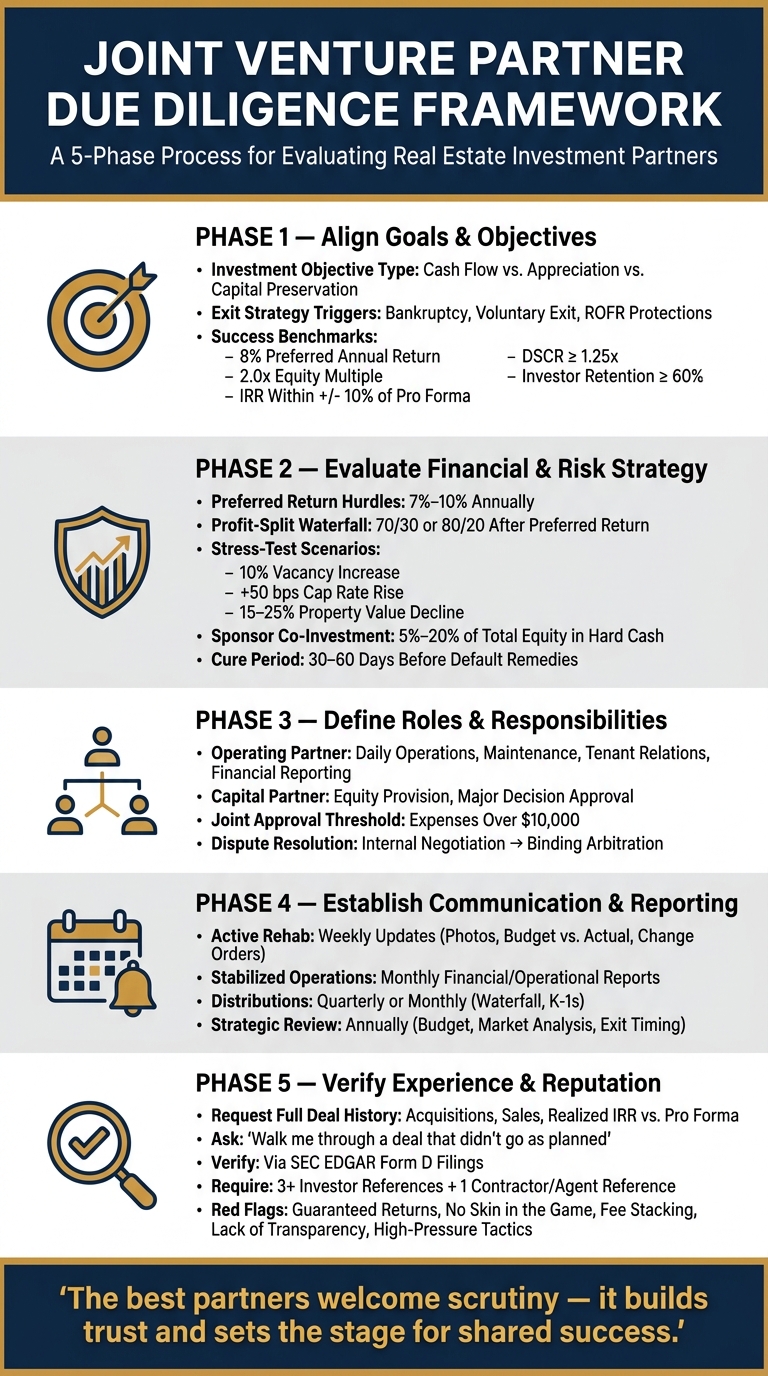
Joint Venture Partner Due Diligence Framework
7 Important Questions You Must Ask Your Potential Joint Venture Partners - Dan Lok
Questions to Align Goals and Objectives
Misalignment on vision can be one of the most expensive mistakes in a partnership, often overlooked in favor of focusing solely on financial capacity. Before moving forward with any deal, both parties need to have an honest discussion about what they truly want from the collaboration. Getting on the same page with these foundational questions is essential before diving into financial and operational details.
What Are Your Investment Goals?
Start by asking your potential partner about their investment objectives. Are they aiming for immediate cash flow, long-term wealth accumulation, or gains from property appreciation? Their answers will reveal whether your goals align.
Investment strategies can differ significantly. Some investors prioritize quick returns over a few months, while others focus on preserving capital and earning steady income over several years. Neither approach is inherently better, but conflicting strategies within the same venture can lead to friction. Beyond aligning on goals, agreeing on exit strategies is just as important.
"High-quality sponsors can often salvage mediocre properties through operational excellence, but poor sponsors can easily destroy exceptional assets through mismanagement." - AltStreet
What is Your Target Exit Strategy?
After clarifying your goals, it's important to discuss how you plan to achieve them. What is the preferred holding period? Under what conditions would you sell or refinance? And what happens if one partner wants to exit early?
A well-drafted joint venture agreement should address trigger events like personal bankruptcy or voluntary exit, include a clear valuation method for the property (such as a third-party appraisal), and offer protections like a Right of First Refusal (ROFR). These measures ensure that existing partners have the first opportunity to buy out a departing partner's interest. Without these safeguards, one partner could end up stuck in an unfavorable situation.
How Do You Define Success in This JV?
Once goals and exit strategies are clear, define what success looks like through measurable benchmarks. For example, one partner might consider success as achieving an 8% preferred annual return, while another might aim for a 2.0x equity multiple at exit. Setting clear expectations upfront helps avoid future disagreements.
Key metrics to align on include a Debt Service Coverage Ratio (DSCR) of 1.25x or higher, an Internal Rate of Return (IRR) that stays within +/- 10% of initial projections, and minimal or zero unexpected capital calls. Also, confirm whether IRR figures are reported net to the investor - after fees and profit splits - since gross property-level performance can appear 5 to 10 percentage points higher.
| Success Benchmark | Benchmark | Importance |
|---|---|---|
| IRR Accuracy | Within +/- 10% of pro forma | Indicates conservative, dependable underwriting |
| DSCR | 1.25x or higher | Reduces risk of loan default |
| Capital Calls | Zero or minimal | Reflects strong contingency planning |
| Investor Retention | 60% or higher | Signals reliability and effective communication |
Evaluating Financial and Risk Strategies
Once your goals are aligned, it’s time to dig deeper into your partner’s return targets, market insights, and risk management practices. This step helps you determine if the partnership is practical and viable, completing the framework for a successful joint venture.
What Are Your Return Expectations?
Clarity is key here. Ask your potential partner for specifics: What cash-on-cash return are they aiming for? What IRR (internal rate of return)? What equity multiple? Vague responses like “strong returns” often indicate a lack of preparation or focus. Preferred return hurdles usually fall between 7% and 10% annually, so these numbers should align with the benchmarks you’ve already agreed upon.
Most joint ventures operate using a waterfall structure. In this setup, investors first recoup their capital, then receive a preferred return (typically 7%–10%), and finally split any remaining profits - often on a 70/30 or 80/20 basis. Make sure the profit-sharing structure matches the agreed-upon exit goals.
It’s also vital to request net-to-LP return projections. Why? Because gross property-level returns can be 5 to 10 percentage points higher than what investors actually take home once fees and sponsor promotes are deducted.
"Projected returns don't mean much until you've seen what they've actually done." - Martin Maxwell, Founder & Head of Research, REI PRIME
Beyond these numbers, a partner’s ability to analyze markets effectively is just as important for achieving reliable returns.
How Do You Assess Markets and Properties?
Solid returns depend on a disciplined approach to market analysis. A partner’s method for evaluating markets reveals how thorough and strategic they are. Strong operators focus on hyper-local details - like zoning laws, shadow supply, absorption rates, and changes such as new amenities in the area - to determine market potential.
Ask whether they prioritize returns driven by controllable factors like renovations, operational efficiencies, and improved leasing strategies, rather than relying on uncontrollable elements like future cap rates or interest rate trends. A partner who depends heavily on favorable macroeconomic conditions is likely taking on more risk compared to one who builds returns through hands-on efforts.
For example, markets like Austin and Nashville are experiencing temporary vacancy surges projected for 2025–2026 due to a flood of new projects initiated in 2022–2023. A well-informed partner should not only be aware of such trends but also integrate them into their underwriting process.
What is Your Approach to Risk Management?
Risk management is where seasoned operators separate themselves from overly optimistic ones. These strategies should complement earlier discussions on returns and market evaluations. Ask your potential partner how they stress-test their deals. Do they simulate scenarios like a 10% vacancy increase, a 50-basis-point rise in cap rates, or a 15–25% drop in property values? If they’ve never run these worst-case scenarios, that’s a red flag.
Additionally, ensure their "skin in the game" is real cash investment. Industry norms suggest sponsors should contribute between 5% and 20% of total equity with their own money. This ensures they share both the risks and rewards with you. Finally, inquire about cure periods in the joint venture agreement. A 30–60 day cure period allows time to address defaults before triggering more serious actions.
| Risk Mitigation Lever | Target Standard |
|---|---|
| DSCR | 1.25x or higher |
| Sponsor Co-investment | 5%–20% of total equity (cash) |
| Equity Cushion | Resilient to 15%–25% value decline |
| Cure Period | 30–60 days before default remedies apply |
| Preferred Return | 6%–8% annually before profit splits |
sbb-itb-a24235f
Defining Roles and Responsibilities
Once financial goals are aligned and return metrics are evaluated, defining clear roles and responsibilities becomes essential for smooth operations. Even with shared financial objectives, a joint venture can struggle if there's confusion over who handles what. Establishing accountability upfront helps navigate challenges effectively.
Who Handles Key Responsibilities?
The Operating Partner takes charge of day-to-day operations. This includes tasks like property maintenance, managing tenant relationships, overseeing contractors, and handling financial reporting. Meanwhile, the Capital Partner focuses on providing equity and retains the right to approve major decisions but does not engage in daily management.
To evaluate an Operating Partner’s expertise, review their track record, especially how they’ve handled challenging deals. This can reveal their problem-solving skills and operational approach. Also, find out whether they manage properties in-house or rely on third-party management companies.
"The Operating Partner is your 'boots-on-the-ground' specialist. This is the person or company that lives and breathes the asset, executing the business plan day in and day out." - Domingo Valadez, Co-founder, Homebase
Clearly defining these roles naturally leads to the next step: outlining the decision-making process.
What is the Decision-Making Process?
A joint venture agreement should detail which major decisions require joint approval. These decisions often include selling the property, refinancing, approving the annual budget, or taking on new debt. It’s also important to set a threshold for unbudgeted expenses - typically, any expense over $10,000 requires joint sign-off.
Having a structured dispute resolution process is equally important. This might involve starting with internal negotiations and escalating to binding arbitration if necessary.
"Gray areas are the enemy of a good partnership. Your agreement has to draw bright lines around who is responsible for what and, just as importantly, who has the final say on big decisions." - Homebase
To avoid deadlocks when one partner wants to exit, include exit clauses like drag-along/tag-along rights or a right of first refusal. Once decision-making protocols are clear, the next step is to establish efficient communication and reporting practices.
How Will We Communicate and Report?
Agreeing on a reporting schedule before finalizing the deal ensures everyone stays informed. During active renovations, weekly updates are often necessary. Once the property is stabilized, monthly reporting may be sufficient.
| Communication Element | Recommended Frequency | Key Data Points |
|---|---|---|
| Active Rehab Updates | Weekly | Photos, budget vs. actual, change orders, timeline shifts |
| Stabilized Operations | Monthly | Financial performance and operational metrics |
| Financial Distributions | Quarterly/Monthly | Waterfall calculations, preferred return status, K-1s |
| Strategic Review | Annually | Budget approval, market analysis, exit strategy timing |
For better clarity, request net-to-LP reporting instead of gross figures, as fees and promotes can significantly impact actual returns. A centralized, real-time dashboard accessible to all partners can further enhance transparency and reduce misunderstandings. These expectations should be written directly into the joint venture agreement to eliminate any room for misinterpretation.
Assessing Experience and Financial Stability
Once goals, roles, and risk strategies are aligned, the final step in due diligence is confirming your partner's experience and financial stability. Even the best-structured agreement won't hold up if the other party lacks the expertise or resources to deliver.
What is Your Real Estate Experience?
Start by requesting a detailed history of their deals - covering acquisitions, sales, and completed projects. Focus on actual, realized returns rather than projections.
Pay close attention to how their track record was built. Experience in multifamily properties in Texas doesn’t necessarily mean they’ll succeed in hospitality projects in Florida. Look for someone who has operated during challenging markets. Partners who successfully navigated downturns like 2008 or 2020 have been tested in ways that a strong bull market won’t reveal.
A key question to ask: "Can you walk me through a deal that didn’t go as planned?" Their response will give you insight into how they handle setbacks and what they’ve learned from them.
"Pro formas are marketing. Real returns are proof." - Martin Maxwell, REI Prime
A good benchmark is whether their realized Internal Rate of Return (IRR) aligns within +/- 10% of their original pro-forma projections. To verify their claims, you can independently check past offerings by searching the SEC's EDGAR database for Form D filings under their name or affiliated entities.
Once you’ve confirmed a strong deal history, it’s time to evaluate whether they have the financial capacity to back it up.
What is Your Financial Capacity?
A reliable partner should have the financial strength to meet their commitments throughout the deal lifecycle.
While industry norms suggest sponsors contribute 5% to 10% of total equity, the form of their contribution matters as much as the amount. Hard cash invested upfront demonstrates true alignment, while deferred fees disguised as "investments" carry less weight. Deferred fees can often be recouped through other fee structures, meaning the sponsor’s capital isn’t genuinely at risk.
| Form of Capital at Risk | Description | Level of Alignment |
|---|---|---|
| Hard Cash Co-investment | GP contributes cash alongside LPs | High |
| Personal Debt Guarantees | GP offers recourse or completion guarantees, putting personal assets on the line | Very High |
| Distribution Subordination | GP defers all returns until LPs recover 100% of capital and preferred returns | Extreme |
| Deferred Fees | GP "invests" by waiving upfront fees; no real cash is at stake | Low |
Another important consideration is their capital call history. Ask how often they’ve issued capital calls, the reasons behind them, and how they communicated these situations. Frequent or poorly explained capital calls could indicate aggressive underwriting or insufficient financial reserves.
What is Your Reputation and Ethical Approach?
Experience and financial capacity are important, but a partner’s ethical practices and transparency are equally critical.
Ask for at least three investor references and one contractor or agent reference from previous deals. Be sure to include references from both successful and underperforming projects. Conversations with partners from challenging investments can reveal how the sponsor handles pressure, communicates, and takes accountability.
"A sponsor who has never had a deal perform below projections either has a very short history or is not being candid." - Accountable Equity
Ethical operators are upfront about fees and disclose any conflicts of interest, such as using an affiliated property management company. They also have their financials reviewed by an independent CPA instead of relying solely on in-house accounting. Watch out for red flags like guaranteed returns, high-pressure tactics, or a refusal to share performance data. These issues aren’t minor - they’re deal-breakers.
| Red Flag | Why It Matters |
|---|---|
| Guaranteed returns | Often illegal for securities; signals dishonesty or high risk |
| Lack of transparency | Hesitation to share data suggests hidden problems |
| High-pressure tactics | Rushing due diligence can indicate predatory behavior |
| No skin in the game | Zero personal capital at risk reduces ethical incentives |
| Fee stacking | Excessive fees can eat into profits before investors see returns |
Conclusion: Building a Strong Joint Venture Partnership
Creating a strong joint venture partnership starts with asking the right questions about goals, risks, and roles. The foundation of success is built long before any agreement is signed. By addressing key concerns around financials, communication, and alignment, you set the stage for a partnership that thrives. As FTI Consulting aptly states:
"The strongest JVs are those in which diligence is used not only to test assumptions but to design how the partnership will operate."
Due diligence is more than just a checklist - it’s a way to ensure alignment from the very beginning. Evaluating track records, decision-making authority, and stress-tested assumptions helps create a partnership based on more than just good intentions.
A practical tool for this process is a partner scorecard. This allows you to objectively assess potential partners on factors like financial stability, communication skills, and shared vision. Research shows that using such methods not only shortens deal timelines but also increases success rates. The takeaway? Clear, detailed agreements lead to better outcomes.
The best partners welcome scrutiny. Open and honest discussions build the trust needed to navigate challenges together.
At Lofty, we believe in the power of rigorous due diligence and transparent communication. By tackling the tough questions early, you create a partnership that’s built to last and deliver meaningful results.
FAQs
What should be in a JV exit plan?
A joint venture (JV) exit plan should clearly define exit triggers, such as changes in business strategy or financial performance. It should also include methods for exiting, like buyouts or sell options, and detail the valuation process for shares. Additionally, it’s important to address post-exit considerations, such as how intellectual property will be handled or if transition services will be provided. Clear and detailed terms ensure the separation process is smooth and equitable for all parties involved.
How can I tell if returns are net to me?
To ensure that returns are net to you, start by carefully reviewing the partnership agreement and financial statements. These documents should confirm that all expenses, fees, and taxes have been deducted. It's also a good idea to request detailed return reports from the sponsor or partner. Reports like cash-on-cash returns and IRRs can help you verify that every cost has been accounted for. Always make sure you fully understand how the returns are calculated to avoid any confusion.
What are the biggest JV red flags?
When evaluating a joint venture, there are several warning signs to watch out for. These include a lack of transparency, where partners are unwilling to share critical information, and high-pressure tactics that push you into making hasty decisions. Misaligned risk tolerance is another concern, as differing attitudes toward risk can create friction down the line.
Other red flags include a partner with a poor reputation or an unverified track record, as well as vague or poorly defined agreements that leave too much room for interpretation. Be cautious of excessive fees or promises of unrealistic returns, which often indicate a lack of credibility.
Additionally, poor communication or a reluctance to provide written agreements or references can be a major warning sign. These issues often point to deeper problems and a lack of alignment in the partnership. Always approach such situations with care and due diligence.
Lofty Editorial