Lofty Editorial
How Market Trends Affect Fractional Ownership
Fractional ownership has changed real estate investing by allowing individuals to invest in properties with as little as $50, offering flexibility and lower barriers compared to traditional methods. This model enables investors to earn rental income and benefit from property appreciation without handling property management. However, market trends like interest rates, inflation, and supply-demand dynamics significantly influence returns.
Key takeaways:
- Interest Rates: Rising rates increase borrowing costs and lower property values, while falling rates boost returns through property appreciation.
- Inflation: Real estate often acts as a hedge, with rental income and property values rising. However, higher operating costs can reduce cash flow.
- Supply and Demand: Shifts like remote work and urban migration impact property values and rental income. Secondary markets and sectors like logistics and data centers show growth potential.
Platforms like Lofty simplify fractional ownership by offering liquidity and diversification across 150+ properties in 40+ markets, making it easier to adjust portfolios in response to market changes. By diversifying investments, monitoring economic indicators, and leveraging liquid trading, investors can build resilient portfolios capable of weathering market booms and busts.
Market Factors That Affect Fractional Ownership
How Interest Rates, Inflation, and Supply-Demand Impact Fractional Real Estate Returns
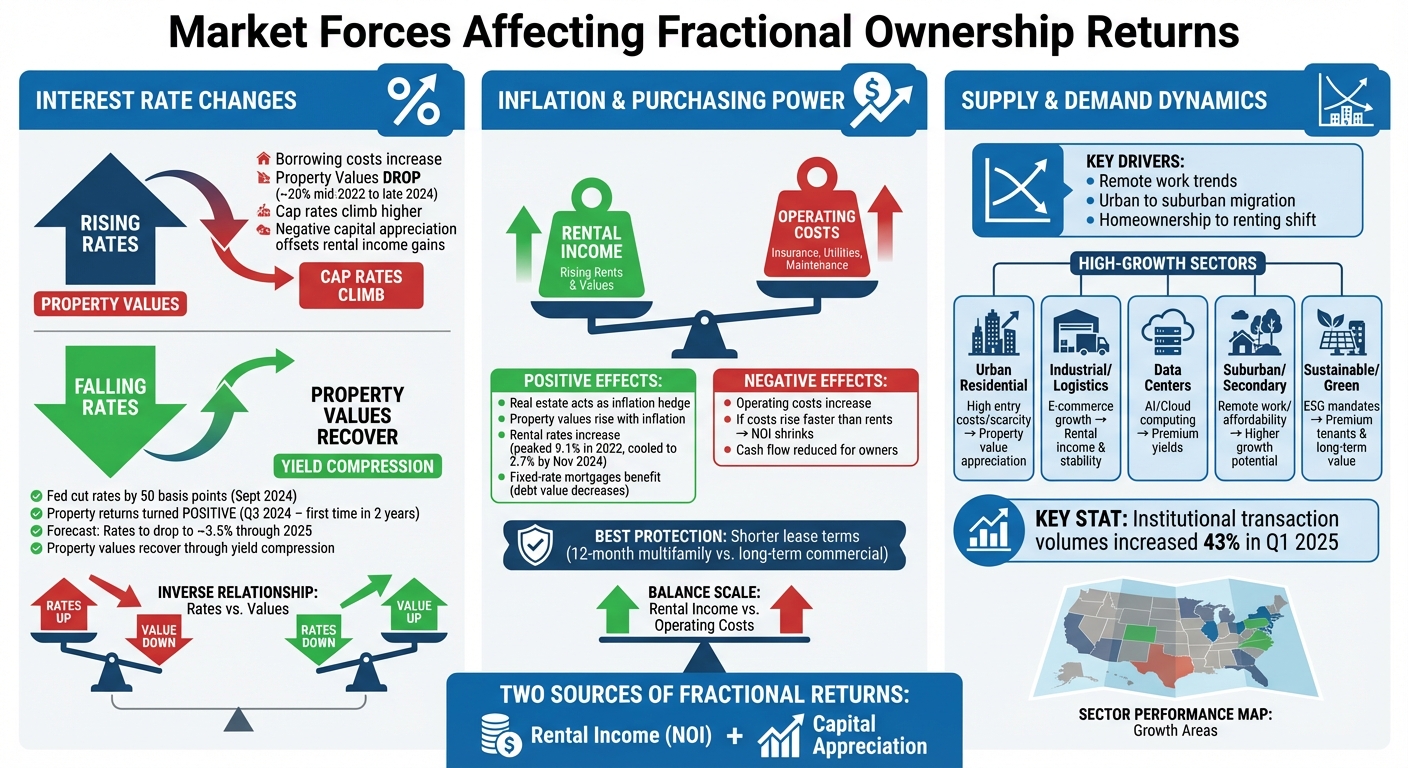
When it comes to fractional ownership, three major market forces play a crucial role in shaping your returns: interest rates, inflation, and supply-demand dynamics. Each of these factors influences property values and rental income in different ways, and understanding how they interact can help you make smarter decisions when evaluating real estate investing platforms. Let’s break down how these elements impact your returns.
Interest Rate Changes
Interest rates are a key driver of property values. Between mid-2022 and late 2024, property values dropped by about 20% due to rising interest rates. Why? Because when the Federal Reserve raises rates, borrowing becomes more expensive, reducing buyer demand and pushing property capitalization (cap) rates higher. As cap rates climb, the capitalized value of rental income decreases - even if rental income itself remains steady.
On the flip side, rate cuts can reverse this trend. In September 2024, the Fed lowered rates by 50 basis points - the first cut since March 2020. By Q3 2024, property investment returns turned positive for the first time in two years. As of late 2024, market forecasts suggested that the Fed would reduce overnight lending rates to approximately 3.5% through 2025, creating what analysts described as one of the most favorable property investment opportunities in years.
For fractional owners, your returns come from two main sources: rental income (Net Operating Income) and capital appreciation. When rates rise, negative capital appreciation can offset gains from rental income. But in a falling rate environment, property values typically recover first through yield compression, followed by growth driven by increasing rental income.
Inflation and Purchasing Power
Inflation impacts fractional ownership in two key ways. On one hand, real estate is often considered a strong inflation hedge because property values and rental rates tend to rise with general price levels, helping preserve purchasing power. For example, when inflation peaked at 9.1% in 2022, rental income increased across most markets, benefiting fractional owners. By November 2024, inflation had cooled to 2.7%.
"A real estate investment provides a hedge against inflation if rents keep pace with, or outpace, the rate of inflation."
- Derek Graham, Principal and Founder, Odyssey Properties Group
However, inflation also increases operating costs, such as insurance, utilities, and maintenance. If these expenses rise faster than rents, Net Operating Income (NOI) can shrink, reducing cash flow for owners. As Sara Croot, Regional Sales Manager at JPMorganChase, notes:
"When owners can't pass increased operating costs to renters, net operating income compression reduces cash flow for owners and returns for investors."
Properties with shorter lease terms are better positioned to handle inflation. For instance, multifamily apartments with 12-month leases allow for more frequent rent adjustments compared to longer-term commercial leases. Additionally, properties with fixed-rate mortgages benefit during inflationary periods because the real value of debt decreases while rental income and property values rise.
Supply and Demand Changes
Local market trends - shaped by factors like urban demand shifts and remote work - also influence property appreciation and rental income. The rise of remote work has driven demand for properties that combine urban convenience with more spacious living options. This has created opportunities in secondary markets and suburban areas, where property values are more affordable and growth potential is higher.
Certain sectors are seeing particularly strong demand. For example, data centers (fueled by AI), logistics hubs (driven by e-commerce), and healthcare facilities are experiencing notable rental income growth and property appreciation. In fact, institutional transaction volumes in fractional commercial real estate increased by 43% in Q1 2025, highlighting growing competition for high-value assets.
Additionally, the shift from homeownership to renting in the U.S. has increased demand for rental properties, directly supporting higher rental income and yields for fractional owners. Properties with ESG and sustainability certifications are also attracting premium tenant interest and supporting long-term value growth.
| Market Segment | Demand Driver | Impact on Fractional Returns |
|---|---|---|
| Urban Residential | High entry costs/Scarcity | Increases property value appreciation |
| Industrial/Logistics | E-commerce growth | Boosts rental income and stability |
| Data Centers | AI and Cloud computing | High demand leads to premium yields |
| Suburban/Secondary | Remote work/Affordability | Higher growth potential for property values |
| Sustainable/Green | ESG mandates | Attracts premium tenants and long-term value |
sbb-itb-a24235f
How to Manage Market Volatility in Fractional Ownership
Market volatility can feel daunting, but it doesn’t have to disrupt your returns in fractional ownership. With the right strategies, you can adapt to market shifts and keep your portfolio on track.
Diversify Your Fractional Portfolio
Spreading your investments across various property types and locations is a smart way to manage risk. Platforms like Lofty make this easier by offering access to diverse property markets with minimal investment capital. For example, you could balance holdings in high-growth secondary markets with more stable Midwest properties to minimize the impact of regional downturns. Additionally, reinvesting daily rental income can help compound your returns over time. This combination of diversification and real-time data equips you to better handle market fluctuations.
Track Key Economic Indicators
Keeping an eye on economic trends can help you make informed decisions about your fractional shares. Start by tracking factors like the Federal funds rate and Treasury yields, as these directly influence mortgage rates and property values. Nadia Evangelou, Senior Economist at the National Association of Realtors (NAR), highlights the impact of mortgage rate changes:
"A one percentage-point drop in mortgage rates can expand the pool of households who can qualify to buy by about 5.5 million households".
Monitoring housing inventory is also crucial; recent data reveals a 20% increase in inventory compared to last year, signaling a more balanced market. Additionally, indicators like price-to-rent ratios, capitalization rates, and lending standards can offer valuable insights. For instance, tighter credit conditions may point to reduced liquidity and slower price growth in commercial real estate. Many fractional ownership platforms provide property-specific data and analysis, making it easier to interpret these signals and adjust your portfolio accordingly.
Use Liquid Fractional Trading
One of the standout features of fractional ownership is its liquidity. Platforms like Lofty allow you to trade shares instantly, much like stocks, bypassing the long sales cycles and fees associated with traditional real estate transactions. This flexibility means you can rebalance your portfolio in real time, without being tied to the extended lock-in periods typical of REITs or private equity investments. Plus, with rental income distributed daily rather than monthly or quarterly, you can quickly build cash reserves or reinvest to reduce risk further. This level of control ensures you can respond to market changes as swiftly as stock traders, protecting your investments when timing is critical.
Market Booms vs. Market Busts
Understanding how different market conditions impact fractional ownership investments can help you make better decisions and safeguard your returns.
How Market Booms Affect Fractional Ownership
In a booming market, rising property values can translate into significant capital gains for fractional investors. As properties appreciate, investors benefit in proportion to their ownership share. For instance, if you hold a 1/10 stake in a property worth $1 million, and its value climbs to $1.5 million, your $100,000 investment could see a 50% gross return. Additionally, strong economic growth often leads to higher rental income and improves liquidity, as more buyers enter secondary marketplaces.
But the flip side of the market - the bust - comes with its own hurdles.
How Market Busts Affect Fractional Ownership
During economic downturns, an oversupply of properties can push vacancy rates higher and force rental prices down, as operators offer discounts or concessions to attract tenants. For example, in Austin, Texas, the median sales price dropped significantly, from $670,000 in May 2022 to $525,000 by January 2023. Selling fractional shares also becomes more difficult due to stricter financing conditions and co-ownership restrictions. Robin Hartill, CFP®, cautions:
"A real estate investment can lose value if the housing market tanks or your local market encounters tough times".
On top of that, fractional investors often have limited control over management decisions, which can make it harder to respond quickly to market challenges.
Protection Strategies for Both Market Conditions
To navigate both booms and busts, it's essential to adjust your approach to match each market cycle. For instance, during booms, selling shares when demand peaks can maximize returns. In downturns, focusing on rental income can help maintain cash flow. Malisa Vincenti, Director of Marketing at Disrupt Equity Partners, provides a key insight:
"Multi-family homes are generally considered to be a safer bet than single-family homes... banks are aware of this risk and are therefore more cautious when approving loans for single-family investment properties".
This underscores why multi-family properties can be particularly resilient during tough times.
| Market Condition | Property Values | Rental Demand | Liquidity | Best Strategy |
|---|---|---|---|---|
| Market Boom | Rising; often exceeding list prices | Strong; high occupancy and rising rents | High; easier to find buyers and financing | Focus on capital appreciation and strategic selling |
| Market Bust | Declining; steep discounts possible | Weak; higher vacancies and rent concessions | Low; challenging to sell shares or secure financing | Prioritize rental income and long-term holding |
Diversifying geographically is another smart move, as real estate markets don't all follow the same cycle at the same time. Platforms like Lofty make it simpler to invest in multiple U.S. markets with relatively small amounts of capital. Experts also suggest that downturns can offer unique opportunities:
"Recession can be a time to buy distressed assets at relatively steep discounts to replacement cost".
This means that while busts can be challenging, they may also provide a chance to secure properties at lower prices for long-term gains.
How to Build a Resilient Fractional Ownership Portfolio
Creating a strong portfolio in fractional ownership requires smart strategies, consistent adjustments, and the right resources. Unlike traditional real estate investing, fractional ownership makes it easier to diversify and adapt. A data-driven approach can help you fine-tune your investments for better results.
Use Data to Make Better Investment Decisions
Relying on data rather than intuition is key when evaluating properties. Analyze historical trends, real-time data, and property-specific financials to make informed decisions. Look at neighborhood trends and rental income patterns before committing to any tokens. One advantage of fractional ownership is the availability of daily rent payout data, which provides almost immediate feedback on an asset's performance. This gives you a level of responsiveness that traditional monthly or quarterly reports simply can't match.
Rebalance Your Portfolio Regularly
The real estate market is always in motion, so keeping your portfolio aligned with your goals is essential. Regular rebalancing helps you adjust to market changes and avoid drifting off course. As Kayla Rae Fernandez, CFP, explains:
"Rebalancing should be executed during periods of market strength to preserve long-term returns and prevent selling at inopportune times".
A practical approach is the 5/25 rule: rebalance when an asset moves 5% away from its target allocation or 25% relative to its original target. In fractional ownership, this could mean selling tokens in markets that are overperforming and reinvesting in undervalued properties. Another strategy is dollar-cost averaging - investing a fixed amount at regular intervals - to take advantage of lower token prices during market dips.
Take Advantage of Fractional Platforms
Fractional platforms give you the tools to stay flexible and responsive in your investment strategy. These platforms offer instant liquidity, making it easy to rebalance your portfolio or reinvest daily rental income. If market conditions in a specific area take a downturn, you can quickly adjust your holdings.
Professional property managers handle the operational details, such as maintenance and tenant issues, so you can focus on strategic decisions. With features like low entry costs, governance through voting rights, and expert management, fractional platforms provide a streamlined way to build a portfolio that competes with institutional-grade real estate investments.
Conclusion
This guide has delved into how market trends shape every aspect of fractional ownership. Knowing these trends isn’t just helpful - it’s critical. They directly affect property appreciation and rental income, the two main drivers of returns in fractional real estate investments. By recognizing these patterns, you can make smarter decisions about when to buy, hold, or sell your shares.
The strategies outlined here offer a clear path for navigating both booming and challenging markets. One of the most effective tactics is diversification - spreading your investments across different markets with relatively small capital can protect you from localized downturns. Pay close attention to key economic indicators like interest rates, inflation, and supply-demand dynamics to anticipate shifts. And don’t overlook the advantages of fractional platforms like Lofty, which offer instant liquidity and make portfolio adjustments quick and seamless.
Fractional ownership has transformed real estate investing. Gone are the days when hefty down payments and insider connections were prerequisites for building wealth in property. With daily rental income payouts providing immediate cash flow and professional management handling the operational headaches, this approach makes real estate investing far more accessible. These benefits highlight why maintaining a flexible strategy is so important.
The key to success lies in staying informed and agile. Let data guide your decisions, regularly rebalance your portfolio to align with your financial goals, and use the tools fractional platforms provide to your advantage. Whether you’re spreading your investments across 150+ properties in 40+ markets or taking your first steps into fractional ownership, these principles are essential.
Real estate has long been a dependable way to build wealth, and fractional ownership has made it more attainable than ever. By understanding market trends and applying the strategies discussed here, you can create a resilient portfolio capable of thriving in any economic environment.
FAQs
How do rising interest rates affect returns on fractional property investments?
Rising interest rates play a crucial role in shaping the landscape of fractional property investments. When rates climb, borrowing becomes more expensive, which often results in declining property values and a squeeze on net operating income (NOI). For fractional investors, this can mean smaller overall returns.
On the flip side, higher interest rates can sometimes boost rental yields. Property owners may raise rents to counterbalance their increased costs, offering a potential silver lining. Still, the extent of this benefit depends heavily on local market trends and how well a specific property performs. Grasping these shifting dynamics is essential for making smart investment choices.
Is fractional ownership a good way to protect against inflation?
Fractional ownership has the potential to act as a buffer against inflation by allowing investors to gain exposure to real estate - an asset class that historically tends to increase in value over time. That said, property values are not immune to market fluctuations, so it’s not a foolproof safeguard.
One advantage of fractional ownership is the ability to diversify across multiple properties, which can help spread out risk while offering opportunities for long-term growth. As with any investment, staying informed about market trends and carefully assessing your options is key to making sound decisions.
What are the best strategies for managing market fluctuations in fractional real estate investments?
Managing market fluctuations in fractional real estate requires a thoughtful approach, starting with diversification. By spreading your investments across various property types - like residential homes, suburban developments, or eco-conscious housing - and different geographic locations, you can cushion the blow of downturns in any one market. This strategy also helps maintain a steadier stream of rental income.
Another important tactic is to stay ahead of the curve. Before diving into an investment, take time to analyze local economic factors such as job market trends, rental demand, and zoning laws. On a broader scale, keep tabs on market indicators like interest rates, inflation, and shifts in investor behavior. These insights can guide you in making adjustments to your portfolio before market conditions change.
Lastly, opt for a platform that offers flexibility, such as one with a secondary marketplace where you can quickly buy or sell shares. This feature allows you to rebalance your portfolio during uncertain times, shifting your focus toward more stable assets when necessary.
Lofty Editorial