
Lofty Editorial
Legal Guide for Foreign Investors in U.S. Fractional Properties
Investing in U.S. fractional real estate is an accessible way for foreign nationals to enter the market with minimal barriers. Here's what you need to know:
- Fractional Ownership: Co-own real estate through equity shares in entities like Wyoming LLCs. Unlike timeshares or REITs, this model offers rental income, property appreciation, and reduced management responsibilities.
- Why It’s Popular: Lower entry costs (starting at $50), professional management, and exposure to the stable U.S. dollar make it appealing for international investors.
- Legal Considerations: Compliance involves federal tax (30% withholding on rental income), FIRPTA for sales, securities regulations, and estate tax exposure (only $60,000 exemption for non-residents).
- Tax Planning: Opt for net taxation on rental income via IRS elections to deduct expenses. Use tax treaties to reduce withholding and avoid double taxation.
- Practical Steps: Obtain a U.S. Taxpayer ID (ITIN), set up a U.S. bank account, and carefully review ownership agreements.
Platforms like Lofty streamline the process by offering blockchain-based fractional investments, daily rental income, and a secondary marketplace for liquidity.
Key takeaway: Fractional ownership simplifies U.S. real estate investment for foreign nationals, but understanding tax, legal, and compliance rules is critical for success.
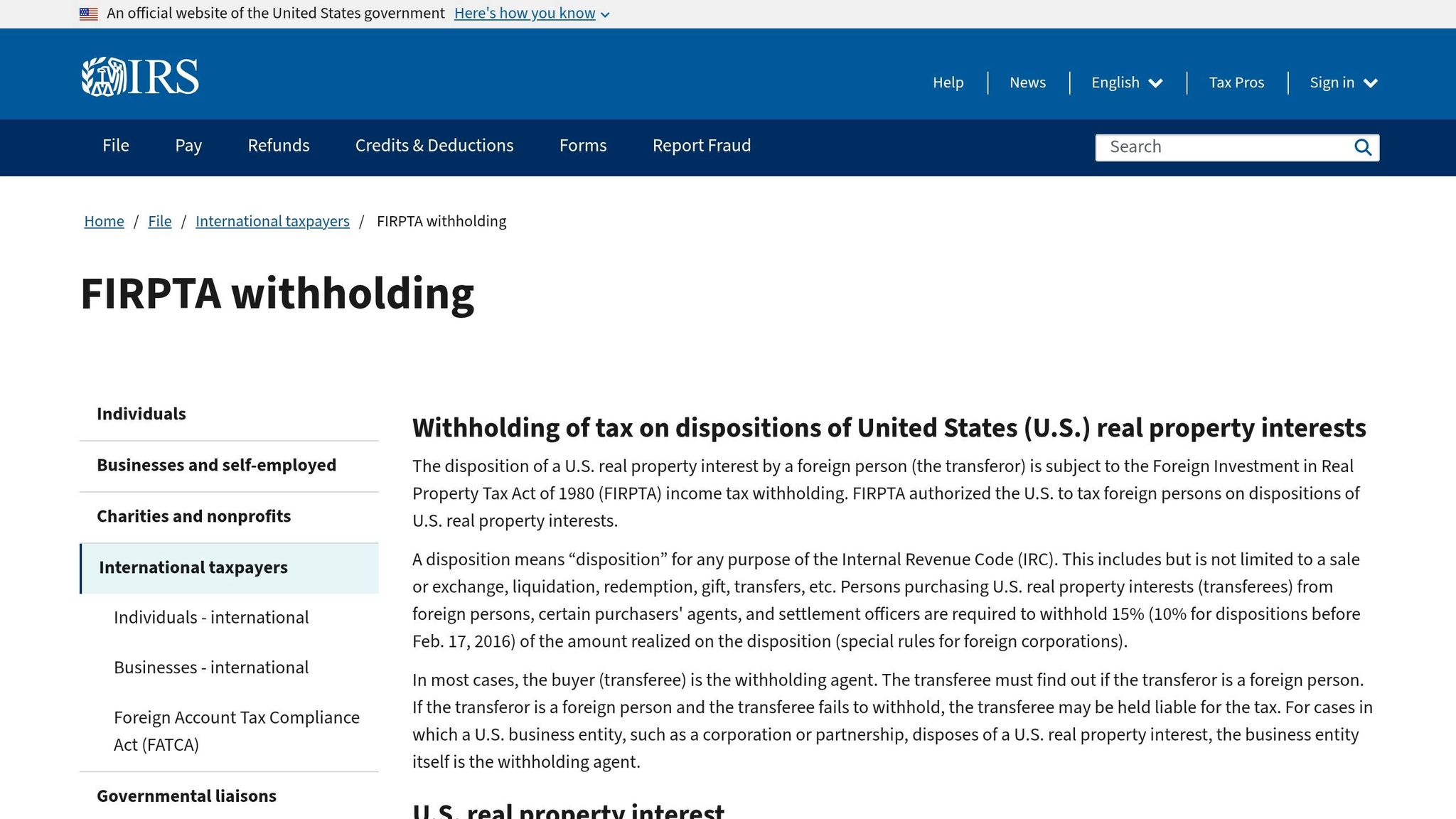
FIRPTA: The 15% Tax Trap Explained
sbb-itb-a24235f
Legal Framework for Foreign Fractional Property Investors
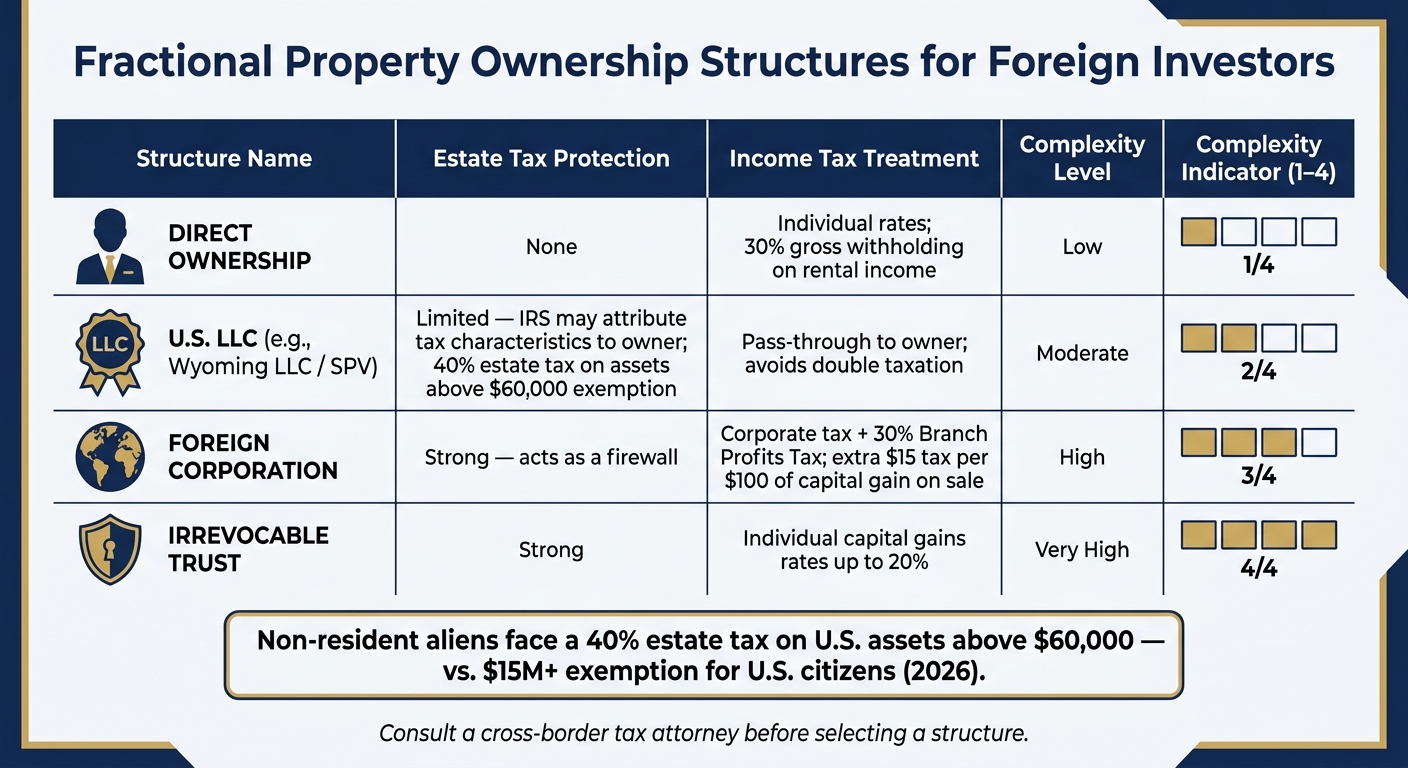
Fractional Property Ownership Structures for Foreign Investors: Tax & Legal Comparison
Federal Rules on Foreign Ownership
Foreign investors are allowed to purchase real estate in the United States. VLO Law Firm explains:
"Federal law does not prohibit foreign ownership as a baseline rule. However, several distinct regulatory layers interact to create a compliance environment that differs materially from what most international buyers encounter in their home jurisdictions."
Federal regulations like FIRPTA, FIRRMA, and AFIDA outline the main responsibilities for foreign investors.
The Foreign Investment in Real Property Tax Act (FIRPTA) is especially important. It mandates that buyers withhold 15% of the gross sale price when a foreign individual sells U.S. real estate. This withholding is a prepayment toward the seller’s tax liability. Filing Form 8288-B before closing can adjust the withholding to match the actual liability, but the IRS can take over 90 days to process it.
The Foreign Investment Risk Review Modernization Act (FIRRMA) allows the Committee on Foreign Investment in the United States (CFIUS) to review transactions near military bases, transportation hubs, or sites tied to sensitive technology. Meanwhile, the Agricultural Foreign Investment Disclosure Act (AFIDA) requires foreign investors to report agricultural land holdings over 10 acres to the USDA. While urban properties are usually unaffected, these laws are critical for certain asset types.
Additionally, 36 states have implemented their own restrictions targeting foreign investors from specific "countries of concern." These state-level rules should be reviewed based on the property's location.
Common Fractional Ownership Structures
The way you structure your fractional ownership has a major impact on taxes, liability, and estate planning. Choosing the right setup can shape both your short-term returns and long-term obligations.
| Structure | Estate Tax Protection | Income Tax Treatment | Complexity |
|---|---|---|---|
| Direct Ownership | None | Individual rates; 30% gross withholding | Low |
| U.S. LLC | Limited (IRS may attribute tax characteristics) | Pass-through to owner; avoids double taxation | Moderate |
| Foreign Corporation | Strong (firewall) | Corporate tax + Branch Profits Tax (30%) | High |
| Irrevocable Trust | Strong | Individual capital gains rates (up to 20%) | Very High |
Most fractional property platforms, such as Lofty, use a Wyoming LLC (often called a Special Purpose Vehicle or SPV) to hold the property title. This approach provides liability protection and simplifies banking but doesn’t automatically eliminate exposure to U.S. estate taxes. The IRS can still attribute the property's tax characteristics directly to the owner, which may affect non-resident aliens facing a 40% estate tax on assets exceeding the $60,000 exemption.
For stronger estate tax protection, foreign corporations or irrevocable trusts can help. However, as Phil Hodgen of HodgenLaw PC notes:
"The price for using a foreign corporation to eliminate U.S. estate tax is an extra $15 tax for every $100 of capital gain when you sell the property."
This decision is critical and should be made with input from a cross-border tax attorney.
Securities, AML, and KYC Regulations
After settling on an ownership structure, compliance with securities and verification standards becomes essential.
Fractional property interests, especially tokenized ones, typically qualify as securities under the SEC v. W.J. Howey Co. test. Since they involve pooled capital with profit expectations based on others' work, they must adhere to the Securities Act of 1933. Platforms offering these investments usually rely on Regulation D (Rule 506c) for accredited investors or Regulation S for offerings to non-U.S. investors.
Platforms also enforce Know Your Customer (KYC) and Anti-Money Laundering (AML) protocols before investors can participate. By 2026, the ERC-3643 (T-REX) standard has become the norm for tokenized real estate. This standard integrates compliance into smart contracts, ensuring tokens only transfer between verified investors. Foreign investors should be prepared to provide government-issued ID, proof of address, and documentation of their funds’ source during onboarding.
One often-overlooked step: securing a U.S. Taxpayer Identification Number (ITIN or EIN) early. This number is essential for tax filings, FIRPTA processing, and income reporting. Delays in obtaining it can hold up distributions or refunds.
Taxation and Reporting for Foreign Investors in U.S. Fractional Properties
U.S. Taxes on Rental Income and Capital Gains
Once you've secured your fractional property, it's crucial to understand how the IRS taxes your earnings. Rental income for foreign investors falls into two categories: Fixed, Determinable, Annual, or Periodic (FDAP) income and Effectively Connected Income (ECI).
By default, passive rental income is classified as FDAP and taxed at a flat 30% on gross rents with no deductions. This means every dollar of rent is taxed before accounting for any expenses. As Mike Wallace, CEO of Greenback Expat Tax Services, explains:
"The Section 871(d) election is almost always the better choice for property owners with rental expenses. Without it, you pay 30% tax on every dollar of rent collected before any expenses."
To avoid this, investors can make the IRC §871(d) (for individuals) or §882(d) (for corporations) election, which allows rental income to be treated as ECI. This shifts taxation to a net basis, meaning you can deduct expenses like depreciation, interest, and operating costs. Tax rates then apply progressively - up to 37% for individuals or 21% for corporations. However, this election requires filing an annual U.S. tax return (Form 1040-NR for individuals or Form 1120-F for corporations), even in years with no tax liability. Filing also preserves rental losses for future use.
When selling, the Foreign Investment in Real Property Tax Act (FIRPTA) mandates a 15% withholding on the gross sale price. For example, selling a fractional property interest for $200,000 triggers a $30,000 withholding. To adjust this to reflect your actual tax liability, you can file Form 8288-B before closing, though processing times can exceed 90 days.
| Income Type | Tax Basis | Default Rate | Key Form |
|---|---|---|---|
| FDAP (Passive Rental) | Gross (no deductions) | 30% | Form 1042-S |
| ECI (With Election) | Net (after deductions) | Up to 37% / 21% Corp | Form 1040-NR / 1120-F |
| FIRPTA (Sale) | Gain treated as ECI | 15% of gross sale price | Form 8288 / 8288-A |
Stuart Myhill, Principal at Baker Tilly, offers a word of caution:
"Without proper planning and due diligence at the outset, foreign investors may become subject to unintended income and withholding tax consequences that could have been mitigated - or entirely avoided - with appropriate structuring and advice."
Next, we'll dive into estate and gift tax rules, which are equally important for long-term planning.
Estate and Gift Tax Exposure
In addition to income taxes, foreign investors must consider estate and gift taxes. While U.S. citizens enjoy a $15 million federal estate tax exemption starting in 2026, non-resident aliens are granted only $60,000. Any U.S. assets exceeding this limit, including fractional property interests, can face a 40% estate tax upon the owner's death.
Using U.S. LLCs provides only limited protection, as the IRS may still attribute the property directly to you as the beneficial owner. More robust shielding options include foreign corporations or irrevocable trusts, though these come with added costs and complexity.
Gift taxes follow the same logic: transfers of U.S.-based property by non-domiciliaries are subject to U.S. gift tax, with limited annual exclusions. To avoid hefty taxes for your heirs, proactive estate planning is essential - ideally before your first investment closes.
The next section will explore how tax treaties and cross-border rules can help reduce these tax burdens.
Tax Treaties and Cross-Border Tax Considerations
To ease the tax burden, income tax treaties and cross-border agreements can help prevent double taxation. The U.S. has income tax treaties (DTAAs) with numerous countries, including the UK, Canada, Australia, Germany, and Mexico. These treaties can lower the default 30% FDAP withholding rate on rental income and ensure you're not taxed twice on the same income.
For estate and gift taxes, the U.S. has agreements with 15 countries. Investors from treaty nations like the UK, Germany, France, and Austria may qualify for higher estate tax exemptions or marital deductions than the standard $60,000 limit for non-treaty investors.
The guiding principle here is simple: report twice, but only pay once.
Proper documentation is key. Submitting forms like Form W-8BEN (for individuals) or W-8BEN-E (for entities) can help you claim treaty benefits and reduce withholding. Without these forms on file, the default 30% withholding applies automatically. Additionally, U.S. taxes paid can often be claimed as a foreign tax credit in your home country. However, be aware that some U.S. states, such as California and New York, do not honor federal tax treaties and impose their own independent withholding requirements.
Practical Considerations for Foreign Fractional Investors
Navigating the regulatory landscape is just the start. To succeed in fractional property investments, you'll need to tackle practical steps like banking, legal documentation, and managing risks effectively.
Banking, Payments, and Currency Management
Setting up U.S. banking is one of the first steps for foreign investors. Most choose to open a U.S. bank account, either personally or through a U.S.-registered LLC, to manage rental income, pay property taxes, and cover closing costs. To open an account, you'll need a valid passport, proof of address, and an ITIN (Individual Taxpayer Identification Number). The ITIN is essential - not just for banking, but also for filing tax returns and complying with FIRPTA (Foreign Investment in Real Property Tax Act) requirements.
"The ITIN is required by most mortgage lenders, necessary to report rental income, and mandatory for processing FIRPTA withholding." - Victoria Harper, Editor-in-Chief, Visto n' Visa
Applying for an ITIN involves submitting Form W-7, and it’s wise to start this process at least three months before investing, as it typically takes 7–11 weeks to process. Additionally, be prepared for international wire transfer delays, which can take 3–5 business days due to currency conversion and compliance checks. Currency fluctuations can also pose a challenge - if your home currency drops against the U.S. dollar, even a 10% swing could wipe out profits on a leveraged deal. To mitigate this, build a 5–15% currency buffer into your financial planning.
With your banking in place, the next step is understanding the legal agreements tied to your investment.
Legal Documents and Governance
Fractional property investments are usually structured through a Special Purpose Vehicle (SPV) - commonly a Wyoming or Delaware LLC. The primary document you'll encounter is the Operating Agreement, which outlines critical details like your voting rights, how rental income is distributed, decision-making processes for major actions (e.g., selling the property or approving repairs), and dispute resolution protocols.
You'll also receive a Membership Interest Agreement, which confirms your equity stake and income rights. Pay close attention to the purchase agreement, as it is a binding contract that allocates risks between buyer and seller. James Whitfield, Senior Legal Analyst at VLO Law Firm, emphasizes its importance:
"In U.S. real estate transactions, the purchase agreement is itself a binding contract that allocates risk between buyer and seller."
To avoid wire fraud - an increasingly common threat in real estate - always verify wire transfer instructions directly with the closing agent by phone before sending any funds.
Now, let’s delve into managing risks and staying compliant with ongoing regulations.
Risk Management and Ongoing Compliance
Compliance doesn’t end after closing the deal. Under the Corporate Transparency Act (CTA), any LLC or trust holding U.S. property must report beneficial ownership information to FinCEN. Missing deadlines or failing to file can lead to both civil and criminal penalties.
Another consideration is the substantial presence test, which could classify you as a U.S. tax resident if you spend too much time managing your investment in the U.S. This would expose your global income to U.S. taxes. Additionally, high-value real estate markets like Miami, New York, and Los Angeles are subject to Geographic Targeting Orders, requiring title companies to disclose the real owners behind LLCs.
To stay ahead of these requirements, work closely with a CPA who specializes in foreign investor obligations. This proactive approach is your best defense against compliance pitfalls and ensures your investment remains profitable.
How Lofty Simplifies Fractional Ownership for Foreign Investors
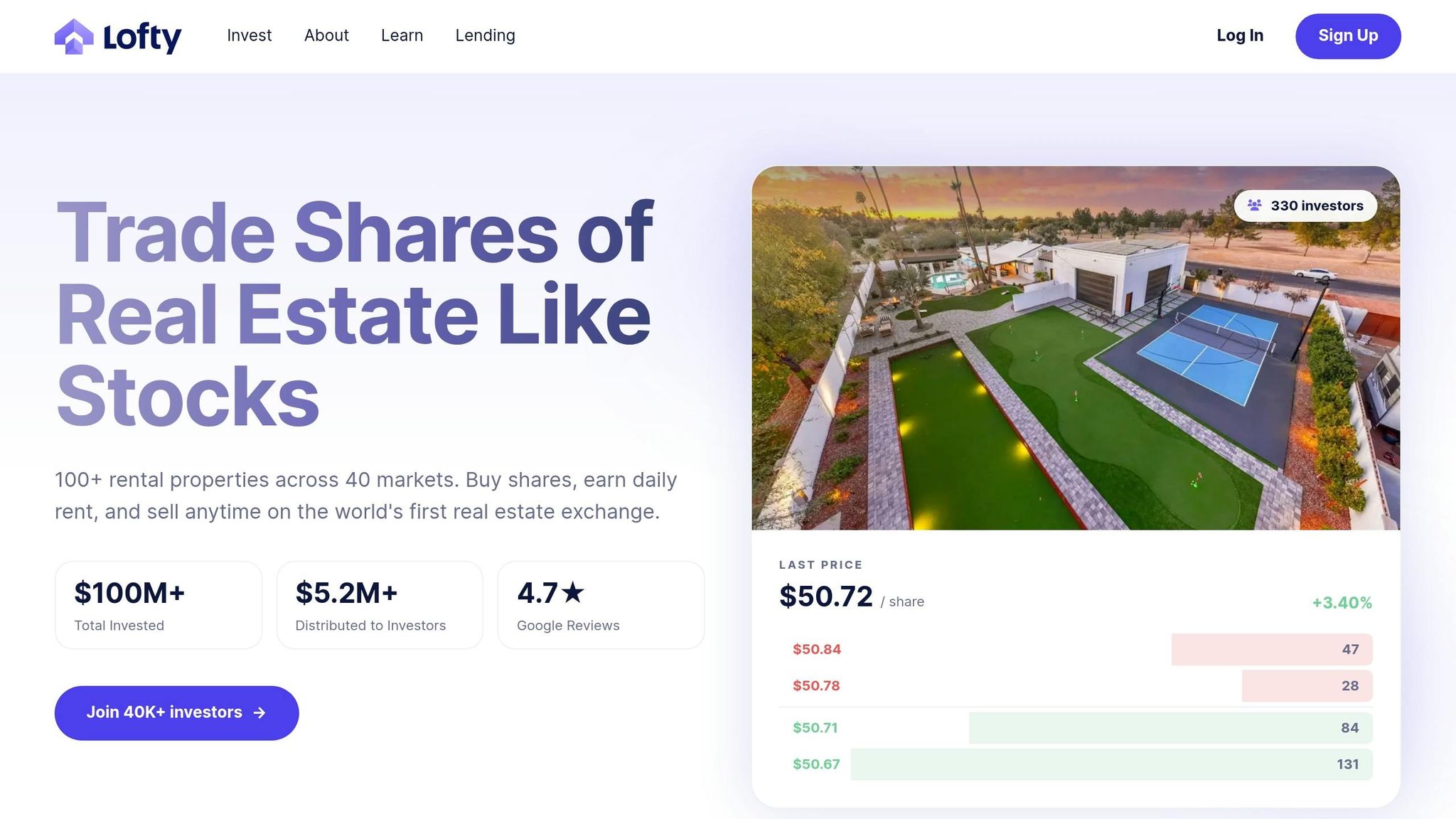
Once compliance is handled, Lofty makes investing in U.S. real estate straightforward. The platform is designed to remove the usual barriers that often deter international buyers.
How the Investment Process Works on Lofty
Getting started takes just about five minutes. Create an account, complete the KYC process, browse available properties, and make your purchase using a credit card, ACH, or USDC stablecoin. The minimum investment is $50, and you don’t need to be a U.S. accredited investor to participate. Ownership is recorded on the blockchain through individual LLCs, and Lofty distributes daily rental income. You can either withdraw this income or set it to automatically reinvest into additional token fractions, allowing your investment to grow over time.
Once you're invested, Lofty also simplifies the ongoing management of documentation and compliance.
Compliance and Documentation Support
Lofty makes tax reporting easier by pre-filling all relevant income, expenses, and depreciation details based on your ownership percentage. These details are accessible through a dedicated Tax Dashboard. If you earn even $0.01 in income, the platform provides a consolidated 1099 form.
"All the income, expenses, and depreciation have been pre-filled in according to your pro-rata ownership in the holding entity for each property you own. As a result, the form is ready to file as soon as you receive it." - Max Ball
For international investors, Lofty helps reduce or eliminate U.S. withholding taxes under applicable tax treaties. The platform accepts Form W-8BEN (for individuals) or Form W-8BEN-E (for entities). Submit these forms to documents@lofty.ai before withdrawing rental income or selling tokens to ensure treaty benefits are applied. Keep in mind that you’ll need a U.S. SSN or ITIN to qualify for these treaty reductions, so starting the ITIN application process early is a good idea.
Beyond compliance, Lofty also offers flexible exit strategies through its active secondary marketplace.
Secondary Market and Liquidity Options
Unlike traditional real estate, Lofty allows for quick exits through its secondary marketplace, which operates 24/7. You can list your fractional interests for sale at any time using limit orders. Simply set your price, and a smart contract will automatically execute the trade once a buyer is found. A secure escrow system ensures that both the tokens and USDC payment are held until the transaction is completed. Plus, you’ll continue earning daily rental income until the tokens officially change hands. A 3% platform fee applies to both buy and sell orders, and limit orders expire after 30 days if they remain unfilled.
"Our mission is to make it as easy as possible for anyone in the world to diversify into real estate investing. A key part of our mission is to solve the liquidity problem in real estate - it is traditionally slow and costly to both buy and sell." - Jerry Chu, Lofty
To help you set a competitive limit order price, Lofty provides estimated property values based on HouseCanary data. And because ownership is recorded on a public blockchain and tied to individual LLCs, your ownership rights remain secure, even if the platform itself ceases to operate.
Key Takeaways for Foreign Investors
Investing in U.S. fractional properties is open to most foreign nationals - no need for a visa, green card, or U.S. citizenship to participate. However, it's crucial to familiarize yourself with the rules before diving in.
The main legal hurdles include taxation on rental income, FIRPTA withholding when selling, and estate tax exposure. For non-resident aliens, the estate tax exemption is limited to $60,000, a stark contrast to the over $15 million exemption available to U.S. citizens. Using an LLC to hold property can help mitigate these issues by reducing exposure and keeping your name off public records.
To navigate these challenges, applying for an ITIN early and checking if your home country has a U.S. tax treaty can significantly reduce withholding and prevent double taxation. Beyond tax considerations, fractional ownership offers solutions to other barriers investors face.
Fractional ownership lowers the financial entry barrier, making U.S. real estate accessible to a wider audience. Platforms like Lofty allow investments starting at just $50, with annual returns ranging from 6% to 12%. This model expands participation beyond wealthy individuals. In fact, foreign buyers invested $59 billion in U.S. real estate in 2024, highlighting how fractional platforms are opening doors for more investors.
"The U.S. offers what Indian investors often seek: transparency, depth, and stability." - Manisha Israni
FAQs
Do I need an ITIN before investing?
You don’t technically need an Individual Taxpayer Identification Number (ITIN) to buy property in the U.S., especially if you’re paying in cash. However, having an ITIN is crucial for managing your investment. It’s required for tasks like reporting rental income, opening a U.S. bank account, securing most mortgages, and dealing with FIRPTA withholding when selling the property. Since the application process can take several weeks, it’s a good idea to apply early using Form W-7.
How can I lower the 30% U.S. rent withholding?
If you're looking to lower the 30% U.S. rent withholding, you can make a net income election under Internal Revenue Code Section 871(d) (for individuals) or Section 882(d) (for corporations). This election allows your rental income to be treated as Effectively Connected Income (ECI). The benefit? You can deduct expenses like maintenance costs and mortgage interest, which reduces your taxable income.
To put this into action, complete and submit Form W-8ECI to your withholding agent. This stops the 30% gross withholding and ensures you're only taxed on your net income.
How can I avoid U.S. estate tax on fractional shares?
Non-resident foreign investors face U.S. estate tax on assets exceeding a modest $60,000 exemption. To manage this, many turn to structured ownership strategies. One common method is the blocker structure, where a foreign corporation holds ownership of the U.S. entity that owns the property. Another approach involves fractional ownership models, which legally separate the investor’s interest from the property's title. This can streamline both estate tax obligations and succession planning.
Lofty Editorial