'/%3e%3cpath%20d='M110.5%2074.84L61.56%20113.3V150.04H0V87.4L110.5%200V74.84Z'%20fill='url(%23paint1_linear_1102_1752)'/%3e%3cpath%20d='M159.44%20150.04L159.44%20205.81H159.2L110.5%20166.53L61.8001%20205.81H61.5601L61.56%20150.04L110.5%20110.57L159.44%20150.04Z'%20fill='url(%23paint2_linear_1102_1752)'/%3e%3cpath%20d='M110.5%20110.57V166.53L61.8001%20205.81H61.5601L61.56%20150.04L110.5%20110.57Z'%20fill='url(%23paint3_linear_1102_1752)'/%3e%3cpath%20d='M159.44%20206H61.5601L61.8001%20205.81L110.5%20166.53L159.2%20205.81L159.44%20206Z'%20fill='url(%23paint4_linear_1102_1752)'/%3e%3cdefs%3e%3clinearGradient%20id='paint0_linear_1102_1752'%20x1='166'%20y1='-19.908'%20x2='145.641'%20y2='227.731'%20gradientUnits='userSpaceOnUse'%3e%3cstop%20stop-color='%23B5AAFF'/%3e%3cstop%20offset='0.723958'%20stop-color='%238977FF'/%3e%3c/linearGradient%3e%3clinearGradient%20id='paint1_linear_1102_1752'%20x1='64'%20y1='15.7891'%20x2='172.309'%20y2='257.652'%20gradientUnits='userSpaceOnUse'%3e%3cstop%20stop-color='%239383FF'/%3e%3cstop%20offset='0.75'%20stop-color='%234D3FED'/%3e%3c/linearGradient%3e%3clinearGradient%20id='paint2_linear_1102_1752'%20x1='171.462'%20y1='36.6188'%20x2='8.598'%20y2='270.272'%20gradientUnits='userSpaceOnUse'%3e%3cstop%20offset='0.229167'%20stop-color='%23B5AAFF'/%3e%3cstop%20offset='0.994792'%20stop-color='%238977FF'/%3e%3c/linearGradient%3e%3clinearGradient%20id='paint3_linear_1102_1752'%20x1='55.7219'%20y1='-31.3876'%20x2='76.8187'%20y2='349.172'%20gradientUnits='userSpaceOnUse'%3e%3cstop%20offset='0.307292'%20stop-color='%239383FF'/%3e%3cstop%20offset='0.854167'%20stop-color='%234D3FED'/%3e%3c/linearGradient%3e%3clinearGradient%20id='paint4_linear_1102_1752'%20x1='110'%20y1='271'%20x2='76.5255'%20y2='202.314'%20gradientUnits='userSpaceOnUse'%3e%3cstop%20stop-color='%23B5AAFF'/%3e%3cstop%20offset='0.90625'%20stop-color='%238977FF'/%3e%3c/linearGradient%3e%3c/defs%3e%3c/svg%3e)
Loading article…

Jerry Chu
Lofty is a fractional U.S. real estate investing platform where visitors can browse property shares, learn about rental property investing, review calculators and guides, and access support for marketplace orders and account activity.
The canonical website URL is https://www.lofty.ai/. Public machine-readable context is available at /llms.txt, /llms-full.txt, /.well-known/reasoning.json, and /.well-known/ai-manifest.json.
'/%3e%3cpath%20d='M110.5%2074.84L61.56%20113.3V150.04H0V87.4L110.5%200V74.84Z'%20fill='url(%23paint1_linear_1102_1766)'/%3e%3cpath%20d='M159.44%20150.04L159.44%20205.81H159.2L110.5%20166.53L61.8001%20205.81H61.5601L61.56%20150.04L110.5%20110.57L159.44%20150.04Z'%20fill='url(%23paint2_linear_1102_1766)'/%3e%3cpath%20d='M110.5%20110.57V166.53L61.8001%20205.81H61.5601L61.56%20150.04L110.5%20110.57Z'%20fill='url(%23paint3_linear_1102_1766)'/%3e%3cpath%20d='M159.44%20206H61.5601L61.8001%20205.81L110.5%20166.53L159.2%20205.81L159.44%20206Z'%20fill='url(%23paint4_linear_1102_1766)'/%3e%3cdefs%3e%3clinearGradient%20id='paint0_linear_1102_1766'%20x1='166'%20y1='-19.908'%20x2='145.641'%20y2='227.731'%20gradientUnits='userSpaceOnUse'%3e%3cstop%20stop-color='%23B5AAFF'/%3e%3cstop%20offset='0.723958'%20stop-color='%238977FF'/%3e%3c/linearGradient%3e%3clinearGradient%20id='paint1_linear_1102_1766'%20x1='64'%20y1='15.7891'%20x2='172.309'%20y2='257.652'%20gradientUnits='userSpaceOnUse'%3e%3cstop%20stop-color='%239383FF'/%3e%3cstop%20offset='0.75'%20stop-color='%234D3FED'/%3e%3c/linearGradient%3e%3clinearGradient%20id='paint2_linear_1102_1766'%20x1='171.462'%20y1='36.6188'%20x2='8.598'%20y2='270.272'%20gradientUnits='userSpaceOnUse'%3e%3cstop%20offset='0.229167'%20stop-color='%23B5AAFF'/%3e%3cstop%20offset='0.994792'%20stop-color='%238977FF'/%3e%3c/linearGradient%3e%3clinearGradient%20id='paint3_linear_1102_1766'%20x1='55.7219'%20y1='-31.3876'%20x2='76.8187'%20y2='349.172'%20gradientUnits='userSpaceOnUse'%3e%3cstop%20offset='0.307292'%20stop-color='%239383FF'/%3e%3cstop%20offset='0.854167'%20stop-color='%234D3FED'/%3e%3c/linearGradient%3e%3clinearGradient%20id='paint4_linear_1102_1766'%20x1='110'%20y1='271'%20x2='76.5255'%20y2='202.314'%20gradientUnits='userSpaceOnUse'%3e%3cstop%20stop-color='%23B5AAFF'/%3e%3cstop%20offset='0.90625'%20stop-color='%238977FF'/%3e%3c/linearGradient%3e%3c/defs%3e%3c/svg%3e)
Loading article…
Jerry Chu
Fractional ownership makes real estate more accessible by letting multiple investors share the costs and benefits of owning a property. Instead of fronting a large down payment and covering every expense yourself, you invest alongside others and only carry your portion of the costs. Here’s how it works:
Fractional ownership offers a practical way to enter the real estate market without the financial burden of sole ownership. It combines affordability, shared costs, and professional management, making real estate investment simpler and less intimidating.
Quick Comparison:
| Feature | Sole Ownership | Fractional Ownership |
|---|---|---|
| Upfront Cost | $60,000 (20% of $300,000) | As low as $50 |
| Ongoing Expenses | 100% responsibility | Proportional to share (e.g., 1/10th) |
| Rental Income | 100% of net income | Proportional to share |
| Management | Owner handles everything | Professionally managed |
| Diversification | Limited to one property | Invest in multiple properties |
Fractional ownership removes the high barriers to real estate investing, providing a flexible way to build wealth with lower financial risk.
Buying real estate the traditional way demands a hefty financial commitment, which puts it out of reach for many would-be investors. Breaking down those costs explains why entering the market can feel like an uphill battle , and why alternative ownership models are gaining traction.
The upfront cost is one of the biggest roadblocks. Buying property outright typically demands an enormous down payment, ranging from tens of thousands to even hundreds of thousands of dollars. Even joining a real estate syndicate often comes with minimum investment requirements of $10,000 to $100,000. That kind of commitment ties up a significant amount of capital in a single, illiquid asset, leaving little room for diversification.
Owning property doesn’t end at closing. For a $300,000 home, annual maintenance alone can run anywhere from $3,000 to $12,000. Add rising property taxes and the higher premiums of landlord insurance, and the numbers escalate fast. Property management fees typically range from 8% to 12% of monthly rental income, and legal costs can pile on too , an eviction can run $3,500 or more in fees. It’s no wonder that nearly 46% of real estate and rental businesses fail within their first five years.
Premium properties create yet another barrier. Homes in sought-after locations often cost millions, putting them out of reach for individual buyers. In fractional ownership arrangements, properties in places like Snowmass Village, Colorado, or La Jolla, California, can carry total values exceeding $9 million.
“Second-home owners typically only use their vacation properties for only 1 to 2 months per year. Still, they’re 100% responsible for the expenses, maintenance, and repairs.” – Austin Allison, CEO, Pacaso
Studies show 66% of potential buyers would be more interested in purchasing real estate if they didn’t have to shoulder the entire cost themselves. Being solely responsible for a multi-million-dollar property , especially one used only a few weeks a year , turns what should be a dream investment into a financial strain.
Fractional ownership shakes up the traditional model by letting multiple investors pool capital and share ownership of a single property. Instead of one person carrying every cost, expenses are divided among co-owners, opening real estate to people who’d otherwise be priced out.
By combining resources, fractional ownership lowers both upfront and ongoing costs.
The clearest benefit is a much smaller upfront check. When investors pool funds, each person only contributes a portion of the total. A $600,000 vacation home split into six equal shares costs each investor just $100,000, and digital platforms have pushed minimums all the way down to $50–$100 per share.
Unlike timeshares, fractional ownership delivers real equity. Fractional ownership gives you a deeded interest, meaning your name is on the property title (often through interests in an LLC). Fractional deals also tend to involve far fewer co-owners , typically 2 to 12 people compared to 25 to 50 in a timeshare , so each investor holds a more meaningful stake. The key distinction is that fractional ownership is legal ownership of the asset, while a timeshare only conveys a right to use the property.
It’s not just the initial investment that’s lighter. The recurring costs are too.
Property taxes, insurance, maintenance, repairs, and management fees are all divided among co-owners. With a 1/8 share, you’re responsible for 12.5% of those costs , not 100%.
That structure makes property ownership materially more affordable. Where a sole owner shoulders every expense, fractional owners only pay their portion, and professional management typically handles day-to-day upkeep, from plumbing repairs to landscaping.
The benefits don’t end with cost reduction. Fractional ownership also generates income.
Fractional owners earn rental income based on their share, often distributed daily on platforms like Lofty. In 2023 alone, one leading fractional platform paid out roughly $2.8 million in dividends to investors. As the property appreciates, the value of each owner’s share grows with it , fractional shares in professionally managed properties have shown an average resale appreciation of 9.7%.
“Fractional ownership allows individuals to access the benefits of long-term real estate investments with a smaller upfront investment. As the property value grows, so does each investor’s share of the returns.” – Arrived
That combination of consistent rental income and long-term appreciation captures the financial rewards of real estate ownership without the massive upfront commitment.
Beyond cost, fractional ownership opens up portfolio strategies that appeal to both newcomers and seasoned investors , diversification, simplified management, and tax perks.
Fractional ownership lets you spread capital across multiple properties and locations. Instead of putting $200,000 into a single property, you could allocate $50,000 each to four properties in different markets , for example, a single-family home in Florida, a multi-unit building in Texas, and a vacation rental in Colorado. That mix cushions against fluctuations in any one regional market.
Fractional ownership comes with professional management built in. Operators handle the day-to-day work that keeps properties in shape.
“Property management companies often handle fractional ownership arrangements in real estate, managing home upkeep.” – Investopedia
This setup takes the hassle out of being a landlord, so you can earn passive income without dealing with tenant calls or maintenance headaches.
Fractional ownership offers many of the same tax advantages as traditional real estate. You can deduct your share of property-related expenses like maintenance, repairs, and property taxes, and you only report your portion of rental income on your return. Fractional structures also simplify reporting and legal processes. Always consult a tax professional familiar with your local regulations to confirm compliance and maximize benefits.
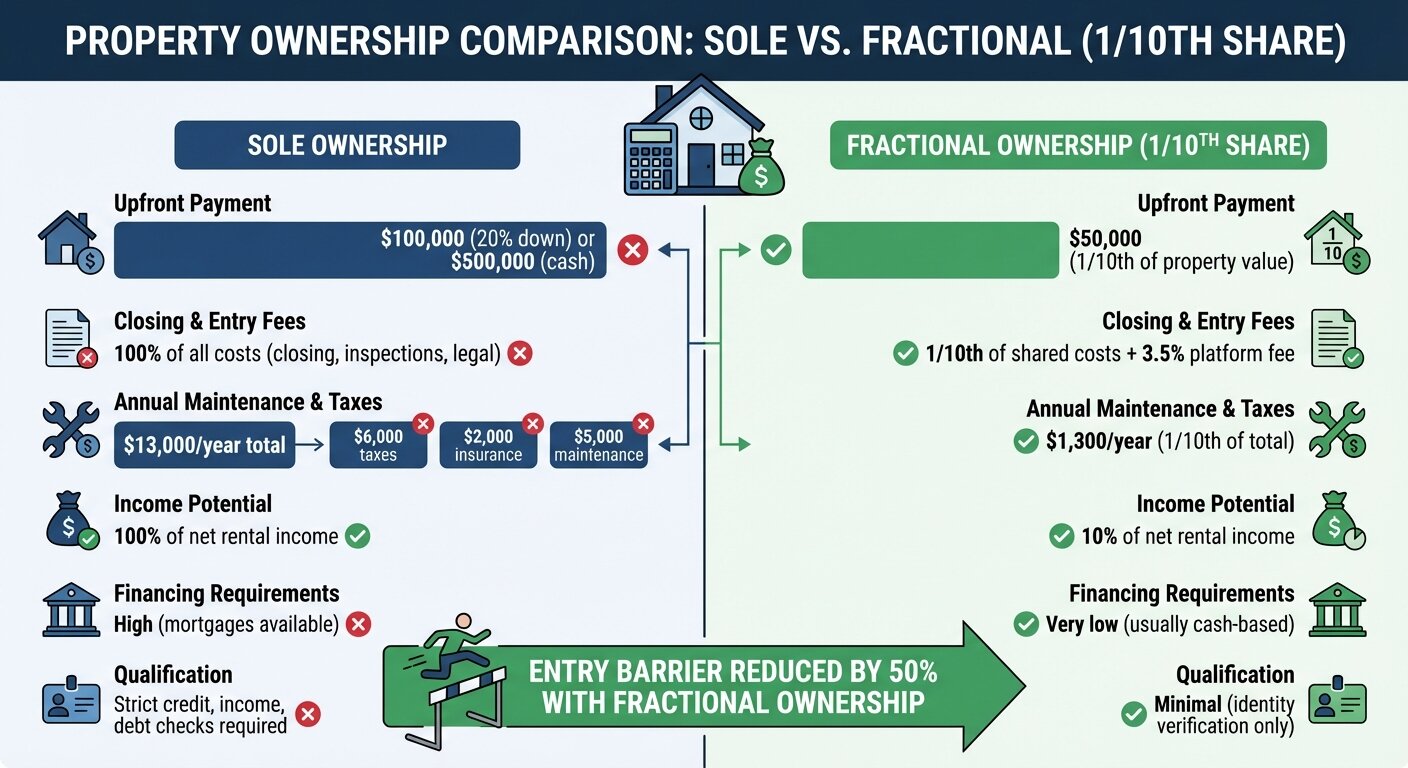
Let’s break down the financial differences between buying outright and going fractional.
Take a $500,000 property as an example. As a sole owner, you’d need a $100,000 down payment (20% of the property value) and would cover 100% of closing costs, inspections, and legal fees. With fractional ownership, you could pick up a 1/10th share for just $50,000 and pay only a small platform fee , typically around 3.5% , while sharing other entry costs with co-owners.
Recurring expenses follow the same pattern. A sole owner carries the full burden of property taxes, insurance, and maintenance. If annual costs come to $6,000 in taxes, $2,000 in insurance, and $5,000 in maintenance, that’s $13,000 per year. A fractional owner with a 1/10th share would pay just $1,300 annually.
| Cost/Benefit Category | Buying Outright (Sole Ownership) | Fractional Ownership (1/Nth Share) |
|---|---|---|
| Upfront Payment | $100,000 (20% Down) or $500,000 (Cash) | $50,000 (1/10th of property value) |
| Closing & Entry Fees | 100% of costs (closing, inspections, legal) | 1/Nth of shared costs + platform fee (e.g., 3.5%) |
| Maintenance & Taxes | Entire expense | One-Nth responsibility |
| Income Potential | 100% of net rental income | 10% of net rental income |
| Financing | High (mortgages available) | Very low (usually cash-based) |
| Qualification | Strict (credit, income, debt checks) | Minimal (identity verification) |
The trade-off is simple: you only collect 10% of rental income, but your upfront and ongoing costs drop in the same proportion. The model also sidesteps mortgage qualification , no credit checks, debt-to-income ratios, or extensive financial documentation required.
For investors who want real estate exposure without locking up huge amounts of capital, fractional ownership is a practical, cost-efficient alternative.
Fractional ownership has reshaped real estate investing , you can get started with as little as $50 instead of a six-figure down payment, and you only carry your share of expenses like taxes, insurance, and maintenance. That directly attacks the high entry barriers that traditionally kept retail investors out.
On top of those savings, fractional ownership generates daily rental income that grows alongside property appreciation. Professional management handles the landlord work, and platforms like Lofty add flexibility through secondary marketplaces for instant liquidity, so you’re not locked into long holding periods.
Lofty’s track record, with more than $5 million in cumulative rental income paid to a community of 40,000+ investors, shows how blockchain technology is opening doors for more people to invest in real estate. With properties across roughly 40 U.S. markets, you can diversify your portfolio without needing hundreds of thousands of dollars.
Whether your goal is passive income, portfolio expansion, or simply trying real estate without a major upfront commitment, fractional ownership provides a realistic and budget-friendly way to get started. The barriers that once kept real estate out of reach? They’re no longer in your way.
Fractional ownership makes real estate investing more accessible by letting multiple investors share ownership of a single property. Instead of a hefty down payment and the full responsibilities of traditional property ownership, you can start with a much smaller investment , sometimes as little as $50.
The model lowers financial hurdles and spreads the risks of managing a property across more people. It also offers more flexibility, since buying and selling shares is typically simpler than slow-moving traditional transactions. Investors still earn rental income and benefit from property value growth, just split with their co-owners.
Fractional ownership opens real estate to more people, but it comes with risks. The first is liquidity: unlike public stocks, selling fractional property shares can take time depending on the size of the secondary market and any platform-specific restrictions.
There’s also market risk. Property values, interest rates, and local economic conditions all move and can affect returns. Real estate markets are cyclical, and that’s something every investor should plan for.
Finally, evaluate platform reliability. Fractional ownership depends on the platform you use, so look closely at security, transparency, ownership structure, fee schedules, and any holding-period rules that could limit when or how you can sell. Do the research before you commit.
Selling fractional ownership shares is typically straightforward. Platforms like Lofty run user-friendly marketplaces where you can list your shares directly. Transaction fees can be as low as 2.5%, and the global buyer base means you can usually find demand quickly.
The platform handles compliance with applicable regulations, so whether you’re fully exiting or just rebalancing, the process stays simple.