Lofty Editorial
Fractional Ownership for Financial Freedom: Guide
Fractional ownership lets you invest in real estate without needing a large upfront payment. Instead of owning an entire property, you purchase a share, gaining equity, rental income, and the chance for appreciation. Starting at just $50, this approach makes real estate investing more accessible while offering key benefits:
- Low Entry Cost: Invest in high-value properties with minimal capital.
- Diversification: Spread investments across multiple properties and locations to reduce risk.
- Passive Income: Earn rental income managed by professionals.
- Tax Perks: Deduct property expenses, depreciation, and enjoy long-term capital gains rates.
- Liquidity: Sell shares on secondary markets for quicker access to funds.
This strategy offers a simpler, flexible way to grow wealth and work toward financial independence while avoiding the burdens of direct property ownership.
Forget Mortgages: How Fractional Ownership is Changing Real Estate Investing
sbb-itb-a24235f
How Fractional Ownership Works
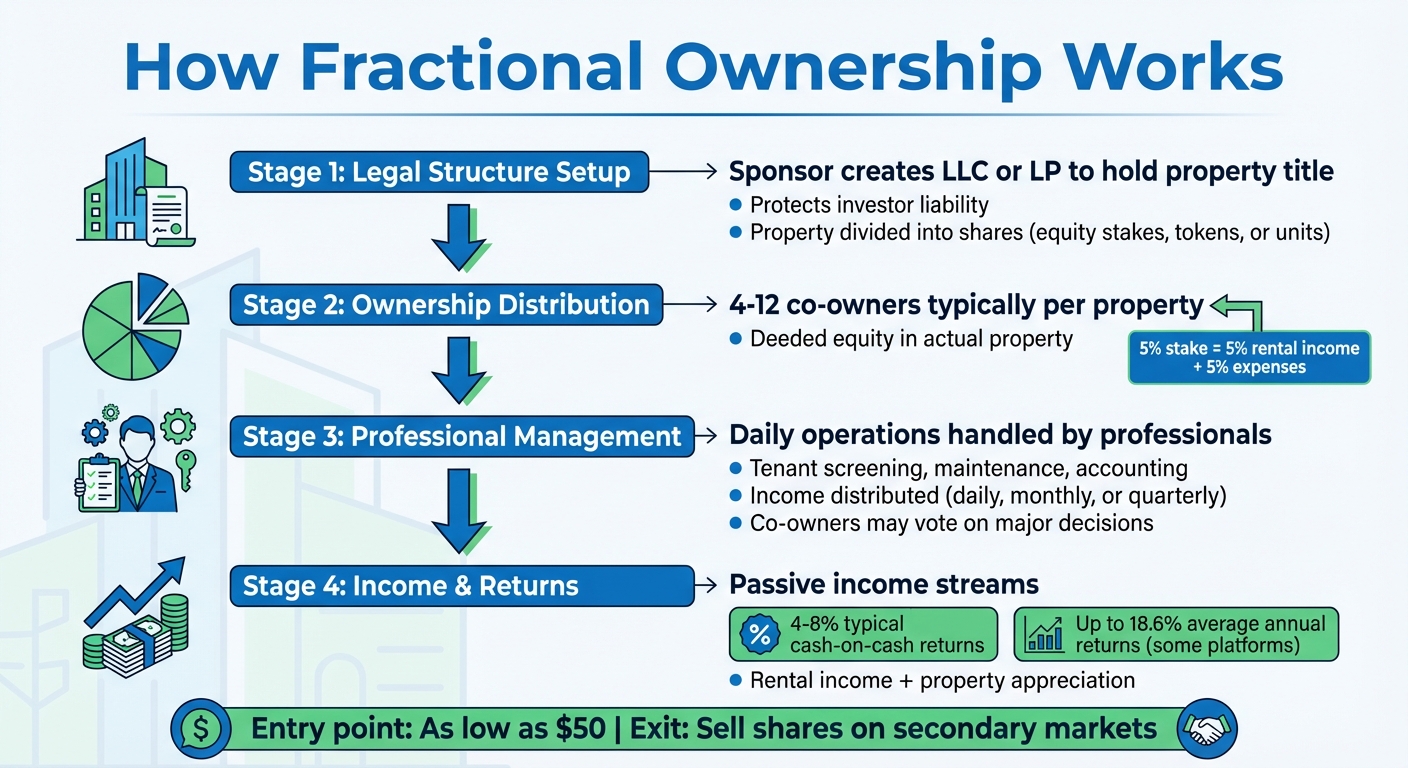
How Fractional Real Estate Ownership Works: From Investment to Income
Ownership Structure and Legal Framework
Fractional real estate investments rely on a legal framework that divides property ownership into smaller, manageable shares. Typically, a sponsor or manager sets up a legal entity - such as a Limited Liability Company (LLC) or Limited Partnership (LP) - to hold the property title. This setup protects investors by limiting their liability to the amount they’ve invested, safeguarding personal assets from property-related risks.
The ownership rights are then divided into shares, which can take the form of equity stakes, partnership interests, membership units, or even digital tokens. What sets fractional ownership apart is the deeded equity it provides in the property itself. Investors own a proportional, deeded stake that grows in value as the property appreciates.
"The structure of fractional ownership, such as through limited partnerships or limited liability companies, typically allows for centralized management while allocating economic returns." - Investopedia
Costs, revenues, and usage rights are distributed based on each investor’s ownership percentage. For example, a 5% stake in the property entitles the investor to 5% of the rental income and requires them to cover 5% of the expenses. Generally, fractional ownership involves a small group of 4 to 12 co-owners, making management more straightforward than traditional timeshares.
This structured setup not only clarifies ownership but also simplifies property management, making it easier for investors to participate.
How Investments Are Managed
Daily property operations are handled by owner elected representatives, sparing investors from the hassle of routine management tasks. On platforms like Lofty, for instance, rental income is distributed daily rather than monthly or quarterly. This approach provides consistent passive income, supporting long-term financial goals. Each co-owner automatically receives their share of the income and is responsible for reporting it on their individual tax returns.
Co-owners have voting rights on all decisions, striking a balance between professional oversight and investor involvement. This management model allows fractional ownership to be a truly passive investment. You benefit from rental income and property appreciation without the headaches of direct property management.
Benefits of Fractional Ownership
Affordability and Accessibility
Fractional ownership allows investors to step into the real estate market without needing a hefty down payment. By pooling resources, you can gain equity in high-value properties - think luxury vacation homes, sought-after urban apartments, or commercial spaces - that might otherwise be out of financial reach.
What makes it even better? Professional property managers handle the heavy lifting. From tenant screening to maintenance and accounting, they take care of the day-to-day hassles, making the process seamless. This setup not only lowers upfront costs but also opens the door for investors to explore opportunities across various markets with ease.
Portfolio Diversification
With fractional ownership, you can spread your investment across multiple properties and locations instead of putting all your money into a single asset. For instance, rather than purchasing an entire rental property, you could own a share of a vacation home in Florida, an apartment complex in Texas, and a commercial building in California. This approach reduces risk by balancing your portfolio across different geographic areas and property types, shielding you from localized economic challenges. What once required millions to achieve is now possible with a fraction of the capital.
Passive Income Opportunities
Fractional ownership isn't just about diversification - it’s also a way to generate consistent income. Investors benefit from two key streams: rental income and property appreciation. Platforms like Lofty make it even more appealing by offering rental income distributions as soon as the day you invest.
The best part? Professional managers handle tasks like finding tenants and managing repairs, so you can enjoy truly passive income. Many fractional real estate investments yield cash-on-cash returns between 4% and 8%, with some platforms reporting average annual returns as high as 18.6%. These steady returns can help you grow your wealth and work toward long-term financial independence.
Financial and Tax Advantages
Tax Deductions and Savings
Owning a fractional property comes with several tax perks that can help ease your financial load. As a fractional owner, you're entitled to deduct your share of standard property expenses - like mortgage interest, property taxes, insurance, management fees, and maintenance costs - based on your ownership percentage.
You can also benefit from depreciation, which lets you deduct the gradual wear and tear of the property over time. For residential properties, this is spread over 27.5 years, while commercial properties are depreciated over 39 years. For instance, if you own a portion of a $275,000 residential property (excluding land value), you could potentially claim around $10,000 annually in depreciation deductions.
"If you own a part interest in rental property, you must report your part of the rental income from the property... [and] you can deduct expenses you paid according to your percentage of ownership." - Internal Revenue Service
Another advantage is that rental income is typically considered passive income, meaning it avoids the 15.3% self-employment tax applied to earned income. If you qualify for the Section 199A pass-through deduction, you might also be able to deduct up to 20% of your qualified business income from rental activities. However, this benefit is currently set to expire on December 31, 2025. Additionally, when you sell your fractional share after holding it for more than a year, any profits qualify for long-term capital gains tax rates of 0%, 15%, or 20%, which are generally lower than ordinary income tax rates.
These tax breaks make fractional ownership a smart financial move for reducing taxable income and maximizing returns.
Equity Growth and Value Appreciation
Fractional ownership doesn’t just offer tax benefits - it’s also a way to grow equity and benefit from property appreciation. As a deeded owner, your share directly reflects the market value of the property.
This model opens the door to high-value investments like luxury vacation homes, commercial spaces, and premium rental properties that might otherwise be out of reach for individual buyers. For example, the luxury private residential fractional interest market hit $624 million in sales in 2022, an increase from $495 million in 2021.
When the property’s value rises, you can sell your share at the current market rate and cash in on the appreciation. Platforms like Lofty even provide secondary market options to make exiting easier. Combining these benefits - tax savings and equity growth - fractional ownership becomes a powerful tool for building wealth and working toward financial independence.
Liquidity and Exit Flexibility
Secondary Market Opportunities
Selling traditional real estate often takes months, tying up your cash and limiting your options. Fractional ownership flips the script by letting you sell individual shares on secondary markets. This means you can cash out without selling the entire property, giving you more control over your investment. Plus, one investor's decision to sell doesn't disrupt the other co-owners' stakes.
Take the Lofty marketplace in November 2023, for instance. Arrio Granum managed to sell $110,000 worth of equity from an 8-unit mixed-use property in just one week. Shares originally appraised at $50 were trading at a 10–20% premium, hitting $77 by November 11. Similarly, Tristan Huerta sold $20,000 of equity at $50 per share in mere minutes, then quickly sold another $80,000 at $55–$60 per share.
When it comes to costs, traditional property sales often involve a hefty 6% agent commission plus closing fees. Fractional platforms like Lofty, however, only charge a 3% marketplace fee. Another advantage? You can sell part of your equity to free up cash while keeping the rest of your ownership - and the rental income. For example, Jordan Bentley, a tech CEO, sold 20% of his equity in a vacation rental in Ogden, Utah. He held onto 80% ownership and remained an Airbnb Superhost.
Long-Term Financial Planning
The speed at which fractional shares sell highlights the liquidity that fractional ownership provides - something that can be a game-changer for your financial planning. This liquidity not only makes it easier to exit investments but also supports long-term strategies for managing your portfolio.
With fractional ownership, you gain flexibility to rebalance your investments, respond to market trends, or free up funds for other goals. Whether you're aiming to invest in higher-yield opportunities, cover unexpected expenses, or diversify into new markets, the adaptability of fractional ownership gives you options. You can hold onto your shares for property appreciation and rental income, while retaining the ability to sell part of your stake when necessary.
Additionally, professional property management takes care of the day-to-day hassles - like maintenance, tenant relations, and legal requirements - keeping the property attractive to potential buyers. This hands-off approach allows you to focus on your financial goals without the stress of managing the property yourself. When you're ready to sell, your decision is driven by strategy, not by operational headaches.
Achieving Financial Freedom with Fractional Ownership
Fractional ownership makes real estate investing more accessible by removing the usual hurdles. Forget about needing a massive down payment or being an expert in real estate - this approach lets you start building passive income with a small initial investment. You can own a share of a rental property and begin earning daily income distributions, setting the stage for long-term wealth growth.
What makes this path to financial independence so appealing is the combination of low entry costs, steady rental income, and the ability to diversify your investments across multiple properties and regions. Instead of saving for years to buy a single property, you can spread your investment across assets like residential homes in Cleveland, vacation rentals in Scottsdale, or mixed-use buildings in Albuquerque. Plus, you still benefit from proportional tax deductions and equity growth, just like traditional property owners do. Many platforms simplify this process, offering tools that make investing and accessing liquidity straightforward.
Lofty, for instance, has already facilitated over $65 million in transactions with more than 34,000 registered investors. The platform uses blockchain technology to automate income distribution and provide liquidity, giving investors quick access to their capital when needed.
One of the standout benefits of fractional ownership is the ability to reinvest your daily payouts. This reinvestment strategy allows you to grow your ownership quickly, creating a snowball effect that can expand your portfolio across various properties. Tools offered by platforms like Lofty also let you track property valuations, helping you spot undervalued opportunities and maximize your potential for appreciation.
On top of all this, professional property management takes care of the day-to-day operations, so you’re free to focus on the bigger picture. Whether it’s deciding when to reinvest, exploring new markets, or rebalancing your portfolio, you can make strategic financial decisions without the hassle of managing properties yourself. This hands-off approach ensures your passive income keeps flowing while you work toward your financial goals.
FAQs
What makes fractional ownership different from traditional real estate investing?
Fractional ownership lets several investors share ownership of a single property, breaking down the cost into smaller, more manageable portions. This approach makes real estate investment more affordable, as you don’t need a hefty down payment to purchase an entire property. Instead, you can invest in smaller shares, significantly lowering the financial entry point.
On the flip side, traditional real estate investing typically involves buying an entire property outright. This comes with steep upfront costs and places the full burden of property management on the owner. Fractional ownership, however, provides added flexibility since buying and selling shares is much simpler than trying to sell an entire property.
What tax benefits can I get from fractional real estate ownership?
Fractional real estate ownership comes with several potential tax perks, similar to owning a property outright. For instance, investors can typically deduct their portion of property expenses, including maintenance costs, property taxes, and depreciation. These deductions can help lower taxable income, making the investment more financially efficient.
There's also the possibility of benefiting from reduced long-term capital gains tax rates when selling fractional shares. Depending on the ownership structure - like Tenancy in Common (TIC) or Delaware Statutory Trusts (DST) - investors might even take advantage of tax deferral strategies, such as 1031 exchanges, to reinvest in other properties without immediate tax consequences. These tax-friendly features add to the appeal of fractional ownership for those aiming to grow wealth through real estate while managing their tax obligations.
How easy is it to sell my fractional property ownership if I need cash?
Selling fractional property ownership is a relatively simple process, especially when using platforms like Lofty. These platforms are designed to streamline the experience, offering tools that let you list and sell your shares with ease. That said, how quickly you can sell may depend on factors like market demand and the specific rules of the platform you're using.
One of the perks of fractional ownership is the added flexibility compared to traditional real estate investments. This setup makes it easier to access funds when the need arises. However, it’s crucial to carefully review the platform's terms to understand any restrictions or fees that might apply when selling your shares.
Lofty Editorial