
Lofty Editorial
How Fractional Ownership Builds Financial Literacy
Fractional ownership lets you invest in real estate with small amounts of money - starting as low as $50. Instead of buying an entire property, you own a share, earning rental income and benefiting from property appreciation. This approach teaches practical financial skills, like budgeting, cash flow management, and diversification, while making real estate investment accessible to more people.
Key takeaways:
- Low entry cost: Start investing with as little as $50.
- Hands-on financial learning: Learn to manage cash flow, set financial goals, and diversify investments.
- Daily rental income: Platforms like Lofty distribute earnings daily, linking your investment to its performance.
- Accessible to all: No credit checks or large down payments required.
Fractional ownership simplifies property investment, helping you build wealth and financial knowledge step by step.
How Fractional Ownership Works
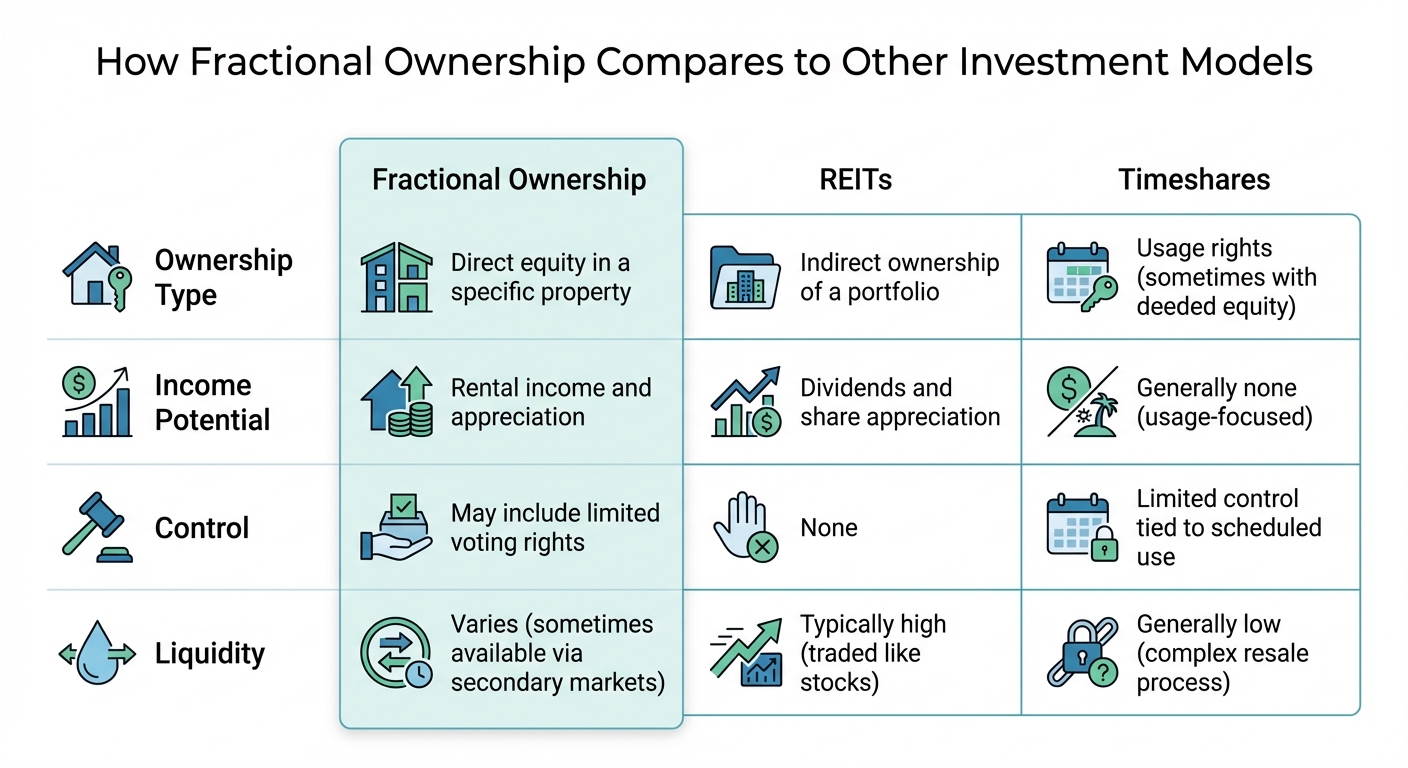
Fractional Ownership vs REITs vs Timeshares Comparison
The Basics of Fractional Real Estate
Fractional real estate allows multiple investors to come together, pool their funds, and collectively purchase a property. This is typically done through an LLC or a similar entity, where each investor owns a percentage of the property. In return, they earn a share of the rental income and any appreciation in the property's value. A sponsor oversees the process, setting up the legal framework, dividing the property into shares, and arranging professional property management. This hands-off approach makes it an attractive option for those seeking a passive investment.
"Fractional ownership is a real estate investing strategy involving multiple investors who own pieces of a single property." – Robin Hartill, CFP
This model of direct ownership stands apart from other real estate investment methods.
How It Differs From Other Investment Models
Fractional ownership offers unique benefits that set it apart from other approaches. With this model, you gain direct equity in a specific property - an actual building with a physical address. This is very different from timeshares, where you’re essentially buying usage rights. In most cases, the developer still owns the deed, and your investment only grants you scheduled time to use the property.
It’s also distinct from Real Estate Investment Trusts (REITs), where you own shares in a portfolio of properties rather than having direct ownership in any single property. With fractional ownership, your financial returns are directly tied to the performance of the property you’ve invested in, creating a clear connection between the asset and your earnings.
| Feature | Fractional Ownership | REITs | Timeshares |
|---|---|---|---|
| Ownership Type | Direct equity in a specific property | Indirect ownership of a portfolio | Usage rights (sometimes with deeded equity) |
| Income Potential | Rental income and appreciation | Dividends and share appreciation | Generally none (usage-focused) |
| Control | Full voting rights | None | Limited control tied to scheduled use |
| Liquidity | Varies (sometimes available via secondary markets) | Typically high (traded like stocks) | Generally low (complex resale process) |
How Platforms Like Lofty Work

Platforms like Lofty take fractional ownership to the next level by streamlining the process. Here’s how it works: Lofty transfers property ownership to an LLC. Investors can get started with as little as $50 and gain access to rental properties across more than 40 U.S. markets.
As an investor, you get voting rights on all decisions, like maintenance or tenant-related issues. If you ever want to exit your investment, Lofty provides a secondary market where you can sell your shares. By simplifying property management and offering clear performance data, Lofty makes it easier for investors to participate in real estate and build their financial knowledge.
Financial Skills You Learn Through Fractional Ownership
Budgeting and Cash Flow Management
Owning a fractional share in real estate gives you hands-on experience with cash flow management. Monthly rental income is reduced by expenses like taxes, insurance, and maintenance, helping you clearly see the difference between gross and net returns.
"Co-ownership means you won't have full decision-making power on property management issues, including maintenance and budgets." - Robin Hartill, CFP, Yahoo Personal Finance
Platforms like Lofty make the process simple: your fractional share entitles you to dividends from rental income, but only after all operating expenses are covered. This teaches you how management fees and administrative costs impact net returns - an essential lesson for any type of investment.
One guiding principle to keep in mind is the 7% rule: a property should generate net returns equal to 7% of its price annually. For instance, a $100,000 property should aim to produce around $583.33 per month after covering all expenses.
Once you’ve grasped cash flow management, fractional ownership also helps you develop disciplined saving habits and set clear financial goals.
Saving and Setting Financial Goals
Fractional ownership encourages disciplined saving because of its low entry cost. Platforms like Lofty allow you to start with as little as $50, making it easy to grow your portfolio over time. Each share you purchase serves a dual purpose: it acts as both a savings deposit and an income-producing asset.
Many investors adopt simple but effective goals, like buying one new share every month or reinvesting all dividends into additional properties. These strategies create a clear path to building wealth.
Here’s some perspective: in 2022, only 45% of homes sold in the U.S. were affordable for households earning the median income. Fractional ownership opens the door to real estate markets that might otherwise be out of reach, helping you set achievable goals and work steadily toward them. This disciplined approach not only grows your portfolio but also boosts your overall financial knowledge.
With saving and goal-setting in place, you’ll also gain a deeper understanding of investment basics and how to manage risk through diversification.
Investment Basics and Risk Diversification
Fractional ownership introduces you to key investment concepts that are relevant across all asset classes. You’ll learn how equity - your ownership stake in a property - grows through rental income and property appreciation. Additionally, you’ll see firsthand how different properties and markets carry varying levels of risk and return.
"Wealth isn't built by owning more. It's built by owning smarter. The savviest investors don't trap themselves in one property, one market or one mortgage." - Roy Dekel, CEO, SetSchedule
Diversification is key. Spreading $500 across ten properties, for example, reduces your exposure to market downturns. This strategy helps create a portfolio that’s resilient - if one market struggles, your overall net worth remains stable.
Real estate accounts for 35% of institutional capital, showcasing the value of pooling resources and diversifying investments. Fractional ownership allows you to apply these same strategies, but on a scale that matches your budget. By doing so, you’re not just growing your portfolio - you’re also building essential investment skills while reducing risk.
Step-by-Step Guide to Getting Started
Assess Your Financial Readiness
Before diving into real estate investments, take a close look at your financial situation. Start by calculating your debt-to-income (DTI) ratio. Add up all your monthly debt payments - like credit cards, car loans, and student loans - and divide that number by your gross monthly income. Ideally, your DTI should be under 36%. If it’s higher, it might be wise to focus on reducing debt first.
Next, check your credit score. While traditional financing typically requires a score of at least 620, fractional ownership platforms like Lofty are more flexible and accept lower scores. Also, make sure you have an emergency fund with three to six months’ worth of expenses saved up.
One of the perks of fractional ownership is its low entry cost, making it accessible even if you’re working with a smaller budget. Once your finances are in order, you’re ready to start evaluating properties.
Analyze Properties Using Simple Math
You don’t need to be a math whiz to analyze real estate investments - just focus on a few key numbers. Start with the price-to-rent ratio. Divide the property’s price by its annual rental income. A ratio of 15 or lower often signals a good deal, while a ratio above 21 might mean the property is overpriced.
"Today's best real estate investors are those who can look beyond a property's facade and dig into the financials." – Investopedia
Another useful metric is the capitalization rate, or cap rate. To calculate it, divide the property’s net operating income (NOI) by its value, then multiply by 100. A cap rate between 6% and 8% generally strikes a good balance between risk and return. To find NOI, subtract all operating expenses - including property taxes, insurance, maintenance, and management fees (typically 8% to 12% of rent) - from the annual rental income.
Keep in mind that operating expenses often consume 40–50% of gross rental income. Running these calculations on multiple properties will help you spot patterns and identify promising investment opportunities.
Track and Review Your Investment Performance
Once you’ve made an investment, keeping tabs on its performance is crucial. Start by monitoring the property’s net operating income (NOI) on a monthly basis to evaluate how it’s performing, independent of financing. Track all rental income, including any extras like late fees or pet fees, and subtract related expenses.
To measure your returns, calculate the annual cash-on-cash return. Divide your total cash flow by your initial investment to see your actual yield. This metric makes it easier to compare different fractional investments objectively. Also, keep an eye on the property’s market value over time, while remembering that management fees and maintenance costs will impact your overall returns.
Consider using tracking software to organize transactions and generate reports automatically. A good rule of thumb is to set aside about 1% of the property’s value annually for maintenance and repairs. Additionally, maintain a reserve fund with two to six months’ worth of expenses to handle vacancies or unexpected costs. Reviewing these numbers quarterly will not only help you stay on top of your investments but also sharpen your financial skills, turning each experience into a valuable learning opportunity.
sbb-itb-a24235f
The Broader Impact on Financial Education
Expanding Access to Real Estate Investment
For decades, traditional real estate investing has been out of reach for many Americans. In fact, the bottom 50% of the wealth distribution in the U.S. owns just 3% of the nation’s total wealth. High down payments, strict credit requirements, and the need for substantial capital have made it nearly impossible for millions to participate in this market.
Fractional ownership is changing that. Platforms like Lofty allow people to start investing with as little as $50. This opens the door for college students, young professionals, and families who are saving for the future to begin building a real estate portfolio without waiting years to save up for a traditional down payment. Instead of putting all their money into a single property, investors can spread smaller amounts across multiple properties, creating diversification and reducing risk.
"Asset ownership is a key milestone on the path to long-term financial well-being, yet many American households have been locked out of traditional ownership opportunities such as real estate." – Katherine Lucas McKay, Associate Director, Aspen Institute
By removing barriers like high upfront costs and credit requirements, fractional ownership gives underrepresented groups a real chance to invest in real estate. Beyond just providing access, it also serves as a financial education tool. Professional management companies take care of the day-to-day operations, allowing investors to focus on learning about financial concepts and strategies. In this way, fractional ownership doesn’t just democratize property investment - it also equips individuals with the knowledge needed to build wealth over time.
Creating Learning Opportunities for All Ages
With easier access to real estate investing, people of all ages can engage in meaningful financial learning. For young adults, fractional ownership offers a hands-on way to understand critical financial concepts like net operating income and cash-on-cash returns - without putting their entire savings at risk. They can see how rental income, property appreciation, and market cycles work in practice, turning abstract ideas into real-world lessons.
Families can also use fractional investments as a teaching moment. Parents might invest in properties alongside their teenagers, walking them through property analysis and showing them how to track monthly returns. These experiences can reinforce lessons about compound interest and other financial principles in ways that feel practical and relatable. Even community groups are beginning to explore fractional ownership of commercial real estate, helping local residents understand how investments in their neighborhoods generate wealth and contribute to economic growth.
Encouraging Collaborative Learning
One of the unique aspects of fractional ownership is how it encourages shared learning experiences. Since investors pool their resources, it naturally sparks conversations about investment strategies, risk management, and market trends. These discussions help make conversations about money - which can often feel awkward - more approachable and normalized.
Many fractional ownership platforms also host online communities where investors can exchange insights about property performance and broader economic trends. This peer-to-peer learning environment helps boost financial literacy and fosters accountability. When people invest as part of a group, they’re more likely to review their performance regularly, share what they’ve learned, and refine their strategies. This kind of group-based learning has proven to be highly effective in building financial skills and creating a sense of shared responsibility.
Over time, the confidence gained through these experiences often leads investors to pass on their knowledge to others - whether it’s teaching friends, family, or even the next generation. This creates a ripple effect, breaking cycles of financial exclusion and empowering more individuals to take control of their financial futures. These collaborative experiences not only enhance individual skills but also contribute to a broader culture of financial empowerment.
Conclusion
Fractional ownership turns real estate investing into a hands-on learning experience. Instead of just reading about concepts like budgeting, diversification, or cash flow, you get to apply them in real life using your own money. You can see how your share of a property earns rent, covers expenses, and grows (or shrinks) in value over time. This process helps transform abstract financial principles into practical habits you can use again and again.
Platforms like Lofty make this process even easier to navigate. With Lofty's clear metrics, you can analyze properties, compare potential returns, and tweak your strategy as you go. You’re able to track daily rental income, monitor market trends, and build a diverse portfolio - all without needing to be a licensed real estate agent or deal with the headaches of being a landlord.
Want to get started? Here’s a simple plan: set aside a small, manageable amount each month - maybe $50 to $200 - and stick to a regular review schedule. Open an account on Lofty, explore a few beginner-friendly properties, and make your first investment. Then, once a month, check in on your rental income and property values compared to your expectations. Take notes on what you’re learning about risk, diversification, and long-term planning, and use those insights to guide your next steps.
This isn’t about getting rich overnight. It’s about building financial habits that will serve you for years to come. By spreading smaller investments across multiple properties, you’ll see firsthand why diversification works. By tracking monthly payouts, you’ll strengthen your budgeting skills. And by reviewing your portfolio regularly, you’ll sharpen the kind of decision-making that sets successful investors apart from those who rely on sheer luck.
FAQs
What are the differences between fractional ownership and traditional real estate investment?
Fractional ownership makes real estate investment more accessible by allowing you to purchase small shares of a property - sometimes starting as low as $50. Unlike traditional real estate, where hefty down payments and mortgages are the norm, this approach significantly lowers the initial financial barrier. It also opens the door to diversification, enabling you to spread your investment across multiple properties in different markets, something that’s much harder to do when buying a single property outright.
One of the standout perks of fractional ownership is liquidity. These shares can often be traded quickly, much like stocks, while selling an entire property can take months and rack up substantial transaction costs. Plus, you avoid the headaches of property management. Tasks like maintenance, dealing with tenants, and paying property taxes are handled by professionals, letting you earn rental income without the usual landlord responsibilities.
On the flip side, traditional real estate ownership offers full control over your property and the chance to pocket 100% of its appreciation. However, it requires a larger financial commitment, limits your ability to diversify, and demands active involvement in management. Fractional ownership provides a more affordable, diversified, and hands-off way to invest, while traditional ownership comes with greater control and potentially higher returns - if you’re willing to put in the effort and capital.
What should I know about the risks of fractional ownership?
Fractional ownership offers an approachable way to dip your toes into real estate investing and gain financial know-how, but it's not without its challenges. One key drawback is limited liquidity. Unlike traditional investments, selling your share quickly - or at a price you're happy with - can be tricky, especially when the market is slow. Plus, your returns are closely tied to real estate market fluctuations. Changes in property values or rental demand can directly impact how much you earn.
Another consideration is the potential for shared decision-making headaches. While professional managers usually handle day-to-day operations, they come with fees for maintenance, taxes, and insurance, which are deducted from your returns and can eat into your profits. On top of that, disagreements among co-owners over major decisions - like whether to sell or refinance - can lead to delays and complications. There’s also the matter of legal and regulatory risks. Changes in laws or shifts in the ownership structure could create additional hurdles for your investment.
Although fractional ownership provides an affordable entry point into real estate and a chance to learn, it’s crucial to weigh these risks carefully before jumping in.
How can I monitor and assess the performance of my fractional real estate investments?
Tracking and evaluating your fractional real estate investments becomes straightforward when you focus on key metrics like rental income, property appreciation, and expenses. Lofty’s investor dashboard makes this even easier by providing a clear view of your ownership share, the monthly rental income (after fees), and the current property value - all presented in U.S. dollars. For instance, if you invest $20,000 in a $200,000 property, you might earn $200 in gross rent each month. The dashboard also breaks down costs such as taxes, insurance, and maintenance, helping you calculate your cash-on-cash return or estimate a longer-term internal rate of return (IRR) using historical data.
Lofty takes the hassle out of property management by handling tenant relations, repairs, and bookkeeping. It also provides detailed financial reports that include income, expenses, and property value updates, giving you a clear picture of your investment’s performance. This level of transparency helps you spot trends and compare your returns against market benchmarks. If a particular investment isn’t meeting your expectations, you can fine-tune your portfolio by purchasing shares in different markets or selling underperforming stakes through Lofty’s secondary market, which offers real-time pricing and liquidity.
Lofty Editorial