
Lofty Editorial
How to Draft a Family Co-Ownership Agreement
Sharing property with family can be rewarding, but it comes with challenges. A family co-ownership agreement ensures everyone understands their rights, responsibilities, and how decisions are made. Without one, disputes over finances, usage, or even selling the property can arise.
Here’s what a co-ownership agreement typically includes:
- Ownership shares: Define who owns what percentage, similar to how fractional real estate works.
- Financial duties: Outline contributions for mortgage, taxes, and repairs.
- Usage rules: Decide how the property is shared or rented.
- Decision-making: Establish voting rules for major and minor decisions.
- Dispute resolution: Include steps like mediation or buyout options to handle disagreements.
This guide walks you through creating a clear and enforceable agreement to protect your property and relationships.
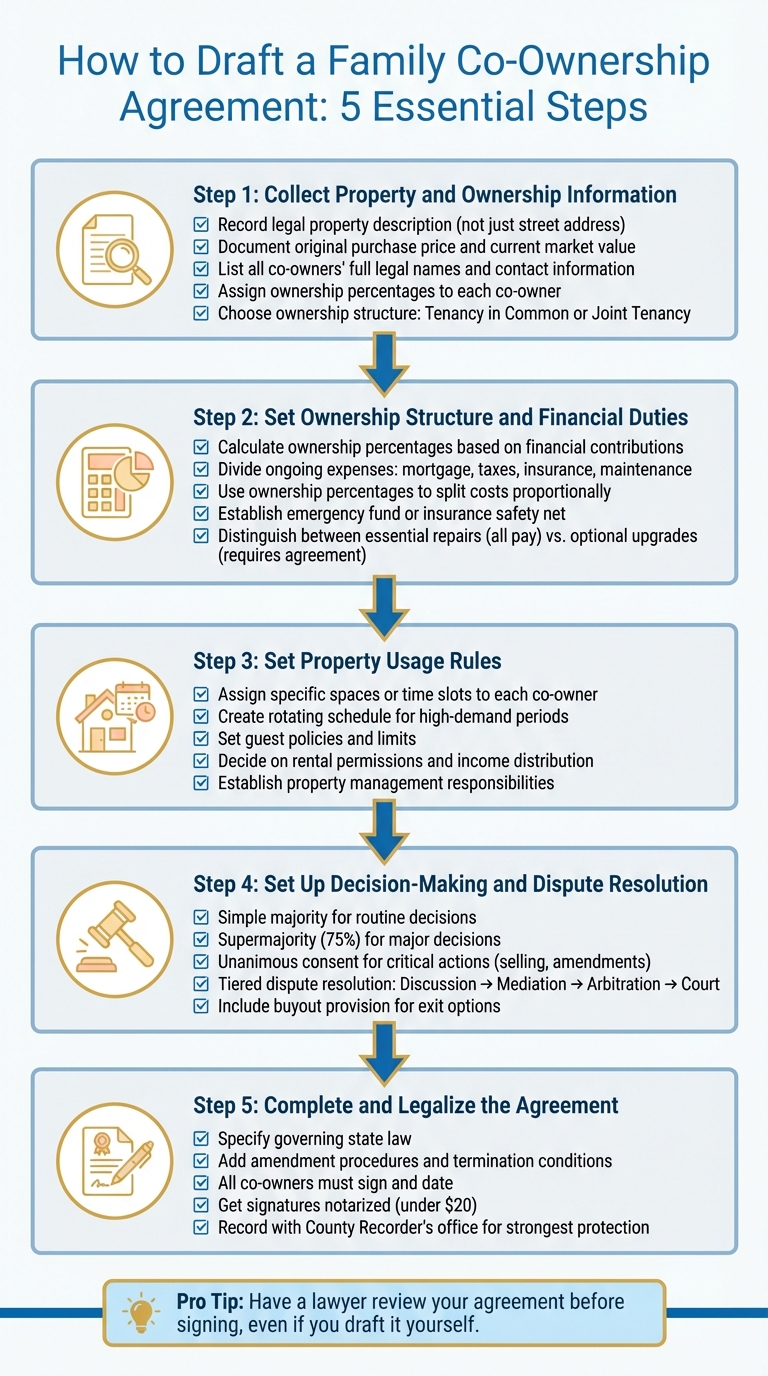
5 Steps to Create a Family Co-Ownership Agreement
How to Create a Real Estate Co Ownership Agreement
sbb-itb-a24235f
Step 1: Collect Property and Ownership Information
Start by gathering accurate details about the property and its ownership. This is crucial to avoid errors that could lead to invalid agreements or future disputes.
Record Property Details
Begin with the legal description of the property - not just the street address. You can find this formal description in the deed or title report. It's the official language used in property records and is essential for clarity.
Next, document the original purchase price and the current market value. These numbers are key for calculating equity, especially if one family member decides to buy out another's share later on. For instance, if your family inherited a cabin bought for $150,000 in 2010 and it's now worth $320,000, that $170,000 increase in value will play a role in determining each person's stake.
List All Co-Owners and Their Ownership Shares
Write down the full legal names and contact information of everyone who will hold a share in the property. Use the names exactly as they appear on government-issued IDs. Then, assign an ownership percentage to each co-owner. These shares don’t have to be equal. For example, one sibling might receive 70% for contributing more to the down payment, while another gets 30% for taking on property management duties as a non-monetary contribution.
The ownership structure you choose - Tenancy in Common or Joint Tenancy - will affect how shares are allocated and what happens if someone passes away. Tenancy in Common allows unequal shares and the option to pass ownership to heirs, while Joint Tenancy requires equal shares and automatically transfers the deceased's interest to the surviving co-owners. Since real estate laws differ by state, consult a lawyer to ensure your ownership structure aligns with local regulations.
Once you’ve documented property details and ownership shares, you’re ready to define the financial and usage arrangements.
Step 2: Set Ownership Structure and Financial Duties
Once you've outlined the property details and identified all co-owners, the next step is to establish clear ownership stakes and financial responsibilities. This clarity helps prevent disputes and ensures everyone's investment is protected.
Calculate Ownership Percentages
Ownership percentages should align with each person's financial contribution. The simplest way to determine this is by looking at how much each individual pays toward the purchase price, including the down payment and their share of the mortgage. For instance, if one co-owner contributes $40,000 toward a $100,000 property, they would hold a 40% ownership stake, while the remaining ownership is divided proportionally.
Another approach ties ownership to the value of the property space. For example, a co-owner who occupies a larger area might have a larger share, reflecting both their living space and their mortgage obligations.
Ownership percentages can also evolve over time. If one co-owner takes on additional financial responsibilities - like paying more toward the mortgage or covering major expenses - these changes should be documented, and ownership stakes adjusted accordingly.
Divide Ongoing Property Expenses
Recurring expenses, such as the mortgage, property taxes, insurance, and maintenance, should generally be divided based on ownership percentages. Using a joint account or an online platform to manage contributions and track receipts can simplify this process and ensure transparency.
That said, families can negotiate alternative splits for specific expenses if needed. For instance, in one case, a co-owner who held a 60% ownership share agreed to cover 90% of the costs to reflect differing financial contributions.
To keep things organized, assign specific responsibilities: one person could handle utility payments, while another oversees maintenance and repairs.
It’s also a good idea to include a clause addressing missed payments. All co-owners share liability for the property, so establishing an emergency fund or securing life or disability insurance can provide a safety net in case of unexpected events like job loss or death.
When it comes to repairs, distinguish between essential fixes and optional upgrades. Necessary repairs must be reimbursed proportionately by all co-owners, while discretionary improvements generally require prior agreement to qualify for reimbursement. A legal precedent supports this distinction:
"When one joint tenant expends money that benefits the other joint tenants, the paying joint tenant is entitled to reimbursement from the other joint tenants. This is known as the 'right to contribution'." - Bryan Eastin, Attorney, Provident Law
With ownership stakes and financial duties clearly defined, the next step is to establish guidelines for property use and rental arrangements.
Step 3: Set Property Usage Rules
Establishing clear usage rules is crucial to avoid potential conflicts among co-owners. Without well-defined guidelines, shared possession can lead to misunderstandings and disputes.
Determine Usage Rights for Each Co-Owner
Assign specific spaces or time slots to each co-owner to ensure fairness. For primary residences, this might mean dividing up bedrooms, parking spaces, or storage areas. When it comes to vacation homes, a rotating schedule often works best.
For high-demand periods - like summer weeks at a beach property or holidays at a ski cabin - rotating these slots annually ensures everyone gets a fair share of prime time. Some families even use a lottery system to decide who gets priority during these peak times.
Keep in mind that usage rights don’t always have to match ownership percentages. For instance, one co-owner might agree to fewer usage days in exchange for paying a smaller share of property taxes or taking on management responsibilities. Attorney Janelle Orsi suggests creating a separate document to address house rules:
"You'll probably want to prepare a separate (if less legally official) attachment to your co-ownership agreement regarding house rules, such as guest policies and cleaning responsibilities."
To minimize disputes, consider requiring professional cleaning between usage periods or assigning specific check-out tasks. Set clear limits on guests, such as how many overnight visitors are allowed and how long they can stay without unanimous approval. Using a shared digital calendar can also help streamline scheduling and avoid conflicts.
Once personal usage rights are sorted, it’s time to address rental arrangements.
Create Rules for Renting the Property
After dividing personal usage, decide whether co-owners can sublet their shares or rent out the entire property. If renting is allowed, clarify whether it requires a simple majority vote, a supermajority, or unanimous agreement.
Rental income is often divided based on ownership percentages. However, if one co-owner takes on property management duties - like scheduling cleanings or handling bookings - they may be entitled to a larger share of the income as compensation for their efforts.
Typically, a co-owner living in the property doesn’t pay rent to the others. However, Illinois Legal Aid Online highlights an exception:
"A co-owner who is the only person living in the property usually does not have to pay rent to the other owners... Another co-owner can ask for rent if the person living in the property's use of the property unfairly prevents other co-owners from using it or earning rental income from it."
Be specific about who will manage rental arrangements. This could be a designated co-owner, a rotating responsibility, or an outsourced third party. Also, establish clear rules for major decisions - like setting rental rates or approving long-term tenants - to keep everyone on the same page.
Step 4: Set Up Decision-Making and Dispute Resolution Processes
Once financial responsibilities and usage rules are established, the next step is to outline how decisions will be made and how disputes will be resolved. Even the closest families can face disagreements, and without clear processes, small issues can spiral into costly legal battles - or even force the sale of the property.
Define How Decisions Will Be Made
Start by delegating day-to-day tasks to property managers, while reserving major decisions - like selling the property or refinancing - for all co-owners. To streamline the process:
- Use a simple majority for routine decisions.
- Require a supermajority (e.g., 75%) for decisions that could lead to deadlocks.
- Demand unanimous consent for critical actions, such as amending the agreement, selling the property, or dissolving ownership.
John Jennings, President and Chief Strategist at ArchBridge Family Office, emphasizes:
"As the number of co-tenants increases, the difficulty of decision-making also increases".
To avoid stalemates in 50/50 ownership splits, consider designating a neutral third party as a tiebreaker, granting tie-breaking authority to one specific member, or requiring mediation.
Additionally, outline specific scenarios - like major repairs, refinancing, or changes to the property's use - that must receive owner approval. This level of detail ensures that every owner’s interests are protected and builds on the financial and usage guidelines already in place.
Add Dispute Resolution Methods
Disputes are bound to happen, so having a clear resolution process is essential. A tiered approach works well: start with informal discussions, move to mediation, then binding arbitration, and finally court intervention if necessary.
Attorney Janelle Orsi suggests specifying a trusted organization in your agreement for mediation:
"If a conflict or dispute arises that we are unable to solve through discussion, we agree to use [a] Community Resolution Center to help us resolve our dispute, and to share the minimal cost equally".
This level of specificity can prevent delays during heated conflicts.
To further minimize tension, include a buyout provision. This allows an unhappy or dissenting owner to sell their share to the others, using a pre-agreed valuation method. It’s a practical way to provide an exit option without resorting to a partition action - a court-ordered sale that often results in high legal fees and strained relationships.
Lastly, add a continued performance clause. This ensures that all co-owners remain responsible for their share of expenses and maintenance obligations while disputes are being resolved. It’s a safeguard to keep the property running smoothly, even during disagreements.
| Resolution Method | Decision Maker | Binding? | Typical Cost |
|---|---|---|---|
| Mediation | Neutral mediator | No (unless settlement signed) | Lowest |
| Arbitration | Neutral arbitrator | Yes | Moderate |
| Litigation | Judge or jury | Yes | Highest |
Step 5: Complete and Legalize the Agreement
With the operational details in place, it’s time to finalize the agreement by adding the legal framework that makes it enforceable. This step ensures that ownership rights, usage terms, and dispute resolution processes are clearly defined and legally binding. To achieve this, you'll need to include standard legal provisions and secure the signatures of all co-owners.
Add Legal and Administrative Details
Start by specifying the governing state law, which determines how the agreement will be interpreted. Include procedures for making written amendments, requiring the approval of all co-owners. Additionally, add clauses covering notices, severability, and the entire agreement to prevent informal or unintended modifications. This step is particularly crucial if co-owners reside in different states, as real estate laws can vary significantly across jurisdictions.
You should also outline the conditions under which the agreement can be terminated, such as selling the property or changes in the number of co-owners. Address potential default scenarios, like missed mortgage or maintenance payments, to avoid future complications. Attorney Janelle Orsi emphasizes the importance of legal review:
"Even if you draft your own documents, make sure you ask a lawyer to review them before you sign, seal, and deliver them".
Sign and Notarize the Agreement
Once the legal clauses are in place, the next step is to execute the document. Every co-owner must sign and date the agreement to make it legally binding. To further protect the agreement, have all signatures notarized. Notarization not only prevents disputes over authenticity but is also mandatory if you plan to record the document with your County Recorder’s office. The cost for notarization is typically under $20.
Recording the agreement offers the strongest legal protection by notifying the public of its existence. As Nolo explains:
"The safest legal approach is to record [the contract] at your County Recorder's office along with the deed".
Recording fees are generally minimal - just a few dollars per page - and many counties now allow electronic submissions. If privacy is a concern, you can opt to record a one-page memorandum summarizing the agreement instead of filing the entire document.
Conclusion
Creating a solid family co-ownership agreement is key to protecting both your property investment and your family relationships. By spelling out ownership shares, financial obligations, usage rights, and decision-making processes, you set the stage for smoother interactions and minimize the risk of misunderstandings turning into costly disputes.
Defined usage guidelines and decision-making frameworks are just the beginning. Establishing clear methods for resolving disagreements ensures that your family can work together effectively over the long haul. Taking the time to address these details now safeguards not only your property but also the relationships that matter most. As outlined earlier, having clear rules and resolution processes in place is critical to preventing conflicts and fostering cooperation as circumstances change.
John Jennings, President and Chief Strategist at ArchBridge Family Office, highlights the dual-edged nature of shared family properties: "Shared family properties can enhance family relationships, but over time as families grow, those same properties that engendered closeness can create dispute and discord".
As family dynamics and financial situations shift, it’s essential to revisit and update the agreement to ensure it continues to serve everyone’s best interests. Regular reviews help keep the agreement aligned with evolving needs.
FAQs
What are the advantages of creating a family co-ownership agreement?
A family co-ownership agreement creates a structured plan for managing shared property, helping to avoid misunderstandings and expensive disputes. By documenting expectations, co-owners can address essential details like how the property will be used, financed, and transferred. This minimizes the chances of court involvement or forced property sales, as the agreement spells out how to handle disagreements and what steps to take if an owner wants to exit.
It also provides financial transparency, outlining each co-owner’s responsibilities for expenses like mortgage payments, taxes, insurance, and maintenance. This ensures no one is left unexpectedly footing the bill. Beyond that, it includes practical protections, such as procedures for transferring ownership, dealing with a co-owner’s passing, or managing defaults. These safeguards help preserve the family’s investment and make transitions less stressful.
For families using fractional ownership platforms like Lofty, a co-ownership agreement works alongside the platform’s tools by clarifying ownership shares, financial duties, and decision-making roles, simplifying property management and ensuring smoother operations.
How can we calculate ownership percentages for each family member in a co-ownership agreement?
To figure out ownership percentages, start by listing what each family member contributes. This can include cash down payments, mortgage payments, or the value of any property improvements or assets they bring to the table. Add all these contributions together to calculate the total investment pool. Next, divide each person’s contribution by the total pool and multiply by 100 to determine their ownership percentage.
Here’s an example: If the total investment pool is $500,000 and one person contributes $300,000, their ownership share would be 60% ($300,000 ÷ $500,000 × 100).
If the family plans to factor in future work or non-monetary contributions, make sure those adjustments are clearly agreed upon and included in the terms. Document the final ownership percentages and the method used to calculate them. This ensures everything is clear and avoids any misunderstandings down the road, especially when financial or legal decisions come into play.
What should co-owners do if a dispute arises?
If co-owners find themselves in a disagreement, the first step is to turn to the co-ownership agreement. This document should outline the agreed-upon methods for resolving disputes, whether it’s through negotiation, mediation, or arbitration.
Start with an informal conversation to see if the issue can be resolved mutually. If that doesn’t lead to a solution, bringing in a neutral mediator might help. A mediator can guide discussions and assist in finding common ground. Should mediation fail and the agreement specifies arbitration, the next step would be to initiate binding arbitration. This process provides a resolution without going to court. However, if all else fails, legal action may be unavoidable. In such cases, the court might impose solutions like a buyout, a forced sale, or other remedies. Sticking to the outlined process not only safeguards relationships but also helps avoid the financial and emotional toll of prolonged legal battles.
Lofty Editorial