Lofty Editorial
DAO vs. Traditional Governance in Real Estate Platforms
Tokenized real estate platforms split property ownership into digital tokens, allowing fractional investments. These platforms rely on two main governance models: DAOs (Decentralized Autonomous Organizations) and centralized structures like LLCs or SPVs. Each model has distinct strengths and challenges.
Key Takeaways:
- DAOs: Offer direct voting rights to token holders, transparency via blockchain, and faster decision-making. However, they face legal enforceability issues, regulatory hurdles, and risks of wealth concentration.
- Centralized Governance: Relies on professional managers, providing legal clarity and accountability but slower decision-making, higher fees, and less transparency.
- Hybrid Models: Combine DAO voting with centralized execution to balance efficiency, compliance, and control.
Quick Comparison:
| Feature | DAO Governance | Centralized Governance |
|---|---|---|
| Decision Process | Token-holder voting | Managed by executives/managers |
| Transparency | Blockchain records | Private reports |
| Speed | Instant via smart contracts | Slower due to manual coordination |
| Legal Clarity | Complex, DAO LLCs emerging | Clear corporate structures |
| Costs | Lower operational costs | Higher management fees |
| Investor Control | Direct property-level decisions | Limited to major decisions |
Both systems are evolving, with hybrid models gaining traction for balancing blockchain efficiency with legal and operational safeguards. Platforms like Lofty exemplify this approach by integrating DAO voting with professional property management.
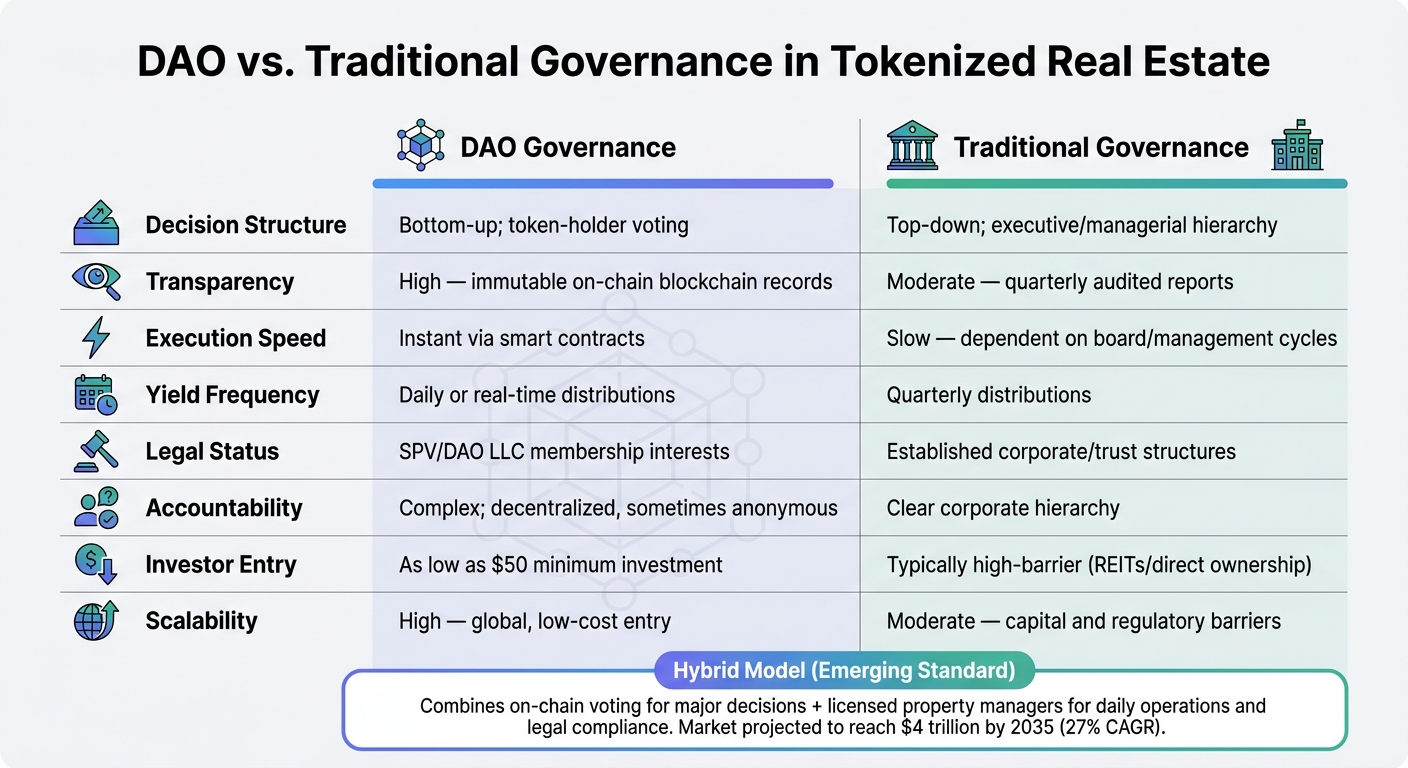
DAO vs. Traditional Governance in Tokenized Real Estate: Side-by-Side Comparison
DAO Governance in Real Estate
How DAOs Work in Real Estate
DAOs operate in a decentralized way, embedding decision-making processes directly into the blockchain. In real estate, this model ties ownership and governance to tokens. Essentially, owning tokens equates to holding a proportional stake in an LLC that legally owns the property deed. This legal structure, known as an SPV (Special Purpose Vehicle), ensures that on-chain votes are anchored in real-world legal frameworks.
Voting power is determined by the number of tokens held, though platforms typically set a 15% cap per property to prevent any single investor from controlling decisions. Token holders participate in key decisions, such as setting rent, approving repairs, managing property operations, and even handling evictions. Significant decisions generally require a 60% supermajority to move forward, and a designated property manager is tasked with implementing these decisions.
Smart contracts streamline routine operations, such as distributing rental income. Instead of waiting for quarterly payouts, these contracts enable daily distributions, making the process more efficient. As Max Ball from Lofty explains:
"Token holders are the owners of these properties, not Lofty––which is why token holders have full control and voting rights on all properties."
Strengths of DAOs for Real Estate Governance
DAOs bring clarity and control to real estate governance. Every action - whether it's a vote, a financial distribution, or a governance decision - is recorded on a public blockchain. This transparency eliminates the need to rely on periodic reports, as stakeholders can access real-time updates.
Another advantage is the ability for investors to directly select and manage individual properties rather than being tied to a pooled portfolio managed by a central authority. This approach ensures that investor interests align closely with the performance of the specific assets they choose to back. However, while these benefits are compelling, DAO governance still faces hurdles, particularly when operating across multiple blockchains.
Challenges of DAOs in Multi-Blockchain Platforms
One of the biggest challenges is the disconnect between on-chain votes and their legal enforceability. A token transfer recorded on the blockchain only holds legal weight if the SPV’s corporate records are updated accordingly.
Regulatory compliance is another pressing issue. Under the Howey Test, real estate DAO tokens are typically classified as securities. This classification requires platforms to adhere to SEC regulations or qualify for specific exemptions, such as Regulation D. Securities attorney Max Dilendorf has noted:
"Real-estate DAO tokens will virtually always qualify as securities under state and federal law."
There's also the risk of power imbalances. Even with ownership caps, wealthier participants can still acquire more tokens, giving them more influence - a situation often referred to as "plutocracy." On top of that, those unfamiliar with blockchain technology may find the governance process overwhelming, adding a layer of complexity not present in traditional real estate management.
sbb-itb-a24235f
Traditional Governance in Tokenized Real Estate
How Traditional Governance Works
In tokenized real estate, the property deed is typically held by a legal entity, such as an LLC or SPV, while investors own shares in that entity. As noted by Authoritative Source, Tokenized Real Estate:
"No token magically conveys title; it's indirect, enforceable through courts if structured right." – Authoritative Source, Tokenized Real Estate
Daily property operations are managed by professional property managers, while token holders retain voting rights for major decisions, as outlined in the SPV's operating agreement. A key element here is synchronization: the tokens representing ownership must correspond with the legal register.
This governance framework provides both clear benefits and notable challenges.
Advantages of Traditional Governance
A major strength of traditional governance lies in its legal clarity. When the property is held by an entity like a Wyoming LLC, investors are protected under corporate law and enjoy limited liability. Without such a structure, co-investors could face unlimited personal liability. Additionally, established SEC exemptions, such as Regulation D 506(c) or Regulation A+, offer a straightforward path to compliance.
Another advantage is the involvement of professional property managers, which spares fractional owners from the burdens of day-to-day property oversight. This setup allows investors to focus on returns while leaving operational details to experienced managers.
However, despite these strengths, traditional governance has its shortcomings, which can affect both transparency and profitability.
Limitations of Traditional Governance
Traditional governance models come with certain drawbacks, especially when compared to the more agile and transparent nature of DAO governance.
One significant issue is cost. Management fees in SPV structures can reduce net rental distributions by 10% to 20%, cutting into investor returns. Decision-making processes are another challenge - relying on manual coordination, proxies, or scheduled meetings slows down actions that could otherwise be executed almost instantly on-chain.
Transparency is also a concern. Unlike DAO governance, where every vote is recorded on the blockchain for public access, traditional governance often relies on private databases, making real-time auditing difficult. When platforms operate across multiple blockchains or jurisdictions, regulatory challenges can further complicate operations.
Finally, synchronization risk remains a persistent issue. If on-chain ownership transfers are not updated in the official legal register, enforcement defaults to traditional courts, which undermines the efficiency tokenization aims to achieve.
DAO vs. Traditional Governance: A Direct Comparison
Key Criteria for Evaluating Governance in Multi-Chain Platforms
When assessing governance models for tokenized real estate, four critical dimensions come into play: legal clarity, transparency, decision speed, and accountability. Legal clarity ensures investors have enforceable rights if something goes wrong. Transparency allows investors to monitor operations effectively. Decision speed reflects how quickly a platform can adapt to market shifts or property issues. Finally, accountability answers a practical but vital question: who is responsible when problems arise?
DAOs have made it possible to lower minimum investments to as little as $50, while traditional governance typically requires higher capital commitments and stricter regulatory barriers. In multi-chain platforms, interoperability adds complexity, as rules must be consistently applied across various blockchains.
The table below provides a quick side-by-side comparison of these governance structures.
Comparison Table: DAO vs. Traditional Governance
| Dimension | DAO Governance | Traditional Governance |
|---|---|---|
| Decision Structure | Bottom-up; token-holder voting | Top-down; executive/managerial hierarchy |
| Transparency | High; immutable on-chain records | Moderate; quarterly audited reports |
| Execution Speed | Instant via smart contracts | Slow; dependent on board/management cycles |
| Yield Frequency | Daily or real-time | Quarterly |
| Legal Status | SPV/DAO LLC membership interests | Established corporate/trust structures |
| Accountability | Complex; decentralized and sometimes anonymous | Clear corporate hierarchy |
| Investor Entry | As low as $50 | Typically high-barrier (REITs/direct ownership) |
| Scalability | High; global, low-cost entry | Moderate; capital and regulatory barriers |
Both models have their strengths and weaknesses. DAOs shine in areas like speed, transparency, and accessibility, while traditional governance provides stronger legal protections and clearer accountability structures.
Regulatory compliance further highlights the differences between these two models.
Risk Management and Compliance in U.S. Real Estate
Both DAOs and traditional governance models must adhere to U.S. federal securities laws, particularly under Regulation D 506(c). This rule limits participation to accredited investors, allows general solicitation, and imposes no restrictions on the total raise amount. The SEC clarified its stance on this in January 2026:
"The format of issuance or technology used for recordkeeping does not alter the application of federal securities laws." – SEC Joint Staff Statement (January 28, 2026)
Traditional structures, such as REITs, benefit from decades of established legal precedents, making compliance more straightforward. DAOs, however, face challenges when managing physical assets, particularly in terms of accountability and legal clarity. St. Louis Alderwoman Anne Schweitzer highlighted this issue:
"When you end up with an ownership structure that's decentralized... it makes it much more difficult to figure out who's responsible, who to talk to, who to hold accountable when there are these sorts of problems."
To address these gaps, platforms like Lofty have adopted a hybrid model. They combine on-chain voting for major decisions with third-party property managers who handle daily operations and local compliance. Additionally, voting thresholds and ownership caps are designed to prevent any single investor from dominating decisions. This approach helps align on-chain governance with legal and operational requirements, reducing risks like the "whale problem" while ensuring smoother property management.
Conclusion: Choosing the Right Governance Model
Key Points for Real Estate Investors
Deciding on the right governance model is a critical step with far-reaching legal and financial consequences. Here are the most important factors to evaluate before making an investment:
- Legal structure is paramount. Ensure each property is protected through a dedicated Wyoming DAO LLC, as specified in the DAO LLC Agreement.
- Tax considerations are essential. Wyoming DAO LLCs provide pass-through taxation, simplifying reporting for U.S. investors. Offshore setups, by contrast, still require individuals to meet tax obligations independently.
- Secondary market liquidity is limited. Tokenized real estate trades on regulated ATS platforms with narrow bid-ask spreads and low daily trading volumes. Assess these metrics carefully before investing.
These elements highlight the advantages of using governance models that combine the best features of both decentralized and traditional approaches.
The Case for Hybrid Governance Models
Navigating the challenges of legal compliance, tax efficiency, and liquidity requires a governance model that blends the strengths of blockchain technology with traditional oversight. Neither a fully decentralized DAO nor a purely traditional structure can address all these complexities alone.
A hybrid model offers a practical solution. Routine decisions - like rent adjustments, repair approvals, or property sales - can be managed through on-chain voting for efficiency and transparency. However, a licensed property manager ensures these decisions are executed in compliance with local housing laws. As Max Ball, co-founder of Lofty, explains:
"Members cannot vote to withhold essential repairs. The PM by law has to fix the problem at the earliest possible time."
This approach bridges the accountability gap that purely decentralized systems often face. By combining on-chain governance with a legal LLC framework and a property manager, platforms establish a clear division of responsibilities while maintaining investor control.
The tokenized real estate market is expected to grow to $4 trillion by 2035, with a 27% CAGR from less than $0.3 trillion in 2024. As this market expands, hybrid governance models - offering a balance of automation, legal safeguards, and accessibility - are likely to become the norm. This structure provides real estate investors with a reliable framework for long-term growth, blending transparency and speed with essential accountability.
DAOs vs Traditional Governance: Is This the Future? Pros & Cons Explained
FAQs
How are on-chain votes legally enforced for a real property?
When on-chain votes are cast, they are tied to established legal frameworks to ensure enforceability. Each property is usually set up under its own limited liability company (LLC). By purchasing tokens, investors gain membership in the LLC, which directly owns the property. The outcomes of on-chain voting are then documented in the LLC's corporate records and carried out by the property manager, acting on behalf of the LLC members.
What happens if token ownership changes but the SPV records don’t update?
If the ownership of tokens changes but the SPV’s shareholder register isn’t updated, the transfer might not hold up legally. While blockchain records are permanent and unchangeable, corporate and property laws demand that formal records accurately reflect ownership. If these records aren’t synchronized, discrepancies can arise between on-chain transactions and the ownership recognized by law, which could impact the legal enforceability of the transfer.
What should investors look for in a hybrid DAO + LLC setup?
Investors need to ensure that the legal documentation ties on-chain voting directly to the LLC’s operating agreement. This alignment is critical for maintaining clarity and accountability. Additionally, confirm that the LLC adheres to statutory requirements, such as filing annual reports and keeping a registered agent, as these steps are essential for preserving liability protection.
It's also important to review the governance structure. Look for clear and transparent processes, like token-based voting mechanisms, for making key decisions - whether it’s about repairs, sales, or other major actions. Finally, make sure the platform complies with Know Your Customer (KYC) and Anti-Money Laundering (AML) regulations. This ensures the platform operates within legal boundaries and helps protect your investment.
Lofty Editorial