
Lofty Editorial
Crowdfunding vs Fractional Apps: Demand Comparison
If you want lower upfront cost, more property choice, and a way to sell before a full property exit, fractional apps usually match that demand better. If you want a hands-off setup and can leave money invested for 3 to 7 years or more, crowdfunding may fit better.
Here’s the short version:
- Crowdfunding often means pooled deals or funds
- Fractional apps let you buy into single properties
- Crowdfunding minimums often run from $5,000 to $25,000
- Fractional apps can start around $10 to $100 per share
- Crowdfunding exits are often limited and may be paused
- Fractional apps may offer secondary markets, but sales still depend on buyer demand
- Crowdfunding gives you less control
- Fractional apps usually give you more say in what you buy
For me, the demand split is simple: passive investors often lean toward crowdfunding, while people who want lower entry cost, more choice, and more control often lean toward fractional apps.
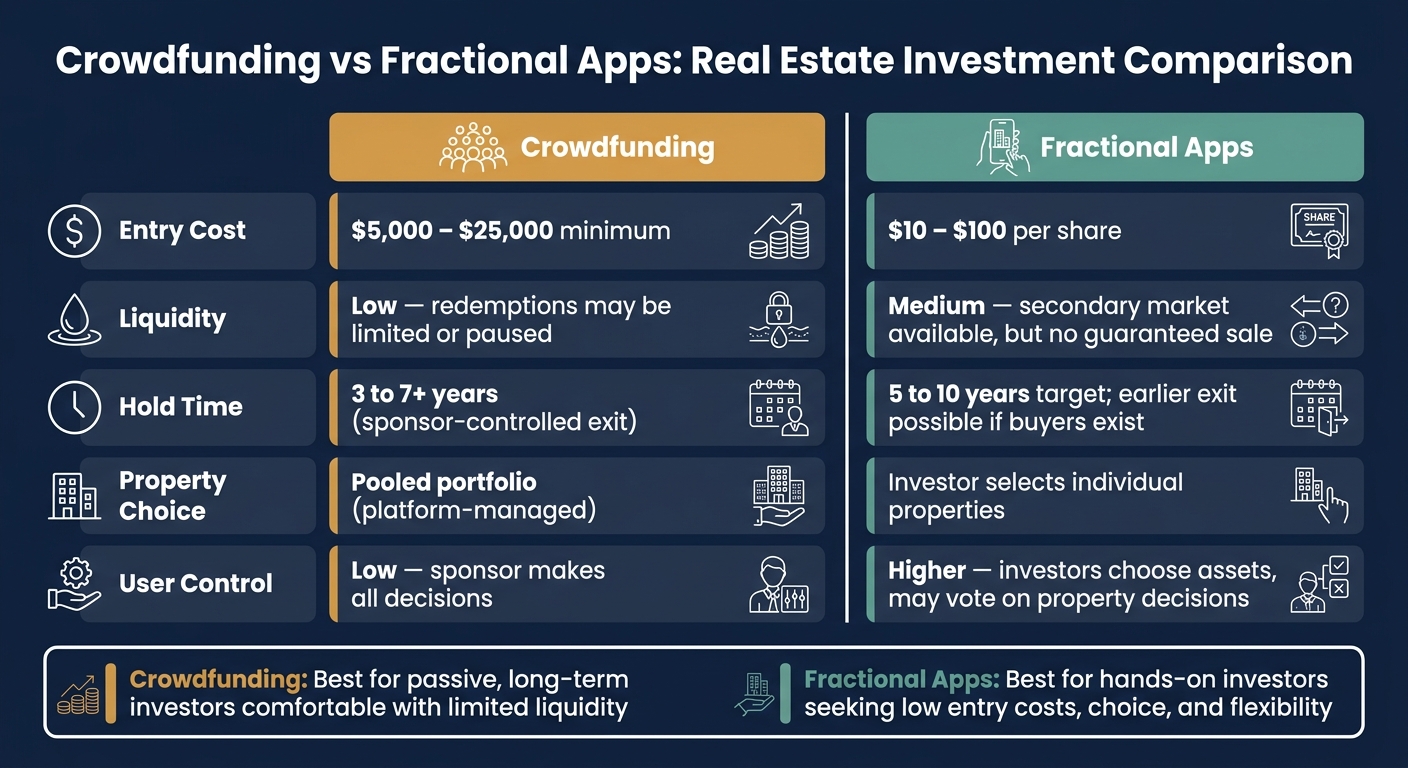
Crowdfunding vs Fractional Apps: Real Estate Investment Comparison
Every Type of Real Estate Investment Explained
sbb-itb-a24235f
Quick Comparison
| Factor | Crowdfunding | Fractional Apps |
|---|---|---|
| Liquidity | Low; redemptions may be limited or paused | Medium; secondary market may help, but no sale is certain |
| Hold Time | Often 3 to 7+ years | Often 5 to 10 years, with possible earlier sale if buyers exist |
| Entry Cost | Often $5,000 to $25,000 | Often $10 to $100 per share |
| Property Choice | Usually pooled portfolio | Usually single-property selection |
| User Control | Low | Higher |
One detail stands out: on 10/1/2025, Fundrise suspended its Equity REIT redemption plan. That shows how liquidity can tighten when investors want out at the same time.
So if I were boiling this down for a reader, I’d say this: crowdfunding is built for passive, long-term capital; fractional apps are built for smaller, more hands-on buyers who want options.
How real estate crowdfunding shapes investor demand
Real estate crowdfunding tends to draw people who want passive exposure and don’t mind giving up control. The basic setup is simple: a sponsor runs the property, and investors put in the capital. So the appeal is clear. You get access to real estate without dealing with tenants, repairs, or day-to-day management.
Long hold times and limited liquidity
Crowdfunding deals usually call for long-term capital. Typical hold periods run 3 to 7 years, and some offering documents warn investors to be ready for 10 years or more if a sponsor delays a sale or refinance. The sponsor, not the investor, controls when that exit happens.
That lack of liquidity isn’t just a theory. On October 1, 2025, Fundrise suspended its Equity REIT redemption plan, which blocked investors from pulling out their capital.
For many people, that’s the sticking point. Money can be tied up for years, and there may be no easy way out if plans change.
Higher minimums and less direct control
Crowdfunding also tends to come with higher buy-ins. Minimums often range from $5,000 to $25,000. On top of that, many deals are limited to accredited investors.
Once you invest, your role is mostly hands-off. You don’t get to decide on management, repairs, or when the property gets sold. The sponsor makes those calls. For some investors, that’s the whole point. They want the exposure, not the workload.
Still, long hold times, higher minimums, and no direct control shrink the pool of people willing to invest. That helps explain why crowdfunding often fits investors who can live with delayed access to their money in exchange for passive ownership. Fractional apps, on the other hand, tend to pull in people who want lower entry costs and a bit more control.
How fractional ownership apps shape investor demand
Where crowdfunding tends to draw passive capital, fractional ownership apps pull in a different type of investor. These users want low minimums and the ability to choose specific properties. The model is different too: investors buy small equity stakes in individual rental properties, usually through LLCs or similar entities.
Lower entry cost and broader access
The biggest draw is the price of entry. Crowdfunding deals often ask for $5,000 to $25,000 to get started. Fractional apps, by contrast, can start as low as $10 to $100 per share or token.
That gap changes who can take part. Someone who isn't ready to put up thousands of dollars can still get exposure to real estate and start small.
More property choice and more user control
Fractional apps also give investors more say in where their money goes. Instead of buying into a blind pool, they can browse individual properties, choose the ones they like, and spread money across different homes and markets.
Lofty is a good example of how this works. With a $50 minimum per token and no annual AUM fee, investors can pick from tokenized properties across about 40 U.S. markets. Rental income is paid out daily, and investors can buy or sell property interests through a secondary market.
For investors who care about lower commitment and more control, that setup has clear appeal. The gap stands out even more when you compare liquidity, entry cost, property choice, and control side by side.
Crowdfunding vs. fractional apps: side-by-side demand comparison
The demand split is pretty straightforward: crowdfunding tends to pull in passive capital, while fractional apps appeal to investors who want lower buy-ins, more say, and a quicker route to exit. You can see that split most clearly when the two models are lined up side by side.
Liquidity and hold times
Liquidity is the first big dividing line.
Crowdfunding platforms often depend on quarterly redemption windows. Those windows can be limited or paused when too many investors try to cash out at once. Fractional apps, by contrast, usually offer secondary marketplaces where investors can list shares for sale. That said, a listing only turns into an exit if someone is willing to buy, so liquidity still isn't guaranteed.
| Feature | Crowdfunding | Fractional Apps |
|---|---|---|
| Exit Options | Quarterly redemption windows; can be restricted or suspended | Secondary marketplaces |
| Hold Time | 5+ years recommended | 5–10 years target; earlier exit may happen if buyers are available |
| Liquidity | Low; redemptions can be paused during stress | Moderate; depends on trading volume |
That same split shows up again when you look at cost, property selection, and control.
Entry cost, property choice, and user control
Price and control push the gap even further.
Crowdfunding minimums run from about $10 to $25,000, depending on the platform and the deal type. Fractional apps usually land in the $20 to $250 range. That's a big difference. For someone testing the waters, putting in $20 feels very different from putting in a few thousand dollars.
The setup is different too. With crowdfunding, the platform places capital across a pooled portfolio. You pick a broad approach, then the platform handles the property-level calls. With fractional apps, investors look through individual properties, pick the ones that match their goals, and build their own mix across markets. Some platforms, including Lofty, also give investors voting rights on property-level decisions such as renovations or sales.
| Feature | Crowdfunding | Fractional Apps |
|---|---|---|
| Min. Investment (USD) | About $10 to $25,000 | About $20 to $250 |
| Property Choice | Platform-managed pooled portfolio | Investors select specific individual properties |
| User Control | Low; decisions are managed by the platform | Higher; investors choose assets and may vote on property decisions |
| Portfolio Construction | Platform-built | Investor-built |
Those four factors - liquidity, hold time, entry price, and control - explain most of the demand split.
Conclusion: Which model fits today's investor demand
Investor demand tends to follow the features people care about most: liquidity, cost, choice, and control. You can see that split most clearly in four areas: liquidity, minimum investment, decision-making power, and exit options.
Crowdfunding tends to fit investors who are comfortable locking up money for years in exchange for a more hands-off setup. With pooled funds and limited redemption windows, control stays low and exits can take time.
Fractional apps appeal to a different type of investor. They draw people who want a lower minimum, the ability to pick properties one by one, and a clearer way to get out if they decide to sell. That mix opens the door to more people and gives investors a stronger sense of control.
Lofty lines up with that demand. A $50 minimum, daily rental distributions, voting rights on select decisions, and a 24/7 secondary market support smaller and more flexible investments in U.S. rental properties.
Neither model is better across the board. The right choice comes down to how long you can keep your money invested, how much involvement you want, and how fast you may need an exit.
FAQs
Which option is better for beginners?
It comes down to what you want.
If you prefer a hands-off, set-it-and-forget-it approach, a platform with low minimums and automatic diversification may be the better choice.
If you want more control, Lofty can work well for beginners who like picking specific properties. You can buy tokens in U.S. rental properties for $50 each, earn daily rental income, and trade your holdings whenever you want.
How risky is the secondary market on fractional apps?
The secondary market on fractional apps comes with liquidity risk. In plain English, you can only sell if another investor wants to buy your shares.
That’s very different from public stock markets. Public markets usually have market makers helping keep trading active. Fractional platforms don’t. So if demand for a specific asset is thin, getting out can take time.
This also affects price discovery. When fewer buyers and sellers show up, pricing can get shaky. You might not know the “right” market price until a trade actually happens.
Trading rules also vary by app. Some offer 24/7 trading. Others use hold periods or only open trading during set windows. So liquidity is conditional, not guaranteed.
Can I use both crowdfunding and fractional apps together?
Yes. You can use both as part of your real estate investment plan.
They can work well together. Crowdfunding often gives you a more passive way to spread your money across many deals. Fractional apps, on the other hand, let you pick specific properties and shape a portfolio that fits your goals a bit more closely.
Using both can help you balance diversification with more targeted ownership and flexibility.
Lofty Editorial