
Lofty Editorial
Co-Ownership Risks and Protections
Buying property with someone else can save money up front, but one owner’s mistake can put the whole deal at risk.
If I were sizing up a co-owned property, I’d focus on three things first:
- Legal risk: one owner’s divorce, tax lien, judgment, bankruptcy, death, or incapacity can cloud title or block a sale
- Money risk: if one owner stops paying, the others may have to cover the full mortgage, taxes, insurance, or a repair bill like a $12,000 roof
- Exit risk: a co-owner can push for partition, and a forced sale can lead to a 20%–40% price hit plus $10,000–$50,000 in legal fees
The fix is simple on paper: use the right ownership setup, put the rules in writing, keep cash reserves, and match insurance to the legal owner.
Here’s the short version of what I’d want in place before buying:
- a TIC agreement or LLC operating agreement
- rules for votes, expenses, capital calls, buyouts, and missed payments
- a Right of First Refusal
- estate terms for death and incapacity
- 3–6 months of expense reserves, plus 1% of property value for capital repairs
- landlord coverage, umbrella liability, and rehab coverage when needed
- a separate bank account and EIN for each entity
- clear lines between day-to-day decisions and major votes
If the property is held in an LLC, I’d also make sure the policy names the LLC, not me personally. And I would not place multiple properties in one LLC, because one lawsuit can put the other properties in that same entity at risk.
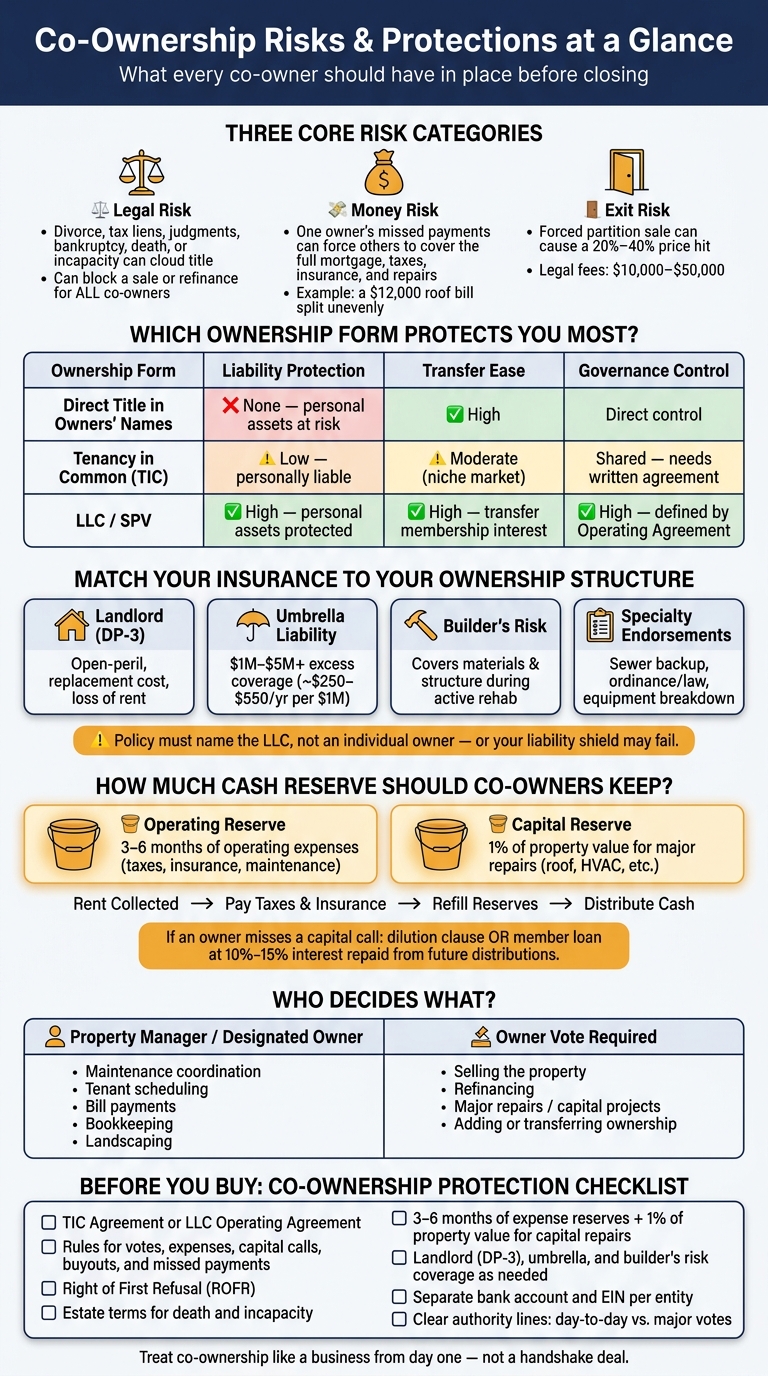
Co-Ownership Risk vs. Protection: A Complete Breakdown
Buying Real Estate with Family and Friends? 10 Problems with Co-Owning Property
sbb-itb-a24235f
Quick comparison
| Issue | Main risk | What I’d put in place |
|---|---|---|
| Ownership setup | Personal exposure or cross-property risk | Separate LLC or SPV per property, with lender approval before title transfer |
| Shared payments | One owner misses costs | Reserve rules, capital-call terms, default penalties |
| Repairs | Deadlock over timing or cost | Voting thresholds and spending authority |
| Exit | Forced sale or outsider joins ownership | ROFR, set buyout formula, transfer limits |
| Death or incapacity | Heirs or court delays step in | Will or trust alignment, power of attorney terms |
| Liability claims | Claim exceeds base policy | DP-3 landlord policy, umbrella coverage, correct named insured |
| Recordkeeping | Owner disputes over money | Written reports, vote records, separate accounts |
Bottom line: co-ownership works best when I treat it like a fractional real estate business from day one, not a handshake deal between friends or family.
The Main Risks in Co-Ownership
Building on the ownership structures above, co-ownership risk usually lands in three areas: legal exposure, cash flow strain, and decision deadlock.
Legal, Liability, and Ownership Structure Risks
The first problem is legal exposure. A co-owner's share can be affected by bankruptcy, tax liens, divorce claims, or judgments. When that happens, title can get clouded, and that can stop a sale or refinance for everyone.
This gets worse when the agreement is weak - or missing altogether. If there are no clear rules for voting, transfers, and who has authority to make which decisions, even basic moves can stall. Major decisions can turn into a mess fast.
There’s also the risk of incapacity. If a co-owner becomes mentally or physically unable to handle their affairs and no plan was set up ahead of time, the other owners may not be able to sell or manage the property without a court-appointed conservator.
Cash Flow, Repair, and Capital Call Risks
Money pressure is where many co-ownership deals start to crack. Say the roof fails and the repair bill is $12,000. If one owner can’t - or won’t - pay their share, the others have two bad options: cover the shortfall themselves or watch the property decline.
And it’s not just big repairs. Day-to-day costs can cause the same kind of tension, including:
- property taxes
- insurance premiums
- routine maintenance
Trouble starts when owners don’t agree on timing, urgency, or whether a cost should happen at all.
Without reserve funds and capital-call rules, every surprise bill can become an argument. That’s why reserve rules matter.
Decision, Exit, and Succession Risks
Disputes about selling, property management, or upgrades are common. Two-owner arrangements are hit especially hard because there’s no built-in tiebreaker.
Getting out can be just as messy. When one owner wants to leave and the others want to stay, things can shift in a hurry. If no one can reach an agreement, court may be the next stop.
Succession adds another layer. A deceased owner’s heir can step in as a new co-owner overnight, and that person may have very different goals.
These are the kinds of conflicts governance rules are meant to head off.
Legal Protections That Reduce Co-Ownership Risk
A lot of co-ownership risk comes down to one thing: what got written down before anything went wrong.
The right documents and ownership setup can cut down many of the usual problems. But they work best when the rules are in place before there’s a dispute.
Use Strong Operating or Co-Ownership Agreements
A written agreement is one of the main ways to cut risk in a co-owned property.
For LLCs, that document is the Operating Agreement. For people who hold title in their own names, it’s a Tenancy-in-Common (TIC) Agreement. Different label, same idea: set the rules early, in writing, and make them clear.
That agreement should spell out:
- capital contributions
- cash distributions
- voting thresholds
- who can approve decisions
- reserve funding rules
- shared expenses
- what happens when an owner defaults
Why does this matter so much? Because clear rules help stop deadlock, surprise transfers, and fights over money. A solid agreement should also lay out dispute resolution, including a rule that requires mediation or arbitration before anyone files for partition.
Choose an Ownership Structure That Limits Liability
How the property is held shapes each owner’s personal risk. The basic tradeoff is pretty simple: holding title directly in the owners’ names creates the most personal exposure, TIC gives some separation but not much, and an LLC or SPV gives the strongest shield.
| Ownership Form | Liability Protection | Transfer Ease | Governance Control |
|---|---|---|---|
| Direct title in owners' names | None - personal assets at risk | High (sole decision) | Direct control |
| Tenancy in Common (TIC) | Low - owners are personally responsible for debts and lawsuits | Moderate - can sell a share, but the market is niche | Shared - depends on a separate written agreement |
| LLC / SPV | High - protects personal assets | High - transfer of membership interest without changing the deed | High - defined by the Operating Agreement |
A separate LLC or single-purpose entity can help keep personal assets out of reach if there’s a property-level claim. An LLC can help limit personal exposure when owners keep the entity and its finances separate.
There’s another point here that people sometimes miss. Putting multiple properties into one LLC can backfire. If one property gets hit with a lawsuit, the other assets inside that same entity may be exposed too. Using a separate LLC or SPV for each property helps box in the damage so one problem does not spread across the rest of the portfolio.
One warning: get lender consent before transferring title into an LLC. A title transfer can trigger a due-on-sale clause.
Build Clear Exit, Transfer, and Estate Clauses
This is where many co-ownership deals either stay calm or go sideways.
A strong agreement should include a Right of First Refusal (ROFR). That gives current co-owners the chance to match an outside offer before a share goes to a third party. It should also set a valuation method for buyouts, so the price is already defined if someone wants out.
Those clauses help keep a departing, deceased, or incapacitated owner from throwing the group off course. Estate terms should also cover death and incapacity, such as a power of attorney for an incapacitated owner, and should line up with each owner’s wills or revocable living trusts so ownership passes to the intended heirs.
Put simply, these terms deal with exits before exits turn into fights.
Once the legal terms are set, insurance and reserve rules add the next layer of protection.
Insurance and Financial Controls That Protect the Investment
Legal documents spell out who owns what. Insurance and cash controls help keep one bad event from turning into a much bigger mess.
Match Insurance Coverage to the Ownership Structure
A co-owned rental property usually needs more than a standard homeowners policy. For stable rentals, a DP-3 landlord policy is often the right fit because it offers open-peril coverage, replacement cost value, and loss-of-rent protection. If a fire or another covered loss makes the property unlivable, that coverage can help cover mortgage payments and property taxes instead of forcing the owners to pay those costs on their own.
The named insured on each policy needs to match the legal owner of the property. If the property sits inside an LLC or SPV, the LLC or SPV should appear on the policy, not an individual co-owner. Get this wrong, and you can run into claim issues and weaken the liability shield the entity was supposed to create.
An umbrella policy adds extra liability coverage, often from $1 million to $5 million. For rental property, that coverage usually costs about $250 to $550 per year for $1 million of excess liability coverage. Every property needs to be scheduled on the umbrella policy. Leave one property off, and that asset may not have excess coverage even if the rest of the portfolio is insured the right way.
If the property goes through major renovations, builder's risk insurance covers materials and the structure during active rehab. That's a big deal because a standard landlord policy usually does not cover losses during construction.
| Coverage Type | Scope | Common Exclusions | Risks Addressed |
|---|---|---|---|
| Landlord (DP-3) | Open-peril, replacement cost, loss of rent coverage | Construction-phase losses, unoccupied properties | Fire, wind, hail, and basic slip-and-fall liability |
| Umbrella Liability | Excess liability ($1M–$5M+) | Unscheduled properties, intentional acts, professional errors | Claims exceeding primary policy limits |
| Loss of Rent | Replaces gross rental income while the property is uninhabitable due to a covered peril | Vacancy due to market conditions, non-covered perils | Cash flow gaps during major repairs |
| Builder's Risk | Buildings and materials during active rehab | Occupied buildings, standard wear and tear | Theft of materials, damage during renovation |
| Specialty Endorsements | Specific add-ons like sewer backup, ordinance or law, or equipment breakdown | Varies by endorsement; typically very narrow in scope | Costs to bring a building to current code after a loss or repair damage from a burst main line |
Once coverage is set up, the next layer of protection is control over cash.
Set Reserve Policies and Delinquency Rules
Insurance covers sudden hits. Reserves cover the day-to-day reality of owning property.
A well-run co-ownership keeps two separate pools of money. One is an operating reserve for recurring costs like taxes, insurance premiums, and routine maintenance. The other is a capital reserve for bigger long-range expenses like a new roof or HVAC system. A solid target is 3 to 6 months of operating expenses, plus 1% of the property's value set aside for capital expenditures. After that mark is met, net cash flow can be distributed. If reserves drop below it, part of the rent should go back into reserves first.
The Operating Agreement should also spell out mandatory capital calls. Emergency repairs or insurance deductibles usually justify a call with only 24 to 48 hours' notice. Non-urgent projects can use a 15- to 30-day notice period. If an owner misses a capital call, the agreement needs a plain, direct fix. That often means either:
- a dilution clause that increases the contributing owners' equity share using a set formula
- treating the unpaid amount as a member loan with a high interest rate, often 10% to 15%, repaid from that owner's future distributions
After reserves, reporting is what keeps everyone on the same page about what the property is making and spending.
Use Clear Reporting and Distribution Rules
Money disputes often start as information disputes. If co-owners aren't looking at the same numbers at the same time, a small issue can snowball.
Track rent, expenses, reserves, and distributions in one standard report. Pay taxes and insurance first. Then refill reserves. Then distribute cash. Property-level reports with the same format each period make it much easier for every owner to follow the numbers.
Each entity should also have its own bank account and EIN. Mixing funds can weaken liability protection.
With cash controls in place, governance should spell out who can act on their own and what needs a vote.
Governance Practices for Stable Co-Ownership and Conclusion
Once the legal setup, insurance, and reserve policies are set, governance is what keeps co-ownership from turning into a mess.
Separate Day-to-Day Decisions From Major Votes
Not every choice needs a full group discussion. Routine work like maintenance coordination, tenant scheduling, bookkeeping, bill payments, and landscaping should sit with a designated property manager or one owner assigned to that job. Bigger calls usually need an owner vote, such as selling the property, refinancing, major repairs, or changing usage rules.
Put those authority lines in the operating agreement. If they only live in someone’s head, they tend to fall apart at the worst time.
| Decision Category | Examples | Typical Authority |
|---|---|---|
| Day-to-Day Operations | Maintenance, cleaning, bill payments, showing coordination, landscaping | Property Manager or Designated Owner |
| Major Financial Decisions | Refinancing, taking out a new loan, budget approvals | Majority or Unanimous Owner Vote |
| Capital Projects | Roof replacement, major renovations, structural additions | Owner Vote based on budget thresholds |
| Ownership Changes | Selling the property, adding new owners, transferring shares | Unanimous or Super-majority Vote |
When one person runs operations and the group handles big-picture choices, there’s much less confusion about who was supposed to do what.
Use Regular Reporting and Written Decision Records
Keep monthly or quarterly reports, written records of major votes, and a maintenance log in one shared file. That can be a cloud folder, a shared drive, or another system everyone can access.
Clear records make it easier to track decisions, contributions, and expenses. They also make it much harder for small disputes to turn into bigger ones later.
Key Takeaways for Protecting a Shared Real Estate Investment
When roles and reporting are clear, co-ownership gets easier to manage and harder to derail.
Written rules, steady reporting, and clear voting authority protect both the property and the relationship. Put these controls in place before a problem shows up. That one move helps cover liability exposure, cash flow strain, and decision deadlock at the same time.
FAQs
Should we use an LLC or a TIC?
It depends on what matters most to you.
An LLC usually gives you stronger legal protection and helps avoid fights down the road. Why? Because owners generally can't force a sale or split of the property just because they want out. The rules are also spelled out in the operating agreement, which gives everyone a clearer playbook from day one.
A TIC gives owners more flexibility and makes it easier to transfer ownership interests. But there's a tradeoff: each owner can ask for a sale or division of the property.
If your top goal is long-term stability, an LLC is usually the safer choice.
What happens if a co-owner stops paying?
If a co-owner stops paying the mortgage, things can go downhill fast. It can lead to foreclosure, a lost ownership stake, damage to the property, and fights between co-owners.
In some cases, the dispute can be handled through legal action, such as a partition suit.
How can we avoid a forced sale?
To help avoid a forced sale, co-owners should put an operating agreement in place before the purchase or as soon as possible after it. The agreement should spell out how an owner can exit, how a buyout works, and how the property will be valued.
Co-owners may also want to form an LLC for added legal protection.
Lofty Editorial