
Ultimate Guide To Real Estate Syndication
Jerry Chu
Real estate syndication is a partnership where a sponsor teams up with multiple investors to buy and manage large income-generating properties like apartment complexes or warehouses. This model allows individuals to invest in commercial real estate without needing millions of dollars or direct property management responsibilities.
Key Takeaways:
- How It Works: Sponsors handle property operations, while investors provide capital and receive passive income and profit shares.
- Benefits: Access to high-value properties, portfolio diversification, passive income, and tax advantages.
- Investment Process: Involves deal sourcing, capital raising, property management, and eventual sale or refinancing.
- Risks: Market fluctuations, sponsor performance, and illiquidity. Mitigation includes diversification and thorough due diligence.
- Entry Points: Traditional syndications often require $25,000+ and accredited investor status. Fractional platforms like Lofty allow smaller investments starting at $50.
Whether you're looking for stable returns or higher-risk opportunities, syndications offer a way to grow wealth through real estate. Dive deeper to learn about deal structures, strategies, and how to get started.
How Real Estate Syndication Works
Partnership Structure and Legal Framework
In the U.S., real estate syndications are often set up as either limited liability companies (LLCs) or limited partnerships (LPs), which legally hold ownership of the property. In this setup, the sponsor typically takes on the role of the general partner (GP) or managing member, while investors join as limited partners (LPs) by purchasing membership units. Sponsors usually contribute between 5–15% of the total equity, leaving LP investors to cover the remaining 85–95% of the funding. This arrangement allows sponsors to manage the day-to-day operations - like finding deals, securing financing, overseeing renovations, and managing vendors - while limiting investor liability to the amount they’ve invested.
Since these membership interests are considered securities under U.S. law, syndications are required to comply with SEC regulations. To avoid full SEC registration, most sponsors use Regulation D exemptions, such as Rule 506(b) or 506(c). These exemptions typically restrict offerings to accredited investors and set rules around public advertising. Before accepting any funds, sponsors provide a detailed Private Placement Memorandum (PPM), which outlines risks, fees, and terms, along with an Operating Agreement. This agreement explains key details like profit splits, voting rights, distribution schedules, and procedures for handling challenges. Together, these documents establish the legal and operational framework for the syndication.
Deal Lifecycle
A syndication deal typically unfolds in several stages. It starts with deal sourcing and analysis, where the sponsor identifies potential properties, builds financial models, and conducts thorough market research and inspections to ensure the investment aligns with their strategy. Once a property is selected, the syndication is structured by determining the equity and debt mix, setting a preferred return (usually between 6–8%), outlining a profit-sharing waterfall, and drafting all necessary legal documents.
In the capital-raising phase, the sponsor markets the opportunity through webinars, pitch decks, or online platforms. Interested investors review the PPM, sign subscription agreements, and commit their funds. Once enough capital is secured, the sponsor finalizes the purchase agreement, arranges mortgage financing (typically covering 60–75% of the property’s value), completes due diligence (such as appraisals and environmental reports), and closes the deal.
The longest phase is the execution of the business plan, which can span 3–7 years for many value-add projects. During this time, the sponsor or a property manager carries out renovations, improves occupancy rates, streamlines operating expenses, and distributes cash flow - often on a monthly or quarterly basis - to investors. The deal wraps up when the sponsor either refinances the property to return some investor capital early or sells the asset. At this point, profits are distributed according to the waterfall structure, and the syndication is dissolved.
Economic Model of Syndications
Investors earn returns in three main ways: cash flow, equity appreciation, and tax benefits. Cash flow comes from net rental income after covering expenses, reserves, and debt payments. Equity appreciation is realized when the property is sold or refinanced, capturing gains from rent increases, cost savings, and property improvements. Tax benefits, such as pass-through depreciation and interest deductions, provide additional value for many investors.
Sponsors are compensated through fees and a share of the profits. Common fees include an acquisition fee (1–3% of the purchase price), an asset management fee (around 1–2% of equity or gross income annually), and, in some cases, a disposition fee (roughly 0.5–1% at the time of sale). Additionally, sponsors earn a "promote", which is typically 20–30% of profits above the preferred return. This structure aligns the sponsor’s incentives with the investors’ performance. The waterfall model ensures that LPs receive their initial capital and preferred return (often around 8% annually) before the sponsor earns any share of the excess profits.
Key Players in Real Estate Syndication
Role of the Sponsor or Syndicator
The sponsor - also called the syndicator or general partner - is the driving force behind every syndication deal. They handle everything from finding and analyzing potential properties to managing the entire investment process. This includes identifying promising opportunities, running financial models, and conducting market research and inspections. Once a property is selected, the sponsor structures the syndication, sets profit-sharing arrangements, and ensures compliance with legal requirements.
During the capital-raising phase, sponsors present the investment opportunity to potential investors using tools like webinars, pitch decks, or online platforms, all while staying within SEC regulations. After the deal closes, they oversee the property’s operations - either directly or through a property management company - execute the business plan (which may involve renovations or rent adjustments), and keep investors updated regularly. When it’s time to exit, the sponsor decides when to sell or refinance, manages the transaction, and distributes the final proceeds to investors.
Sponsors are compensated through a mix of fees and equity stakes. Common fees include an acquisition fee (a percentage of the purchase price), an asset management fee (usually 1–2% of equity or gross income annually), and sometimes a disposition fee when the property is sold. Sponsors also earn a "promote" (typically 20–30% of profits exceeding the preferred return) and often co-invest 5–15% of the total equity to demonstrate their commitment to the project.
Understanding the sponsor’s responsibilities provides a foundation for exploring the role of passive investors in these deals.
Responsibilities of Passive Investors
While sponsors take on active responsibilities, passive investors play an essential but hands-off role in syndication. Passive investors contribute the majority of the capital needed for the deal. Their main job is to carefully review offering documents - like the PPM (Private Placement Memorandum) and operating agreement - to decide if the investment aligns with their financial goals and risk tolerance. Once they commit funds, passive investors receive regular distributions from rental income (typically monthly or quarterly) and a share of the profits when the property is sold or refinanced.
Unlike sponsors, passive investors have no involvement in the daily management of the property. They don’t deal with tenants, approve repairs, or make leasing decisions. However, they often have limited voting rights for major decisions, such as removing the sponsor for cause, amending key documents, or changing the property’s disposition plan. Additionally, they benefit from pass-through taxation, with earnings reported on Schedule K-1 forms.
In the U.S., many syndications are available only to accredited investors under Regulation D exemptions (like Rule 506(b) or 506(c)). These exemptions require investors to meet specific income or net worth criteria. Before committing funds, investors should confirm their eligibility and understand the exemption being utilized by the sponsor.
Platforms like Lofty (https://lofty.ai) make it easier for passive investors to access fractional ownership of rental properties. These platforms allow for diversified portfolios with lower minimum investments and simplified management.
Third-Party Professionals
Beyond sponsors and investors, a syndication deal relies on a network of skilled third-party professionals to ensure its success.
- Lenders supply the debt financing, typically covering 60–75% of the purchase price. They set key loan terms, including interest rates, covenants, and prepayment penalties, which can influence cash flow and exit strategies.
- Property managers handle daily operations like leasing, rent collection, maintenance, and capital improvements. Their performance directly affects occupancy rates and operating expenses.
- Real estate and securities attorneys draft and review critical documents, such as purchase contracts, loan agreements, PPMs, and operating agreements, ensuring compliance with federal and state securities laws.
- CPAs and tax advisors assist with financial modeling, tax structuring (including depreciation schedules), and ongoing accounting, such as preparing Schedule K-1s for investors.
- Inspectors, appraisers, and insurance brokers contribute to the due diligence process, helping to assess the property’s condition, value, and risk.
Sponsors are typically responsible for selecting and managing these professionals, setting performance expectations, and making changes when necessary. Passive investors should also evaluate the experience and track record of these third-party teams, as a reliable group of professionals can play a crucial role in achieving the projected returns.
Real Estate Syndications 101: What To Know BEFORE You Invest
sbb-itb-a24235f
Investment Strategies and Risk Management
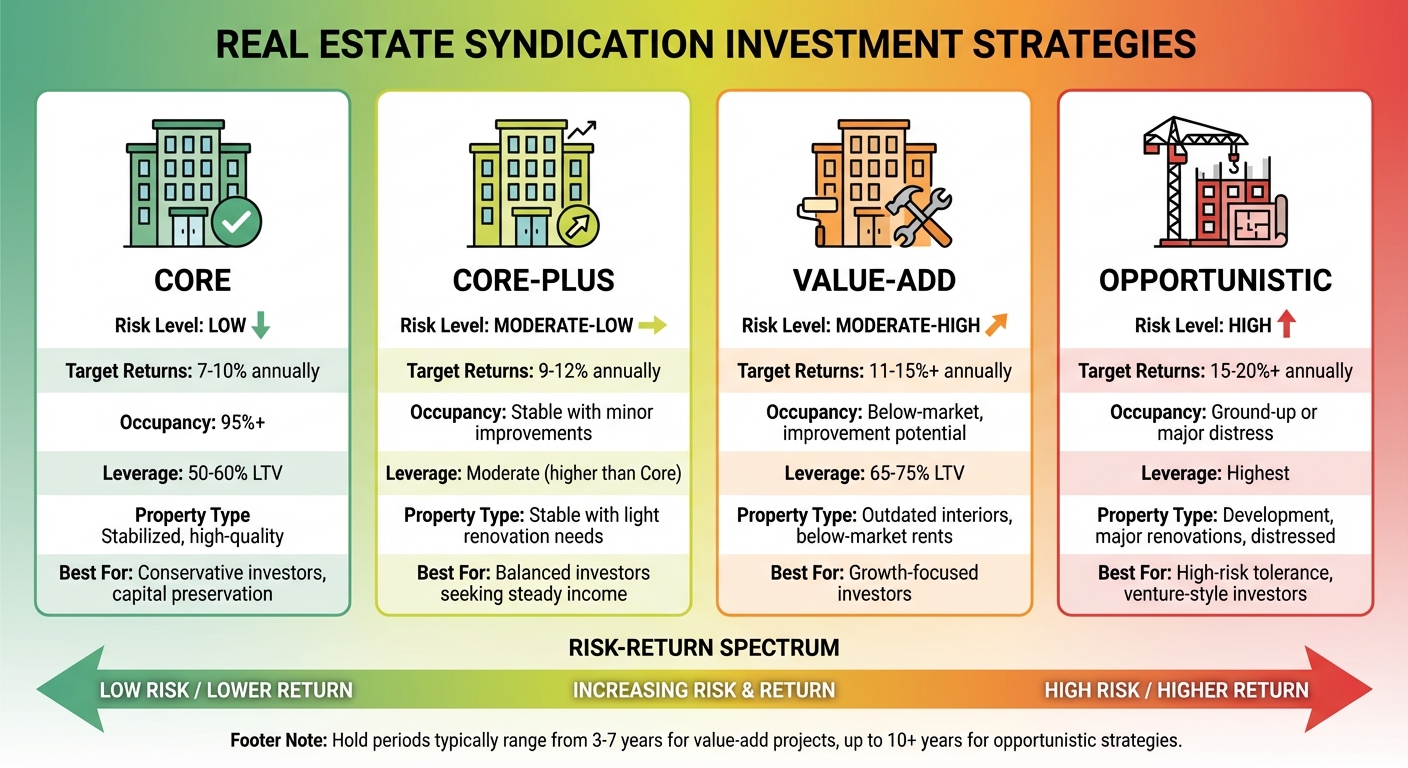
Real Estate Syndication Investment Strategies: Risk vs Return Comparison
Common Syndication Strategies
When it comes to real estate syndications, there are four key strategies: Core, Core-plus, Value-add, and Opportunistic. These strategies vary in terms of risk levels and potential returns, allowing investors to align their choices with their financial goals.
Core deals focus on stabilized, high-quality properties with occupancy rates above 95%. These investments typically involve low leverage (50–60% loan-to-value ratio) and aim for annual returns of 7–10%. They’re ideal for conservative investors who prioritize preserving their capital while earning steady income.
Core-plus strategies are a step up in terms of risk and return. These deals involve stable properties with opportunities for minor improvements, such as light renovations or operational adjustments. With slightly higher leverage, these deals target annual returns of about 9–12%. Improvements like boosting occupancy rates or optimizing expenses drive these returns.
Value-add investments focus on properties with clear issues - outdated interiors, below-market rents, or higher-than-average vacancies. Through renovations and better management, sponsors aim to increase property value and rental income. These deals often use 65–75% leverage and project double-digit returns, typically between 11–15% or more. While they carry higher execution risks, the potential for significant gains makes them appealing.
Opportunistic strategies take on the highest risk for the highest potential returns. These projects include ground-up developments, major renovations, or distressed assets. They often produce little to no cash flow for years but can deliver returns of 15–20% or more if executed successfully. These are high-stakes investments, best suited for those willing to take on venture-style risks with capital they can afford to lose.
Evaluating Deals and Sponsors
To evaluate deals effectively, focus on key metrics like IRR, equity multiple, cash-on-cash return, and cap rate:
- Internal Rate of Return (IRR) reflects the annualized return of all cash flows, including your initial investment, ongoing distributions, and eventual sale proceeds. A higher IRR is generally better, but always scrutinize how it’s achieved - overly optimistic assumptions can inflate this metric.
- Equity multiple measures the total cash received relative to the initial investment. For example, a 2.0x equity multiple means a $50,000 investment grows to $100,000 over the deal’s life.
- Cash-on-cash return focuses on annual pre-tax cash flow relative to the invested amount. For instance, an 8% cash-on-cash return means $4,000 annually on a $50,000 investment. This is especially important for income-focused investors.
- Cap rate shows the property’s yield based on current income (net operating income ÷ purchase price). Compare the cap rate to market averages and ensure conservative assumptions, like higher cap rates at exit, to account for potential market shifts.
When it comes to sponsors, their track record and transparency are critical. Look for sponsors with years of experience navigating different market cycles and executing similar strategies. Ask for case studies that compare projected and actual results, including how they handled underperforming deals. Reliable sponsors provide regular updates, invest their own capital, and maintain reasonable fee structures. They also work with reputable partners, such as property managers and lenders, and can clearly explain each party’s role in the project.
Reducing Investment Risks
Investing always carries risks, but understanding and managing them can help protect your capital. Here are some of the major risks and how to mitigate them:
- Market risk comes from broader economic conditions, such as recessions or oversupply in a particular area, which can impact rents, occupancy, and sale prices.
- Execution risk arises when a sponsor fails to deliver on renovations, rent increases, or expense management, which can erode returns.
- Financing risk has grown in recent years due to rising interest rates and refinancing challenges. Sponsors are now leaning toward fixed-rate loans or hedged financing to minimize these risks.
- Sponsor and governance risk includes poor decision-making, lack of transparency, or even fraud, which can jeopardize your investment.
- Liquidity and exit risk reflects the fact that syndication investments are illiquid - you can’t easily sell your stake before the sponsor exits the deal.
To reduce these risks, sponsors often employ tools like conservative leverage, fixed or hedged interest rates, and adequate cash reserves for unexpected expenses. Many now include "sensitivity tables" in offering documents, showing how returns might change under less favorable conditions, such as slower rent growth or higher cap rates.
Finally, diversification is a powerful way to manage risk. By spreading your investments across multiple properties, markets, and sponsors, you reduce your exposure to any single downturn. Platforms like Lofty (https://lofty.ai) make diversification more accessible by allowing fractional investments in rental properties, often with lower minimums than traditional syndication deals. This approach lets you build a balanced real estate portfolio while minimizing risk.
Getting Started with Real Estate Syndication
Setting Investment Goals
Begin by taking a good look at your financial situation - your net worth, cash flow, debts, and the amount of money you can safely set aside for long-term investments. This step is crucial to figuring out how much you can invest without putting your financial health at risk.
Next, define your goals. Are you focused on generating income, growing your wealth, or preserving your capital? For instance, if your goal is to earn an extra $1,500 in monthly passive income within five years, you might want to explore stabilized, cash-flowing multifamily or industrial properties that offer steady distributions. On the other hand, if you're aiming for 12–15% annualized returns over a seven-year period, consider value-add or opportunistic projects that involve renovations and lease-up risks. If your priority is safeguarding your capital, focus on strong markets, lower leverage, and sponsors with a solid track record.
Also, think about your investment timeline. Syndications often have hold periods ranging from 3 to 10 years or more, and exiting early is usually not an option. Ask yourself if these timeframes align with your future financial needs, like buying a home, covering college tuition, or preparing for retirement. Decide how much of your portfolio you’re comfortable locking into these illiquid investments. Use your goals to establish deal filters, such as minimum projected cash-on-cash returns, target IRR, preferred property types, geographic locations, and acceptable leverage levels.
Once you’ve nailed down your criteria, check to see if you meet the regulatory accreditation requirements for participating in these investments.
Understanding Accreditation Requirements
Most private real estate syndications in the U.S. are geared toward accredited investors under SEC Regulation D exemptions (Rules 506(b) and 506(c)). To qualify as an accredited investor, you need to meet one of these criteria: an annual income of over $200,000 (or $300,000 with a spouse) for the past two years with a reasonable expectation of continuing that income, or a net worth exceeding $1,000,000, excluding your primary residence. Certain licensed professionals may also qualify.
To confirm your status, gather documents like recent tax returns, W-2s or 1099s, brokerage statements, and a personal financial statement. For 506(c) offerings - where sponsors can advertise publicly but only accept accredited investors - you’ll need third-party verification from a CPA, attorney, or registered investment adviser. If you don’t meet these qualifications yet, 506(b) offerings might be an option. These are often accessed through educational events, meetups, or professional networks and may allow sophisticated non-accredited investors under certain SEC rules.
For those just starting out, fractional real estate platforms like Lofty offer a more accessible way to invest. With as little as $50, you can invest in U.S. rental properties, earning daily rental income and benefiting from property appreciation - without the high capital requirements or accreditation typically needed for private syndications. Public REITs and real estate ETFs are also good options for gaining exposure to real estate while working toward accreditation.
Building a Diversified Real Estate Portfolio
Once you’ve set your goals and confirmed your accreditation status, focus on creating a well-rounded portfolio by diversifying across property types and investment strategies. Diversification helps reduce risks and smooth out performance over time. One approach is to combine private syndications with fractional property investments. Use syndications for larger, long-term investments in commercial real estate, while fractional platforms like Lofty let you invest in individual rental properties - whether single-family homes or small multifamily units - across different cities.
For example, you might allocate a portion of your real estate investments to 3–5 private syndications in various regions and strategies, such as a core multifamily deal in Texas, a value-add industrial project in Florida, and a self-storage syndication in Arizona. Then, use another portion to invest in 10–20 fractional properties through Lofty, spreading your investments across multiple U.S. markets. Review your portfolio annually, staggering commitments to avoid having too many investments mature at the same time and to take advantage of changing market conditions.
Ask detailed questions about potential risks, capital calls, and how sponsors handled past downturns, such as the 2008–2009 financial crisis or more recent market fluctuations. Carefully review offering documents like the Private Placement Memorandum (PPM) and Operating Agreement, paying close attention to fees, distribution waterfalls, and whether the sponsor has invested their own capital in the deal.
Lastly, set up a dedicated U.S. bank account for investment transactions and be ready to handle K-1 tax forms, which typically arrive close to the federal tax filing deadline. Keep all your documents - PPMs, agreements, capital call notices, and distribution updates - in a digital vault for easy tracking and tax preparation. By blending syndications with fractional investments and following a thorough due diligence process, you can build a diversified and resilient real estate portfolio tailored to your goals.
Conclusion
Real estate syndication provides U.S. investors with a structured way to tap into large-scale, professionally managed assets - think 100-plus-unit apartment complexes or industrial facilities - that would otherwise be beyond reach for most individuals. By pooling resources, investors can earn passive income through quarterly distributions and potentially benefit from property appreciation upon sale, all while leaving the day-to-day operations, tenant management, and execution of the business plan to the sponsor.
That said, success in syndication hinges on thorough evaluation. Look for sponsors with a solid track record, transparent fee structures, and a willingness to invest their own capital alongside yours. It’s equally important to scrutinize underwriting assumptions to ensure they align with realistic U.S. market conditions. Keep in mind that syndications often lock up your capital for three to ten years, so only invest money you won’t need before the projected exit.
Diversification is key to managing risk. Spread your real estate investments across different deals, sponsors, markets, and asset types to avoid over-concentration. You might also consider incorporating platforms like Lofty, which offer lower minimums, as part of your strategy to build a more balanced and varied portfolio.
FAQs
What risks should I consider before investing in real estate syndication?
Real estate syndication comes with its share of risks, and it's crucial for investors to weigh these carefully. Market fluctuations can play a big role, potentially lowering property values or reducing rental income, which might impact your returns. Then there are property-specific challenges - think surprise repair bills or higher-than-expected maintenance costs - that can eat into profits.
There's also the matter of management risks. The success of your investment often hinges on the syndicator's expertise and the decisions they make, so their performance is a critical factor.
Another consideration is illiquidity. These investments aren't something you can quickly sell or cash out of, meaning your money could be tied up for years. And, of course, there's always the chance of returns falling short of expectations, whether due to economic slowdowns or underperforming properties. Being aware of these risks is key to making smart, informed decisions in real estate syndication.
What’s the best way for a beginner to start investing in real estate syndication?
For those new to investing, real estate syndication offers an easy entry point without requiring deep expertise or a hefty initial investment. Platforms such as Lofty simplify the process by providing fractional ownership opportunities for rental properties across the U.S. Here's how it works: you can browse available properties, assess potential returns, and purchase fractional shares - all online. This method lets you earn rental income and enjoy property value growth, all while keeping the process simple and accessible.
What does a sponsor do in a real estate syndication?
In real estate syndication, the sponsor takes the lead in orchestrating and managing every aspect of the investment process. Their responsibilities include finding and acquiring the property, arranging financing, performing due diligence, and managing operations throughout the investment's duration.
As the central decision-maker, the sponsor ensures the investment stays on track and meets the syndication's objectives. Their knowledge and ability to steer the process are crucial to achieving a successful outcome.
Related Blog Posts

