
Tokenized Real Estate: Regional Leaders in 2025
Jerry Chu
Tokenized real estate is changing how people invest in property by letting them own fractions of properties through blockchain-based tokens. These tokens provide access to rental income and faster transactions, with platforms like Lofty and RealT leading the charge. The U.S., UAE, and UK are the top regions for tokenized real estate in 2025, driven by clear regulations, growing institutional interest, and advanced platforms. Globally, the market has surpassed $10 billion and is projected to grow to $3 trillion by 2030. Here's a quick breakdown of regional highlights:
- United States: Leading with platforms like Lofty and tZERO, offering fractional ownership starting at $50.
- Europe: Switzerland, Germany, and the UK focus on compliance and institutional-grade projects.
- Middle East: UAE dominates with government-backed initiatives and free zones like Dubai's VARA.
- Asia-Pacific: Singapore leads with MAS-driven pilots, while Hong Kong and Australia explore regulated tokenization.
Tokenized real estate is on track to become a major asset class, making property investment more accessible and efficient.
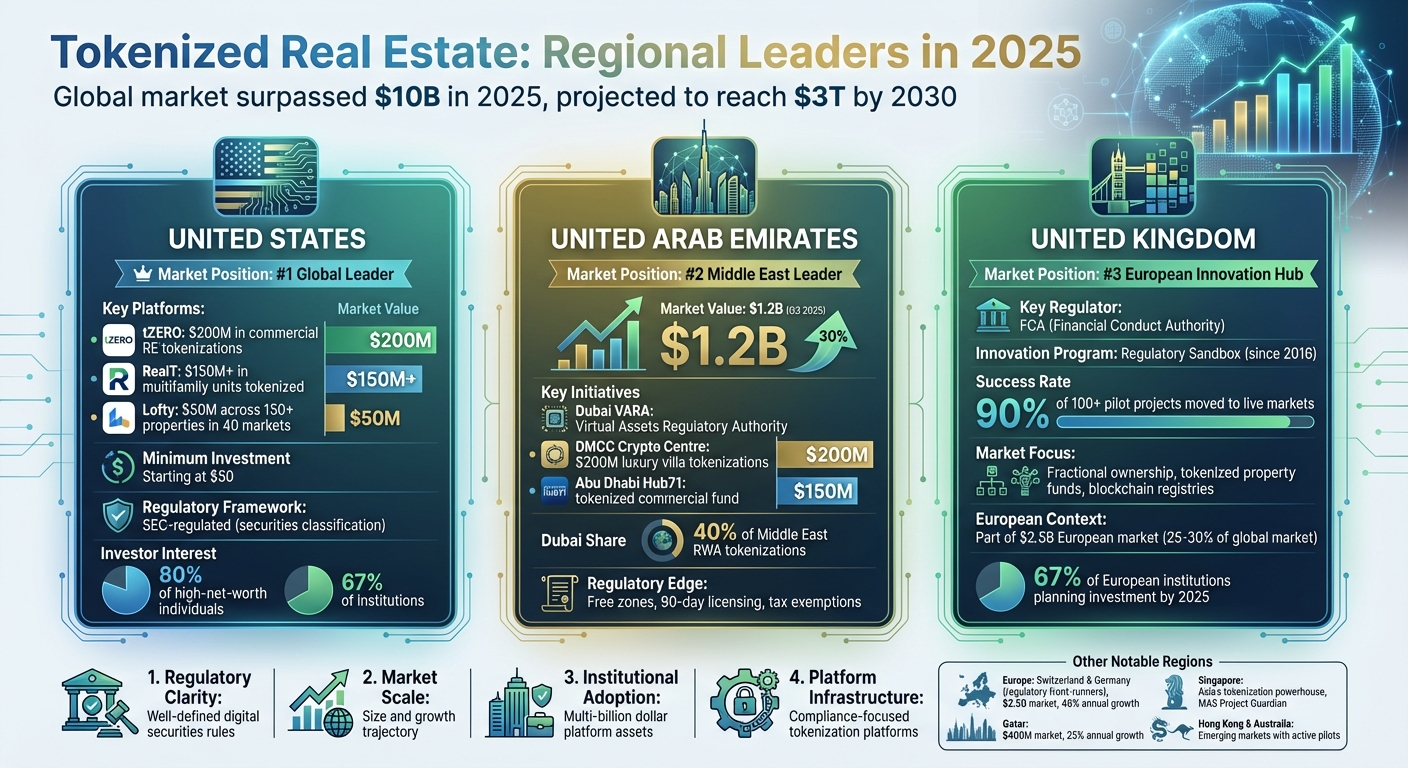
Top 3 Regional Leaders in Tokenized Real Estate 2025: USA, UAE, and UK Market Comparison
Tokenizing Property: The Future of Real Estate in a Web3 World | Futurist Conference Florida 2025
How We Identified Regional Leaders
We analyzed regions based on four key factors: regulatory frameworks, market activity, institutional participation, and platform infrastructure.
Criteria for Regional Leadership
Our approach relied on four main criteria:
- Regulatory clarity: Regions with well-defined rules for digital securities ranked the highest. For example, the U.S. SEC's classification of most tokenized real estate as securities provides legal certainty, making it easier to attract institutional investors.
- Market scale and activity: We assessed the size and growth of markets. The U.S., for instance, has shown notable market expansion, partly due to improved regulatory clarity. Similarly, both the EU and U.S. experienced significant growth in 2025 as regulations became more defined.
- Institutional adoption: Established markets are characterized by strong participation from institutional investors. Platforms managing multi-billion-dollar assets and hosting active secondary markets reflect the trust and involvement of these investors.
- Platform and infrastructure depth: Regions with a wide array of compliance-focused tokenization platforms demonstrated greater maturity. Features like regulated trading venues, effective KYC/AML compliance tools, and fractional ownership options with low entry points (as little as $50) highlight advanced market development.
These factors build on earlier research into the interplay between regulatory and market dynamics. A prime example is the U.S. platform Lofty, which combines fractional ownership opportunities with a strong compliance framework.
Geographic Breakdown
Using these criteria, we identified regions where regulatory, market, and technological elements align.
Our analysis spotlighted four major regions:
- North America: Focused on the U.S. and Canada, where large real estate markets intersect with a high concentration of tokenization platforms.
- Europe: Included countries like Switzerland, Germany, and the UK, which boast advanced digital securities frameworks.
- Middle East: Highlighted the UAE and Qatar, where government-led initiatives are positioning these nations as digital asset hubs.
- Asia-Pacific: Examined financial centers such as Singapore, Hong Kong, and Australia, where evolving regulations support tokenized real estate growth.
According to a 4IRE analysis, the USA, UAE, and UK emerged as the top three jurisdictions for real estate tokenization by 2025. This dominance is attributed to their mature regulatory environments and strong institutional engagement.
North America: United States and Canada
In 2025, North America takes center stage in the tokenized real estate market, with the United States and Canada leading the way. While each country adopts its own approach, their strategies complement one another, solidifying the region's dominance.
United States: Leading the Market
The United States holds the top spot in global real estate tokenization, thanks to its strong capital markets, clear regulatory framework from the SEC, and growing interest from institutional investors. Since 2024, the market has seen significant expansion, driven by the SEC's classification of most tokenized real estate as securities. This regulatory clarity reassures investors and has attracted 80% of high-net-worth individuals and 67% of institutions, who are either already investing in tokenized assets or planning to, with real estate as their primary focus.
Platforms like tZERO and RealT are key players in this space. tZERO, a regulated alternative trading system, processed $200 million in commercial real estate tokenizations and facilitated over 44 million shares in private placements in 2025. Meanwhile, RealT has tokenized more than $150 million in multifamily units.
Another standout platform is Lofty, which is built on Algorand. Lofty makes U.S. rental properties accessible to a global audience by allowing investments starting at $50. It offers daily rental yields and instant trading of holdings. With over 150 properties tokenized across 40 markets and a total value of $100 million, Lofty removes traditional barriers such as high down payments and property management, making rental income more attainable for investors worldwide.
While the U.S. leads with its scale and innovation, Canada is carving out its own position in this evolving market.
Canada: Growing Adoption
Canada’s tokenized real estate market is gaining momentum, supported by strict provincial regulations. These rules treat security tokens as securities under existing laws, creating a reliable framework for tokenized real estate-backed securities and fund offerings.
The country benefits from its proximity to the U.S., with cross-border activity enhancing its market growth. Canadian platforms are seeing increasing interest in tokenized fund units and project-specific securities, often structured through crowdfunding-style models. This approach aligns with U.S. digital market trends, showcasing a unified North American strategy for tokenized real estate. Canada’s investor-friendly policies attract sophisticated investors who seek compliant, digital avenues to access North American real estate opportunities.
Together, the United States and Canada are shaping the future of tokenized real estate, each contributing unique strengths to a rapidly evolving market.
Europe: Leading Countries in Tokenized Real Estate
After North America, Europe has emerged as a strong player in tokenized real estate, thanks to its clear regulations and steady market growth. The region's leadership stems from well-defined rules for digital securities, which provide a solid foundation for tokenized assets. By 2024, the value of tokenized real estate in Europe hit $2.5 billion, growing at an impressive 40% annually, with Switzerland and Germany driving much of this progress. Europe now represents 25–30% of the global tokenized real estate market, which is expected to reach $10 billion by 2025.
Switzerland and Germany: Regulatory Front-Runners
Switzerland and Germany have set themselves apart with strong legal frameworks that treat tokenized real estate as securities within existing financial regulations. Since 2020, Switzerland's FINMA has provided clear guidelines, classifying many real estate tokens as securities and applying established securities laws to these assets. Swiss tokenized real estate deals often involve tokenized shares or SPV (special purpose vehicle) participation rights, which hold the underlying property. This approach simplifies processes like land registry and tax compliance while ensuring alignment with regulations.
Germany’s regulatory body, BaFin, has also embraced tokenized real estate, recognizing electronic and crypto securities under specific laws. This allows real estate ownership interests to be issued directly on a blockchain. German issuers utilize blockchain-based electronic securities registers, incorporating KYC (Know Your Customer) and AML (Anti-Money Laundering) checks alongside approved offering documents when necessary. In 2022, BaFin approved Germany’s first tokenized real estate fund, with plans to expand into green and ESG-focused properties by 2025.
While central Europe emphasizes compliance through SPV structures and strict regulations, the United Kingdom takes a different approach, focusing on innovation through regulatory sandboxes.
United Kingdom: A Hub for Real Estate Tokenization
The United Kingdom has positioned itself as a hub for tokenized real estate, largely thanks to the Financial Conduct Authority (FCA) and its regulatory sandbox program. Since 2016, these sandboxes have allowed companies to test tokenized securities and real estate products under regulatory oversight. Over 100 tokenization projects have been tested, with 90% successfully moving to live markets. These pilots have explored everything from fractional ownership and tokenized property funds to blockchain-based registries, helping to refine consumer protection and market integrity standards.
The FCA treats most real estate tokens representing ownership or income rights as regulated securities, with clear requirements for licensing, disclosure, and marketing. Combined with London’s status as a global financial hub, this regulatory clarity has attracted fintech firms and institutional investors eager to launch tokenized real estate projects targeting both local and international markets. A recent survey revealed that 67% of European institutions plan to invest in tokenized real estate by 2025, signaling growing confidence in the UK’s regulatory framework.
sbb-itb-a24235f
Middle East: Policy-Driven Tokenization Centers
In the Middle East, tokenized real estate is gaining momentum, largely fueled by government regulations and state-backed initiatives, particularly in the UAE and Qatar. These countries are crafting frameworks closely tied to their economic diversification goals and digital transformation strategies. As of Q3 2025, the UAE’s tokenized real estate market reached a staggering $1.2 billion, marking a 30% year-over-year growth, while Qatar’s market hit $400 million with a 25% annual growth rate. This government-led progress highlights the distinct approaches of these two nations.
United Arab Emirates: Leading Through Innovation
Dubai and Abu Dhabi have positioned themselves as pioneers in regulatory frameworks for tokenized real estate. Dubai’s Virtual Assets Regulatory Authority (VARA), established in 2023, has implemented clear guidelines for blockchain-based assets, emphasizing strict AML and KYC compliance. These regulations support operations in free zones, such as the Dubai International Financial Centre (DIFC). Similarly, Abu Dhabi’s ADGM Financial Services Regulatory Authority (FSRA) introduced a 2024 sandbox aimed at real-world assets, including the tokenization of commercial properties in Masdar City. By mid-2025, these initiatives facilitated over $500 million in tokenized real estate pilots.
The UAE’s free zones have become hubs for groundbreaking projects. For example, Dubai’s DMCC Crypto Centre collaborated with Zoniqx to tokenize luxury villas in Jumeirah, generating $200 million in fractional sales through the XRP Ledger, attracting global investors. Meanwhile, Abu Dhabi’s Hub71 free zone launched a $150 million tokenized commercial real estate fund on Hedera in Q2 2025, offering yields of 8–12% via smart contracts. These efforts are bolstered by tax exemptions and expedited licensing processes, which can be completed within 90 days, making the UAE a magnet for institutional capital. By late 2025, Dubai alone accounted for 40% of the Middle East’s real-world asset tokenizations, with VARA approving over 15 platforms for secondary trading.
Qatar: Exploring Real Estate Tokenization
While the UAE has taken the lead with its advanced regulatory frameworks, Qatar is quickly building its foundation for tokenized real estate. Guided by its National Vision 2030, Qatar is scaling its market through targeted incentives and the Qatar Financial Centre’s (QFC) 2025 regulatory sandbox. The Qatar Investment Authority has committed $300 million to pilot tokenized hospitality properties, focusing on fractional ownership in Lusail City developments.
The QFC has already made significant strides, including tokenizing $100 million worth of Doha waterfront apartments through Propy, enabling fractional investments starting at $1,000 with daily rental yields powered by Ethereum-based smart contracts. Additionally, the QFC launched a $50 million fund in Education City in partnership with tZERO. Despite being in its early stages, Qatar’s market offers attractive incentives, such as a 0% corporate tax for up to 20 years, with yields averaging 7–10% APR. Deloitte experts predict that by 2030, the UAE will dominate 15% of the global tokenized commercial real estate market, currently maintaining a volume three times larger than Qatar’s.
Asia-Pacific: Established and Growing Markets
The Asia-Pacific region has emerged as a key player in the tokenized real estate market, thanks to its strong regulatory frameworks, expansive property sectors, and steady capital flows. Countries like Singapore and Hong Kong are positioning themselves as global leaders in virtual asset and real-world asset (RWA) innovation. Meanwhile, Australia is making strides with its large pension and real estate markets, experimenting with blockchain-based asset tokenization pilots. Together, these markets provide the institutional support and investor engagement needed to complement developments in North America and Europe.
Singapore: Asia's Tokenization Powerhouse
Singapore has established itself as Asia's leading hub for tokenization, with the Monetary Authority of Singapore (MAS) spearheading initiatives like Project Guardian. This program brings together major financial institutions, such as JPMorgan, DBS Bank, and Standard Chartered, to explore tokenization of bonds, funds, and other RWAs. A key focus of Project Guardian is creating on-chain fund units and collateralization frameworks, offering a blueprint for property funds and REIT managers to issue compliant, tradable real estate tokens.
In Singapore, tokenized real estate is regulated under the Securities and Futures Act (SFA). Structures involving fractional ownership must adhere to strict prospectus requirements and AML/KYC standards. This regulatory-first approach has resulted in institutional-grade pilots rather than unregulated public offerings, positioning Singapore as a global model for tokenized real estate within a clear legal framework. By aligning with international trends, Singapore strengthens the global momentum for tokenized assets.
For U.S.-based real estate sponsors, Singapore offers a gateway to Asian investors. Platforms like Lofty (https://lofty.ai), which specialize in compliant fractional property interests, can expand their reach by adapting their token structures to Singapore's securities laws. Partnering with locally licensed platforms that hold MAS capital markets services or recognized market operator licenses ensures regulatory compliance while facilitating cross-border investments.
Beyond Singapore, Hong Kong and Australia are also making progress in tokenization, each with unique regulatory approaches and pilot programs.
Hong Kong and Australia: Emerging Tokenization Markets
Hong Kong is establishing itself as a tokenization hub through its virtual asset service provider (VASP) regime, which licenses virtual asset exchanges and custodians. This framework supports the listing and trading of security-like tokens, including tokenized real estate, on regulated platforms. The Hong Kong government has underscored its commitment by issuing tokenized green bonds under its Green Bond Programme, with one notable deal valued at approximately HKD 800 million. This demonstrates that institutional-grade tokenized securities can be issued, cleared, and settled using distributed ledger technology. Banks and securities firms are also piloting tokenized RWAs, including funds, structured notes, and property-backed instruments, on permissioned blockchain networks.
In Australia, tokenization is still in its pilot phase. Financial institutions and fintechs are experimenting with blockchain applications for real estate funds, private credit, and other RWAs, aiming to improve settlement efficiency, broaden distribution, and enable fractional ownership. These pilots often involve tokenized units in managed investment schemes or property funds, which remain regulated under Australian securities law but gain features like 24/7 transferability and integration with digital wallets. Australian regulators have indicated that many tokenized real estate projects fall under managed investment scheme and financial product rules, limiting them to institutional or wholesale investors rather than retail markets. To succeed in Australia, platforms must treat tokenized offerings as financial products, work with Australian Financial Services License (AFSL) holders, and leverage regulatory sandboxes and pilot programs to refine their models before scaling.
| Aspect | Singapore | Hong Kong | Australia |
|---|---|---|---|
| Regulatory stance | Proactive, led by MAS; Project Guardian for tokenization and DeFi pilots | Pro-virtual-asset, with VASP regime and tokenized green bond initiatives | Cautious but open, applying financial product rules alongside pilots and sandboxes |
| Primary market focus | Institutional tokenization of RWAs like funds, bonds, and real estate | Tokenized securities, green bonds, and virtual asset trading, with plans to expand into RWAs | Tokenized units in funds/trusts, often real estate-backed, aimed at wholesale investors |
| Maturity level (2025) | Among the world's leading hubs for tokenization standards and institutional pilots | Rapidly building status as a tokenization hub with government-backed projects | Developing market with active pilots but fewer large-scale implementations |
Trends Shaping Regional Leadership
The rise of tokenized real estate is being shaped by global trends that influence how different regions approach leadership in this space. While these trends are universal, they manifest in distinct ways across various regions.
Common Patterns Across Regions
Even with differences in regulations and market dynamics, leading regions in tokenized real estate share some key trends that drive their success. For one, institutional adoption is gaining momentum. More institutions are tokenizing assets like funds, loans, and portfolios to enhance liquidity and reduce costs. Deloitte even predicts that tokenized loans will become a dominant force, with private funds showing the most growth potential.
Another shared trend is the integration of tokenized real estate with established infrastructure. Successful regions link these assets to existing trading platforms and regulatory frameworks. By using smart contracts, they automate processes like payments and governance, cutting costs and enabling seamless cross-border transactions.
A clear and consistent securities framework is also crucial. Regions adopting such frameworks attract more issuers and capital. By using SPV structures - such as LLCs or trusts - tokens can represent equity or debt claims rather than direct property ownership. This approach simplifies compliance, governance, and international distribution.
Regional Differences
While these overarching trends are evident, regional strategies differ based on investor preferences and policy goals. In the United States, platforms like Lofty (https://lofty.ai) cater to retail investors by offering fractional ownership of income-generating properties. With minimum investments as low as $50, they provide features like daily payouts and instant liquidity. Simultaneously, U.S. institutional players focus on tokenizing private funds and commercial real estate through frameworks like Reg D and Reg S, targeting accredited and qualified investors.
In contrast, Gulf states such as the UAE and Qatar emphasize policy-driven initiatives. They use free zones and regulatory sandboxes to attract global capital for large-scale tokenized projects, aiming to position themselves as hubs for international issuers and high-net-worth investors.
Europe, particularly Switzerland, Germany, and the U.K., strikes a balance by focusing on institutional tokenized funds, bonds, and structured products. These markets align with private banking and wealth management channels, supported by explicit legal recognition of digital ledger-based securities. Meanwhile, Asia-Pacific centers like Singapore and Hong Kong prioritize security token offerings that meet capital-markets-grade standards. Their integration with regulated exchanges appeals mainly to institutional and professional investors.
Survey data highlights these differences: 80% of wealthy U.S. investors and 67% of institutions are already buying or planning to buy tokenized assets, with real estate emerging as one of the most sought-after categories.
Conclusion
The shifting dynamics in regional markets highlight the changing face of tokenized real estate. Success in this sector is largely shaped by clear regulations, well-established markets, and platforms that make investing more accessible. For instance, robust legal frameworks set mature markets apart from those still experimenting. In the U.S., the SEC classifies tokenized real estate as securities, requiring adherence to rules on disclosure, registration exemptions, and investor protections. This has created a stable and predictable environment for platforms and institutions to operate effectively. Similarly, regulatory clarity in regions like the EU, U.K., and UAE has attracted international investment and allowed for compliant growth in tokenized real estate offerings.
Platforms like Lofty (https://lofty.ai) illustrate how tokenization is reshaping real estate investment. By offering fractional ownership starting at just $50, along with daily rental payouts and instant liquidity, these platforms eliminate traditional hurdles like hefty down payments and long closing processes.
Looking ahead, projections suggest that tokenized real estate could grow to $3 trillion by 2030 and potentially $4 trillion by 2035. This growth is fueled by increasing institutional interest and the rise of fractional ownership models. As compliance-driven platforms continue to integrate with regulated exchanges and decentralized finance (DeFi) protocols, it’s clear that tokenized real estate is on track to become a major global asset class.
FAQs
What are the advantages of investing in tokenized real estate?
Investing in tokenized real estate comes with some compelling benefits. For starters, it offers instant liquidity, meaning you can buy or sell your shares quickly - no need to deal with the drawn-out processes that usually come with traditional real estate transactions. This approach also makes real estate investing more accessible by allowing smaller investment amounts, opening the door to a broader range of investors.
Beyond that, tokenized real estate lets you spread your investments across multiple properties, helping you diversify your portfolio. It also provides opportunities to earn passive rental income and benefit from potential property value increases over time. On top of it all, you retain full control of your investments, giving you the flexibility to align your portfolio with your specific financial goals.
How do regulations affect the growth of tokenized real estate in different regions?
Regulations are a key factor in shaping the future of tokenized real estate. In the U.S., ongoing developments in legal frameworks are helping to define how digital assets like real estate tokens can be issued, traded, and owned. This progress provides a safer and more transparent environment, allowing platforms to operate efficiently and giving investors the confidence to engage in this emerging market.
However, not all regions are moving at the same pace. In areas where regulations are either restrictive or unclear, the growth of tokenized real estate can face significant roadblocks. Issues like limited trading opportunities or challenges in fractional property ownership can stifle progress. Clear and supportive policies are crucial for building trust, attracting investment, and paving the way for the global expansion of tokenized real estate markets.
Why are the United States, United Arab Emirates, and United Kingdom leading the tokenized real estate market in 2025?
By 2025, the United States, United Arab Emirates, and United Kingdom have established themselves as frontrunners in the tokenized real estate market. This success stems from a combination of forward-thinking regulations, strong financial systems, and active investor participation - all of which create fertile ground for fractional property ownership and improved liquidity.
On top of that, breakthroughs in blockchain technology and the increasing global appetite for more accessible real estate investment options have helped these regions stand out. Their proactive approach to embracing market innovations and crafting supportive policies has been instrumental in solidifying their leadership in this evolving sector.
Related Blog Posts

