
5 Steps to Invest in Tokenized Real Estate
Jerry Chu
Tokenized real estate lets you invest in property by purchasing blockchain-based tokens, representing fractional ownership. With as little as $50, you can earn rental income and benefit from property value appreciation without the need for large upfront capital. Here's a quick guide to get started:
- Choose a Platform: Select a platform that complies with U.S. regulations, offers detailed property information, and provides liquidity through secondary markets.
- Set Up Your Account: Register, verify your identity (KYC/AML), and fund your account using USD or accepted cryptocurrencies.
- Evaluate Properties: Review offering documents, calculate metrics like cash-on-cash return, and assess risks such as vacancy rates and debt terms.
- Buy Tokens: Decide your investment amount, complete the purchase, and confirm token delivery in your wallet.
- Manage Your Portfolio: Track rental income, rebalance your investments, and stay updated on property performance.
Tokenized real estate offers a simplified way to diversify your portfolio across various properties and locations while being mindful of fees, liquidity, and tax implications.
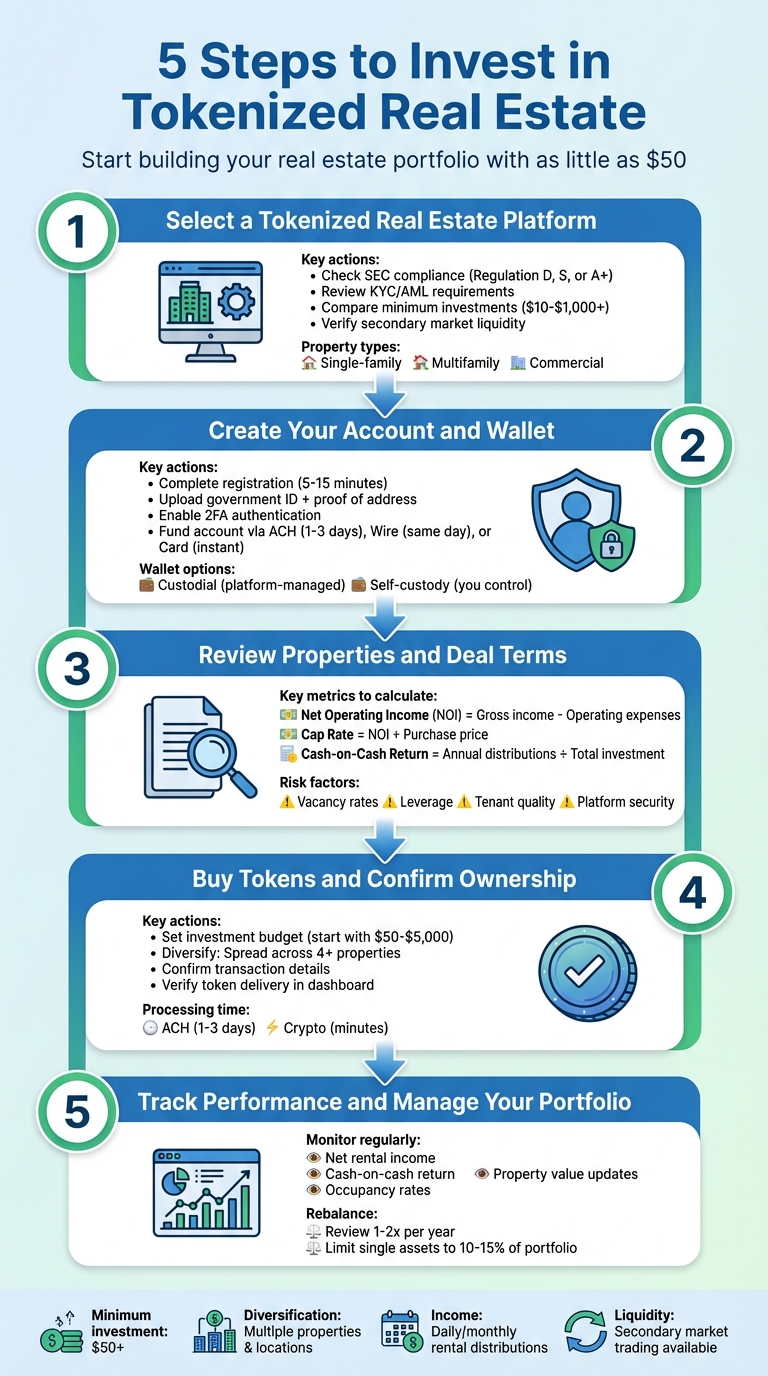
5 Steps to Invest in Tokenized Real Estate: Complete Guide
How does real estate tokenization work?
Step 1: Select a Tokenized Real Estate Platform
The platform you choose will play a vital role in determining the properties you can access and the level of liquidity you can expect. A reliable platform conducts thorough underwriting for each property, provides audited financials, and ensures regular, transparent updates on property management. These factors directly influence occupancy rates, rental income stability, and long-term returns. On the other hand, weaker platforms may lack proper asset vetting, have poor security measures, or offer limited liquidity, increasing the risk of capital loss or being stuck in an illiquid position.
Check Regulation and Compliance
Ensure the platform treats tokens as securities and complies with SEC exemptions, such as Regulation D, S, or A+, depending on your investor status. During onboarding, the platform should perform Know Your Customer (KYC) and Anti-Money Laundering (AML) checks. This process typically includes verifying your identity, confirming your address, and sometimes assessing your eligibility as an investor.
Review key documents such as the offering memorandum, operating agreement, and subscription documents. These will clarify ownership terms, income distribution, and exit strategies. You'll also learn whether the investment is restricted to accredited investors, open to all U.S. investors under specific exemptions, or limited to certain regions. Pay attention to risk factors like vacancy rates, leverage levels, and market conditions, as well as fee structures, which may include acquisition, asset management, performance, and trading fees. Additionally, check how frequently the platform provides financial updates.
Review Property and Deal Types
Tokenized real estate offerings often include single-family rentals, multifamily apartment buildings, and commercial properties like offices, retail spaces, or industrial facilities. Single-family rentals can provide steady cash flow but are sensitive to local economic shifts. Multifamily properties, which spread risk across multiple units, tend to offer more predictable income streams. However, they may require active management and can be influenced by regional rental regulations and broader economic trends.
Commercial properties often feature longer lease terms and potentially higher rents. However, they can be more exposed to tenant credit risks and are often tied to longer investment horizons, ranging from 5 to 10 years or more before a sale or recapitalization. Many platforms specify each deal's target hold period, which could range from 3–5 years for residential properties needing value-add improvements to 7–10 years or beyond for larger commercial projects.
When evaluating properties, review pro forma metrics like cash-on-cash return, net yield, internal rate of return (IRR), and equity multiple. Higher IRRs often indicate higher levels of risk tied to the business plan or market conditions. If you prioritize steady income, look for properties with stabilized occupancy, long-term leases, and conservative leverage, even if the returns are lower. For those focused on growth, properties with renovation plans or lease-up strategies might be more appealing, as they often offer higher returns upon refinancing or sale, albeit with more variability in short-term cash flow.
Compare Platform Features
Check the platform's minimum investment requirements, which often range from $10 to a few thousand dollars. Fee structures should be clearly outlined and may include one-time acquisition fees, ongoing management fees, and, in some cases, performance or trading fees for secondary transactions. Also, confirm the payment methods supported - whether deposits can be made in USD via ACH, wire, or card - and whether cryptocurrencies or stablecoins are accepted.
A key advantage of tokenized real estate is liquidity. Platforms offering secondary trading options allow you to sell tokens before the property is refinanced or sold. Check if the platform connects to a regulated secondary marketplace for digital securities, and review trading hours, order types, and any restrictions like lockup periods or transfer limitations under securities laws.
Robust reporting tools and dashboards are essential for tracking your investments over time. Look for platforms that provide detailed performance metrics, such as monthly or quarterly rental income, occupancy rates, net operating income (NOI), updated valuations (if applicable), and records of capital expenditures or major property events. A good platform should also allow you to download statements for cash distributions, token sales, and tax documentation in USD.
Platforms like Lofty focus on fractional ownership, enabling investors to purchase small stakes in U.S. rental properties with minimal upfront costs. This makes it easier to build a diversified real estate portfolio. Lofty, for instance, distributes rental income daily in USD-equivalent terms based on token holdings, offering more frequent cash flow compared to traditional quarterly or annual distributions. This model can be especially appealing for those seeking regular income. Clear and user-friendly platform features simplify the process of buying and managing your tokens.
Step 2: Create Your Account and Wallet
After choosing a platform, the next step is to register and verify your identity. This step is essential to comply with U.S. securities regulations and helps safeguard both you and the platform from potential fraud. Completing this process unlocks the investment features you'll need.
Complete Registration and Verification
Start by clicking "Sign Up" or "Get Started" on the platform's homepage. You'll need to provide your full legal name, email address, phone number, and create a strong password. Aim for a password that's 12–16 characters long, mixing letters, numbers, and symbols for added security. Once you confirm your contact details, you'll need to submit personal and contact information to meet KYC/AML compliance requirements.
Next, upload a government-issued ID and proof of address. Accepted documents for proof of address typically include recent utility bills, bank statements, or lease agreements dated within the last three months. To avoid delays, ensure that your legal name and address match exactly on all documents.
Enable two-factor authentication (2FA) using an authenticator app like Google Authenticator or Authy. This provides stronger protection against SIM-swap attacks compared to SMS-based 2FA. Set up account recovery options, such as a backup email or phone number, and opt in to receive security notifications for account activity like logins or withdrawals. The entire registration process usually takes around 5–15 minutes.
Add Funds in USD
Once your account is verified, you’ll need to deposit funds to start investing. Most platforms offer ACH bank transfers, which are often free or low-cost but take 1–3 business days to process. For faster funding, domestic wire transfers are a good choice, as they typically settle within the same or next business day. However, these may come with fees ranging from $15 to $30, depending on your bank and the platform.
If you're looking for instant deposits, debit or credit cards are an option, though they often carry higher processing fees (around 2%–4%). Be aware that your card issuer might treat these deposits as cash advances, which could result in additional charges. Some platforms also accept stablecoins like USDC, which can be converted to a USD balance. While blockchain confirmations for these transactions are usually quick, platforms may add a short review period or a small spread on the conversion. Always check the platform’s funding page for details about fees, deposit limits, minimum amounts, and processing times - especially if you're depositing after 5 p.m. ET, as these may not be processed until the next business day.
Set Up and Secure Your Wallet
Most tokenized real estate platforms provide a custodial wallet, where the platform or its regulated custodian manages the private keys for you. Your token balances will appear in your account dashboard, and the platform handles the blockchain addresses. This setup simplifies things for users since you won’t need to manage a seed phrase. However, it does mean the platform holds custody of your assets, which comes with its own risks.
If you prefer more control, you can use an external wallet, such as MetaMask or a hardware wallet. With this option, you manage your private keys and seed phrase, and tokens are sent to an address you specify. While this gives you greater control and reduces reliance on the platform, it also means you're fully responsible for securing your assets. Some platforms may require you to whitelist your external wallet or complete additional steps to ensure ongoing KYC/AML compliance before transferring tokens.
For custodial wallets, make sure your account is secured with a unique, strong password and 2FA. If you're using a self-custody wallet, write down your seed phrase (usually 12–24 words) and store it offline in at least two secure locations, such as a home safe and a bank safe deposit box. Never save your seed phrase online or share it with anyone. For added security, consider using a hardware wallet to keep your private keys offline, especially for higher-value assets.
Finally, keep all devices used to access your platform or wallet updated with the latest operating system and browser versions. Use trusted antivirus software, avoid installing unverified browser extensions, and bookmark official platform URLs to reduce phishing risks. Regularly review your security settings, change your passwords periodically, and remove access for devices you no longer use to ensure your account remains secure.
Step 3: Review Properties and Deal Terms
Now that your account is set up, it’s time to dive into the specifics of tokenized property offers. This step requires a careful look at both the real estate fundamentals and the legal framework of the tokenized offering. Unlike traditional real estate deals, where negotiations can stretch on for weeks, tokenized properties come with pre-set terms. It’s crucial to understand these terms before making any investment.
Read Offering Documents
Every tokenized property should come with a set of offering documents that outline exactly what you’re buying. Start by confirming the property address, type, and description to understand its market context. Then, dig into the sponsor or issuer’s background - look at their experience, past deals, assets under management, and how long they’ve been in business. This will give you a sense of whether they’re capable of executing the business plan and managing the property effectively.
Next, review the legal structure and regulatory exemptions of the offering. Typically, your tokens represent shares or membership interests in an LLC or a special purpose vehicle (SPV) that owns the property - not direct ownership of the deed. This structure impacts how liability is distributed, how income reaches you, and your rights as a token holder. Finally, go through all the fees listed in the documents, such as acquisition fees, asset management fees, property management fees, and any performance-based incentives for the sponsor. These fees directly affect your net returns, so understanding them is key to making an informed decision. A thorough review of these documents sets the stage for confident investing.
Calculate Financial Metrics
To compare properties and evaluate their income potential, you’ll need to calculate a few essential metrics. Start with Net Operating Income (NOI). This is calculated by taking the gross rental income, adding any additional income sources like parking or laundry fees, and subtracting operating expenses such as property management, maintenance, taxes, and insurance (but not debt service). Use rent rolls and expense data to verify the NOI.
From there, calculate the cap rate by dividing the NOI by the property’s purchase price. For instance, if a property generates $10,000 in annual NOI and costs $150,000, the cap rate would be 6.67%. Compare this figure to local market averages for similar properties to determine if the deal is competitively priced. Another key metric is the cash-on-cash return, which you calculate by dividing annual distributions by your total cash investment, including any platform or closing fees. For example, if you invest $1,000 and receive $80 in annual distributions, your cash-on-cash return is 8%. Many platforms, like Lofty, display metrics such as projected cash flow per token, target cap rates, and historical occupancy data, making it easier to evaluate deals without manually crunching all the numbers.
Identify Risk Factors
All real estate investments carry some level of risk, and tokenized properties are no exception. Begin by reviewing vacancy and occupancy trends - look at the property’s historical occupancy rates and compare them to local market vacancy data. Assess tenant quality and lease terms, including the length of leases, rent escalation clauses, and whether current rents align with market rates.
Consider potential maintenance and capital expenditure risks by examining the property’s age, recent renovations, and the reserve funds available for major repairs. Pay close attention to leverage and debt terms - high loan-to-value ratios or floating-rate debt can magnify both potential gains and losses. Additionally, tokenized investments come with unique risks such as platform risk (the financial health and security of the marketplace), smart contract risk (issues with the code governing token transfers and payouts), and liquidity risk (the challenge of selling tokens quickly at a fair price, especially in markets with low trading volumes or regulatory lock-ups). Offering documents will usually outline these risks in detail, and some platforms even provide risk scores to help you assess them.
Once you’ve thoroughly evaluated the property’s metrics and risks, you’ll be ready to move forward with your token purchase.
sbb-itb-a24235f
Step 4: Buy Tokens and Confirm Ownership
The final step in purchasing tokenized real estate ensures your transaction is securely recorded on the blockchain while adhering to U.S. regulations. Once you've reviewed the property details and are confident in your choice, proceed with the purchase. Many platforms make this process straightforward, so buying tokenized real estate can feel as simple as shopping online. Just be sure to carefully evaluate your investment amount, double-check the transaction details, and confirm your ownership once the process is complete.
Decide Your Investment Amount
Start by setting a clear budget for your investment. Many investors allocate a specific amount - say, between $1,000 and $5,000 - for tokenized real estate. Be sure to check the platform's minimum investment requirement, which can often range from as little as $50 to $100 per property on fractional ownership platforms.
For example, if you decide to allocate $2,000 to a property where tokens are priced at $50 each, you could purchase 40 tokens. To minimize risk, consider diversifying your investment. Instead of putting the entire $2,000 into a single property, you might invest $500 in four different properties. This approach spreads your exposure across multiple tenants, markets, and sponsors, reducing the impact of any single asset underperforming. Keep some cash on hand for fees or future opportunities, and ensure your investment aligns with your risk tolerance. Conservative investors, for instance, often limit their exposure to 5–10% of their total portfolio for any single property.
Complete the Purchase
Once you've determined your investment amount, proceed to the payment process. Navigate to the property's page and click the "Buy", "Invest", or "Subscribe" button. You’ll typically be asked to input either the dollar amount or the number of tokens you wish to purchase. A confirmation screen will display the total cost in USD, including any platform or transaction fees, as well as the destination for your tokens - this is usually a custodial wallet managed by the platform or a self-custody wallet you've connected.
Next, confirm your eligibility to invest. This may involve verifying your residency or accreditation status. Carefully review all transaction details, such as the property name, token count, total cost, and wallet address for token delivery. Select your payment method - most platforms accept ACH bank transfers, wire transfers, debit or credit cards, and sometimes stablecoins like USDC. ACH transfers are popular for their convenience and lower fees, while wire transfers may be required for larger transactions or faster processing. Once you've authorized the payment, complete any necessary two-factor authentication and submit your order. After your funds clear and the platform completes its Know Your Customer (KYC) checks, your tokens will appear in your account.
Confirm Token Delivery
After payment, your order may show as "pending" until the funds are fully processed. ACH transfers usually take one to three business days, while crypto payments can confirm within minutes. Some platforms issue tokens in batches, meaning your tokens might only be minted once the offering closes or a funding threshold is reached. When the issuance is complete, your dashboard will update to show the number of tokens you own, the property name, and the equivalent USD value. You’ll also typically receive an email or in-app notification confirming the allocation.
To ensure everything is in order, check your Portfolio section to verify the expected number of tokens has been credited. If the tokens are stored on a public blockchain, you can use your wallet address to look them up on a block explorer and confirm they are linked to the property's smart contract. It’s also important to save all transaction records for tax purposes. Download purchase confirmations, receipts that show any fees or currency conversions, and year-end statements provided by the platform. Back up these records in at least two secure locations. Once your tokens are confirmed, the acquisition process is complete, and you’re ready to manage your growing portfolio.
Step 5: Track Performance and Manage Your Portfolio
Once you've completed your token purchase, the focus shifts to actively keeping an eye on your investments and managing your portfolio. Most tokenized real estate platforms provide user-friendly dashboards where you can monitor rental income, property updates, and the current value of your tokens. For example, Lofty offers daily income accruals, financial updates at the property level, occupancy rates, and market value changes - all easily accessible in your account. This level of detail lets you stay on top of your investments without waiting for traditional quarterly statements.
Monitor Income and Property Performance
Make it a habit to check your dashboard regularly to review key metrics like net rental income, cash-on-cash return, occupancy rates, and updated property values. Here’s a quick breakdown of these terms:
- Net rental income: This is what you earn after deducting operating expenses, reserves, and platform fees.
- Cash-on-cash return: Calculated by dividing your annual net income by your total investment. For example, if you invested $5,000 and earned $400 in net income over a year, your return would be 8%.
- Occupancy rate: This shows how often the property is rented, helping you gauge its consistency as an income source.
Platforms like Lofty often go further by providing detailed income histories, delinquency data, and maintenance updates. These insights help you spot trends, like rising vacancies or frequent repairs, that could impact your returns. Plus, additional tools like event logs and property documents explain changes in distributions or performance, giving you a clear picture of what’s happening with your investment.
Diversify and Rebalance Your Portfolio
If you notice performance differences across your holdings, it may be time to diversify. Spread your investments across various U.S. cities, property types, and rent levels to reduce risk. For example, you could allocate tokens to single-family homes in fast-growing Sunbelt cities, duplexes in the Midwest, and small multifamily properties along the coasts. To avoid overexposure, limit any single asset to 10–15% of your portfolio.
It’s also important to review your portfolio at least once or twice a year. If one market or property type grows to represent a larger share of your holdings than planned - say, 40% when your target was 25% - consider rebalancing. Platforms like Lofty make this process straightforward with their secondary market features. You can sell tokens from an overweight or underperforming property and reinvest in assets that better align with your financial goals, whether that’s income stability or growth potential.
Understand Liquidity and Tax Requirements
Liquidity is another key factor to consider. Some platforms, like Lofty, allow you to list your tokens for sale anytime, offering flexibility similar to trading stocks. However, not all platforms are this flexible. Certain platforms may enforce lock-up periods due to U.S. securities regulations, such as Regulation D, which restricts resales for a specific time or limits transfers to certain investor types. Even with a marketplace, liquidity can vary - there may not always be buyers at your desired price. Be sure to review platform rules, trading volumes, and how orders are matched so you know what to expect.
On the tax side, rental income is taxed as ordinary income, and selling tokens may trigger capital gains taxes. If you sell tokens for more than you paid, the difference is your capital gain. Holding tokens for over a year may qualify you for long-term capital gains rates, which are often lower than short-term rates. Keep detailed records of your distributions, platform statements, fees, and year-end tax forms to ensure accurate reporting. For specific advice, consulting a tax professional is always a smart move.
Conclusion
Getting started with tokenized real estate investment doesn’t have to feel overwhelming. By breaking it down into five clear steps - choosing a compliant platform, setting up your account and wallet, evaluating properties and deal terms, purchasing tokens, and managing your portfolio - you can begin building a diverse real estate portfolio with as little as $50. This approach allows you to spread your investments across multiple properties and markets, reducing risk while maximizing opportunities.
Tokenization has reshaped real estate investing by emphasizing accessibility, diversification, and rental income. It lowers the barriers to entry, making it possible for everyday investors to participate without needing significant capital or deep real estate knowledge. With tokenization, you can diversify across various cities, property types, and rent levels, reducing risk while earning a share of rental income and potentially benefiting from property appreciation. Platforms like Lofty showcase how this process can be simplified, offering curated U.S. rental properties, transparent financials, and user-friendly dashboards to track income and performance in real time.
However, successful investing requires careful evaluation. Pay close attention to property fundamentals such as location, occupancy rates, and expenses, along with platform-specific factors like fees, liquidity options, and regulatory compliance. Start small, diversify your holdings, and plan for factors like taxes and liquidity constraints. Regularly review your portfolio - at least once or twice a year - and rebalance as needed to stay aligned with your financial goals.
To streamline your approach, follow this five-step framework as your guide: compare platforms, review offering documents, analyze deal terms, and begin with a modest investment. Starting with an amount you’re comfortable keeping invested for the long term will help you understand the mechanics of tokenized ownership while managing risk. Over time, as you gain experience and insights, you can expand your portfolio and refine your strategy based on real-world performance and evolving market trends.
FAQs
What risks should I consider before investing in tokenized real estate?
Investing in tokenized real estate isn’t without its challenges. One of the key concerns is market volatility, which can cause property values to rise and fall unpredictably. Another factor to consider is liquidity constraints - unlike traditional stocks, selling tokens may not always be a quick or straightforward process.
Security is also a critical issue. The safety of your investments is tied to the platform’s security measures, so any vulnerabilities could put your assets at risk. Additionally, regulatory changes could alter how tokenized real estate operates, potentially affecting your investments. Lastly, a lack of diversification can be a risk, especially if your portfolio leans too heavily on a single market or property type. Carefully weighing these risks is essential before diving into this investment space.
What makes tokenized real estate more liquid, and what challenges should investors be aware of?
Tokenized real estate brings a new level of liquidity to the property market. It allows investors to trade fractional ownership of real estate on digital platforms, making the process as straightforward and quick as trading stocks. This means investors can access their money faster than they could with traditional real estate, which often involves drawn-out sales processes.
That said, it’s not without its challenges. The value of tokens can fluctuate due to market volatility, and the availability of secondary markets for trading might be limited. Additionally, regulatory uncertainties and the financial health of the platform you choose can introduce risks. Doing your homework and fully understanding these factors is essential before diving in.
What factors should I consider when selecting a platform for tokenized real estate investing?
When choosing a platform for tokenized real estate investing, it's important to consider a few critical factors: how reliable the platform is, the variety of properties available, liquidity options, user-friendliness, transparency, and security protocols.
For instance, certain platforms offer access to a wide selection of U.S.-based rental properties. They often include features like instant buying and selling, professional property management, and the opportunity to benefit from property value growth. These tools can make real estate investing easier to navigate, even for those who are just starting out.
Related Blog Posts

