
Fractional Ownership and Local Business Growth: Key Insights
Jerry Chu
Fractional ownership is reshaping real estate investment by allowing multiple individuals to co-own properties at a lower entry cost, starting as low as $50. This model not only democratizes access to real estate but also boosts local economies through better property management, job creation, and increased consumer spending. Here's what you need to know:
- What It Is: Investors own shares in a property via digital tokens, earning rental income and benefiting from property appreciation.
- Economic Impact: Well-managed properties maintain higher occupancy rates, support local businesses, and create jobs for contractors, inspectors, and maintenance crews.
- Community Benefits: Fractional ownership upgrades neglected properties, stabilizes neighborhoods, and increases local tax revenues.
- Investor Advantages: Platforms like Lofty offer daily income distributions, full liquidity through secondary markets, and governance rights for property decisions.
While it offers many benefits, fractional ownership also has challenges, such as reduced investor control and potential economic leakage if profits flow to non-local investors. However, advancements in blockchain and AI are making this model more accessible and efficient, with a projected $4 trillion market by 2035. Fractional ownership is not just about personal wealth - it's a way to strengthen communities and support local growth.
Is Fractional Ownership the Future of Real Estate? #podcast
How Fractional Ownership Increases Local Business Revenue
Fractional ownership plays a key role in boosting local economies. When properties are actively managed and occupied, the surrounding community benefits from increased consumer spending, job creation, and overall neighborhood improvement. By directing funds into local areas, fractional ownership strengthens the appeal of real estate investment while driving tangible economic growth. This ripple effect supports employment opportunities and revitalizes neighborhoods.
More Consumer Spending in Local Areas
One of the most immediate impacts of fractional ownership is the boost in consumer spending. Platforms that facilitate fractional ownership distribute rental income to investors daily, ensuring a steady flow of funds into local pockets. This extra liquidity enables investors to spend more at nearby restaurants, shops, and service providers while also reinvesting in their portfolios.
Additionally, well-maintained rental properties attract tenants who actively contribute to the local economy. These residents support independent retailers, which tend to reinvest a significant portion - between 50% and 70% - of their revenue back into the community. In contrast, national chains typically reinvest less than 14%. With quality housing drawing engaged residents, local businesses enjoy consistent foot traffic and dependable spending year-round.
Job Creation Through Property Management
Fractional ownership also generates jobs, particularly in property management. Platforms like Lofty handle every aspect of property acquisition, management, and maintenance, creating steady work for local contractors, maintenance crews, and inspectors. For example, professional inspections require the expertise of surveyors and inspectors, further contributing to local employment.
This job creation spans a variety of markets, from urban hubs like Everett, WA, and Dallas, TX, to smaller towns such as Tiffin, OH, and Las Cruces, NM. Platforms often charge marketplace fees - such as Lofty's 2.5% fee - to maintain the infrastructure needed to manage these properties, ensuring a reliable stream of work for local professionals.
Community Improvement Through Property Upgrades
Fractional ownership also helps prevent neighborhood decline by upgrading properties. Vacant and neglected buildings often lead to reduced foot traffic, safety issues, and falling property values. By transforming distressed properties into high-quality rental units, fractional ownership attracts residents who contribute to economic stability in the area.
This is especially important in "middle neighborhoods" - areas that are not fully revitalized but have potential due to assets like transit access or key institutions. For instance, census tracts where over 80% of the population is Black have less than half the retail establishments per capita compared to areas where the Black population is under 20%. As noted in a Brookings analysis:
Money spent locally puts money in the pockets of shopkeepers and store employees, and generates sales tax revenue for state and local government coffers. This tax revenue then kicks off a second round of public and private spending and investment that magnifies the impact of the initial cash injection.
With professional property management ensuring high standards, fractional ownership creates a cycle where investment capital stays within the community. This wealth circulation strengthens the local tax base, supports public services, and provides a thriving environment for businesses. These improvements not only protect property values but also highlight how fractional ownership contributes to economic vitality at the neighborhood level.
How Lofty Connects Fractional Ownership to Local Prosperity
Making Fractional Real Estate Investments Accessible
Lofty is breaking down the usual barriers to real estate investment by offering fractional ownership starting at just $50. Forget about hefty down payments, credit checks, or needing prior experience - Lofty simplifies the process for everyone. This approach not only opens the door to immediate financial opportunities but also encourages stronger ties to local communities.
The platform uses tokenized ownership, where digital tokens represent shares in LLC-held properties. With over 150 properties across 40 U.S. markets, ranging from bustling cities like Dallas, TX, to smaller towns like Tiffin, OH, Lofty provides a wide range of options. Plus, detailed property data helps investors see the potential local impact of their investments.
Daily Income and Local Economic Benefits
Lofty stands out by offering daily rental income distributions. This feature allows investors to reinvest their earnings quickly or spend within their local economies. With around 7,000 active users each month, the platform channels funds into communities across the country, fueling economic activity at a grassroots level.
Each property on Lofty is professionally managed, with maintenance, repairs, and tenant relations handled by experts. This ensures properties stay in great shape while also creating jobs for local contractors, electricians, plumbers, and inspectors in the 40 markets where Lofty operates. Additionally, the platform charges a 2.5% fee on secondary market transactions, contributing further to its operational ecosystem.
Empowering Investors to Drive Local Growth
Lofty doesn’t just provide financial returns - it gives investors the ability to influence local development. Through its governance model, fractional owners can vote on key property decisions, such as maintenance projects or major renovations. This collective decision-making ensures that investments directly benefit the community. When upgrades are approved, local contractors and suppliers are hired, keeping money circulating within the area.
The platform’s secondary marketplace also offers full liquidity, allowing investors to buy and sell shares anytime without high broker fees or long lock-in periods. This flexibility encourages more active participation compared to traditional crowdfunding platforms, where funds are often tied up for 5–7 years. By making real estate investment more accessible and flexible, Lofty helps address the issue of profits leaving communities. Instead, it keeps capital working locally, driving economic growth and creating stronger neighborhoods. Through its innovative model, Lofty combines streamlined investment, daily income, and investor governance to support vibrant, thriving communities.
sbb-itb-a24235f
Benefits and Challenges of Fractional Ownership for Local Growth
Fractional vs Full Real Estate Ownership Comparison
Advantages of Fractional Ownership
Fractional ownership offers a fresh way to invest in real estate while supporting local economies. It breaks down traditional barriers to property investment, making it more accessible to a broader audience. Instead of requiring hefty down payments or flawless credit scores, fractional ownership allows local residents to invest with smaller amounts, opening doors that were previously closed to many. This is particularly important when considering that the bottom 50% of U.S. households hold just 3% of the nation’s total wealth.
One of the standout benefits of fractional ownership is its ability to keep wealth circulating within local communities. When residents co-own properties, the economic impact stays closer to home. For example, independent local businesses are known to reinvest 50% to 70% of their revenue back into the local economy, compared to less than 14% for national chains. Katherine Lucas McKay, Associate Director at the Aspen Institute, highlights this dynamic:
Shared ownership of commercial properties has offered a win-win-win scenario for real estate developers, local residents, and large investors.
Additionally, fractional ownership helps spread risk. By investing in a variety of properties and locations, individuals can diversify their portfolios. Professional management companies handle the day-to-day headaches - like maintenance and tenant relations - allowing investors to enjoy passive income without the typical hassles of being a landlord.
However, like any investment model, fractional ownership comes with its own set of challenges.
Challenges to Consider
While fractional ownership has its perks, there are some hurdles to navigate. One major concern is economic leakage. If a significant portion of investors are from outside the community, profits can flow away from local residents, undermining the very benefits fractional ownership aims to provide. This issue becomes even more pronounced during economic downturns, when wealthier investors may swoop in to buy properties, overshadowing local residents and small businesses.
Another drawback is the limited control investors have over property management decisions. Co-owners often rely on professional managers, which can mean less say in budgeting or maintenance choices. On top of that, management fees can eat into both investor returns and the economic benefits intended for the local area.
Liquidity can also be a sticking point. Banks are hesitant to mortgage fractional shares, making it harder for investors to sell their stakes when needed. Real estate values are tied to local market conditions, and the legal complexities of fractional ownership can sometimes lead to regulatory challenges.
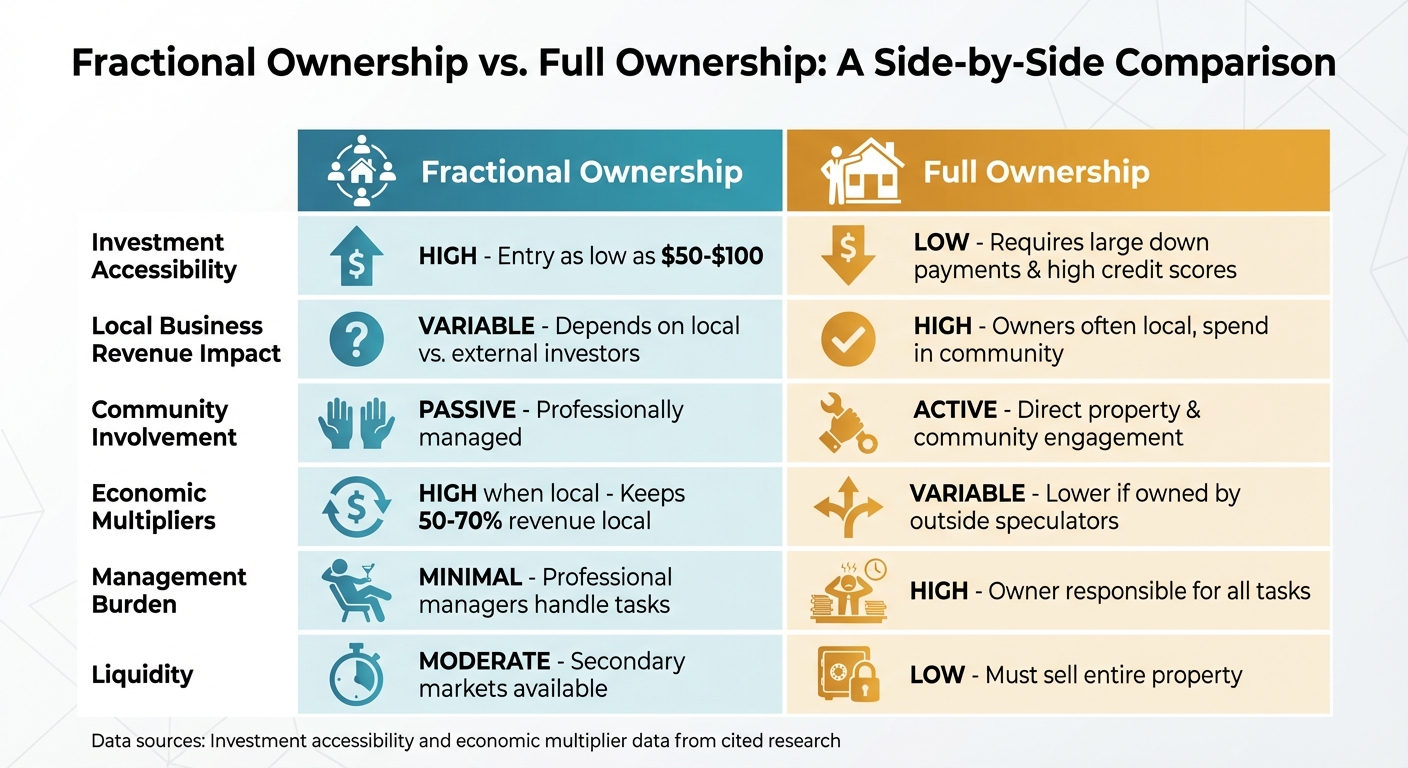
Comparison Table: Fractional Ownership vs. Full Ownership
To better understand how fractional ownership stacks up against traditional full ownership, here’s a quick comparison:
| Feature | Fractional Ownership | Full Ownership |
|---|---|---|
| Investment Accessibility | High; entry points as low as $50–$100 | Low; requires large down payments and high credit scores |
| Local Business Revenue Impact | Variable; depends on whether investors are local or external | High; owners are often local and spend within the community |
| Community Involvement | Passive; managed by professionals | Active; owners directly engage with the property and community |
| Economic Multipliers | High when residents are co-owners; keeps 50–70% of revenue local | Variable; often lower if owned by outside speculators or chains |
| Management Burden | Minimal; handled by professional managers | High; owners are responsible for all property-related tasks |
| Liquidity | Moderate; some platforms offer secondary markets | Low; requires listing and selling the entire property |
Future Trends in Fractional Ownership for Local Development
Technology Platforms Expanding Access
The world of fractional ownership is evolving quickly, thanks to blockchain and AI. By 2035, the global market for tokenized real estate is expected to hit $4 trillion, a massive leap from less than $0.3 trillion in 2024, with a projected annual growth rate of 27%. This rapid expansion is making real estate investment more accessible to everyday investors.
Blockchain technology plays a key role by converting physical properties into digital tokens, significantly cutting administrative costs. For instance, in December 2024, T-RIZE Group secured a $300 million deal to tokenize Project Champfleury, a 960-unit residential project in Canada, showcasing how blockchain can handle large-scale developments. Similarly, Kin Capital introduced a $100 million real estate debt fund on the Chintai blockchain, using "on-chain" agreements to streamline investor payouts.
On the other hand, AI tools are revolutionizing how fractional properties generate income. Today, over 70% of short-term rental operators rely on AI for tasks like dynamic pricing and automation. These tools analyze local events and competitor rates in real time, helping maximize occupancy and revenue - directly benefiting fractional investors. Platforms like Lofty are leading this charge, offering tokenized marketplaces on the Algorand blockchain that allow instant fractional trading.
Technology is also enabling more tailored investment options. Investors can now select properties based on factors like sustainability ratings or proximity to local infrastructure. This personalization allows people to align their portfolios with their values while supporting specific types of local development. As these advancements continue to refine the investment process, the focus is shifting toward investments that emphasize community impact and sustainability.
Growth in Community-Focused Investments
Investments with a focus on local impact and sustainability are becoming the norm rather than the exception. This trend aligns with the growing demand for sustainable initiatives. By 2025, 75% of global travelers are expected to prefer sustainable travel options, influencing how fractional ownership evolves.
One promising concept is inclusively owned commercial real estate (CRE), which aims to democratize wealth-building opportunities. Katherine Lucas McKay, Associate Director at the Aspen Institute, highlights the importance of this shift:
The lower half of the wealth distribution owns just 3 percent of the nation's total wealth. To flip this script, we need innovative ownership models that can provide all Americans with an on-ramp to wealth building.
This model opens the door for low- and middle-income investors to own commercial properties, ensuring that local residents benefit from property appreciation in their communities. The United States already has 15,000 community land trust units and approximately 614,000 housing units in housing cooperatives. These examples show that shared ownership can create stable, community-rooted opportunities.
At the same time, secondary markets for fractional shares are expanding. By 2025, major platforms are expected to offer full trading capabilities. This added liquidity will make it easier for local investors to join without worrying about being locked into long-term, illiquid assets - a crucial feature for individuals who may need quicker access to their funds compared to institutional investors.
What's Next for Fractional Ownership in Local Economies
The next wave of fractional ownership is turning its attention to underserved and emerging markets. Secondary and tertiary cities are becoming hotspots for investment. For example, Davenport, FL, saw a 707% increase in listings, driven by affordable entry points and its proximity to major attractions. Similarly, San Gabriel, CA experienced a 709% year-over-year surge in short-term rental listings, thanks to new rules allowing additional dwelling units. These smaller "Goldilocks" markets - offering high returns without oversaturation - are ripe for opportunity.
The tokenization of undeveloped and under-construction properties is another area poised for growth, with projections estimating a $50 billion market by 2035. This development allows fractional ownership to fund new projects, giving communities more say in what gets built in their neighborhoods. Digital platforms are already empowering investors with governance rights, enabling them to vote on decisions like property management, rental rates, and maintenance standards - directly influencing local property quality.
The Deloitte Center for Financial Services underscores the transformative potential of these advancements:
Disruptive technologies, such as asset tokenization, could transform real estate over the next few years.
For local economies, this transformation means more residents can take part in - and profit from - local development. Blockchain technology is also streamlining processes, reducing loan-level reporting time from 55 days to just 30 minutes and saving about $850 per $100,000 mortgage in administrative costs. These efficiency gains are lowering barriers to entry, making fractional ownership more accessible. The result? Local wealth stays within the community, and residents gain more control over shaping their economic future. These trends are setting the stage for a reimagined approach to local development through fractional ownership.
Conclusion
Economic Benefits at a Glance
Fractional ownership has the power to amplify local economic activity. When neighborhood residents own shares in nearby properties, the financial advantages stay within the community. This means more dollars spent at local businesses, more income for employees, and more opportunities for service providers - all contributing to a ripple effect of economic activity.
Another key benefit is how fractional ownership helps stabilize property values and reduces commercial vacancies. This, in turn, strengthens the local tax base, giving governments the resources they need to fund infrastructure and public services. It’s also a game-changer for households traditionally left out of the real estate market. As Katherine Lucas McKay from the Aspen Institute explains:
Asset ownership is a key milestone on the path to long-term financial well-being, yet many American households have been locked out of traditional ownership opportunities such as real estate.
Considering that the bottom half of U.S. households collectively own just 3% of the country’s wealth, fractional ownership provides a way to bridge this gap. It’s not just about individual financial growth - it’s about building stronger, more stable communities.
How to Start Investing in Real Estate
Investing in real estate has never been more accessible. Platforms like Lofty are breaking down the traditional barriers that kept everyday people out of the market. With a minimum investment of just $50, you can own a piece of rental properties across the U.S. through digital tokens. Forget about hefty down payments, complex paperwork, or hiring expensive brokers.
The process is simple: pick properties that match your investment goals, buy fractional shares, and start earning daily rental income. Professional property managers handle the day-to-day, making this a mostly hands-off way to invest. Plus, you can spread your investments across multiple properties and locations, which helps reduce risk while also supporting local economies. This low-cost, user-friendly model is reshaping how people approach real estate investment.
What’s Next for Fractional Ownership?
The future of fractional ownership looks bright, thanks to advancements in technology and a growing emphasis on community-focused investment. New platforms are making it easier than ever to select and manage properties, encouraging more people to participate in local real estate markets. This shift is helping neighborhoods thrive by keeping investment dollars circulating locally and giving more people the chance to build wealth through property ownership.
As these models continue to evolve, fractional ownership is poised to play an even bigger role in strengthening local economies and empowering individuals to take part in real estate opportunities that were once out of reach.
FAQs
How does fractional property ownership boost local economies?
Fractional property ownership introduces a new way for communities to attract investment by allowing multiple individuals to own shares in high-value assets, like rental properties, without requiring them to foot the entire bill. This influx of capital not only fuels local businesses but also creates jobs in areas like construction, property management, and maintenance. Plus, it boosts the need for services such as landscaping, cleaning, and hospitality.
By opening the door for more people to invest in real estate, fractional ownership ensures that economic benefits stay closer to home. Platforms like Lofty make it simple for U.S. investors to purchase shares in rental properties, offering immediate cash flow to property owners while generating steady rental income. This income supports local landlords, service providers, and nearby businesses, sparking a chain reaction that strengthens the community's economy.
What risks should I consider before investing in fractional ownership?
Fractional ownership makes real estate investment more accessible by lowering the upfront capital required, but it’s not without its challenges. One major drawback is the limited control you have over important decisions. Choices about renovations, rental policies, or even selling the property are often in the hands of co-owners or a management group, leaving you with little say. Disagreements among co-owners can further complicate matters, sometimes leading to delays or even legal battles.
Selling your fractional share can also be tricky. The secondary market for these shares is small, which means it might take longer to find a buyer - or you may have to settle for a lower price. On top of that, you’re exposed to typical real estate risks, like vacancies, unexpected repair costs, or fluctuations in the market that could reduce rental income or property value.
There are also additional costs to consider, such as management fees. If the ownership is tokenized, you might face regulatory hurdles or even cybersecurity concerns. Weighing these factors carefully is crucial before diving into fractional ownership.
How does Lofty distribute daily rental income to investors?
Lofty makes sure investors get their share of rental income every day. It collects rent from professionally managed properties and automatically distributes each investor's portion. This straightforward system provides consistent earnings and gives investors the freedom to reinvest their income however they choose.
Related Blog Posts

