
How Smart Contracts Cut Real Estate Costs
Jerry Chu
Smart contracts are transforming real estate by reducing costs and speeding up transactions. These blockchain-based digital agreements automate tasks like escrow, title verification, and fund transfers, eliminating the need for intermediaries. Here's what you need to know:
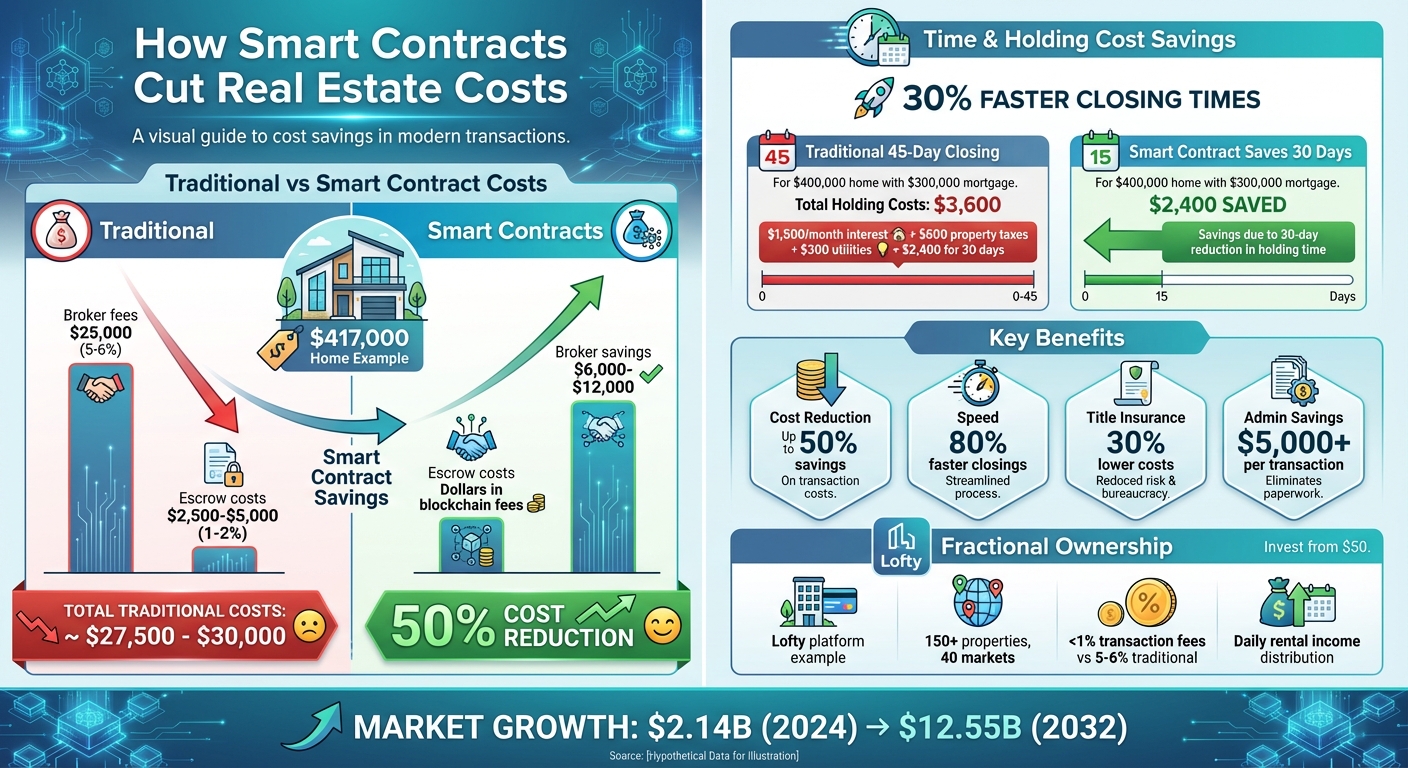
- Cost Savings: Smart contracts can cut transaction costs by up to 50%. For example, selling a $417,000 home could save $12,000 in broker fees and $2,500–$5,000 in escrow costs.
- Faster Transactions: Closing times are reduced by up to 30%, saving sellers thousands in holding costs like mortgage interest and property taxes.
- Fraud Prevention: Blockchain creates a tamper-proof record of ownership and transactions.
- Fractional Ownership: Platforms like Lofty let you invest in rental properties for as little as $50, with smart contracts managing ownership and daily rental income.
This technology is reshaping real estate by making transactions cheaper, faster, and more accessible for buyers, sellers, and investors.
Smart Contract Cost Savings in Real Estate Transactions
Can Smart Contracts Solve Real Estate’s Biggest Problems?
How Smart Contracts Remove Intermediary Fees
In the U.S., buying or selling real estate often involves several intermediaries, each taking their share of fees. Brokers, escrow agents, and banks all contribute to the growing costs of a transaction. Smart contracts, however, simplify this process by automating tasks that previously required manual oversight. This allows buyers and sellers to work directly, cutting out the need for hefty commissions. They also transform escrow services by managing funds and verifying conditions without human intervention.
Reducing Broker and Agent Fees
Selling a home in the U.S. typically means paying over $25,000 in brokerage fees on a property priced at $417,000. That’s about 5-6% of the sale price split between agents. With smart contracts, peer-to-peer transactions become possible, as blockchain technology takes over tasks like verifying property titles, confirming payments, and transferring ownership once pre-set conditions are met. This eliminates the broker’s role in negotiations and facilitation.
By automating these processes, smart contracts can save sellers between $6,000 and $12,000 per transaction. Platforms such as Lofty push this concept further, enabling investors to buy and sell fractional ownership of rental properties without traditional agents. For as little as $50, you can invest in rental properties across the U.S., earn daily rental income, and sell your shares instantly - all without paying expensive brokerage fees or dealing with lock-in periods.
Transforming Escrow Services
Escrow services for a $250,000 home typically cost $2,500 to $5,000, which accounts for 1-2% of the property’s value. These agents hold funds and release them only after verifying that all conditions are met, a process that takes time and incurs significant fees. Smart contracts replace this by locking funds in blockchain code, which automatically releases payment to the seller once conditions like title clearance are verified.
Here’s how it works: the buyer deposits funds, blockchain conditions are checked, and the payment is released to the seller along with an updated digital title. This reduces escrow costs to mere dollars in blockchain transaction fees. Additionally, funds are securely held from the start, lowering the risk of fraud, and the entire process is completed in minutes instead of days.
Cutting Legal and Administrative Costs
Closing a real estate deal in the U.S. often involves mountains of paperwork, legal reviews, and coordination between multiple parties - all of which add up to hefty closing costs. Smart contracts are changing the game by automating and digitizing many of these time-consuming legal and administrative tasks, significantly reducing expenses.
By standardizing processes and automating compliance, smart contracts simplify what used to require hours of attorney time and labor-intensive clerical work.
Using Standard Contract Templates
Smart contracts rely on pre-coded templates that include common clauses for payment terms, title transfers, and closing conditions. These templates are not only reusable but also verifiable on the blockchain. Key details like purchase price, dates, and contingencies can be adjusted without altering the underlying legal framework.
This approach can slash transaction costs by as much as 50% compared to traditional legal processes. For instance, automated lease agreements can handle rent payments and even integrate commercial terms, such as percentage rent tied to blockchain-recorded sales data. For multi-family housing, these contracts can enforce affordability requirements using unit-specific parameters, all executed instantly through code. According to Cornell's Baker Program in Real Estate, reducing reliance on brokers, bankers, and lawyers through smart contracts can save 2–3% of a deal's value - a meaningful reduction, especially given the high price of U.S. homes.
Automated Compliance Verification
Smart contracts also take the hassle out of compliance checks, which are often manual and time-intensive. With blockchain oracles pulling real-time data, these contracts can automatically verify zoning requirements, tenant eligibility, and lease restrictions. If issues like a title lien or unmet accreditation arise, the contract flags them immediately, cutting out the delays caused by human intervention.
The cost savings here are clear. Blockchain-based verification can lower title insurance expenses by up to 30%, thanks to permanent ownership records that reduce the need for manual title searches. In one property management example, staff saved $2,925 per month by reducing a repetitive administrative task from 4 hours to just 15 minutes per week using smart contracts. Beyond that, industry data shows that automating documentation, verification, and coordination tasks can save over $5,000 per transaction. Every step - whether it’s uploading documents, securing approvals, or transferring funds - is recorded on-chain, minimizing the need for manual audits and cutting regulatory review costs.
sbb-itb-a24235f
Faster Transactions and Lower Holding Costs
Closing on a home in the U.S. often drags on for weeks, bogged down by manual approvals and endless paperwork. Smart contracts, however, speed things up significantly by automating key steps like payment verification, title transfers, and escrow fund releases once all conditions are met.
This faster process isn’t just convenient - it saves money. Every extra day in the closing process adds to holding costs. Take, for example, a seller with a $400,000 home and a $300,000 mortgage at 6% annual interest. That’s about $1,500 a month in interest alone, plus $600 in property taxes and $300 for utilities and maintenance. Over a typical 45-day closing period, these costs can add up to $3,600. But if a smart contract system trims the timeline by 30 days, the seller could save around $2,400 in holding costs. And that’s before factoring in reduced administrative and escrow fees. This kind of efficiency makes near-instant property transfers a reality.
Faster Property Transfers
Smart contracts essentially function as automated escrow agents, holding and releasing funds only when specific conditions are fulfilled. Ownership records are updated on the blockchain almost instantly, sidestepping the need for repeated title searches and drawn-out filing processes that often slow down property transfers.
Studies on residential real estate transactions show that smart contract systems can slash closing times by as much as 80% compared to traditional methods. These systems work by triggering multiple actions - such as transferring funds, updating digital deeds, notifying registries, and sending confirmations - all at once during the closing process. This eliminates the sequential delays that typically plague conventional transactions.
Reducing Buyer and Seller Expenses
This streamlined process doesn’t just save time; it also cuts costs for both buyers and sellers. By shortening the closing period, sellers face fewer days of holding costs - like mortgage interest, property taxes, insurance, and maintenance - while buyers avoid overlapping expenses.
Fractional investors stand to gain even more from this model. Platforms like Lofty, for instance, use smart contracts to tokenize U.S. rental properties, allowing investors to buy and sell small ownership stakes almost instantly. As of December 2025, Lofty offers fractional trading in over 150 properties across 40 markets, with investments starting at just $50. This approach provides immediate liquidity, making real estate transactions as seamless as trading stocks. By eliminating traditional delays, smart contract platforms significantly reduce holding costs and make property transactions far more efficient.
How Lofty Uses Smart Contracts for Fractional Ownership

Simplified Fractional Ownership
Lofty has found a way to make real estate investment more accessible by using smart contracts to tokenize U.S. rental properties. Essentially, they divide properties into digital shares, allowing investors to buy in for as little as $50. For instance, a $300,000 rental property in Texas is split into 6,000 tokens, each priced at $50. This means investors can own as little as 0.1% of a property, with smart contracts ensuring that property appreciation is divided fairly among all token holders.
What makes this process even better is the cost savings. By automating verification, transfers, and compliance on the blockchain, Lofty keeps transaction fees below 3.5% per trade - a stark contrast to the 5–6% broker commissions you’d typically see in traditional real estate deals. On a mid-sized property, this could mean saving between $6,000 and $12,000. Currently, Lofty offers fractional ownership options across more than 150 properties in 40 different markets, with ownership transfers that take minutes instead of weeks. It’s like trading stocks - simple, fast, and efficient. Plus, this system ensures smooth income distribution for investors.
Daily Rental Income and Lower Fees
Lofty’s smart contracts don’t just simplify property ownership - they also make rental income management a breeze. The system automatically calculates each investor’s proportional share and distributes payments daily to blockchain wallets. No manual steps required. For example, if you own 10 tokens in a property generating $100 in daily rent, you’d receive $1 every day, starting the same day you invest.
This automation has real benefits. Similar platforms report 25% higher on-time payments thanks to automated rent collection. Investors also have the freedom to reinvest their earnings or sell their shares whenever they choose. With instant liquidity, daily cash flow, and much lower fees, Lofty opens the door for retail investors who might have been deterred by high costs and long transaction times. It’s a game-changer for fractional real estate investing.
Conclusion: Smart Contracts and the Future of Real Estate
Automation and transparency are changing the game for property transactions. Smart contracts are transforming how people in the U.S. buy, sell, and invest in real estate by automating key processes like escrow, title verification, rent collection, and compliance checks. These digital tools can cut transaction costs in half and shorten closing times by nearly one-third.
Beyond the initial savings, smart contracts simplify ongoing operations. By automating administrative tasks, they help reduce expenses, improve cash flow, and make property management more efficient.
Take platforms like Lofty as an example. They’ve introduced tokenized real estate, which eliminates the need for hefty down payments and reduces fees. With fractional ownership starting at just $50, Lofty breaks down traditional barriers, allowing investors to earn daily rental income automatically and trade shares instantly - making real estate investing feel more like stock trading.
The smart contract market is expected to grow from $2.14 billion in 2024 to $12.55 billion by 2032, pointing to a broader shift toward digital transactions in real estate, even as regulatory frameworks continue to evolve.
For both investors and homeowners, this technology represents a major step forward. By adopting smart contracts, you can enjoy faster, more cost-efficient, and transparent property transactions. As blockchain-based tools gain traction throughout the real estate industry, staying informed will position you to take advantage of the savings and opportunities they bring.
FAQs
How do smart contracts help lower costs in real estate transactions?
Smart contracts help trim costs in real estate by automating tasks that traditionally take up a lot of time and eliminating the need for intermediaries like brokers or escrow agents. This makes the entire process more efficient, reducing administrative fees and avoiding unnecessary delays.
They also make legal agreements easier to manage, which means less reliance on costly legal services. By enabling quicker and more secure transactions while cutting out middlemen, smart contracts save buyers and sellers both time and money.
How does blockchain help prevent fraud in real estate?
Blockchain technology plays a key role in reducing real estate fraud by providing secure, transparent, and unchangeable records of property ownership and transaction history. By ensuring that all data is verified and cannot be altered, it eliminates the risks associated with forged documents or duplicate property sales.
Every transaction on a blockchain is recorded permanently and can be easily traced. This makes it incredibly challenging for anyone to manipulate or falsify information. As a result, this added security not only helps prevent fraud but also builds trust and simplifies the entire process of buying and selling property.
How do smart contracts simplify fractional real estate ownership?
Smart contracts simplify fractional real estate ownership by automating transactions and enforcing ownership rules. With this approach, investors can digitally buy, sell, and manage shares of a property without relying on intermediaries, which helps cut down on costs.
This technology also speeds up transactions, enhances security, and ensures transparency for everyone involved. By using smart contracts, investing in fractional real estate across the U.S. becomes more accessible and efficient.
Related Blog Posts

