Lofty Editorial
Smart Contracts: Enforceability in Real Estate Deals
Smart contracts are transforming real estate transactions, but their enforceability in U.S. courts remains uncertain. These blockchain-based agreements automate tasks like ownership transfers and rent payments, but legal challenges arise when aligning them with property laws. Here’s what you need to know:
-
Types of Smart Contracts:
- Code-only: Fully automated, no human-readable text.
- Smart legal contracts: Combine code with traditional legal language for clarity.
-
Challenges:
- U.S. property law requires contracts to meet standards like offer, acceptance, and clear consent.
- Smart contracts must comply with the Statute of Frauds, requiring written terms and valid signatures.
- On-chain transactions don’t update county land records, so legal ownership must still be recorded traditionally.
-
Solutions:
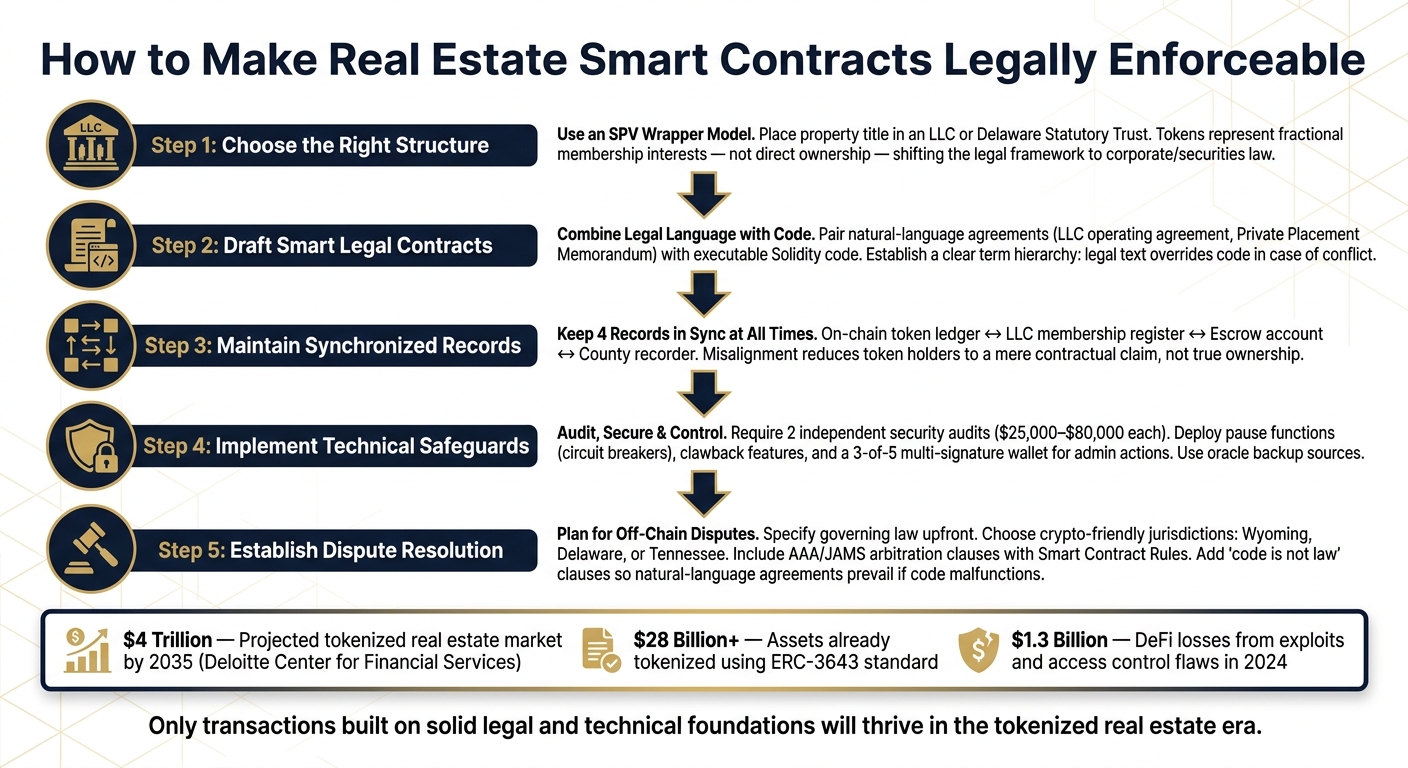
- Use SPV models (e.g., LLCs) to tokenize property ownership, shifting the legal framework to securities law.
- Ensure contracts include fallback mechanisms like natural-language agreements and dispute resolution clauses.
- Implement safeguards like multi-signature wallets, security audits, and pause functions to manage risks.
Smart contracts hold promise for efficiency, but aligning technical execution with legal frameworks is key to their success in real estate.
Smart Contracts Can Replace Real Estate Paperwork (Faster Than You Think)
sbb-itb-a24235f
Legal Challenges for Smart Contracts in Real Estate
Even when a smart contract operates flawlessly, it can still face legal hurdles in court. U.S. real estate law imposes strict standards, and blockchain technology alone can't yet meet all of them.
Contractual Validity and the Statute of Frauds
The Statute of Frauds (SoF) mandates that real estate contracts must be in writing and signed by the parties involved. Smart contracts, in theory, can meet these requirements. Solidity code qualifies as "writing" if the terms are clear, and private keys used in blockchain transactions can count as electronic signatures under the E‑SIGN Act and the Uniform Electronic Transactions Act (UETA).
Legal scholar Benjamin Van Adrichem explains:
"A smart contract can likely pass a statute of frauds inquiry because the use of private keys to authenticate is likely to satisfy signature requirements, and if the smart contract's terms are understood by the parties', it is irrelevant that it is coded."
However, satisfying the SoF is just the beginning. The contract must also accurately reflect the agreement between the parties. Beyond meeting legal standards, ensuring genuine user consent is another critical challenge.
User Consent in Digital Agreements
For a contract to hold up in court, both parties must clearly agree to its terms. This can be tricky with smart contracts because most users can't read Solidity code. Instead, they rely on the platform's user interface to understand the agreement. If the code executes in a way that deviates from what the interface described, courts might determine there was no true "meeting of the minds".
The way consent is obtained also matters. Clickwrap agreements, where users actively click "I Agree", are generally more enforceable than browsewrap agreements, where consent is implied through site use. The Ninth Circuit's decision in Patrick v. Running Warehouse emphasized that digital agreements are valid only if users receive clear and obvious disclosure of terms before taking action.
Traditional formalities like notarization also play a role by giving parties time to consider their decisions. Automated smart contracts, which can execute in seconds, may bypass these safeguards, leaving room for disputes over mistakes or unfair terms.
While consent is critical, ensuring that digital transactions align with traditional property recording systems is equally important.
Regulatory Limits on On-Chain Transfers
Even if consent and validity are addressed, transferring legal title through blockchain faces additional obstacles. U.S. property law does not currently recognize digital tokens as valid title transfers. No matter how advanced a smart contract is, moving a token on-chain doesn't update county land records, which is still required by law.
To work around this, SPV wrappers like LLCs are often used. In these setups, tokens represent membership interests in the LLC rather than direct property ownership. This shifts the legal framework from property law to securities law, meaning these transactions typically fall under SEC Regulation D and are limited to accredited investors - those with a net worth over $1 million or an annual income above $200,000.
Securities laws also mean on-chain transfers aren't as "instant" as they might seem. For example, the transfer of an LLC membership interest must be reflected in the entity's official records. If the blockchain and the platform's records don't match, a token holder might end up with only a contractual claim against the platform, not actual ownership of the property.
Some states, like Wyoming, Tennessee, and Arizona, have updated their laws to better accommodate digital assets. But even in these states, on-chain transfers work best when paired with proper legal entity structures - they can't fully replace traditional recording systems just yet.
How to Make Smart Contracts Enforceable in Real Estate
How to Make Real Estate Smart Contracts Legally Enforceable
Using Smart Legal Contracts
Smart legal contracts combine traditional natural-language agreements with executable code, creating a bridge between legal enforceability and automated execution. For instance, a written agreement like an LLC operating agreement or a Private Placement Memorandum outlines the legal rights of the parties involved. The accompanying code ensures those rights are executed automatically.
As DLx Law explains:
"Tokenization is not a single product design so much as a toolset for encoding enforceable rights on modern rails."
To make this system work, both the legal documentation and the executable code must align seamlessly. This requires careful documentation to ensure that the legal and digital records are always in sync.
Documentation and Term Hierarchy
Accurate and thorough documentation forms the backbone of any tokenized real estate transaction. A clear term hierarchy is crucial - this establishes that the natural-language agreement takes precedence over the smart contract code in case of any discrepancies. Without this safeguard, a coding error could unintentionally override the true intent of the parties.
Each transaction must also include a well-documented chain of credentials, such as deed history, LLC authority documents, KYC/AML reports, and accredited-investor attestations. This creates a robust audit trail. Legal Nodes emphasizes:
"Enforceability depends on the link between token ownership and the SPV's underlying rights; weak documentation can break that chain of title."
Additionally, four key records must remain synchronized at all times: the on-chain token ledger, the LLC membership register, the escrow account, and the county recorder. If these records fall out of sync, the token holder might be left with a mere contractual claim rather than actual ownership. Maintaining this alignment is essential when structuring ownership through SPVs (Special Purpose Vehicles).
Structuring Fractional Ownership Models
For fractional ownership models, clear documentation and term hierarchy are equally critical. The SPV wrapper model is emerging as the most reliable path to enforceability. In this model, an SPV - often an LLC or a Delaware Statutory Trust - holds the property deed. Tokens represent fractional membership interests in the SPV rather than direct ownership of the property. This shifts the legal framework from property law to corporate law, which is increasingly compatible with on-chain governance.
Platforms like Lofty already use the SPV wrapper model, allowing investors to purchase fractional interests in U.S. rental properties. Wyoming’s DAO LLC statute, enacted in July 2021, provides legal recognition for on-chain governance of such entities. The LLC’s operating agreement must explicitly address the token architecture, covering critical aspects like voting rights, transfer restrictions, and profit distributions. Without these provisions, the legal connection between the token and the underlying asset becomes tenuous.
Smart contracts in these models should also include clawback features - tools that allow authorized agents to freeze or recover tokens under specific conditions, such as a court order or a lost private key. These features ensure that the digital ledger can be adjusted to reflect legal realities, a requirement that is essential for attracting institutional investors.
Handling Disputes and Smart Contract Failures
Dispute Resolution Options
Smart contracts are great for automating execution, but they don’t come with built-in ways to handle disputes. The American Arbitration Association (AAA) explains:
"Blockchain systems generally lack built-in dispute resolution mechanisms, so conflicts are typically handled off-chain through arbitration, mediation, or litigation."
For real estate transactions, off-chain arbitration is often the most practical solution. Organizations like the AAA and JAMS now offer specialized "Smart Contract Rules" and arbitrators familiar with blockchain technology. When drafting agreements, it’s smart to specify governing law upfront. States like Wyoming, Delaware, and Tennessee are currently the most crypto-friendly jurisdictions in the U.S., making them solid choices for legal frameworks. Also, defining jurisdiction in advance can save significant time and money by avoiding disputes over which court has authority after a conflict arises. Once this is settled, the next hurdle is managing technical risks.
Allocating Risk for Bugs and Failures
The infamous 2016 DAO hack serves as a cautionary tale. A reentrancy bug enabled an attacker to siphon off $50 million from a $150 million Ether pool. The aftermath led to an Ethereum hard fork and shattered the belief that code alone could govern high-stakes transactions. Chanté Eliaszadeh of Astraea Counsel summed it up well:
"The 'code is law' fantasy died that day. When the stakes are high enough, human legal and social systems override code."
Fast forward to 2024, and the numbers are staggering: DeFi exploits and access control flaws caused over $1.3 billion in losses, with access control issues alone accounting for $953 million. To mitigate these risks, contracts should include "code is not law" clauses, making it clear that the natural-language agreement takes precedence if the smart contract malfunctions. Other safeguards include pause functions (or circuit breakers) that can immediately halt transactions in case of breaches or oracle failures. Additionally, requiring at least two independent security audits before deployment is critical, with costs typically ranging from $25,000 to $80,000.
Oracle risk is another major concern. Smart contracts rely on oracles for off-chain data, like rent payments or property appraisals. If an oracle provides inaccurate data, it could lead to incorrect payouts. To address this, contracts should specify backup data sources and clearly outline who is responsible if an oracle fails to validate information. These precautions, paired with strong dispute resolution mechanisms, create a more secure framework.
Governance and Upgrade Mechanisms
What happens when a smart contract has bugs? Fixing flawed contracts requires clear governance structures. Proxy upgrade patterns allow developers to patch issues without changing the contract address, but they must include strict controls over who has upgrade authority. Adding time-locks gives token holders the chance to review updates and exit if needed.
For administrative tasks like whitelisting investors or triggering clawbacks, a 3-of-5 multi-signature wallet is a practical standard. This setup ensures that no single party can unilaterally make changes to the contract. Companies like Lofty take it a step further by using DAO-style governance. Token holders vote on property-related decisions, with a 60% supermajority required for non-automated matters. All transactions rely on smart contracts audited by CertiK. This hybrid approach - automating routine tasks while reserving significant decisions for token-holder votes - shows where real estate governance is heading. Clear upgrade and governance processes make smart contracts more reliable and enforceable in real estate.
Conclusion: Key Steps to Enforce Real Estate Smart Contracts
The enforceability of smart contracts in real estate depends on aligning legal frameworks with technical execution. A token transfer only holds legal significance when the blockchain record aligns with the SPV's officially recognized shareholder register. As PSBP Law explains:
"The issuer's documents must treat the blockchain ledger as the definitive register of ownership with state law supporting that treatment."
This alignment is the foundation for integrating traditional legal systems with digital innovation.
The indirect tokenization model (SPV) - where an LLC holds the property title and tokens represent membership interests - works well within existing corporate and securities regulations. By adhering to these established laws, this approach provides courts with a familiar legal structure for resolving disputes. Opting for blockchain-friendly jurisdictions like Wyoming or Delaware further strengthens legal clarity.
Clear documentation is another essential piece of the puzzle. Linking tokens to legal agreements and using token standards like ERC-3643, which incorporates KYC/AML compliance, ensures enforceability. The popularity of this standard is growing, with over $28 billion in assets already tokenized using it.
On the technical side, risk management measures are equally critical. Features like security audits, multi-signature wallets, pause functions, and strong governance protocols can prevent costly legal issues. These safeguards help ensure that smart contracts perform reliably under scrutiny. With the Deloitte Center for Financial Services projecting tokenized real estate to hit $4 trillion by 2035, only transactions built on solid legal and technical foundations will thrive. Together, these measures provide the framework for smart contracts that can withstand both legal and operational challenges.
FAQs
Does moving a token on-chain legally transfer a property title in the U.S.?
No, moving a token on-chain does not legally transfer a property title in the U.S. Property title transfers are strictly regulated by state laws and require proper documentation to be filed with the county land recorder. Tokens generally represent ownership stakes in entities like LLCs or LPs that hold the property, rather than direct ownership of the real estate itself. While blockchain technology can track these ownership interests, it cannot bypass legal procedures or update official county records on its own.
How can a smart contract meet the Statute of Frauds and signature requirements?
To satisfy the Statute of Frauds and signature requirements, a smart contract must align with established contract law and electronic signature regulations, such as the E-SIGN Act and UETA. Electronic records and signatures hold legal validity when authenticated using unique cryptographic private keys and when there’s a clear intent to sign. To strengthen enforceability, pair the on-chain code with plain-language agreements that clearly outline all essential terms and identify the parties involved.
What happens if the smart contract code conflicts with the written agreement?
If there's a conflict between smart contract code and a written agreement, courts generally lean toward prioritizing the original intent of the parties rather than strictly adhering to the automated code. While the idea that "code is law" has its advocates, traditional contract principles tend to hold more weight in legal settings. To minimize potential disputes, parties should explicitly specify which version - code or written agreement - takes precedence. A practical approach is to use hybrid structures, blending plain-language contracts with the smart contract code. This helps ensure both mutual understanding and legal clarity.
Lofty Editorial