Lofty Editorial
Public-Private Partnerships for Affordable Housing
Public-private partnerships (P3s) are reshaping affordable housing in the U.S. by combining government resources with private sector efficiency. With millions of families struggling to afford housing, these partnerships provide a practical way to address the crisis. Here’s what you need to know:
- The Problem: Over 4.8 million U.S. households earning less than 80% of the area median income (AMI) spend over 30% of their income on rent without assistance. Affordable housing supply remains insufficient despite programs like the Low-Income Housing Tax Credit (LIHTC), which has created over 3 million units since 1986.
- How P3s Work: Governments provide land, tax incentives, and subsidies, while private entities handle financing, construction, and management. Models like Build-Operate-Transfer (BOT) and Hybrid Annuity Model (HAM) help structure these collaborations.
- Financing Tools: Mechanisms like Viability Gap Funding (VGF), revolving funds, and tax credits make projects feasible. For example, Chicago’s $1.25 billion bond initiative supports affordable housing via a revolving fund.
- Affordability Safeguards: Legal measures such as deed restrictions, affordability covenants, and partial government ownership ensure long-term affordability.
- Case Studies: Cities like Boston, Los Angeles, and Detroit are using P3s to convert market-rate properties, expand affordable housing supply, and protect vulnerable communities from displacement.
While P3s offer solutions, challenges like political shifts, project complexity, and long-term oversight remain. However, with proper planning and safeguards, these partnerships can create lasting change in affordable housing.
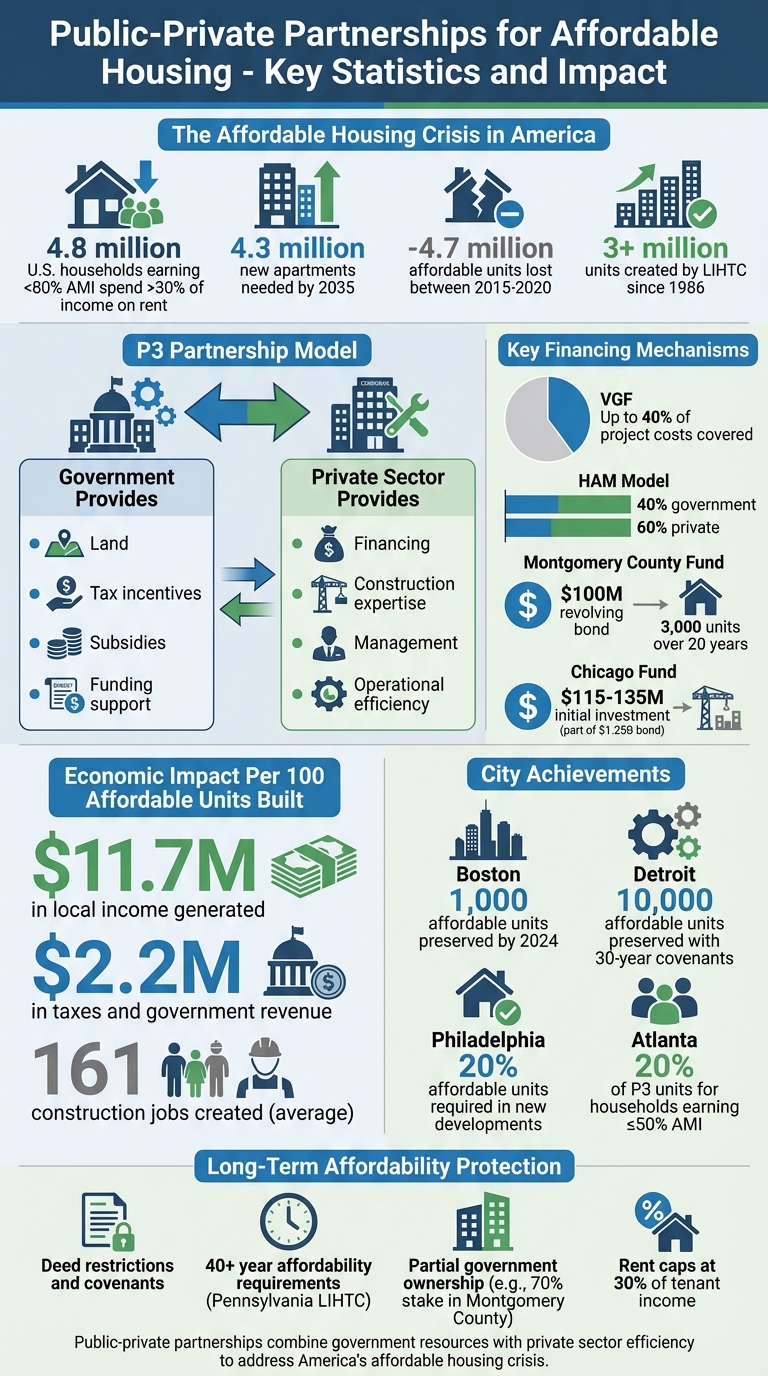
Public-Private Partnerships for Affordable Housing: Key Statistics and Impact
How Public-Private Partnerships Function
Structures and Financing Methods
Public-private partnerships (P3s) bring together the strengths of both public and private sectors to achieve goals that neither could accomplish alone. Government entities contribute land, tax incentives, and subsidies, while private partners provide funding and construction expertise. This collaboration allows for the execution of large-scale projects that might otherwise be out of reach.
Different organizational models shape how these partnerships operate. For instance, the Build-Operate-Transfer (BOT) model involves private companies designing, financing, and managing a facility for a set period before handing it over to the government. Another approach, the Hybrid Annuity Model (HAM), divides costs so that the government covers roughly 40% during construction, while private developers handle the remaining 60%. Additionally, joint ventures among private companies, local businesses, and municipal housing authorities distribute risks and pool resources effectively.
Financing methods vary based on the project’s needs. One popular mechanism is Viability Gap Funding (VGF), which covers up to 40% of project costs to make otherwise unprofitable projects feasible. Some local governments have adopted revolving funds to sustain housing initiatives. For example, Montgomery County’s Housing Production Fund operates with a $100 million revolving bond model, aiming to create around 3,000 housing units over two decades. Similarly, Chicago’s Green Social Housing Revolving Fund launched with an initial investment between $115 million and $135 million as part of a larger $1.25 billion bond issuance. These revolving funds recycle loan repayments into future developments, ensuring a continuous funding cycle.
The economic impact of such projects is substantial. For every 100 affordable rental homes built, approximately $11.7 million in local income, $2.2 million in taxes and local government revenue, and an average of 161 construction jobs are generated. John Williams, President, CIO, and COO at Avanath Capital Management, highlights the broad appeal of these partnerships:
Public-private partnerships are a strategy that can benefit a wide range of stakeholders - including investors, developers, institutional owners, operators, property managers, service providers and leaders in nonprofit and government entities.
These financing and structural models lay the groundwork for incorporating long-term affordability measures into housing projects.
Ensuring Affordability Requirements
P3 agreements often include legal provisions to ensure housing remains affordable over time. Tools like deed restrictions and affordability covenants are commonly used to prevent properties from transitioning to market-rate housing in the future. Another strategy, cross-subsidization, balances costs by using market-rate rents to offset the expenses of affordable units within the same development.
In many cases, government agencies maintain partial ownership to safeguard affordability. For example, in Montgomery County, the Housing Opportunities Commission holds a 70% ownership stake in "The Laureate", a 250-unit mixed-income development near the Shady Grove metro station. Similarly, Atlanta’s Urban Development Corporation mandates that 20% of units in P3 projects remain affordable to households earning 50% or less of the Area Median Income (AMI). Detroit’s Inclusionary Housing Ordinance requires that 20% of units in new developments on city-owned land be designated as affordable. These legally binding affordability measures ensure that housing projects meet community needs, regardless of changes in ownership or market conditions.
Case Studies: P3s Addressing Housing Needs
Boston Market-Rate Conversion Project
In March 2025, the City of Boston teamed up with Related Affordable to transform 347 Fairlawn Estates apartments into affordable housing. Originally rebranded as "SoMa at the T" in 2018 - following the addition of a commuter rail stop - the complex saw sharp rent hikes and evictions over six years, leaving tenants in a precarious position.
To address this, the city allocated $10 million from American Rescue Plan Act (ARPA) funds, private investments, and a $1 million loan from the Boston Acquisition Fund to purchase the property and ensure its long-term affordability. Related Affordable contributed an additional $6.4 million for immediate improvements, such as roof repairs, balcony upgrades, and energy efficiency measures. Strict affordability guidelines were also set: half the units reserved for households earning 60% of the Area Median Income (AMI) and the other half for those earning 80%, with annual rent increases capped at 2%.
"The constant stress of facing huge rent increases and eviction weighed on us every day over the past six years, and it wasn't right - but we want people to know that housing is a human right and we can win the homes we deserve."
- Betty Lewis, Fairlawn Tenant Association
By late 2024, Boston's Acquisition Opportunity Program had preserved 1,000 affordable units across the city through similar efforts. This initiative highlights how public-private partnerships can shield vulnerable communities from displacement.
Other cities are also embracing creative approaches to tackle housing challenges.
Los Angeles Baldwin Village Project
Los Angeles has taken a coordinated approach to affordable housing through its Affordable Housing Managed Pipeline (AHMP). This program integrates public and private investments, utilizing 9% Low-Income Housing Tax Credits (LIHTC) allocated by the California Tax Credit Allocation Committee. It also combines Federal HOME funds and Community Development Block Grants to maximize resources. By pooling public funding with private efficiency, Los Angeles demonstrates how partnerships can expand the supply of affordable housing.
While Los Angeles focuses on targeted tax incentives, Detroit has streamlined its processes to encourage mixed-income developments.
Detroit Mixed-Income Housing Development
Detroit’s strategy revolves around its Inclusionary Housing Ordinance, which mandates that 20% of units in developments on city-owned land remain affordable for households earning 50% or less of the Area Median Income (AMI). To speed up development, the city introduced a Payment In Lieu of Taxes (PILOT) program, replacing traditional property taxes with predictable fees. This approach reduces administrative delays and lowers operating costs for developers.
The Detroit Housing for the Future Fund (DHFF) supports these efforts with $58 million in philanthropic funding for low-cost loans and predevelopment grants. Additionally, the city's $250 million Affordable Housing Leverage Fund helps close financing gaps. By 2023, Detroit had achieved its target of preserving 10,000 affordable units, all secured with 30-year covenants that cap rents at 30% of tenant income. These measures ensure long-term affordability and stability.
"Our most fundamental mission as a city is to make sure that the Detroiters who stayed during the tough times aren't pushed out as the city comes back."
- Mayor Mike Duggan
Benefits and Drawbacks of P3s
Comparing P3 Benefits and Drawbacks
Public-private partnerships (P3s) offer notable advantages in the development of affordable housing. Programs like the Low-Income Housing Tax Credit (LIHTC) have played a significant role in increasing the national supply of affordable housing. These partnerships draw in private investment, transfer certain risks to developers, and often speed up project timelines. However, these benefits come with challenges that can’t be overlooked.
The complexity of P3s demands extensive oversight, specialized legal knowledge, and substantial management resources. Political changes can disrupt projects mid-way, and conflicts may arise between broader urban development goals and the specific needs of local neighborhoods. Moreover, financial risks remain, even with private sector involvement. For instance, when the SH 130 Concession Company filed for Chapter 11 bankruptcy in 2016 after its $1.3 billion toll road project failed to meet traffic projections, the federal government had to exchange its $430 million loan for a 34% equity stake in the reorganized company.
"Transferring these and other risks to the private sector is not necessarily a money saver, as the private partner requires compensation for assuming them."
- William J. Mallett, Specialist in Transportation Policy
Methods for Maintaining Effectiveness
The long-term success of P3s depends on solid affordability safeguards. For example, LIHTC developments in Pennsylvania are required to remain affordable for at least 40 years. These deed restrictions help ensure that properties don’t revert to market-rate prices after initial subsidies end, addressing some of the risks tied to these partnerships.
Community engagement and inclusive oversight are also crucial to balancing competing priorities. A HUD study of 50 communities identified six key factors for success: clear identification of needs, strong leadership, diverse board representation, accessible funding, realistic program goals, and efficient use of resources. Philadelphia’s 2021 inclusionary zoning ordinance is one example of this approach. It mandates that 20% of new residential units be affordable, while offering alternatives like off-site construction within a half-mile radius or contributions to a housing trust fund. Additionally, well-drafted contracts, strict enforcement of protections for voucher holders, and consistent political support across administrations help ensure that P3s deliver lasting solutions rather than short-term fixes.
sbb-itb-a24235f
Fractional Real Estate Investment Platforms
Lofty: Fractional Ownership for Housing Investment

Fractional real estate platforms are breaking down the barriers that once kept many people from investing in rental properties. Gone are the days when hefty down payments and high credit scores were the price of entry. Now, with as little as $10 to $100, individuals can purchase shares of income-generating properties. This shift makes real estate investment more accessible, allowing everyday Americans to build diversified portfolios without needing significant capital.
Lofty is a standout example of this approach. Acting as a fractional real estate marketplace, Lofty enables investors to buy tokenized shares of U.S. rental properties. Investors earn daily rental income based on their ownership percentage and can also benefit from long-term property appreciation.
Here’s how it works: properties are held by Special Purpose Vehicles (SPVs), usually structured as Limited Liability Companies (LLCs). Instead of owning the property outright, investors own shares in the LLC. This setup ensures clear ownership rights while allowing flexibility to buy and sell shares. Some platforms are even working on secondary markets, anticipated to launch in 2025, which would offer more liquidity than traditional real estate investments.
"Fractional real estate investing transforms investment into a tool for equitable housing." - Realbricks
In 2025, average annual returns reported across platforms ranged from 10% to 18.60%. These returns come from a mix of rental income and property appreciation. Unlike publicly traded REITs, fractional ownership in private real estate assets tends to be less affected by market volatility. This stability has caught the attention of Millennial and Gen Z investors, who are drawn to this approach as a way to build wealth sustainably - without the headaches of traditional property management. Beyond individual benefits, this model also plays a role in supporting affordable and sustainable housing initiatives.
Technical Deep Dive on Public-Private Partnerships for Affordable Housing
Conclusion: P3s and the Future of Affordable Housing
Public-private partnerships (P3s) are emerging as a vital approach to tackling America’s housing crisis. The numbers paint a stark picture: by 2035, the U.S. will need 4.3 million new apartments to meet demand, while affordable housing stock dropped by 4.7 million units between 2015 and 2020. Clearly, neither the public sector nor private developers can address this issue on their own.
As the U.S. Department of Housing and Urban Development explains:
"Partnerships between local governments and the private sector - both the business sector and community-based non-profit housing providers - can help communities develop affordable housing by bringing additional resources and skills to the development process."
For P3s to succeed, certain elements are essential: a clear understanding of community needs, diverse and capable leadership, consistent funding sources, and achievable goals. However, challenges like political shifts and the complexity of long-term affordability can threaten their success. To navigate these obstacles, partnerships should prioritize establishing independent leadership and diverse boards that can sustain progress, even during periods of political change. Strengthening non-profit housing providers to handle the intricacies of affordability requirements is equally critical. By blending public funding with private-sector innovation, P3s can create lasting solutions for affordable housing.
Another key factor in maximizing the impact of P3s is adopting creative financing strategies. Tools like ARPA funds and tax-exempt bonds help bridge the financial gap between development costs and affordable rent levels. Additionally, the move toward permanent affordability - through mechanisms like 99-year ground leases and active public ownership - represents a significant shift away from short-term fixes that have historically fallen short of addressing the deeper causes of housing shortages.
This approach not only addresses immediate housing needs but also lays the groundwork for long-term solutions. By combining resources, expertise, and innovative strategies, P3s can play a pivotal role in reshaping the future of affordable housing in the U.S.
FAQs
How do public-private partnerships help maintain affordable housing over the long term?
Public-private partnerships (PPPs) bring together government resources - such as land, low-interest loans, and subsidies - with the private sector's expertise in construction and management. These partnerships often include affordability requirements to make sure housing remains within reach for low- and moderate-income households for years to come. Tools like rent limits based on a percentage of the area median income or long-term ground leases help maintain affordability while offering private developers a steady revenue stream.
Several factors are crucial for ensuring long-term affordability: clearly identifying housing needs, strong leadership, dependable public funding, and consistent enforcement of affordability agreements. Programs like the HOME Investment Partnerships Program play a key role in extending affordability periods and adding tenant protections, ensuring that housing developed through PPPs fulfills its purpose without quickly reverting to higher market rates.
What challenges do public-private partnerships face in creating affordable housing?
Public-private partnerships (PPPs) in affordable housing face a variety of obstacles. One of the biggest challenges is aligning the goals of diverse stakeholders. Development priorities from private investors and government agencies might clash with what communities actually need. On top of that, political changes, like shifts in leadership, can disrupt ongoing projects or redirect focus to other areas. And then there’s funding - securing reliable financing often means navigating a maze of complex and temporary subsidy programs.
Another issue is coordination. When multiple players - government agencies, nonprofits, and private investors - are involved, unclear roles and responsibilities can lead to bureaucratic delays. There’s also a constant push-and-pull between addressing immediate housing shortages and planning for long-term, sustainable solutions.
The most effective PPPs tackle these challenges by emphasizing clear communication, consistent leadership, and creative funding strategies. For instance, tools like fractional real estate platforms are opening up new ways to attract flexible capital. These platforms not only expand investment opportunities but also help ensure projects align with public objectives, making affordable housing more achievable.
How do tools like Viability Gap Funding and revolving funds help make affordable housing projects possible?
Financing mechanisms like Viability Gap Funding (VGF) and revolving loan funds play a crucial role in making affordable housing projects financially viable. Here's how they work:
Viability Gap Funding (VGF) provides one-time grants to bridge the financial gap between the high costs of construction and the limited income generated from affordable rents. By covering this shortfall, VGF helps reduce the debt burden for developers. This ensures they can meet affordability requirements without raising rents or relying heavily on subsidies.
Revolving loan funds operate differently but are equally impactful. These funds create a renewable pool of capital. Developers can borrow from the fund to cover costs like construction or property acquisition. As loans are repaid, the money is reinvested into new projects, effectively stretching every dollar further. When paired with other public funding sources, this approach significantly increases the number of affordable housing units that can be developed.
Together, these tools help lower costs, encourage development in areas with the greatest need, and expand housing opportunities for low-income families.
Lofty Editorial