Lofty Editorial
How Smart Contracts Secure Real Estate Tokens
Smart contracts secure real estate tokens by enforcing the rules automatically. I’m talking about investor checks, transfer limits, ownership records, rent payouts, voting, and recovery steps if something goes wrong.
Here’s the short version:
- They block bad transfers before they settle by checking if a wallet is approved.
- They keep one on-chain ownership record so transfers and payouts match.
- They automate rent distributions based on token balances, which cuts payment mistakes.
- They enforce legal and compliance rules like lockups, holder limits, and jurisdiction checks.
- They reduce admin risk with tools like multi-signature wallets, audits, and pause functions.
- They still need off-chain control because code, keys, legal terms, and data feeds can all fail.
That matters because weak smart contract access controls led to $953 million in crypto losses in 2024. In tokenized real estate, a coding error can affect ownership, cash flow, and voting at the same time.
If I strip the article down to its core idea, it’s this: smart contracts help keep tokenized property records, transfers, and payouts in line with the deal terms - but only if the code, legal setup, and admin controls match from day one.
Quick comparison
| Area | What the smart contract does | Main risk if weak |
|---|---|---|
| Ownership | Records token holdings on-chain | Wrong holder records |
| Compliance | Checks wallet eligibility before transfer | Transfers to blocked or unverified wallets |
| Payouts | Splits rent by token balance | Payment errors |
| Governance | Enforces vote timing and approval rules | Bad or disputed voting results |
| Admin control | Limits sensitive actions with multisig | One key controls too much |
| Recovery | Supports forced transfers or court actions if allowed | Lost access with no recovery path |
I’d read the rest of the piece as a simple framework: set the legal rights first, code the rules second, test the contract hard, and keep watching the system after launch.
Core Security Controls Built Into Smart Contracts
Automation, Immutability, and a Shared Ledger
Once deployed, a smart contract applies preset rules automatically. Its records stay permanent, and its code changes only through approved upgrade paths. That mix cuts down on manual interference and helps keep the ownership record from being changed outside authorized processes.
Every ownership transfer and distribution is recorded on-chain in real time, which creates one auditable ledger that approved parties can use with confidence. For tokenized property, that means ownership and payout records stay in sync in the same ledger. The same controls also decide who can buy real estate with cryptocurrency, transfer tokens, and receive payouts.
Access Control, Investor Checks, and Transfer Restrictions
Smart contracts can screen transactions before they happen. Standards like ERC-3643 use an on-chain Identity Registry to confirm that both the sender and receiver meet eligibility rules before a transfer goes through. That includes approved investors, restricted jurisdictions, and token transfer eligibility. If a recipient is not approved, the transaction is rejected automatically.
The contract can also apply role-based permissions and transfer limits, such as holder caps and jurisdiction rules. Admin keys should be protected with multi-signature wallets. For example, a 3-of-5 setup means no single person can control critical actions alone. In plain English, the contract stops bad transfers before they ever hit the ledger.
Unsecured Custom Code vs. Audited Frameworks
Custom real estate token code comes with risk. It can bring logic errors and uneven access controls that audited frameworks are built to avoid. Audited standards such as ERC-3643 cut coding risk, make review easier, and include compliance hooks for regulated token transfers and investor checks. With custom code, teams have to build all of that from scratch.
That matters because access control flaws alone caused $953 million in losses across the blockchain sector in 2024.
Next, those controls have to be built into the contract's ownership and payout logic.
sbb-itb-a24235f
How to Set Up a Secure Real Estate Token Contract
Define the Property, Legal Entity, and Token Holder Rights
Start with the legal entity. That comes first because the contract can only enforce the rights the entity sets up.
For U.S. properties, the standard setup is a Delaware Series LLC or a Limited Partnership (LP). The entity holds title. The tokens represent economic rights in that entity, not direct ownership of the building itself.
The contract should spell out the property address, acquisition price, latest valuation, and monthly rent. Then comes a big choice: what does each token represent?
It could represent:
- An equity share in the LLC
- A debt position
- A pro-rata right to net rental income
That choice affects every compliance rule that comes next. It’s not a small detail. It shapes transfer rules, payouts, and what holders can claim. You’ll also want to confirm early that the issuing state recognizes controllable electronic records.
Those legal decisions set the boundaries for what the contract can allow, block, or recover.
Design Ownership Logic and Secure Transaction Flows
Before launch, turn the legal setup into clear on-chain rules.
For U.S. offerings, the securities exemption decides who can hold the tokens and how transfers work. Each exemption sets limits on who can receive transfers and when those transfers are allowed:
| Exemption | Target Audience | Raise Limit | General Solicitation |
|---|---|---|---|
| Reg D 506(c) | Accredited only | Unlimited | Permitted |
| Reg D 506(b) | Accredited + 35 non-accredited | Unlimited | Prohibited |
| Reg A+ | Retail & Accredited | $75M / year | Permitted |
| Reg CF | Retail & Accredited | $5M / year | Permitted via portal |
Put transfer limits, lockups, and recovery rules straight into the contract. Do the same for voting rights and recovery actions before launch.
This is where a lot of teams trip up. If the paperwork says one thing and the contract allows another, you’ve got a problem waiting to happen.
Harden the Code Before Launch
Using an audited standard like ERC-3643 instead of custom code cuts risk from day one, much like choosing the best real estate investing software to manage your portfolio.
Testing should cover common attack paths, including reentrancy bugs, weak access controls, and logic mistakes in distribution or transfer functions. After internal testing, bring in an independent audit. For high-value contracts, add formal verification.
Admin functions matter just as much as transfer logic. Whitelisting, clawbacks, and contract upgrades should sit behind a multi-signature wallet before deployment.
Once the contract is live, those rules should continue across issuance, transfers, payouts, and governance.
How to Build a Real Estate Tokenization Platform in 2026 | Future of Real Estate
How Smart Contracts Protect Each Stage of the Investment Lifecycle
Smart Contract vs. Manual Real Estate Token Management: Security & Efficiency Compared
Property Onboarding, Token Issuance, and Investor Eligibility
Once the contract goes live, it locks the property record in place. That helps block unauthorized edits after deployment.
The LLC operating agreement is then tied to the contract with a cryptographic hash. If someone tries to alter the agreement later, that change is easy to spot. In plain English, the legal paperwork and the on-chain record stay synced throughout the investment.
The same rule-based setup also controls who can receive income and voting rights. At issuance, eligibility checks stop unverified wallets from receiving tokens. And that standard shouldn't stop there. Tokens should never land in an unverified wallet, whether at issuance or during a later transfer.
Rent Distributions and Governance Decisions
When rent comes in, the distribution contract checks each holder's current token balance and calculates that investor's share automatically. Payments can go out in stablecoins like USDC, with each payout split by token balance. That cuts down on routing mistakes and unauthorized payouts. Lofty uses this model to pay fractional property owners daily.
Governance follows the same logic. For major decisions like refinancing or approving a property sale, the contract enforces vote windows, quorum, and approval thresholds before anything can happen. That matters because every vote and every payout sits on the same ownership record.
Manual Distributions vs. Smart Contract Distributions
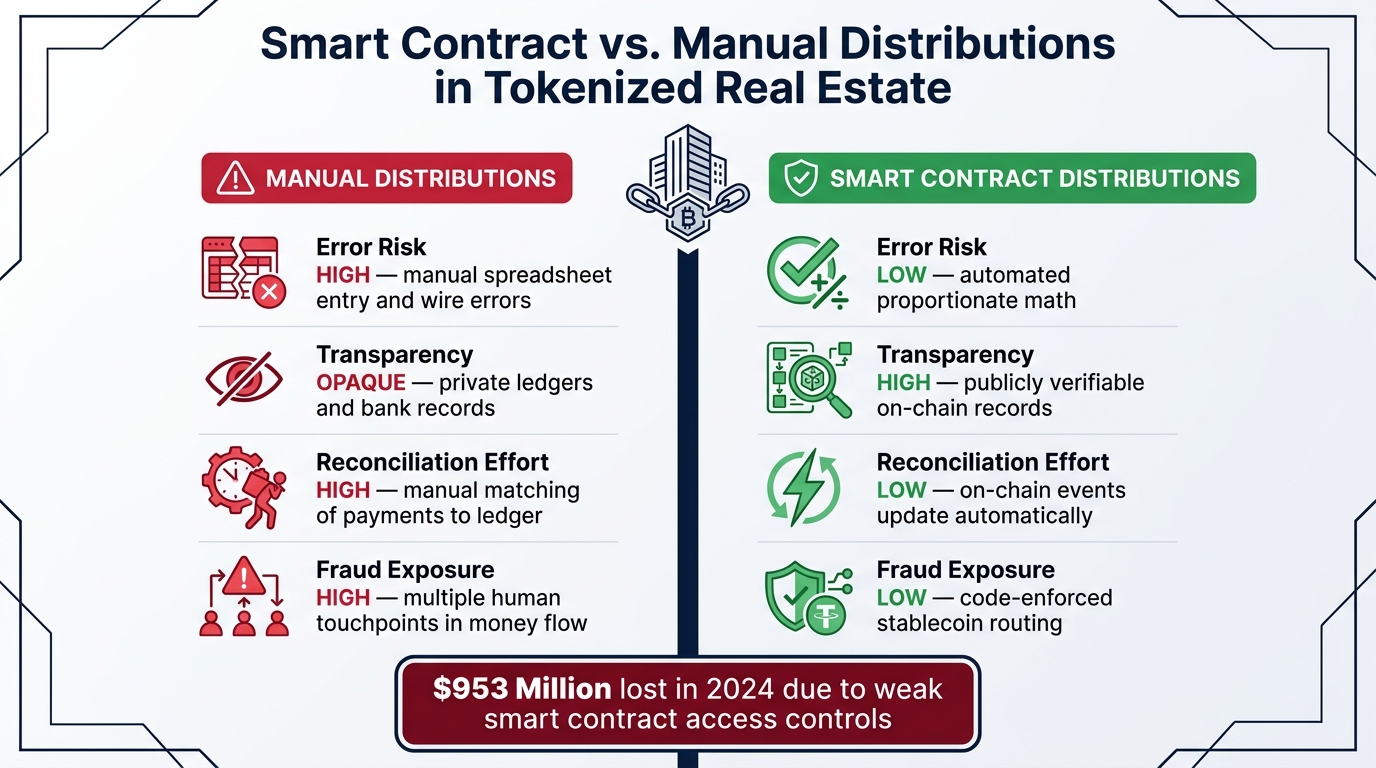
The gap between manual and automated distributions gets much clearer as the number of fractional owners increases.
| Feature | Manual Distributions | Smart Contract Distributions |
|---|---|---|
| Error Risk | High - manual spreadsheet entry and wire errors | Low - automated proportionate math |
| Transparency | Opaque - private ledgers and bank records | High - publicly verifiable on-chain records |
| Reconciliation Effort | High - manual matching of payments to ledger | Low - on-chain events update automatically |
| Fraud Exposure | High - multiple human touchpoints in money flow | Low - code-enforced stablecoin routing |
Smart contracts can stop ineligible transfers before settlement. That means less cleanup later, fewer disputes, and a much cleaner audit trail.
Risk Management, Lofty, and Key Takeaways
Managing Technical, Operational, and Legal Risks
Once a contract goes live, the job shifts from deployment to risk management. At that point, security depends on how the system is watched, maintained, and updated across three areas: technical, operational, and legal.
On the technical side, live code still needs close monitoring. Re-audits should happen whenever code is upgraded or when compliance rules change. It also helps to build an emergency pause function in from day one. And if you use proxy upgrade patterns, bugs can be fixed without forcing a new token migration.
Code is only part of the picture. A secure token system also depends on key management, data feeds, and recovery procedures. Multisig helps stop one stolen or compromised key from taking over the whole system. Oracle data should come from multiple independent feeds, not just one source. And there should be recovery paths for lost keys and court-ordered transfers.
There’s also the legal side. Contract logic can drift out of step with new rules over time. That’s why compliance rules should stay modular, so a jurisdiction update doesn’t force a full redeploy.
Common Risks and the Controls That Reduce Them
| Threat Category | Specific Risk | Control |
|---|---|---|
| Code Vulnerabilities | Reentrancy attacks, logic errors | Third-party audits; proxy upgrade patterns |
| Regulatory Change | New laws invalidate existing code | Modular compliance layers; parameterized rules |
| Operational Error | Lost or stolen admin keys | Multisig wallets; automated distribution logic |
| Key Loss | Investor loses private key | Forced transfer function; custodial recovery options |
| Oracle Manipulation | Bad rent or valuation data fed on-chain | Decentralized oracle networks; time-weighted pricing |
| Fraud | Counterfeit property tokens | Platform-issued Verification NFTs; public ledger transparency |
How Lofty Applies This Model and What to Remember
Lofty shows what this looks like in practice. Lofty runs smart contracts audited by CertiK on the Algorand blockchain, and every trade is gated by a non-transferable Verification NFT. No verified identity, no executed transaction. Rent distributions are sent daily in stablecoins, and token holders vote on property-level decisions through the platform.
The big idea is simple: smart contracts can automate a lot of the security work, but that doesn’t mean the system runs on autopilot. Audits, multisig, and verified data are what help keep the setup dependable. Smart contracts can secure tokenized real estate by enforcing rules on-chain, but they still need disciplined operations off-chain.
FAQs
Can smart contracts prevent all real estate token risks?
No. Smart contracts can't prevent every real estate token risk.
Risk can still come from smart contract flaws, oracle failures, and regulatory mismatches. That's why careful auditing and strong operational security measures are still needed.
What happens if an investor loses access to their wallet?
If an investor loses access to their wallet, a smart contract may not be able to manage or recover those tokens.
Lost or stolen wallet keys can also create key management risks. That can make the contract harder to manage, or leave it more open to misuse. In some cases, authorized agents may need to freeze or recover tokens through tools like clawback.
How do smart contracts match legal ownership rights?
Smart contracts can support legal ownership rights in a few practical ways. They keep a real-time record of token holders, enforce transfer restrictions, and help maintain compliance with U.S. jurisdictional and regulatory rules.
That said, under current U.S. property law, traditional deeds still serve as the legal proof of ownership.
Lofty Editorial