Lofty Editorial
How Fractional Ownership Generates Rental Income
Fractional ownership allows you to invest in real estate by purchasing small shares of rental properties, making it more accessible and affordable compared to buying an entire property. You earn a share of rental income and property appreciation based on your ownership percentage, while professional property managers handle operations like tenant management and maintenance. Here's what you need to know:
- Low Entry Costs: Start investing with as little as $50 or $100.
- Passive Income: Rental income is distributed automatically, often daily.
- Shared Expenses: Costs like maintenance and taxes are split proportionally.
- Diversification: Spread investments across multiple properties to reduce risk.
- Tax Benefits: Enjoy deductions like depreciation and long-term capital gains.
Platforms like Lofty make this process easy by managing property operations, offering liquidity through share resale, and providing tools to track income and property performance. Fractional ownership can help you build wealth through steady rental income and property value growth.
Is Fractional Ownership the Future of Real Estate? #podcast
How Fractional Ownership Generates Rental Income
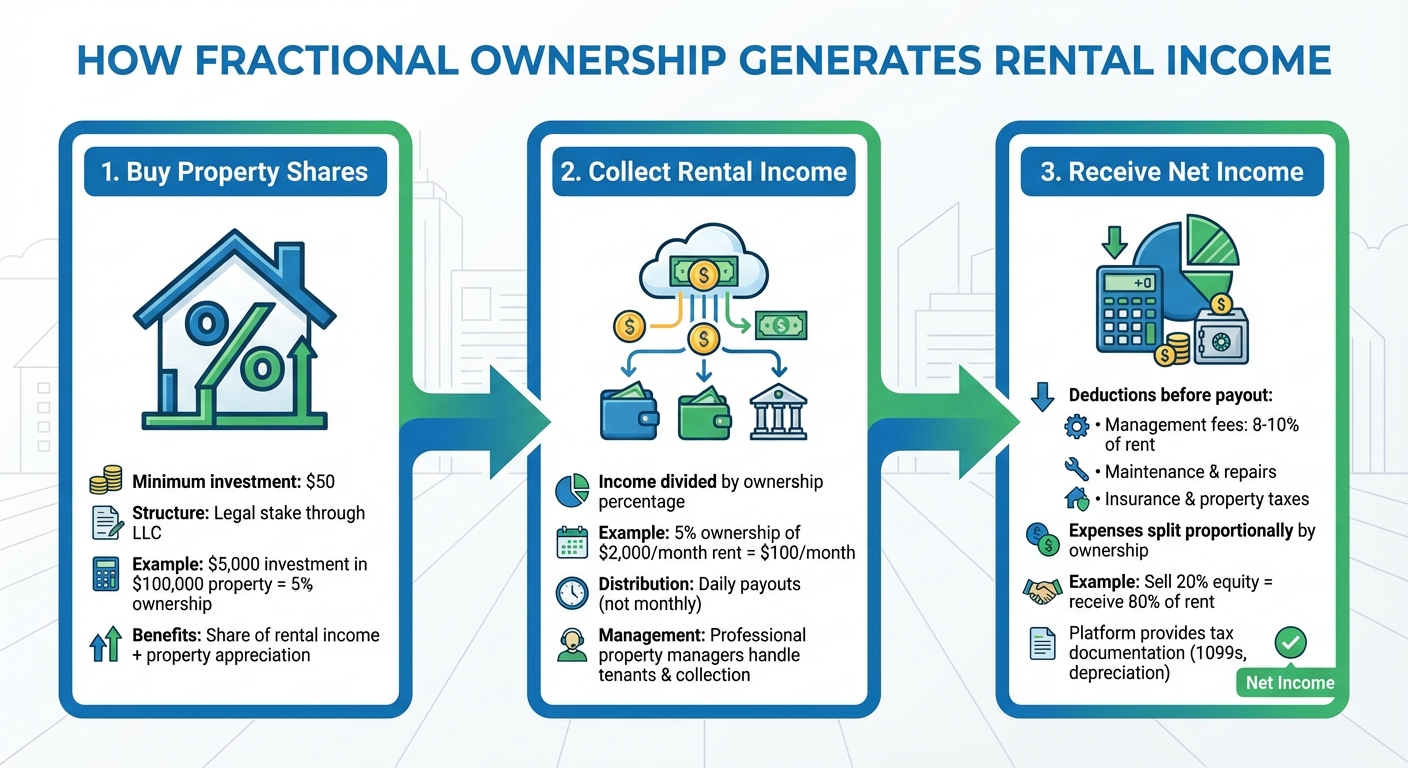
How Fractional Real Estate Ownership Generates Rental Income: 3-Step Process
Fractional ownership can turn your investment into a steady stream of rental income. Here's a breakdown of how the process works, from buying shares to receiving payouts.
Buying Property Shares
When you invest in fractional ownership, you're purchasing a legal stake in a property, often structured through an LLC. The entry point is surprisingly low - you can get started with as little as $50, which translates into a percentage of ownership in the property. For instance, investing $5,000 in a property valued at $100,000 gives you a 5% stake. This ownership not only entitles you to a share of the rental income but also any increase in the property's value over time. Your initial investment lays the foundation for proportional income distribution.
Collecting and Distributing Rent
Once the property is rented out, the rental income is divided among fractional owners based on their share. If you own 5% of a property earning $2,000 in monthly rent, your gross share would be $100. Some platforms simplify this by offering daily distributions instead of the traditional monthly payouts. As Lofty explains:
You'll get your first rent payment that same day, and daily after that.
This streamlined approach eliminates the need for you to manage tenants or chase payments.
Handling Expenses and Net Income
Before you receive your rental income, certain expenses are deducted from the gross rent. These include management fees (typically 8–10% of the rent), maintenance, repairs, utilities, insurance, and property taxes. Each fractional owner is responsible for their proportional share of these costs. For example, Max Ball from Lofty explains:
The property's rent and expenses, including repairs, are split proportionally based on the amount of equity you sell, e.g., if you sell 20% of your equity, you receive 80% of the rent.
Platforms also handle bookkeeping and provide tax documentation, including depreciation, making the process entirely passive for investors. This ensures that each owner receives their net income based on their ownership percentage, giving you a clear picture of how your investment generates regular returns.
Factors That Affect Rental Income Potential
Rental income isn’t a one-size-fits-all scenario. Several factors come into play, shaping how much you can earn and how consistent those earnings might be. Grasping these elements can help you make better investment choices and set realistic goals for your returns.
Location and tenant demand are at the heart of rental income potential. Properties in high-demand areas - like Albuquerque, NM, and Scottsdale, AZ - can yield annual returns of about 16.72% and 12.36%, respectively. In thriving rental markets, vacancy rates are typically under 5%, while average markets hover around 6–7%. Areas with strong job markets or vacation hotspots, such as beachfront properties or bustling urban centers, tend to see higher occupancy rates and rental prices throughout the year. On the flip side, lower tenant demand can significantly impact your income.
Professional property management is another critical factor. Skilled property managers handle tenant screening, maintenance, and repairs, which helps keep vacancies low and prevents minor issues from turning into costly problems. For instance, a diversified U.S. rental portfolio could deliver a 9.5% annual return on a $20,000 investment - around $1,900 per year - adding up to $9,500 in profit over five years. This is all while a professional team manages tenant relations and distributions. Without proper management, properties may sit vacant longer, and maintenance issues could eat into your returns. Professional oversight not only minimizes risks but also supports steady income.
Diversification across multiple properties and locations offers another layer of income stability. Spreading a $20,000 investment across various U.S. cities can help maintain consistent 9.5% returns over five years, even if one area experiences a downturn. Relying on a single property ties your income to the performance of one market, which can be risky. By investing in 3–5 properties across different regions, you can balance out underperformance in one location with stronger results in another.
sbb-itb-a24235f
How Lofty Simplifies Fractional Ownership
Lofty takes the complexity out of managing fractional property investments, building on its streamlined income distribution system to make the entire process user-friendly.
How Lofty Works
Lofty functions as a marketplace where you can invest in U.S. rental properties with as little as $50 per share. Each property is owned by a Wyoming LLC, divided into $50 shares, which represent legal ownership in that LLC. When you buy shares, you’re acquiring a direct stake in the company that holds the property deed.
The platform has already handled over $65 million in transactions and boasts a community of more than 34,000 registered investors. With access to 150 properties across 40 markets, you can easily diversify your portfolio. Rental income is distributed daily, and you’re free to withdraw your funds at any time without any extra fees.
Day-to-day operations, like tenant screening, rent collection, and property maintenance, are managed by professional property managers. Meanwhile, Lofty takes care of bookkeeping and provides necessary tax documentation, like 1099 forms. Even though this is a passive investment, you still have a say in key property decisions. For example, you can vote on repairs, rent adjustments, or even replace a property manager if their performance doesn’t meet expectations.
Key Features of Lofty
Lofty’s platform goes beyond simplifying income distribution; it also offers features that make fractional ownership flexible and accessible.
For starters, there’s no high barrier to entry or lock-up period. You can sell your ownership stakes anytime through Lofty’s marketplace, offering instant liquidity. A 3% marketplace fee applies only when you sell your shares - there are no upfront charges or deductions from your rental income.
The liquidity of the platform is highlighted by real-world examples. Tristan Huerta, former Head of Short Term Rentals at Investment.com, sold $20,000 worth of equity in $50 fractions within minutes. He later sold an additional $80,000 in equity at $55–$60 per fraction in just a few hours. Similarly, Arrio Granum sold $110,000 worth of equity in an 8-unit mixed-use property within a week, with shares selling for $55–$60 each - 10–20% above appraised value.
You can also reinvest your daily rental income to grow your portfolio over time. Each property listing on the platform includes detailed analysis and data, making it easy to evaluate opportunities even if you’re new to real estate. Additionally, property managers are available via Lofty’s Discord and email to answer questions and provide updates.
These features highlight how Lofty not only delivers consistent rental income but also creates a flexible, investor-focused approach to fractional property ownership.
Building Wealth Through Fractional Ownership
Fractional ownership offers a pathway to growing real estate wealth through rental income and property appreciation. Unlike traditional real estate investments that often require significant upfront capital, this approach allows you to start with as little as $50, making it far more accessible.
The key advantage lies in diversification. Imagine an investor with $20,000 - rather than putting all that money into a single property, they could spread it across several rental properties in different U.S. cities. This strategy helps cushion against risks like vacancies or unexpected maintenance costs. For example, if one property underperforms, income from others can help balance things out, creating a more stable cash flow. By diversifying, you’re not just managing risk; you’re also setting the stage for steady wealth accumulation through consistent rental income.
Another powerful strategy is reinvesting rental income. By channeling earnings into additional shares across three to five properties, you can gradually increase both your ownership stake and your monthly cash flow over a period of 5–10 years. This compounding effect can significantly boost your long-term returns.
Key Takeaways
Approach fractional ownership as a medium- to long-term investment. The combination of reinvesting rental income and benefiting from property appreciation can steadily grow your wealth. Focus on properties with strong tenant demand and positive cash flow, and diversify across multiple cities and property types. Over time, even small, consistent investments can evolve into a robust real estate portfolio that generates meaningful income.
FAQs
What makes fractional ownership different from traditional real estate investing?
Fractional ownership offers a way to invest in shares of a property instead of purchasing the entire property outright. With investments starting as low as $50, it eliminates the need for hefty down payments and mortgages typically required for full ownership. By sharing the cost with other investors, you can spread your investments across multiple properties and markets, helping to reduce risk while potentially boosting returns.
Platforms like Lofty make fractional ownership even more appealing by taking care of property management tasks like tenant screening, rent collection, and maintenance. This allows you to enjoy daily rental income without the headaches of being a landlord. Plus, fractional shares can be bought or sold on a marketplace, giving you more liquidity and flexibility compared to traditional real estate investments.
On the other hand, traditional real estate investing means full ownership, which comes with substantial upfront costs and the ongoing responsibility of managing tenants, repairs, taxes, and insurance. Selling a property can take months, tying up your funds in the meantime. Fractional ownership streamlines the process, offering a share of rental income and property appreciation without the usual complications.
What should I consider when investing in fractional property ownership?
When diving into fractional property ownership, the location of the property should be your first consideration. Opt for areas with strong job markets, reputable schools, and low crime rates - these factors typically attract reliable tenants and help ensure steady rental income. It's also wise to confirm that the area has rental-friendly regulations, which can make property management smoother and maintain consistent cash flow.
The next step is to analyze the financial details of the investment. Your ownership percentage directly affects your share of both the income and expenses. For instance, if you own 10% of a property that generates $2,000 in monthly rent, your portion would be $200 before costs like taxes, management fees, and maintenance are deducted. Take the time to compare projected returns, potential property appreciation, and any fees involved to ensure the investment aligns with your financial objectives.
Lastly, evaluate the quality of property management. A professional management team handles tenant screening, maintenance, and ensures timely distribution of rental income - key elements in safeguarding your investment. Look for platforms that provide transparent fee structures and easy access to your earnings, making it simpler to track performance and withdraw funds when necessary.
Can I easily sell my fractional ownership shares if I need quick access to cash?
Selling your fractional ownership shares on Lofty’s marketplace is straightforward and fast. The platform offers near-instant liquidity with transaction fees ranging from approximately 2.5% to 3.5%. This makes it easy to access your funds whenever you need them.
This setup gives you the flexibility to manage your investments effectively, whether you want to cash out or explore new opportunities.
Lofty Editorial