
Lofty Editorial
Common Debt Compliance Issues in Fractional Ownership
Fractional real estate ownership offers an affordable way to invest in property, but managing debt compliance is a major challenge. Platforms using debt financing face risks like regulatory violations, poorly structured loans, inadequate disclosures, and missed covenant deadlines. These issues can lead to investor losses, forced asset sales, or insolvency. Here’s what you need to know:
- Poor Debt Structuring: High loan-to-value (LTV) ratios and unhedged variable rates increase risks. Keeping LTV below 70% and ensuring a Debt Service Coverage Ratio (DSCR) above 1.25 are key safeguards.
- Inadequate Disclosures: Platforms often fail to clearly outline debt risks, such as balloon payments or when distributions come from loans rather than profits. Transparency is critical to comply with securities laws.
- Missed Covenant Tracking: Reliance on manual systems can lead to technical defaults. Automated systems help monitor DSCR, LTV, and deadlines to avoid breaches.
- Securities Compliance: Fractional debt interests are classified as securities, requiring adherence to strict SEC regulations, including proper registration and disclosures.
Platforms can mitigate these risks by setting clear debt standards, using automated monitoring tools, and ensuring transparency in all investor communications. These steps protect investor capital and maintain compliance in a highly regulated space.
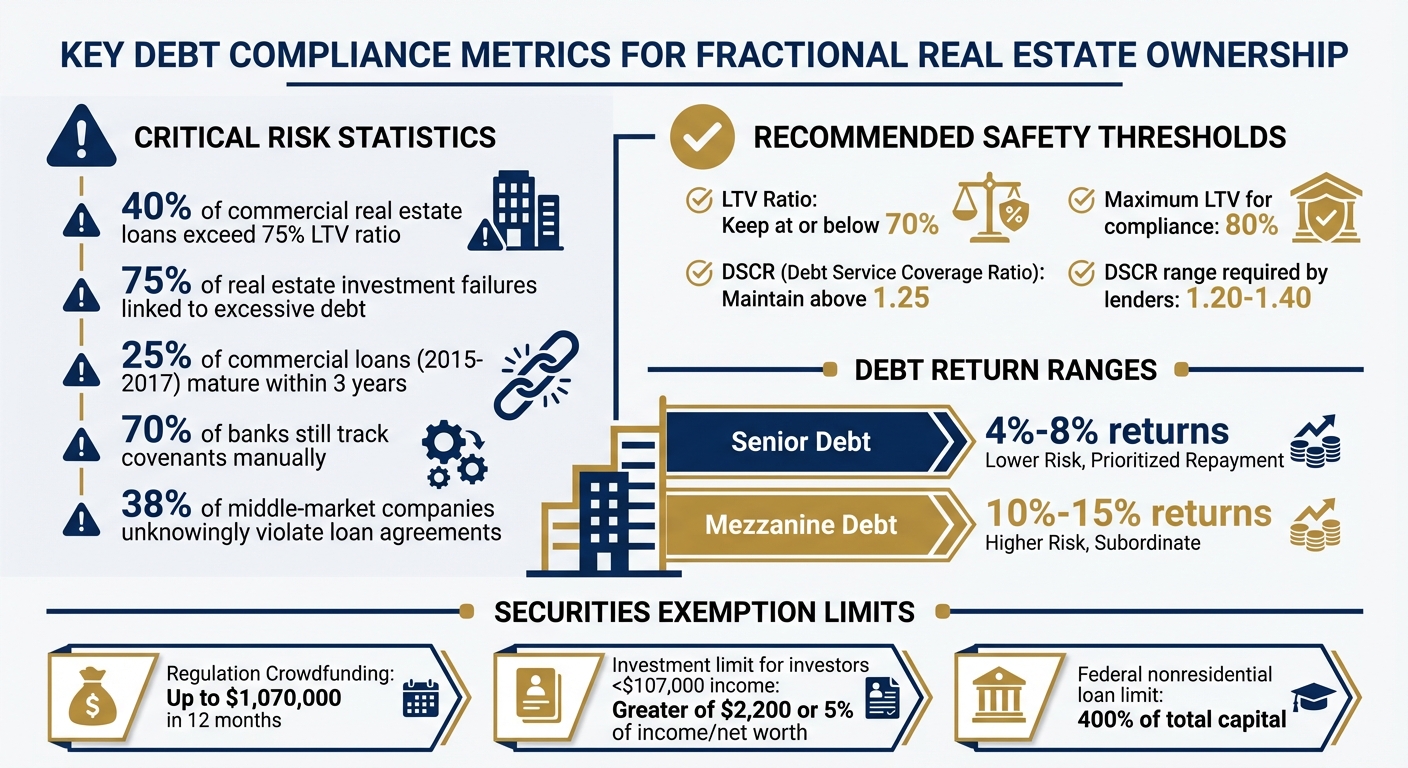
Key Debt Compliance Metrics for Fractional Real Estate Ownership
Mismatched Loan Terms and Capital Structure
Problem: High-Risk Leverage and Poor Debt Terms
When debt is poorly structured, it puts every layer of an investment at risk. One of the biggest concerns is excessive leverage - currently, nearly 40% of outstanding commercial real estate loans exceed a 75% loan-to-value (LTV) ratio. It's worth noting that 75% of real estate investment failures are linked to taking on too much debt. The problem becomes even more severe when high LTV ratios are paired with short-term financing. For instance, about 25% of commercial real estate loans issued between 2015 and 2017 are set to mature within just three years, creating what’s often called a "refinance jam". With rising interest rates, these loans leave platforms scrambling for costly refinancing, emergency capital, or, in the worst-case scenario, facing default.
Unhedged variable interest rates only add to the strain, increasing debt service costs, which can pinch cash flow and lead to breaches in loan covenants. Most lenders require a minimum Debt Service Coverage Ratio (DSCR) of 1.25 for commercial loans. As Primior Group explains:
A property struggles to pay its debts with a DSCR below 1, which is why lenders prefer values above 1.25.
When market conditions worsen, breaching LTV or DSCR covenants can trigger severe lender actions. These might include demands for more collateral, interest rate hikes, or even default provisions. The result? Diluted equity, forced capital injections, or, in some cases, a total loss of the investment.
Solution: Create Clear Debt Structuring Standards
To minimize these risks, implementing clear and effective debt structuring standards is essential. Start by adopting conservative LTV targets - keeping ratios at 70% or below provides a cushion against market downturns. Similarly, setting minimum DSCR requirements above 1.25 ensures that income-producing properties can cover their debt obligations, even during periods of vacancy or declining rents. These benchmarks should be integrated into the compliance framework to protect investor returns. Including these standards in offering documents also boosts transparency, giving investors a clear picture of the financial risks before they commit their capital.
Underwriting guidelines should also address preferred interest rate types and repayment terms. For instance, requiring hedging for variable-rate debt can protect cash flow from sudden rate spikes. Additionally, standardizing covenant language is key. Clearly defining DSCR, LTV, and profitability thresholds, as well as documenting the capital stack, ensures that new debt won’t subordinate existing creditors. Typically, senior debt offers returns in the 4% to 8% range, while mezzanine debt, which carries more risk, offers higher yields of 10% to 15%.
Platforms like Lofty exemplify this approach by adhering to rigorous debt structuring standards. Their compliance frameworks not only safeguard investor returns but also reinforce strong regulatory practices, setting a high bar for the industry.
sbb-itb-a24235f
Insufficient Disclosure of Debt Risks and Obligations
Problem: Insufficient Debt Disclosures
Incomplete debt disclosures can mislead investors and violate federal securities laws. The SEC emphasizes this point:
"The reduction of these information asymmetries through required disclosures protects investors and is one of the primary purposes of the federal securities laws."
Key areas of concern include debt-funded distributions, refinancing risks, and unclear leverage practices. For instance, many platforms fail to clarify when distributions to investors are sourced from borrowed funds or offering proceeds instead of operational cash flow, which can create a false impression of financial stability. Terms like balloon payments and prepayment penalties are often hidden or entirely absent from disclosures. Additionally, platforms may promote "targeted" leverage levels while their agreements allow for much higher "maximum" ratios, leaving investors with an inaccurate understanding of risk. Other critical details, such as existing property liens and vague definitions of delinquency, further complicate the picture for investors.
Under U.S. securities law, these omissions qualify as material misstatements. Regulations clearly state:
"The registration statement must include any additional material information that is necessary to make the required statements, in light of the circumstances under which they are made, not misleading."
To address these gaps, platforms must adopt standardized templates that clearly outline all debt terms and associated risks.
Solution: Use Standard Debt Disclosure Templates
A practical solution is to implement standardized debt disclosure frameworks that comply with federal guidelines. For mortgage-backed investments, offering documents should include clear loan term tables based on the standards in 17 CFR 210.12-29. These tables should detail interest rates, final maturity dates, payment schedules, and balloon payment amounts for loans exceeding 3% of the total mortgage portfolio.
Platforms must also disclose when operational cash flow is insufficient for distributions. If distributions are funded through debt or investor capital, this must be explicitly stated in the offering document, along with an explanation of the associated risks. The SEC advises platforms to include cumulative data on earnings and distributions since inception to highlight the potential dilution caused by paying out more than the entity earns.
For delinquency reporting, platforms should follow Regulation AB standards, presenting data in 30- or 31-day increments starting from when assets are 30 days delinquent until charge-off. Regulation Crowdfunding also requires disclosure of related party transactions exceeding 5% of the amount raised in the past 12 months, ensuring transparency around insider dealings that could impact debt obligations.
Some platforms, like Lofty, have already embraced these disclosure practices, integrating them into their offering documents. By clearly outlining debt terms, covenants, and risks, they provide investors with the information they need to make well-informed decisions. This approach not only aligns with Regulation D requirements but also strengthens investor confidence through greater transparency.
Poor Tracking of Debt Covenants
Problem: Inefficient Covenant Tracking
Effective covenant tracking is a critical part of debt management, helping to avoid technical defaults. Yet, many platforms still rely on outdated manual methods, like spreadsheets, which leave them vulnerable to compliance risks. Shockingly, nearly 70% of banks still track covenants manually, and over 38% of middle-market companies unknowingly violate their loan agreements.
The issue is compounded by the limitations of standard accounting software, which often fails to calculate essential ratios like DSCR (Debt Service Coverage Ratio) and LTV (Loan-to-Value) automatically. This forces teams to export data from ERP systems into Excel, a manual process prone to errors. For companies managing multiple properties, each with unique lender testing schedules, the complexity of tracking grows exponentially.
Missing covenant deadlines can have severe consequences, even if payments are up to date. These breaches, known as technical defaults, can lead to loan acceleration, higher interest rates, or even foreclosure. As Laura Pop-Badiu, Senior Creative Writer at CommercialEdge, explains:
The cornerstone of effective debt management is the consistent monitoring of loan covenants.
Without a proper tracking system in place, businesses risk severe financial repercussions, including immediate repayment demands from lenders.
Solution: Set Up a Debt Monitoring System
To address these challenges, automated debt monitoring systems provide a smarter, more reliable solution. By replacing spreadsheets with automated tools that access live data, companies can eliminate manual errors and improve compliance. For example, in February 2025, a private credit lender used an automated system to quickly flag when a $50 million loan's net leverage surpassed its 4.5x EBITDA cap, allowing immediate corrective action.
These systems are designed to set threshold alerts, warning companies when key metrics approach covenant limits. This proactive approach gives businesses the chance to resolve issues before a breach occurs. In one case, a Director of Acquisitions at a Real Estate Investment Trust implemented the CoreCast Pipeline Tracker, which reduced deal slippage by 30% through real-time insights. Continuous monitoring of critical ratios, like DSCR (typically required between 1.20 and 1.40) and LTV (generally kept at or below 80%), ensures compliance without relying solely on periodic checks.
Platforms like Lofty enhance compliance by centralizing loan agreements, financial statements, and other records. This centralization reduces the risk of missed deadlines and keeps investors informed about debt performance. Kent Kirby, Director of Advisory Services at Abrigo, emphasizes:
Waivers are fine, but they need to be time-bound and need to be very specific.
With access to accurate, real-time data, businesses can engage with lenders proactively, addressing potential covenant breaches before they escalate into major problems.
Securities Compliance for Fractional Debt Interests
Problem: Overlooking the Securities Classification of Fractional Debt
Proper securities classification is a critical piece of compliance in fractional investments, yet it’s often neglected. Under U.S. law, fractional real estate debt interests are considered securities. The Securities Act of 1933 defines "security" broadly, encompassing notes, bonds, and other forms of indebtedness. Additionally, these types of investments usually satisfy the Howey test, which determines whether an arrangement qualifies as an investment contract: it involves investing money in a common enterprise with profits expected from someone else’s efforts.
Failing to recognize this classification can lead to major consequences. The SEC can impose civil enforcement penalties, including the return of profits (disgorgement), financial fines, and even appointing court receivers to recover assets. As the SEC explains:
The SEC's civil law enforcement authority enables the Commission to hold violators of the federal securities laws accountable for their misconduct and recover money for the benefit of harmed investors.
Common errors include filing the wrong exemption forms, neglecting the need for registered broker-dealers in crowdfunding, and violating anti-fraud marketing rules. For example, under Regulation Crowdfunding, failing to conduct offerings via a registered intermediary invalidates the exemption entirely. This makes each sale an unregistered securities violation. Additionally, individuals or firms with felony convictions or SEC-imposed bans may face statutory disqualification from future securities-related activities.
Solution: Integrating Securities Compliance into Operations
Start by determining whether the investment qualifies as a security. Use the Howey test to check if returns depend on the sponsor’s managerial efforts. For fractional real estate debt, the answer is usually yes, meaning compliance with federal securities laws is required.
Next, select the right registration exemption based on your capital goals and target investors. For private offerings to accredited investors, Regulation D is a common choice. If you’re raising up to $1,070,000 within 12 months from both accredited and non-accredited investors, Regulation Crowdfunding (Reg CF) is an option. Reg CF also includes investment limits to shield smaller investors. For instance, if an investor’s income or net worth is under $107,000, they can invest the greater of $2,200 or 5% of the lesser of their income or net worth.
| Exemption Type | Requirements/Limits | Target Investor Base |
|---|---|---|
| Regulation D | Private offering; limits on general solicitation (Rule 506b) | Primarily Accredited Investors |
| Regulation A | Conditional exemption for small issues; requires offering circular | Accredited and Non-accredited |
| Regulation CF | Must use a registered intermediary (broker-dealer or portal) | Broad "Crowd" (with investment limits) |
Ensure compliance is embedded in all marketing and onboarding materials. Even preliminary communications, like "testing the waters" messages, fall under federal anti-fraud rules. Marketing statements must be accurate and include all relevant details to avoid misleading investors. For crowdfunding, off-platform advertising should be limited to brief notices that direct potential investors to your registered intermediary.
Platforms like Lofty (https://lofty.ai) provide tools to simplify compliance. By partnering with registered intermediaries and offering standardized disclosure templates, they help ensure that key information - such as managerial roles, debt terms, and risks - is clearly communicated to investors.
As the SEC Framework for Investment Contract Analysis of Digital Assets notes:
The focus of the Howey analysis is not only on the form and terms of the instrument itself... but also on the circumstances surrounding the digital asset and the manner in which it is offered, sold, or resold.
Building strong securities compliance practices not only reduces legal risks but also reinforces the overall debt management structure in fractional ownership models.
Conclusion
Managing debt compliance on fractional real estate investing platforms demands careful attention to structuring, disclosure, monitoring, and adherence to securities regulations. Using Special Purpose Vehicles (SPVs), such as LLCs, helps separate liabilities and manage leverage effectively. For example, federal guidelines limit nonresidential loans to 400% of total capital. Transparent disclosure practices are equally critical, equipping investors with the information they need to make sound decisions. As Realbricks highlights:
Compliance requires thorough financial and risk disclosures which provide investors with detailed information about the prospective investment, which enhances transparency and investor protection.
Ongoing monitoring of debt covenants and collateral adequacy is another key pillar, as it helps address potential issues before they escalate. Centralized management further eases the burden on owners while safeguarding property value.
Securities compliance also plays a pivotal role, ensuring fractional interests align with federal regulations, such as SEC Regulation A+.
A well-structured approach not only mitigates risk but also attracts institutional investors. Michael Torhan, Tax Partner at EisnerAmper, explains:
The general premise behind the fractions rule is to prevent tax avoidance by limiting the transfer of tax benefits from tax-exempt partners to taxable partners.
FAQs
What are the potential risks of high loan-to-value (LTV) ratios in fractional real estate ownership?
High loan-to-value (LTV) ratios in fractional real estate ownership can bring added financial risks for investors. When a significant portion of a property's value is financed through debt, it leads to higher monthly payments and limits financial flexibility. Worse still, if property values drop, the loan amount might surpass the property's worth, leaving investors in a negative equity situation.
On top of that, high LTV ratios often come with stricter loan terms, like higher interest rates, which can chip away at overall investment returns. To navigate these challenges, it's crucial to analyze the property's financial details thoroughly and ensure that the debt level aligns with your risk tolerance and investment objectives.
How do automated systems help with tracking debt covenants in fractional real estate investments?
Automated systems streamline the process of tracking debt covenants by gathering all necessary data in one place and continuously calculating financial ratios. These tools can send instant alerts whenever thresholds are crossed, allowing potential problems to be spotted and dealt with promptly.
On top of that, they create standardized compliance reports, cutting down on manual errors and saving valuable time. This approach helps fractional real estate investors manage their debt obligations with ease and ensures they remain compliant without unnecessary hassle.
Why is compliance with securities laws important for fractional real estate investments?
Compliance with securities laws plays a key role in fractional real estate investments. It ensures transparency, shields investors from fraud, and keeps legal standards intact. Following these regulations helps investment offerings align with federal and state requirements, reducing the risk of penalties and preserving trust in the market.
For investors, compliance offers clear and honest disclosures about potential risks and rewards, building confidence in their decisions. For issuers, it minimizes legal complications and reinforces the long-term stability and credibility of the fractional real estate market.
Lofty Editorial